University of California, Berkeley
Berkeley, California, United States · Established 1868
Official website ↗Total Students
46,151
Intl. Students
15.8%
Student:Faculty
19.4:1
Setting
Urban
Overview
Founded in 1868 as the first campus of the University of California system, UC Berkeley is a public research university on the eastern shore of San Francisco Bay, a short transit ride from downtown San Francisco. Its 178-acre central campus sits at the base of the Berkeley Hills and is organized into 14 colleges and schools, including the College of Engineering, the College of Letters and Science, and the Haas School of Business, spanning essentially every major academic discipline. Berkeley is consistently ranked the top public university in the United States and, unlike most of its private-university peers, does not use the Common Application: undergraduate applicants apply directly through the University of California's own UC Application, answering four of eight Personal Insight Questions instead of a single personal essay. Berkeley has been a test-blind (SAT/ACT not considered) campus since 2020 as part of a University of California-wide policy, though the UC system's Board of Admissions and Relations with Schools has this policy under active review, with any change unlikely before the Class of 2028 or 2029. Academically, Berkeley is best known for Engineering and Computer Science (EECS), the Haas School of Business, Economics, and a research enterprise credited with helping found the biotechnology industry and playing a central role in early internet and computing research; the university counts more Nobel laureates among its faculty and alumni than nearly any public institution in the world. For prospective IELTS or TOEFL candidates, one especially important distinction from most other elite US universities is that Berkeley requires no letters of recommendation as part of its standard UC undergraduate application, but it does enforce firm minimum English-proficiency test scores for admission (unlike, for example, Harvard College, which sets no minimum at all): 90 TOEFL iBT / 6.5 IELTS / 115 Duolingo for undergraduates, submitted by a January 31 deadline for enrolling students. Berkeley enrolled a record 46,151 students and over 7,300 international students in Fall 2025, and, notably, expanded international offers substantially that cycle even as several peer institutions pulled back.
Rankings
US News National Universities
#15 (2026)
US News National Universities · Top Public Schools
#1 (2026)
Times Higher Education (THE) World University Rankings · Overall (Global)
#9 (2026)
US News Best Global Universities · Overall (Global)
#7 (2026)
Admissions, Requirements & Costs
Requirements, deadlines, and test-score cutoffs differ significantly between undergraduate and graduate/Master's programs — shown separately below.
Undergraduate
Acceptance Rate
11.4%
Application Fee
$95
Documents required: UC Application (not the Common Application), Four of eight Personal Insight Questions (350 words each), Official secondary school transcripts showing UC-required 'A-G' coursework, TOEFL iBT (90+), IELTS Academic (6.5+), or Duolingo (115+) scores for applicants who don't qualify for a waiver, due by January 31, Proof of financial support / Non-immigrant Information Form (NIF), required only after admission, No letters of recommendation are required or accepted for most applicants (unlike most private US universities)
| Term | Deadline | Type |
|---|---|---|
| Fall | November 30 | Regular Decision |
Test Scores
IELTS Minimum
6.5 (Gabble rec. 7)
TOEFL Minimum
90 (4.5 new scale) · Gabble rec. 100 (5 new scale)
IELTS notes: Berkeley's published undergraduate minimum is an overall IELTS Academic score of 6.5; no separate per-component minimum is published for undergraduate applicants.
TOEFL notes: Official minimum is 90 overall (for tests taken before ETS's January 2026 rescale) with no separate section minimums published for undergraduates; Berkeley notes a 100+ score is generally preferred as more competitive, though 90 remains the hard floor for admission eligibility.
TOEFL scores shown as: legacy 0–120 scale (new 1.0–6.0 CEFR-aligned scale, effective Jan 2026).
Accepted tests: IELTS Academic, TOEFL iBT, Duolingo English Test
Waiver: Applicants are generally exempt if they have attended a school where English is the primary language of instruction for at least three years, or are a citizen of a UC-recognized English-speaking country; exact waiver criteria are set by UC systemwide policy and applied by Berkeley's admissions office.
Tuition (Intl.)
$57,484
Tuition (Domestic)
$18,214
Living Expenses/yr
$31,478
Total Cost of Attendance
$88,962
Scholarships
Regents' and Chancellor's Scholarship
Varies; ranges from a namebearing honorary award up to a substantial renewable stipend for top recipients
Berkeley's most prestigious undergraduate scholarship, awarded to entering students who show exceptional academic achievement alongside creativity, leadership, and service; all admitted undergraduates (domestic and international) are automatically considered with no separate application.
Eligibility: Automatic consideration for all admitted first-year and transfer undergraduates based on the admission application; no separate application required
Swaniker Scholars Program
Up to full cost of attendance for four years
A need-based scholarship for talented undergraduate students from across the African continent, covering up to the full cost of attendance for four years.
Eligibility: Open to admitted undergraduates who are citizens of an African nation and demonstrate financial need and strong academic promise; requires a separate application
Popular Programs
Gabble Prep Insights
Where applicants lose points: Writing carries the most weight in practice, since Berkeley's UC application replaces a single personal essay with four separate 350-word Personal Insight Question responses and requires no recommendation letters at all, putting unusually concentrated pressure on an applicant's own written self-presentation across several short pieces rather than one long essay backed by outside references.
Because Berkeley's published English-test floor (TOEFL 90 / IELTS 6.5) sits meaningfully lower than the 'competitive' scores Berkeley itself suggests (TOEFL 100+), many applicants clear the minimum comfortably but then discover the real bar for a genuinely competitive file is higher, particularly for Writing, since dense UC application short-answer writing and rigorous first-year coursework both demand more than a bare-minimum score suggests.
Figures above use Berkeley's official 2026-27 nonresident undergraduate cost-of-attendance budget (living off-campus): $18,214 in-state-equivalent tuition and fees, plus $39,270 Nonresident Supplemental Tuition (all new nonresident undergraduates, regardless of citizenship, pay this on top of base tuition and fees), for a combined $57,484 tuition figure, plus $5,066 student health insurance and $26,412 in personal/housing/food/transportation costs (combined here as livingExpensesPerYear: $31,478). Housing on campus instead of off-campus raises the total cost of attendance further. The 11.4% acceptance rate is UC Berkeley's own published Fall 2025 aggregate figure (14,451 admitted of 126,842 applicants) and does not represent a separately published international-only rate; Berkeley does not publish one, though international admit rates are generally understood to run somewhat below the overall figure given the systemwide split between in-state, out-of-state domestic, and international applicant pools. UC Berkeley does not offer need-based institutional aid to international undergraduates, unlike Harvard's need-blind policy — nearly all funding for international undergraduates comes from outside scholarships, family resources, or the two named merit/need-based programs above.
Recommended prep timeline: 10 weeks
Graduate (Master's & PhD)
Application Fee
$155
Documents required: Statement of Purpose and (for many PhD programs) a Personal History Statement, Official transcripts from all previously attended institutions, Three letters of recommendation, CV/resume, TOEFL iBT or IELTS scores for applicants who don't qualify for a waiver (Graduate Division minimum; individual departments may set a higher bar), GRE or GMAT scores, only where a specific department or professional program (e.g. Haas MBA) requires it — most Berkeley PhD programs have dropped the GRE requirement
| Term | Deadline | Type |
|---|---|---|
| Fall | Department-specific, generally clustering between December 1 and January 6 for Fall entry | Regular Decision |
Test Scores
IELTS Minimum
7 (Gabble rec. 7)
TOEFL Minimum
90 (4.5 new scale) · Gabble rec. 90 (4.5 new scale)
IELTS notes: Graduate Division minimum is 7.0 overall; for tests taken on or after January 21, 2026 (ETS's rescaled TOEFL/aligned IELTS reporting period), Berkeley additionally requires at least 6.5 in Speaking and Writing. Individual departments may require a higher overall score.
TOEFL notes: Graduate Division minimum is 90 overall for tests taken through January 20, 2026; for tests taken on or after January 21, 2026 (ETS's new 1-6 CEFR-aligned scale), Berkeley's published minimum converts to 5 overall with at least 4.5 in Speaking and Writing. Individual departments may set a higher bar than this university-wide floor.
TOEFL scores shown as: legacy 0–120 scale (new 1.0–6.0 CEFR-aligned scale, effective Jan 2026).
Accepted tests: IELTS Academic, TOEFL iBT
Waiver: Applicants who hold a bachelor's or advanced degree from an institution where English is the sole language of instruction are generally exempt from the Graduate Division's English-test requirement; some departments apply narrower or additional criteria.
Tuition (Intl.)
$40,858
Tuition (Domestic)
$25,756
Living Expenses/yr
$33,248
Total Cost of Attendance
$74,106
Scholarships
Graduate Student Instructor (GSI) / Graduate Student Researcher (GSR) appointments
Varies by department and appointment type; typically covers tuition/fees plus a living stipend for the academic year
The dominant form of PhD funding at Berkeley: most PhD students are funded through a combination of fellowships, teaching appointments (GSI), and research appointments (GSR), which typically cover tuition, the Nonresident Supplemental Tuition, and provide a living stipend.
Eligibility: Offered selectively by individual departments as part of a PhD admission offer; not guaranteed for all admitted PhD students and generally not available to most terminal master's students
Departmental and Graduate Division fellowships
Varies considerably by fellowship
A range of named, donor- and endowment-funded fellowships administered by individual departments and the Graduate Division, awarded competitively to incoming and continuing graduate students.
Eligibility: Varies by fellowship; most require nomination or automatic consideration through the standard graduate application, assessed by the department
Popular Programs
Gabble Prep Insights
Where applicants lose points: Writing is generally the toughest section for graduate applicants, since a compelling research-focused Statement of Purpose (and, for many PhD programs, a separate Personal History Statement) is scrutinized closely and demands the kind of sustained, precise academic argument that a bare-minimum English test score does not guarantee.
Applicants to quantitative and engineering-heavy programs (EECS, Data Science, most PhD tracks) tend to clear Reading and Listening comfortably but sometimes underprepare Speaking, which carries its own minimum under Berkeley's post-January-2026 policy; applicants to policy, education, and social-science master's programs most often need focused extra Writing practice given the essay- and proposal-heavy nature of those application processes.
Figures above use Berkeley's official 2026-27 international/nonresident graduate academic (non-professional) cost-of-attendance budget, living off-campus: $17,550 tuition and fees, $15,102 Nonresident Supplemental Tuition, and $8,206 student health insurance, combined here as $25,756 tuitionPerYear (fees+insurance, matching the schema's 'Home' field, since Berkeley does not separately publish a resident-only total excluding NST elsewhere on this page) and $40,858 tuitionInternationalPerYear (direct costs including NST); living/personal expenses of $33,248/year (housing, food, books, transportation, misc.) are drawn from the same official budget. Professional master's programs (the Haas MBA in particular) are priced very differently and considerably higher than this academic-track figure — always check the specific program. GRE/GMAT: the large majority of Berkeley PhD and academic master's programs have dropped the GRE requirement; GMAT or GRE is required specifically for the Haas MBA and some other professional master's programs, and Berkeley does not publish one official aggregate average score across all programs, so avgScore is left null. Berkeley does not publish one official aggregate graduate acceptance rate (admission is decided independently by each of dozens of departments and professional schools), so that field is left null rather than estimated.
Recommended prep timeline: 10 weeks
Programs Offered
BS in Electrical Engineering and Computer Sciences
Undergraduate · 4 yr
BS in Business Administration
Undergraduate · 4 yr
BA in Economics
Undergraduate · 4 yr
BA in Data Science
Undergraduate · 4 yr
MBA
Masters · 2 yr
Master of Information and Data Science (MIDS)
Masters · 1 yr
Master of Public Policy
Masters · 2 yr
PhD (various departments)
PhD · 5 yr
Campus Life
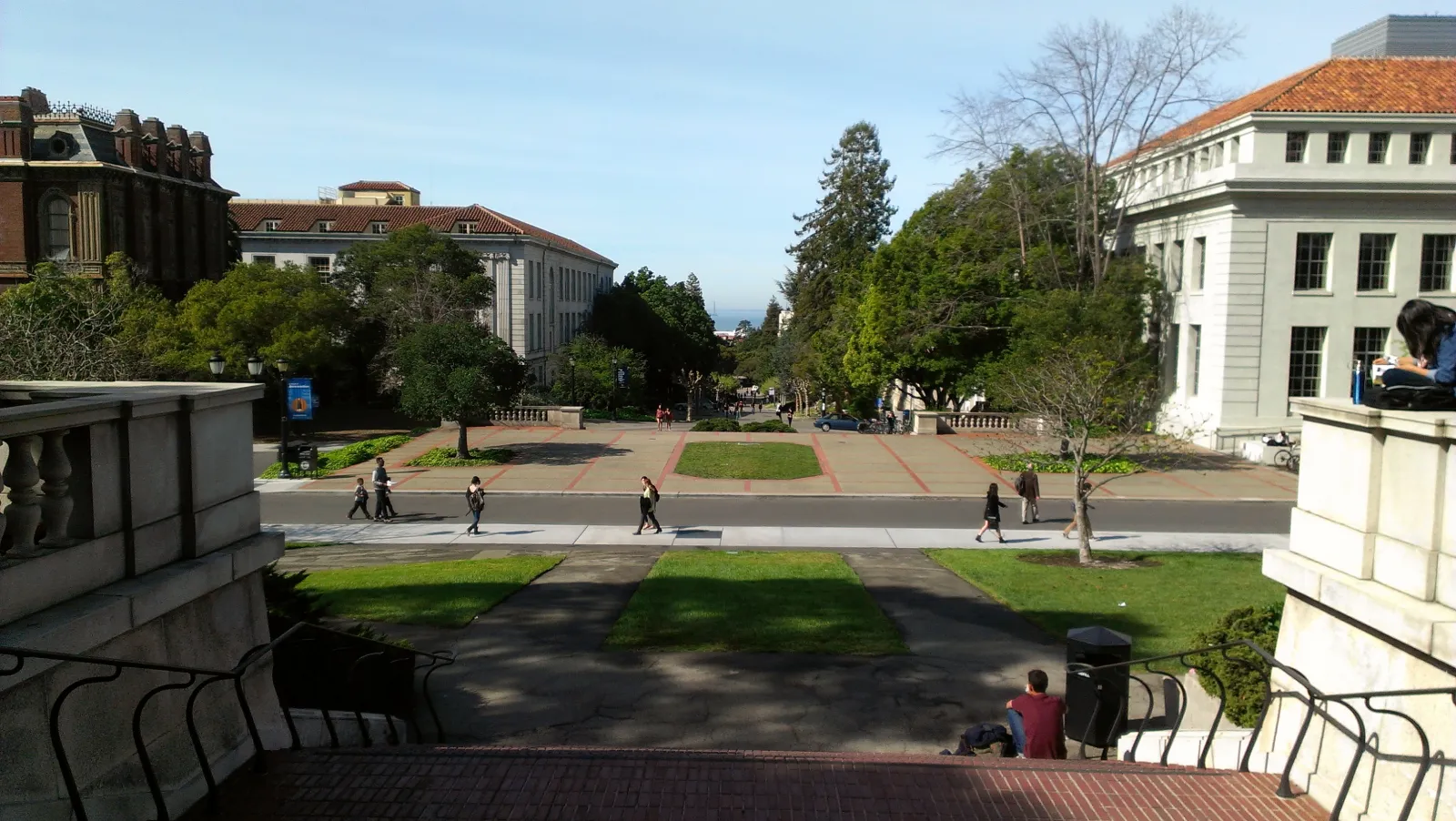
Berkeley's 178-acre central campus sits at the base of the Berkeley Hills, a short walk from Telegraph Avenue and downtown Berkeley, with San Francisco itself a short BART ride away. The ASUC (undergraduate) and Graduate Assembly (graduate) together charter more than 1,000 recognized student organizations spanning academic, cultural, political, and hobby interests, and Berkeley's Cal Golden Bears compete in NCAA Division I athletics, having moved to the Atlantic Coast Conference (ACC) starting with the 2024-25 season. Berkeley's history of student activism, dating to the 1964 Free Speech Movement, continues to shape a politically engaged campus culture, and its location directly across the Bay from San Francisco gives students unusually close access to the city's tech, finance, and cultural industries.
Notable clubs: Associated Students of the University of California (ASUC), the official undergraduate student government, The Daily Californian, Berkeley's independent student newspaper, Cal Band and Cal Cheer, Model United Nations at Berkeley, Over 1,000 student organizations registered with the ASUC and Graduate Assembly
Outcomes
Undergraduate
Graduate
Notable Alumni
Steven Chu — Nobel laureate in Physics (1997) and former US Secretary of Energy; earned his PhD in Physics at Berkeley
Eric Schmidt — Former CEO and Executive Chairman of Google/Alphabet; earned MS and PhD degrees in Electrical Engineering and Computer Science at Berkeley
Gordon Moore — Co-founder of Intel and originator of 'Moore's Law'; earned his BS in Chemistry at Berkeley
Jerry Brown — Former Governor of California; earned his BA at Berkeley
Gregory Peck — Academy Award-winning actor (To Kill a Mockingbird); attended Berkeley
Visa Interview Prep
Berkeley International Office (BIO) issues Form I-20 to admitted students once financial documentation (the Non-immigrant Information Form and proof of sufficient funds) is submitted, which the student then uses to pay the SEVIS I-901 fee and schedule the F-1 visa interview at a US embassy or consulate. Unlike the UK's Student visa route, the US F-1 process centers on an in-person consular interview assessing genuine student intent and non-immigrant intent, alongside financial and academic documentation; Berkeley recommends starting this process as soon as the I-20 is issued given known visa-appointment backlogs in some countries. Starting Fall 2026, Berkeley also charges a $100 International Student Service Fee to help fund BIO's advising and support services.
- Clarity on the specific program of study and why Berkeley specifically
- Demonstrating strong ties and credible intent to return home after studies
- Financial sufficiency and clear documentation of funding sources for the full program length
- Consistency between prior academic background and the chosen field of study
FAQs
What TOEFL or IELTS score do I need to apply to UC Berkeley as an undergraduate?Undergrad
Berkeley's published undergraduate minimums are TOEFL iBT 90, IELTS Academic 6.5, or Duolingo 115. Scores must be received by January 31 of your admission year, and Berkeley notes that a TOEFL score of 100+ is generally considered more competitive than the bare 90 minimum, even though 90 is the hard eligibility floor.
Does UC Berkeley use the Common Application?Undergrad
No. Berkeley, like every other UC campus, uses the University of California's own UC Application. Instead of one personal essay, applicants answer four of eight Personal Insight Questions (350 words each), and — unusually among elite US universities — the standard UC application does not require or accept letters of recommendation from most applicants.
Do I need to submit SAT or ACT scores to apply to Berkeley?Undergrad
No. The University of California system has been test-blind (SAT/ACT scores are not considered in admission decisions, even if submitted) since 2020, and this remains the policy for the current admissions cycle. UC's Board of Admissions and Relations with Schools is reviewing the policy, but no reinstatement has been approved, with any change considered unlikely before the Class of 2028 or 2029.
Will I need to attend a visa interview to study at Berkeley?
Yes. As a US institution, Berkeley issues an F-1 Form I-20 through its Berkeley International Office, and admitted international students must attend an in-person interview at a US embassy or consulate as part of the standard F-1 visa process — unlike the UK's Student visa route, which generally does not require a routine interview.
Does UC Berkeley offer need-based financial aid to international students?
Not in the way Harvard or other well-endowed private universities do. Berkeley does not have a large-scale need-based institutional aid program for international undergraduates; most funding comes from the merit-based Regents' and Chancellor's Scholarship (open to all admitted students, including international), the Africa-focused Swaniker Scholars Program, outside scholarships, or family resources. Graduate funding works differently and is typically tied to Graduate Student Instructor/Researcher appointments and departmental fellowships rather than need-based aid.
Is the GRE or GMAT required for Berkeley graduate programs?Grad
It depends on the program. Most Berkeley PhD programs and academic master's programs have dropped the GRE requirement entirely. GMAT or GRE is required for professional programs such as the Haas MBA — always check your specific program's current policy rather than assuming a university-wide rule.
How competitive is UC Berkeley for international applicants?
Very. Berkeley's own published Fall 2025 figures show an overall 11.4% acceptance rate (14,451 admitted of 126,842 applicants), though Berkeley does not publish a separate international-only rate, and admit rates vary hugely by intended major — from roughly 4% for Haas Business to around 25% for some Humanities majors.
How many weeks should I spend preparing for IELTS or TOEFL before applying to Berkeley?
A realistic window is 8-10 weeks of focused preparation. Because Berkeley's published minimum (TOEFL 90 / IELTS 6.5) is lower than what Berkeley itself flags as more competitive (TOEFL 100+), applicants aiming for a genuinely strong file should prepare well past the bare minimum, with particular attention to Writing given the short-answer-heavy UC application.