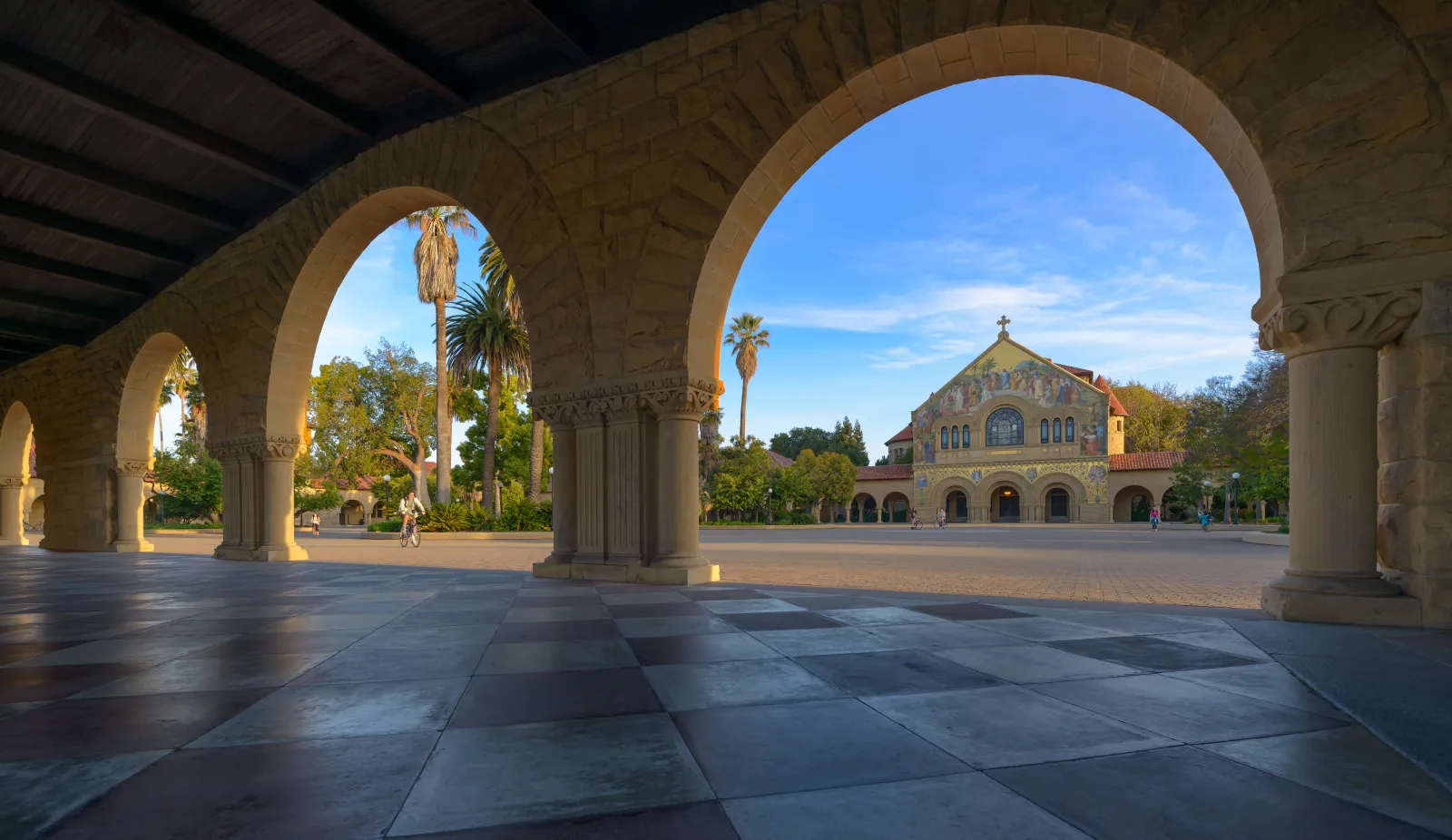

Stanford University
Stanford, California, United States · Established 1885
Official website ↗Total Students
18,625
Intl. Students
26%
Student:Faculty
5:1
Setting
Suburban
Overview
Stanford University is a private research university located on the San Francisco Peninsula in Northern California, roughly 35 miles south of San Francisco and at the heart of Silicon Valley. Founded in 1885 by Leland and Jane Stanford in memory of their son, the university opened its doors in 1891 and has since grown into one of the world's leading institutions for research, entrepreneurship, and technology innovation, closely tied to the growth of the surrounding tech industry. The university is organized into seven schools spanning the humanities and sciences, engineering, business, law, medicine, education, and sustainability, and it offers undergraduate, master's, doctoral, and professional degrees across more than 90 departments and programs. Its sprawling 8,180-acre campus is one of the largest in the United States and houses academic buildings, research labs, museums, athletic facilities, and on-campus housing for the vast majority of its students. For international applicants, Stanford is best known for its extremely low acceptance rate, holistic admissions process, and strong emphasis on intellectual vitality and impact beyond academics. It draws students from well over 100 countries and maintains a need-blind admissions policy for undergraduates that extends to international applicants, along with a commitment to meet full demonstrated financial need for all admitted students regardless of citizenship.
Rankings
US News National Universities
#4 (2026)
US News Best Global Universities · Global
#3 (2026)
Times Higher Education World University Rankings · Global
#5 (2026)
US News Best Business Schools (Full-Time MBA) · Graduate - Business
#1 (2026)
US News Best Engineering Schools · Graduate - Engineering
#2 (2026)
Admissions, Requirements & Costs
Requirements, deadlines, and test-score cutoffs differ significantly between undergraduate and graduate/Master's programs — shown separately below.
Undergraduate
Acceptance Rate
3.8%
Application Fee
$100
Documents required: Common Application or Coalition Application, Personal Essays, Letters of Recommendation, Official Transcripts (translated into English), School Report / Counselor Recommendation, SAT or ACT Scores (optional/test-flexible, self-reported), Application Fee or Fee Waiver, Mid-Year and Final Transcripts
| Term | Deadline | Type |
|---|---|---|
| Fall | November 1 | Early Action |
| Fall | January 5 | Regular Decision |
Test Scores
SAT Range
1510–1570
ACT Range
34–35
Waiver: Stanford does not require an English proficiency test (IELTS/TOEFL/PTE/Duolingo) for undergraduate first-year or transfer applicants at all. Applicants may voluntarily self-report a score if they feel it strengthens their application, but it is never mandatory and there is no published minimum for undergraduates.
Tuition (Intl.)
$67,731
Tuition (Domestic)
$67,731
Living Expenses/yr
$28,000
Total Cost of Attendance
$96,000
Scholarships
Stanford Undergraduate Need-Based Financial Aid
Varies by demonstrated need; average need-based grant around $70,000+/year
Stanford's need-blind admissions policy for undergraduates is paired with a commitment to meet 100% of demonstrated financial need for every admitted student, including international students, through grants rather than loans.
Eligibility: Admitted undergraduate students who apply for aid and demonstrate financial need
Popular Programs
Gabble Prep Insights
Where applicants lose points: Since Stanford does not require any English proficiency test for undergraduates, the hardest part for international applicants is rarely a specific test skill and instead the essays and 'intellectual vitality' components (Common App personal essay plus Stanford's own short-answer supplements), which reward idiomatic, distinctive English writing built over years rather than a test-prep sprint.
Because SAT/ACT is optional and self-reported and there is no IELTS/TOEFL requirement, applicants most often lose ground not on a test score gap but on generic, template-like essays that don't reflect authentic voice or specific fit with Stanford's culture of undergraduate research and interdisciplinary exploration.
International undergraduate applicants should redirect the time they might have spent on English test prep toward essay drafting, activity-list positioning, and (if submitting scores) SAT/ACT practice, since admissions officers spend far more of their review time on the former than on any language-proficiency signal.
Recommended prep timeline: 12 weeks
Graduate (Master's & PhD)
Application Fee
$125
Documents required: Online graduate application (department-specific portal), Statement of Purpose, 3 Letters of Recommendation, Official Transcripts (translated into English, all post-secondary institutions), Resume / CV, GRE or GMAT scores (only for programs that require or accept them, e.g. GSB), TOEFL/IELTS/PTE/Duolingo scores (unless exempt), Application Fee or Fee Waiver, Department-specific supplements (writing samples, portfolios, etc. for some programs)
| Term | Deadline | Type |
|---|---|---|
| Fall | Early December (varies by department, e.g. Computer Science/Engineering PhD & MS) | Regular Decision |
| Fall | September 9 (GSB MBA Round 1) | Priority |
| Fall | January 6 (GSB MBA Round 2) | Regular Decision |
| Fall | April 7 (GSB MBA Round 3) | Rolling |
Test Scores
GMAT Range
690–770
IELTS Minimum
7 (Gabble rec. 7.5)
TOEFL Minimum
100 (5 new scale) · Gabble rec. 105 (5 new scale)
PTE Minimum
68
IELTS notes: No official section minimums published; scores below 8.0 overall may trigger a required English Placement Test after admission for graduate students
TOEFL notes: Minimum iBT 100 for most doctoral and Humanities/Sciences/Education master's programs; iBT 89 minimum for some Engineering master's programs; scores below 109 may trigger a required English Placement Test after admission
TOEFL scores shown as: legacy 0–120 scale (new 1.0–6.0 CEFR-aligned scale, effective Jan 2026).
Accepted tests: IELTS, TOEFL, PTE
Waiver: Graduate applicants can be exempted if they are a U.S. citizen or permanent resident, their first language is English, they completed a bachelor's, master's, or doctoral degree from a university where instruction was entirely in English, or they have two or more consecutive years of full-time professional or educational experience conducted in English within the past 10 years.
Tuition (Intl.)
$64,890
Tuition (Domestic)
$64,890
Living Expenses/yr
$27,000
Total Cost of Attendance
$93,000
Scholarships
Knight-Hennessy Scholars
Full tuition, living stipend, and travel stipend
Stanford's flagship, fully-endowed multidisciplinary graduate scholars program covering up to three years of graduate study across any of Stanford's seven schools, paired with a leadership development curriculum.
Eligibility: Open to citizens of all countries applying to or already admitted to a Stanford graduate program, within five years of completing a bachelor's degree
Stanford Graduate Fellowships
Varies by department and program
A range of school- and department-specific fellowships (e.g., Stanford Graduate Fellowship in Science and Engineering) that fund tuition and stipends for incoming PhD students.
Eligibility: Incoming PhD students nominated by their department; some are open to international students
Stanford GSB Fellowships
Varies by demonstrated need; can cover a substantial portion of tuition
Need-based MBA fellowships awarded automatically to all admitted students based on financial need, without a separate application, funded by the GSB's endowment and donor gifts.
Eligibility: Admitted MBA students, including international students, who submit financial aid documentation
Popular Programs
Gabble Prep Insights
Where applicants lose points: For most non-native English speakers targeting Stanford's graduate programs, the Speaking and Writing sections tend to be the hardest to push above the 100+ TOEFL / 7.0+ IELTS threshold, since undergraduate coursework abroad rarely trains extended spoken argumentation or the kind of analytical academic writing Stanford's placement test screens for.
Applicants often clear the Reading and Listening sections comfortably but arrive 3-5 points short on Speaking, which is the section most likely to trigger a mandatory post-admission English Placement Test at Stanford even after meeting the overall minimum.
Because Stanford's undergraduate track does not require IELTS/TOEFL at all, the test genuinely matters most for graduate applicants — and even then only as a threshold to clear rather than a differentiator, since admissions committees weight research fit, recommendations, and statement of purpose far more heavily. Applicants should treat the English test as a box to check well above the minimum (aim 5+ points over the published floor) rather than a score to optimize down to the wire, freeing time for the substantially more decisive parts of the application. Note that Stanford does not publish a single university-wide graduate acceptance rate or minimum GPA — admissions are fully decentralized by school and department (PhD programs commonly run 5-8% admit rates, the GSB MBA around 6-7%, and individual MS programs vary widely), so applicants should check their specific department's published statistics rather than relying on a blended figure.
Recommended prep timeline: 10 weeks
Programs Offered
B.S. Computer Science
Undergraduate · 4 yr · $67,731/yr
B.S. Electrical Engineering
Undergraduate · 4 yr · $67,731/yr
B.A. Economics
Undergraduate · 4 yr · $67,731/yr
M.S. Computer Science
Masters · 2 yr · $64,890/yr
M.S. Management Science and Engineering
Masters · 2 yr · $64,890/yr
MBA
Masters · 2 yr · $84,000/yr
JD (Juris Doctor)
Masters · 3 yr · $74,000/yr
Ph.D. Computer Science
PhD · 5 yr · $64,890/yr
M.D. (Doctor of Medicine)
Masters · 4 yr · $68,000/yr
M.A. Education (STEP / Policy)
Masters · 1 yr · $64,890/yr
Campus Life
Stanford's campus culture blends serious academics with a famously entrepreneurial, low-key vibe shaped by its proximity to Silicon Valley — many students juggle coursework with startups, research labs, or internships at nearby tech companies. Nearly all undergraduates live in university housing across a system of themed dorms, co-ops, and Greek houses, which anchors a strong residential community life. With around 600 registered student organizations, a 36-team NCAA Division I athletics program that is consistently among the most decorated in the country, and traditions like Full Moon on the Quad and Big Game week against UC Berkeley, campus life outside the classroom is unusually active for a research university of Stanford's caliber.
Notable clubs: ASSU (Associated Students of Stanford University), The Stanford Daily, Stanford Solar Car Project, BASES (Business Association of Stanford Entrepreneurial Students), Stanford Model United Nations
Outcomes
Undergraduate
Graduation Rate
96%
Employed within 6mo
94%
Avg. Starting Salary
$95,900
Graduate
Avg. Starting Salary
$185,000
Notable Alumni
Sundar Pichai — CEO of Alphabet and Google (M.S. Materials Science and Engineering)
Larry Page & Sergey Brin — Co-founders of Google, met as Ph.D. students at Stanford
Sally Ride — First American woman in space; B.S./M.S. in Physics from Stanford
Reed Hastings — Co-founder and former CEO of Netflix (M.S. Computer Science)
Peter Thiel — Co-founder of PayPal and Palantir Technologies (B.A. Philosophy, J.D.)
Visa Interview Prep
Stanford's Bechtel International Center provides dedicated visa and immigration guidance to admitted international students, including document checklists and pre-arrival webinars; students should apply for their F-1 visa as soon as they receive the I-20 given typically long wait times for interview slots at U.S. consulates.
- Clarity on chosen program and specific research or career fit at Stanford
- Ability to demonstrate sufficient funding for tuition and living costs
- Ties to home country and credible intent to return after studies
- Consistency between SEVIS Form I-20 details and interview answers
FAQs
Does Stanford require IELTS or TOEFL for undergraduate admission?Undergrad
No. Stanford does not require an English proficiency test for undergraduate applicants, though you may voluntarily self-report an IELTS or TOEFL score if you feel it strengthens your application. Fluency in English is still expected for coursework.
What IELTS or TOEFL score do I need for a Stanford graduate program?Grad
Most graduate programs require a minimum TOEFL iBT score of 100 (89 for some Engineering master's programs) or an IELTS Academic score of 7.0, unless you qualify for an exemption. Scores below roughly 109 TOEFL / 8.0 IELTS may still require you to take an English Placement Test after you arrive on campus.
Is Stanford need-blind for international undergraduate applicants?Undergrad
Admissions are need-blind for most applicants, though for non-U.S. citizens who request financial aid, that request is considered as one factor in a more selective portion of the review. Once admitted, Stanford meets 100% of demonstrated financial need regardless of citizenship.
How low is Stanford's acceptance rate, really?Undergrad
Extremely low — around 3.8% for the most recently reported entering undergraduate class, making it one of the most selective universities in the world. International applicants should treat Stanford as a reach school even with a very strong profile.
Can I get conditional admission to Stanford if my English score is below the minimum?Grad
Stanford does not offer a formal conditional-admission or pathway program tied to English scores. Instead, graduate students admitted with borderline scores may be required to take an English Placement Test and, if needed, non-credit English coursework after enrolling.
Do I need the GRE or GMAT to apply to Stanford's MBA program?Grad
The Graduate School of Business accepts both GRE and GMAT (or an approved alternative) and evaluates them holistically with no minimum or preferred score; recent classes have been roughly split between GMAT and GRE submitters, with an average GMAT around 738.
How many weeks should I prepare for IELTS/TOEFL before applying to Stanford?Grad
Most well-prepared graduate applicants benefit from about 8-12 weeks of focused prep, prioritizing the Speaking and Writing sections since these tend to be the harder ones to push comfortably above Stanford's published minimums. Undergraduate applicants do not need to take these tests at all.
Does Stanford's tuition differ for international students?
No. As a private university, Stanford charges the same tuition rate to domestic and international students at both the undergraduate and graduate level; the main cost difference for international students comes from mandatory health insurance (Cardinal Care) and travel, not tuition itself.
What is Stanford's acceptance rate for master's programs like the MS in Computer Science?Grad
Stanford does not publish a single, university-wide graduate acceptance rate. Admissions are fully decentralized by school and department: PhD programs commonly report admit rates in the 5-8% range, the GSB MBA runs around 6-7%, and individual master's programs like MS Computer Science or MS Management Science & Engineering each publish (or informally report) their own statistics, which can vary considerably year to year. Check the specific department's admissions page for the most accurate figure.
Is the GRE required for Stanford graduate admissions?Grad
It depends entirely on the program. Several departments (e.g., the Graduate School of Education and East Asian Languages and Cultures) have waived or made the GRE optional in recent cycles, while others, like the GSB PhD, still require either a GRE or GMAT score. Master's programs in Engineering generally do not require the GRE. Always confirm the current policy on your specific department's admissions page before applying.
How is Stanford's graduate application fee different from the undergraduate fee?Grad
The standard graduate application fee is $125, compared to $100 for undergraduate applications. Both are nonrefundable, and fee waivers are available for applicants who qualify under need-based or program-specific criteria.