
University of Melbourne
Melbourne, Victoria, Australia · Established 1853
Official website ↗Total Students
53,963
Intl. Students
44%
Setting
Urban
Overview
The University of Melbourne was established in 1853 by an act of the colonial Victorian parliament, making it Australia's second-oldest university (after the University of Sydney) and the oldest in the state of Victoria; its original Parkville site, granted on the northern edge of the young city, remains the university's principal campus today. Research achievement runs deep in its history and continues into the present -- ten Nobel laureates have taught, studied, or carried out research at Melbourne, from immunologist Sir Frank Macfarlane Burnet in the mid-twentieth century through to chemist Richard Robson's 2025 Nobel Prize for metal-organic framework research -- and four Australian prime ministers, including Robert Menzies and Julia Gillard, are Melbourne graduates. In 2008 the university restructured most of its undergraduate offering around what it calls the "Melbourne Model": rather than admitting most school leavers directly into narrow professional degrees, the majority of undergraduates enter one of a small number of broad generalist bachelor's degrees (Arts, Science, Commerce, Biomedicine, Design, Environments, Music, and others) and then progress into specialist graduate degrees -- including professional programs like the Juris Doctor (Melbourne Law School's graduate-entry law degree) and the Doctor of Medicine -- a two-tier structure that sets Melbourne apart from most other Australian and UK universities, which more commonly admit undergraduates straight into single-discipline professional degrees. Today Melbourne enrolls roughly 54,000 students across nine faculties, split fairly evenly between undergraduate and graduate coursework/research study, with international students making up close to 44% of the student body and drawing from more than 150 countries. The Parkville campus anchors most faculties, while the Victorian College of the Arts sits at the Southbank campus and agriculture/veterinary programs extend to Werribee, Dookie, and other regional Victoria sites. Melbourne is consistently ranked Australia's leading or near-leading university on the major global tables -- 22nd in the QS World University Rankings 2027, 37th in the Times Higher Education World University Rankings 2026 (the only Australian university in THE's global top 50 that year), and 28th in the US News Best Global Universities 2027 rankings -- and its subject-level strength in Law and Medicine, longstanding themes for Melbourne, shows up clearly in both QS and THE's subject tables. For prospective international students, the pathway into Melbourne looks noticeably different from the US, UK, or Canadian process this dataset has covered so far. There is no centralized application clearinghouse like the US Common App, the UK's UCAS, or Ontario's OUAC -- international applicants for direct-entry courses apply straight to the University of Melbourne through its own online portal, paying a one-time non-refundable application fee. Because Australia's own domestic entry metric, the ATAR, is calculated only from Australian senior-secondary results, it plays no role in an international applicant's file; instead, Melbourne converts each applicant's actual overseas qualification (IB Diploma, a specific country's Year 12/school-leaving results, A-Levels, or another recognized curriculum) into a course-specific "notional entry score" and publishes minimum and guaranteed entry scores per degree on that basis. Once an offer is accepted, admitted students apply for Australia's Student visa (subclass 500) through the federal Department of Home Affairs -- a process distinct from the US F-1/SEVP system, the UK's Student Route and CAS letter, and Canada's IRCC study permit -- and, like the UK and Canadian processes already in this dataset, subclass 500 generally does not require an in-person visa interview for the large majority of applicants, unlike the US F-1 route. On the academic testing side, most Melbourne graduate programs do not require the GRE or GMAT; Melbourne Business School's MBA is a notable exception, requiring one of the two from applicants whose undergraduate degree was not completed at an Australian or New Zealand university.
Rankings
Times Higher Education (THE) World University Rankings · Overall (Global)
#37 (2026)
US News Best Global Universities · Overall (Global)
#28 (2027)
QS World University Rankings by Subject · Law and Legal Studies
#11 (2026)
QS World University Rankings by Subject · Life Sciences and Medicine
#14 (2026)
Times Higher Education (THE) World University Rankings by Subject · Law
#8 (2026)
Times Higher Education (THE) World University Rankings by Subject · Education Studies
#16 (2026)
Times Higher Education (THE) World University Rankings by Subject · Clinical and Health
#20 (2026)
Admissions, Requirements & Costs
Requirements, deadlines, and test-score cutoffs differ significantly between undergraduate and graduate/Master's programs — shown separately below.
Undergraduate
Application Fee
$107
Documents required: Direct online application through the University of Melbourne's own application portal (no UCAS/Common App/OUAC-style centralized body for international direct-entry applicants), Official transcripts/results (final or predicted) in the applicant's overseas senior-secondary qualification, English language proficiency test scores (IELTS/TOEFL/PTE/Duolingo/Cambridge or another approved pathway) unless exempt, Course-specific prerequisite subjects at the required level (e.g., a recognized senior mathematics subject for Agriculture, Biomedicine, Commerce, and Science), Personal statement or selection-task materials for a small number of competitive/portfolio-based courses (e.g., Fine Arts, Music), Certified copies of identity documents and, where applicable, evidence supporting any scholarship application
| Term | Deadline | Type |
|---|---|---|
| Semester 1 (late February) | 31 October of the preceding year for the following year's Semester 1 intake (main intake for the large majority of undergraduate courses) | Regular Decision |
| Semester 2 (late July) | 31 May of the same year, for the courses that offer a mid-year intake (not every undergraduate course admits in Semester 2) | Mid-Year Intake |
Test Scores
IELTS Minimum
6.5 (Gabble rec. 7)
TOEFL Minimum
79 (4 new scale) · Gabble rec. 90 (4.5 new scale)
PTE Minimum
58
IELTS notes: Overall band of 6.5 with no individual band below 6.0 is the standard undergraduate English requirement; a small number of competitive or professional-track courses set a higher overall band or higher individual component minimums, so applicants should confirm the exact figure on their specific course page.
TOEFL notes: Overall score of 79 (0-120 scale) is the standard undergraduate minimum. Melbourne had not published a clearly confirmed conversion for ETS's new 1-6, CEFR-aligned TOEFL iBT scale (rolling out from January 2026) at the time of this research, so applicants testing on the new scale should verify the current equivalent directly with the university.
TOEFL scores shown as: legacy 0–120 scale (new 1.0–6.0 CEFR-aligned scale, effective Jan 2026).
Accepted tests: IELTS Academic, TOEFL iBT, PTE Academic, Duolingo English Test, Cambridge English (CAE/CPE), LanguageCert Academic, Michigan English Test
Waiver: Applicants who have recently completed a qualifying period of full-time study taught and assessed entirely in English (including some overseas curricula and Australian senior secondary study) can be assessed as meeting the English requirement without a separate test score; exact waiver rules vary by course.
Conditional admission: The University of Melbourne English Language Bridging Program (UMELBP), delivered through the university-endorsed provider Hawthorn-Melbourne, lets applicants who are academically admissible but fall short of the English score requirement complete a structured English pathway (with an even lower-level UMELBP Prep option for larger gaps) that leads into a packaged offer for the Melbourne course itself, often under a single student visa.
Tuition (Intl.)
$40,210
Tuition (Domestic)
$12,092
Living Expenses/yr
$20,648
Total Cost of Attendance
$60,858
Scholarships
Melbourne International Undergraduate Scholarship
25% tuition fee sponsorship for the standard full-time duration of the bachelor's degree (for scholarships awarded before 2027)
A merit-based partial tuition scholarship aimed at talented international undergraduate applicants who are citizens of countries where access to international education is limited by financial disadvantage.
Eligibility: International students commencing a bachelor's degree who are citizens of an eligible country and meet the university's academic entry requirements; competitive, limited number of awards per year
Melbourne Chancellor's Scholarship
Full Commonwealth Supported Place-equivalent fee sponsorship for the standard degree duration, plus a living allowance of up to AUD 5,000-10,000 per year for up to three years
Melbourne's top undergraduate merit scholarship, recognizing outstanding academic achievement in Australian Year 12 or an IB Diploma completed in Australia; includes a living allowance alongside fee sponsorship.
Eligibility: Available to top-performing students who completed their Australian Year 12 or IB Diploma within Australia -- this generally excludes international applicants who complete their final secondary qualification overseas, though it can apply to international students schooled in Australia
Popular Programs
Gabble Prep Insights
Where applicants lose points: Writing tends to be the section undergraduate applicants most underprepare for relative to Reading and Listening, since Melbourne Model courses lean on essay- and report-style assessment from first year, and applicants from exam-heavy secondary systems often have stronger receptive than productive English skills going in.
Applicants to Commerce, Science, and Biomedicine -- Melbourne's most STEM/business-heavy generalist entry degrees -- typically clear Reading and Listening comfortably but need more Speaking practice, since tutorial-style discussion and group assessment are built into first-year Melbourne Model subjects far more than in lecture-only systems some applicants are used to.
Figures were converted from AUD at approximately 1 AUD = 0.695 USD (July 2026). Melbourne does not publish one flat university-wide undergraduate tuition rate -- costs above use the Bachelor of Commerce (Honours) 2026 official international course fee (AUD 57,856/year) as the representative figure, since Commerce is one of Melbourne's most-enrolled international undergraduate degrees; 2026 international fees run lower for Bachelor of Arts (roughly AUD 40,000-44,000/year) and higher for Bachelor of Science (roughly AUD 52,944-62,208/year) and Bachelor of Biomedicine (roughly AUD 48,000-52,000/year), since Melbourne prices tuition per subject/EFTSL rather than a single flat course fee. The domestic tuitionPerYear figure (AUD 17,399/year) reflects the 2026 Commonwealth Supported Place student contribution band that applies to Business/Commerce/Economics for domestic (Australian citizen/permanent resident) students -- this is not comparable to the international rate and is entirely irrelevant to international applicants, who are always full-fee-paying. Living expenses were estimated using the Department of Home Affairs' official minimum living-cost financial-capacity figure for a single Student visa (subclass 500) applicant in 2026 (AUD 29,710/year), used as a standardized proxy since Melbourne does not publish one fixed annual living-cost figure of its own. On overseas-qualification entry standards (since ATAR/SAT/ACT/GPA do not apply to international applicants): Melbourne publishes course-by-course minimum and guaranteed IB Diploma score requirements rather than one university-wide figure, and requires at least a grade 4 in English (Standard or Higher Level) to meet the English component of IB-based entry; Mathematics at a specified level is also a stated prerequisite for the Bachelor of Agriculture, Biomedicine, Commerce, and Science. Melbourne does not publish one official aggregate undergraduate acceptance rate for international applicants, and third-party estimates for it conflict substantially (ranging from roughly 40% to 80% depending on methodology and program), so acceptanceRate has been left null rather than fabricated from unreliable secondary sources; what is well documented is that Medicine (accessed via the graduate-entry MD, not directly at undergraduate level) and the Juris Doctor are far more competitive than the general undergraduate average. The application fee used above (AUD 154, the standard non-refundable direct-application fee for all new international applicants) is Melbourne's own published figure.
Recommended prep timeline: 10 weeks
Graduate (Master's & PhD)
Application Fee
$107
Documents required: Direct online application through the University of Melbourne's own application portal, Official transcripts from all previously attended post-secondary institutions, CV/resume (required for most professional graduate programs, e.g., MBA, JD), Statement of purpose, personal statement, or research proposal (program-dependent), Two or more references, generally academic and/or professional depending on the program, English language proficiency test scores (IELTS/TOEFL/PTE/Cambridge or another approved pathway) unless exempt, GMAT or GRE score -- required specifically for Melbourne Business School's MBA when the applicant's undergraduate degree was not completed at an Australian or New Zealand university; not required for the large majority of Melbourne's other graduate programs, GAMSAT or MCAT score, plus a structured multi-mini interview -- required specifically for the Doctor of Medicine (MD), not for other graduate programs
| Term | Deadline | Type |
|---|---|---|
| Semester 1 (late February) or Semester 2 (late July), program-dependent | Rolling and program-specific; many graduate coursework programs accept applications for both semesters while some professional programs (e.g., Juris Doctor, Doctor of Medicine, MBA) run a single annual intake with earlier, staged deadlines | Rolling |
Test Scores
IELTS Minimum
7 (Gabble rec. 7.5)
TOEFL Minimum
102 (5 new scale) · Gabble rec. 105 (5 new scale)
PTE Minimum
65
IELTS notes: Overall band of 7.0 with no individual band below 6.5 is the 'Band 7' English standard applied to many of Melbourne's professional and research-intensive graduate programs (including the Juris Doctor and the MBA); Melbourne actually runs a tiered set of graduate English standards (commonly referenced as Levels 1 through 3) that vary by course, so exact requirements should be confirmed on the specific program page.
TOEFL notes: For programs on Melbourne's standard graduate 'Band 7' English tier (e.g., the MBA): overall TOEFL iBT score of 102, with a Writing score of at least 24. Other graduate programs may sit on a different tier of Melbourne's Level 1-3 English framework with a different overall/component minimum.
TOEFL scores shown as: legacy 0–120 scale (new 1.0–6.0 CEFR-aligned scale, effective Jan 2026).
Accepted tests: IELTS Academic, TOEFL iBT, PTE Academic, Cambridge English (CAE/CPE), LanguageCert Academic, Michigan English Test
Waiver: Applicants who have completed a prior degree of at least one year's duration taught and assessed entirely in English, where that degree's own English entry standard was at least IELTS 6.5 (Academic) or equivalent, can generally satisfy Melbourne's graduate English requirement without a separate test score; exact rules vary by graduate program.
Conditional admission: The University of Melbourne English Language Bridging Program (UMELBP) pathway extends to a defined set of graduate courses (not every graduate program), letting academically admissible applicants who are short of the required English score complete a structured bridging program before their place is confirmed; availability should be checked per program.
Tuition (Intl.)
$45,957
Living Expenses/yr
$20,648
Total Cost of Attendance
$66,605
Scholarships
Melbourne Research Scholarship (graduate research / Masters by Research and PhD)
Full tuition fee offset for up to two years (Masters by Research) or up to four years (PhD), plus a living stipend of AUD 39,500/year pro rata (2026 full-time rate) for up to two years (Masters by Research) or up to 3.5 years (PhD), plus a one-off relocation allowance
Melbourne's primary funding package for graduate researchers, combining a full tuition fee offset with a living stipend; international Masters-by-Research and PhD applicants are automatically considered when they apply to a graduate research course, with no separate scholarship application required.
Eligibility: Automatic consideration for international students who apply to a Masters by Research or Doctoral degree by the relevant course's closing date; most successful applicants to Melbourne's research higher degrees receive a full fee-offset scholarship
Melbourne Business School merit scholarships (MBA and other MBS programs)
Varies by award; MBS does not publish one fixed scholarship amount, and receiving a GMAT/GRE waiver is a separate matter from being awarded a scholarship
A set of merit-based partial tuition scholarships that Melbourne Business School awards to a subset of incoming MBA and other degree-program students based on the overall strength of their application.
Eligibility: Assessed automatically as part of the standard MBS application for admitted students; not a separate application in most cases
Popular Programs
Gabble Prep Insights
Where applicants lose points: Writing is typically the weakest section for graduate applicants, since a personal statement or research proposal, and for the JD and MBA specifically case- and argument-based written assessment, demand structured academic or professional English well beyond conversational fluency.
Applicants to research-intensive programs (Master of Data Science, Master of Engineering, PhD) often post strong Reading/Listening scores but need more Speaking practice for supervisory meetings and presentation-style assessment, while JD and MBA applicants most often need additional Writing polish given the case-study- and argument-heavy application and coursework style.
Figures were converted from AUD at approximately 1 AUD = 0.695 USD (July 2026). Melbourne does not publish one flat university-wide graduate tuition rate -- costs above use the Master of Data Science 2026 official international course fee (AUD 66,125/year) as a representative coursework-master's figure, since it is one of Melbourne's most-enrolled international graduate STEM programs. Fees vary sharply by program: the Juris Doctor runs roughly AUD 52,992/year, Master of Engineering (Management/Environmental specializations) runs roughly AUD 62,976/year, the MBA's total published course fee runs in the low six figures over two years with figures cited anywhere from roughly AUD 56,000 to AUD 95,000/year depending on the specific intake and source (Melbourne Business School does not publish one single consistently-cited annual figure, so MBA tuitionPerYear has been left null in the courses list rather than estimated), and Doctor of Medicine figures cited in secondary sources ranged so widely (roughly AUD 112,000 to AUD 142,000/year) without one clearly official current figure that MD tuitionPerYear has also been left null. The domestic tuitionPerYear field has been left null at the graduate level because Australia has no single standard domestic postgraduate-coursework subsidy comparable to the undergraduate Commonwealth Supported Place system -- most domestic coursework master's students at Melbourne are full-fee-paying much like international students (with access to a FEE-HELP government loan international students cannot use), while domestic graduate research (PhD/Masters by Research) students typically receive the same full fee-offset scholarship funding as international research students, making a single 'domestic tuition' figure not meaningful. Living costs use the same Department of Home Affairs Student visa (subclass 500) minimum living-cost figure (AUD 29,710/year) as the undergraduate figure. Per this dataset's hard rule against fabricating GRE/GMAT figures: the large majority of Melbourne's graduate programs do not require the GRE or GMAT at all, so gre.required/gmat.required have been left false at the university-wide graduate level. Melbourne Business School's MBA is the clear exception -- its official entry requirements (published in the University of Melbourne Handbook for the MC-BA Master of Business Administration) require a GMAT score of at least 560, or a GRE score of at least 310 overall with a minimum of 157 on the Quantitative section and 152 on the Verbal section, from applicants whose undergraduate degree was not completed at an Australian or New Zealand university (a GMAT/GRE waiver is available for Australian/New Zealand-degree holders who are not seeking an MBS scholarship). That GRE 310 minimum is Melbourne's own genuinely published combined figure, not a sum of the two section minimums, and MBS does not publish an official average GMAT or GRE score for its class -- third-party MBA consultancy sites cite unofficial average GMAT figures anywhere from roughly 635 (GMAT Focus) to 695 (GMAT Classic), but since these are not MBS-published figures, gmat.avgScore and gre.avgScore have been left null rather than populated from unverified secondary sources. An official, university-wide graduate acceptance rate is not published and has been left null.
Recommended prep timeline: 12 weeks
Programs Offered
Bachelor of Commerce
Undergraduate · 3 yr · $40,210/yr
Bachelor of Science
Undergraduate · 3 yr · $40,015/yr
Bachelor of Arts
Undergraduate · 3 yr · $29,190/yr
Bachelor of Biomedicine
Undergraduate · 3 yr · $34,750/yr
Juris Doctor (JD)
Masters · 3 yr · $36,829/yr
Doctor of Medicine (MD)
Doctoral · 4 yr
Master of Business Administration (MBA)
Masters · 2 yr
Master of Data Science
Masters · 2 yr · $45,957/yr
Master of Engineering (various specializations)
Masters · 2 yr · $43,768/yr
Doctor of Philosophy (PhD, various graduate schools)
PhD · 4 yr
Campus Life
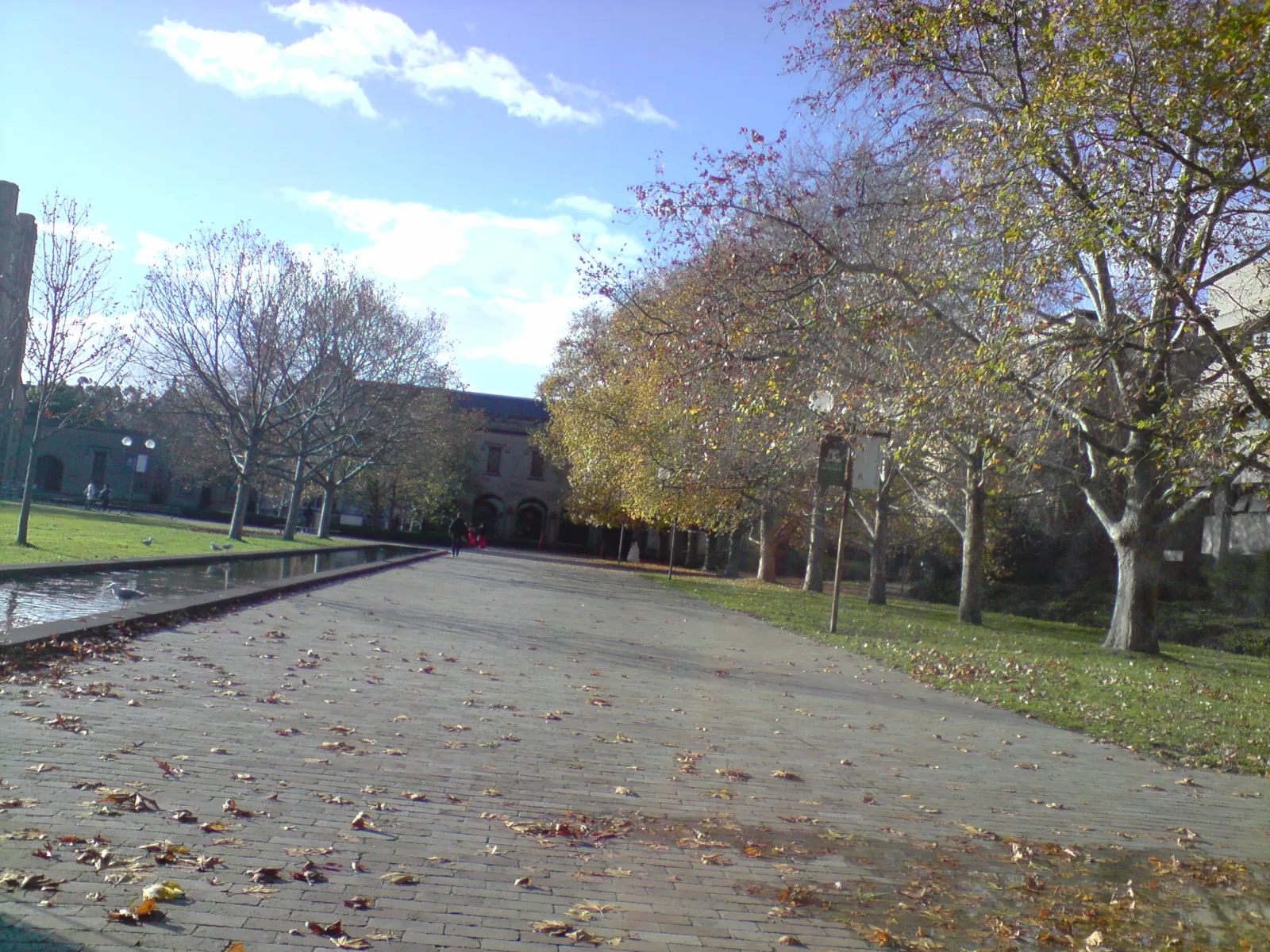
Melbourne's student life centers on the Parkville campus, with the Victorian College of the Arts contributing a distinct creative-arts community at the Southbank campus. The University of Melbourne Student Union (UMSU) runs student representation and more than 230 affiliated clubs and societies, spanning faculty-specific groups, cultural and special-interest clubs, and UMSU's own services including the Rowden White Library and Union House. A distinctive feature of Melbourne's campus life is its system of historic, semi-independent residential colleges (including Trinity, Ormond, Newman, and others), which run their own housing, dining, and club/society programs alongside university-run accommodation. Sport at Melbourne runs through Melbourne University Sport and club-based competitive and recreational teams rather than a US-style varsity athletics conference, with students also able to compete in national inter-university competitions such as the Australian University Games.
Notable clubs: University of Melbourne Student Union (UMSU) and its 230+ affiliated clubs and societies, Faculty-based societies including the Melbourne Arts Students' Society, Science Students' Society, Engineering Students' Club, Commerce Students' Society, and Biomedicine Students' Society, Residential college clubs and societies (e.g., Trinity College, Ormond College, Newman College) affiliated with Melbourne's system of independent residential colleges, Rowden White Library and Union House clubs/events run out of UMSU, Melbourne University Sport clubs across a wide range of competitive and recreational sports
Outcomes
Undergraduate
Graduate
Notable Alumni
Julia Gillard — 27th Prime Minister of Australia (2010-2013) and Australia's first female Prime Minister; studied Arts and Law at the University of Melbourne
Sir Robert Menzies — Australia's longest-serving Prime Minister; earned his law degree at the University of Melbourne and was later Chancellor of the university
Peter Doherty — Shared the 1996 Nobel Prize in Physiology or Medicine for discovering how the immune system recognizes virus-infected cells; longtime University of Melbourne-affiliated researcher
Elizabeth Blackburn — Shared the 2009 Nobel Prize in Physiology or Medicine for the discovery of telomerase; completed her science degrees at the University of Melbourne before her Nobel-winning research career
James P. Gorman — Chairman and former CEO of Morgan Stanley; earned his law degree at the University of Melbourne before moving into global finance
Visa Interview Prep
Australia's Student visa (subclass 500) process, run by the federal Department of Home Affairs, is procedurally distinct from the US F-1/SEVP system, the UK's Student Route and CAS letter, and Canada's IRCC study permit and Provincial Attestation Letter steps. After accepting a Melbourne offer and receiving a Confirmation of Enrolment (CoE), applicants apply for the subclass 500 visa online through the Department of Home Affairs' ImmiAccount portal, submitting the CoE, evidence of sufficient funds (in 2026, a published minimum living-cost benchmark of AUD 29,710 for a single applicant, plus tuition and travel costs), Overseas Student Health Cover (OSHC), and a written Genuine Student statement addressing their study intentions, ties to their home country, and post-study plans -- a written equivalent to the 'non-immigrant intent' the US F-1 process tests through an in-person consular interview. Like the UK Student Route and Canada's IRCC study permit process already covered in this dataset, the standard subclass 500 pathway generally does not include a routine in-person interview; most decisions are made from the documented application alone, though the Department of Home Affairs can request more information, a health examination, or (in narrower risk-based cases) an interview. From 1 July 2026, the subclass 500 visa application charge is AUD 2,500 for the main applicant, with additional fees for accompanying family members. Processing times vary by country and study level, and the University of Melbourne advises applying well ahead of the intended semester start once the CoE is issued. Student visa holders are generally permitted to work up to 48 hours per fortnight while their course is in session.
- Most subclass 500 applicants do NOT attend an in-person visa interview the way US F-1 applicants do -- the large majority of applications are decided from the online ImmiAccount application, a Confirmation of Enrolment (CoE) from Melbourne, evidence of financial capacity, health insurance (Overseas Student Health Cover), and a written Genuine Student (GS) statement
- The Department of Home Affairs may request additional documents, a health examination, or in narrower cases an interview, but this is not the standard process for the large majority of applicants
FAQs
What IELTS score do I need to apply to the University of Melbourne as an undergraduate?
The standard undergraduate minimum is an overall IELTS Academic band of 6.5, with no individual band below 6.0. Graduate applicants generally face a higher standard bar of 7.0 overall with no band below 6.5, though Melbourne actually runs a tiered set of graduate English standards that vary by specific program, so you should always confirm the exact figure on your course page.
Does the University of Melbourne use UCAS, the Common App, or a centralized application service?Undergrad
No. Unlike the UK's UCAS or the US Common App, international applicants for direct-entry courses apply straight to the University of Melbourne through its own online application portal, paying a one-time non-refundable AUD 154 application fee. There is no shared application body across Australian universities that international applicants use in the way UCAS or OUAC work in the UK and Ontario.
Will I need to attend a visa interview to study at Melbourne, like the US F-1 process?
Almost certainly not. Australia's Student visa (subclass 500), processed by the Department of Home Affairs, generally does not build in a routine in-person interview the way the US F-1 visa does. Most applications are decided from the online application, your Confirmation of Enrolment, proof of funds, health insurance, and a written Genuine Student statement. The Department of Home Affairs can request an interview or further documents in specific cases, but this is not the standard process -- a pattern similar to the UK's Student Route and Canada's IRCC study permit process rather than the US F-1 model.
I don't have an ATAR -- how does Melbourne assess my application as an international student?Undergrad
The ATAR is Australia's domestic senior-secondary ranking and does not apply to international applicants at all. Instead, Melbourne converts your actual overseas qualification -- an IB Diploma, your country's own Year 12/school-leaving result, A-Levels, or another recognized curriculum -- into a course-specific minimum and guaranteed 'notional entry score' that it publishes per degree. For IB applicants specifically, Melbourne also requires at least a grade 4 in English (Standard or Higher Level) as part of meeting the English language requirement.
Is the GRE or GMAT required for Melbourne graduate programs?Grad
For the large majority of Melbourne's graduate programs, no. The clear exception is Melbourne Business School's MBA, which requires a GMAT score of at least 560, or a GRE score of at least 310 overall (with section minimums of 157 Quantitative and 152 Verbal), from applicants whose undergraduate degree was not completed at an Australian or New Zealand university. MBS does not publish an official average GMAT or GRE score for its incoming class, and a waiver is available for Australian/New Zealand-degree holders not seeking an MBS scholarship.
Can I get a waiver for the IELTS/TOEFL requirement at Melbourne?
Yes, in certain cases. If you have recently completed a qualifying period of full-time education taught and assessed entirely in English, you may be assessed as meeting the requirement without a separate test score. At the graduate level, completing a prior degree of at least one year, taught in English, where that degree's own English entry standard was at least IELTS 6.5 or equivalent, can also satisfy the requirement. Exact rules vary by program.
Does Melbourne offer conditional admission if my English score is slightly below the requirement?
Yes, for many courses. The University of Melbourne English Language Bridging Program (UMELBP), delivered through the university-endorsed Hawthorn-Melbourne provider, lets academically admissible applicants who fall short of the standard English score complete a structured pathway program, often packaged with your Melbourne course offer under a single student visa. Coverage extends to undergraduate courses and a defined set of graduate courses, not every program, so availability should be checked for your specific course.
What is the 'Melbourne Model' and how does it affect undergraduate applicants?Undergrad
Since 2008, most Melbourne undergraduates enter one of a small number of broad generalist bachelor's degrees (Arts, Science, Commerce, Biomedicine, Design, Environments, Music, and others) rather than a narrow professional degree straight out of secondary school. Many students then progress into a specialist graduate degree -- including professional programs like the Juris Doctor (law) or the Doctor of Medicine -- after their bachelor's degree. This is a different structure from most UK and other Australian universities, which more commonly admit undergraduates directly into single-discipline professional degrees like a bachelor's in Law or Medicine.
As an international student, can I get financial aid at Melbourne?
At the undergraduate level, support is mainly merit-based rather than need-based: Melbourne offers scholarships such as the Melbourne International Undergraduate Scholarship (a 25% tuition sponsorship for students from countries with limited access to international education). At the graduate research level, funding works differently than aid in the US/UK sense -- most successful international Masters-by-Research and PhD applicants automatically receive a Melbourne Research Scholarship covering full tuition plus a living stipend. Melbourne does not offer broad need-based financial aid to international students the way some need-blind US universities do.
How many weeks should I spend preparing for IELTS or TOEFL before applying to Melbourne?
A realistic window is 10-12 weeks of focused preparation. Undergraduate applicants often need the most additional work on Writing, since Melbourne Model courses lean on essay- and report-style assessment from first year, while graduate applicants -- particularly to the Juris Doctor and MBA -- tend to need extra time polishing Writing given the case-study- and argument-heavy application and coursework style.