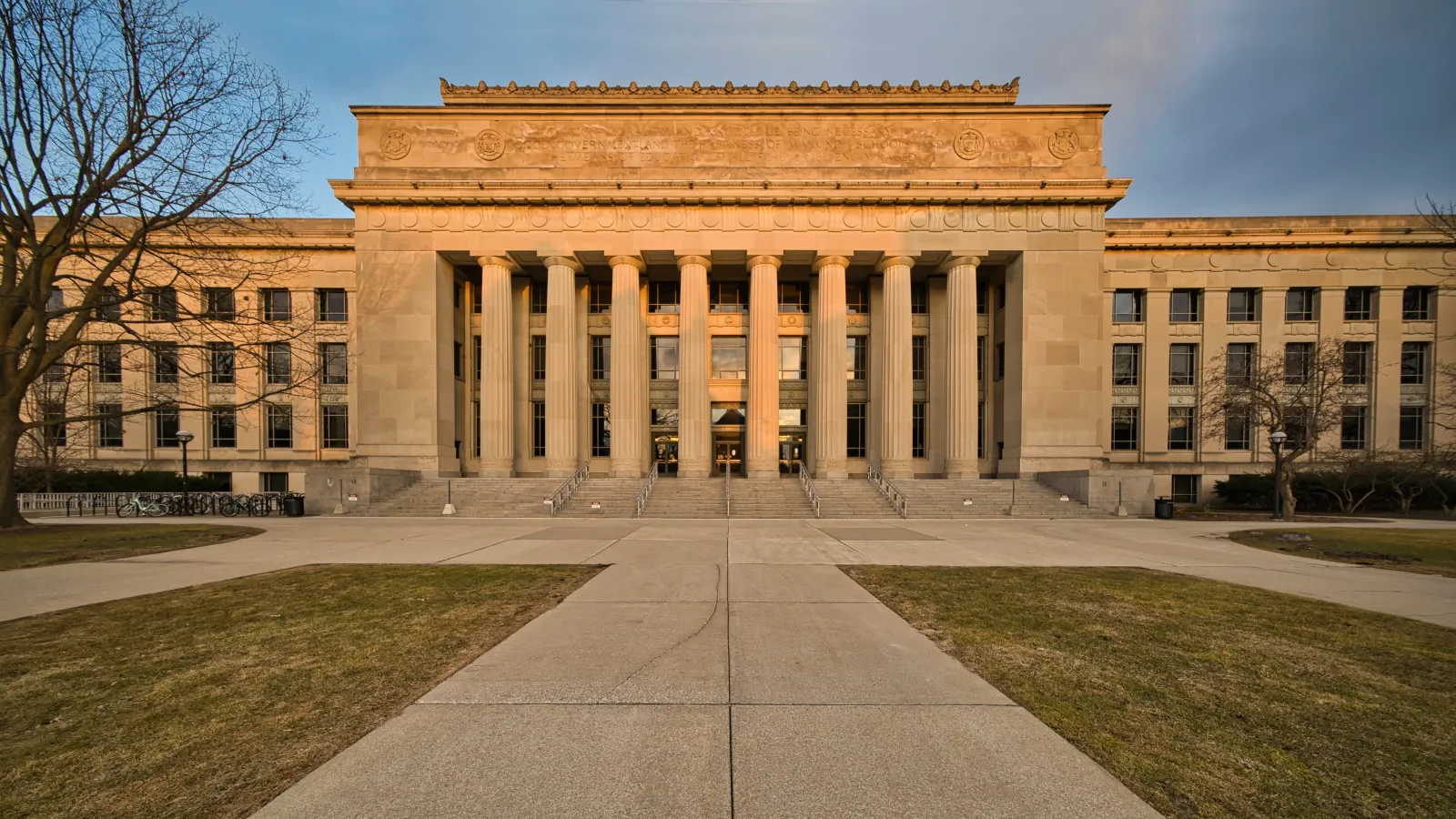

University of Michigan
Ann Arbor, Michigan, United States · Established 1817
Official website ↗Total Students
53,488
Student:Faculty
15:1
Setting
Suburban
Overview
The University of Michigan, founded in 1817 in Ann Arbor, is one of the largest and most comprehensive public research universities in the United States, with 19 schools and colleges spanning engineering, business (Ross), public policy (Ford), law, medicine, and the liberal arts. Its scale -- more than 50,000 students across undergraduate and graduate programs -- gives it unusual breadth: strong programs exist across dozens of departments rather than a narrow set of flagship majors, and its College of Engineering and Ross School of Business are both consistently ranked among the top handful of public-university programs in the US. Michigan draws one of the largest international student populations of any US public university, including a substantial graduate and PhD population from South Asia, with especially deep pipelines into engineering, computer science, and business. Ann Arbor's proximity to Detroit adds a distinctive automotive- and mobility-technology dimension to Michigan's engineering recruiting that few peer public research universities match, alongside the university's broader reputation across public policy, medicine, and the arts. For prospective IELTS or TOEFL candidates, Michigan's English-proficiency requirements vary meaningfully by school and program level: undergraduate admission generally expects a moderate IELTS/TOEFL threshold, while specific graduate and professional programs (notably the Ross MBA) set a higher bar. Michigan accepts IELTS, TOEFL, Duolingo, and PTE across most of its schools, though exact thresholds should always be confirmed on the specific program's own admissions page rather than assumed from a university-wide figure.
Rankings
US News National Universities
#21 (2026)
US News National Universities · Top Public Universities
#3 (2026)
Admissions, Requirements & Costs
Requirements, deadlines, and test-score cutoffs differ significantly between undergraduate and graduate/Master's programs — shown separately below.
Undergraduate
Acceptance Rate
18%
Application Fee
$75
Documents required: Common Application, Michigan-specific supplemental essays, Official high school transcript, Counselor recommendation, SAT or ACT scores (test-optional policy in effect -- confirm current cycle status), English proficiency test scores (IELTS/TOEFL/Duolingo/PTE) for applicants not schooled primarily in English, Application Fee or Fee Waiver Request
| Term | Deadline | Type |
|---|---|---|
| Fall | November 1 (Early Action, non-binding) | Early Action |
| Fall | February 1 (Regular Decision) | Regular Decision |
Test Scores
SAT Range
1350–1530
ACT Range
31–34
IELTS Minimum
6.5 (Gabble rec. 7)
TOEFL Minimum
88 (4.5 new scale) · Gabble rec. 100 (5 new scale)
TOEFL scores shown as: legacy 0–120 scale (new 1.0–6.0 CEFR-aligned scale, effective Jan 2026).
Accepted tests: IELTS Academic, TOEFL iBT, Duolingo English Test, PTE Academic
Waiver: Applicants who completed secondary education taught primarily in English, including at an accredited US high school, are generally exempt from the English-proficiency testing requirement.
Tuition (Intl.)
$61,000
Tuition (Domestic)
$17,786
Living Expenses/yr
$15,500
Total Cost of Attendance
$76,500
Scholarships
International Center and college-specific merit scholarships
Varies; typically a partial tuition contribution
A limited set of merit scholarships administered through individual Michigan colleges and the International Center; most Michigan financial aid for undergraduates is need-based and predominantly directed at domestic students.
Eligibility: Varies by college; competitive and limited for international applicants specifically
Popular Programs
Gabble Prep Insights
Where applicants lose points: Because Michigan's undergraduate IELTS/TOEFL minimum (6.5/88) sits at a moderate level relative to Michigan's overall selectivity, some applicants underweight English-test prep relative to the Common Application essays and Michigan's own supplemental short-answer questions, which carry substantial weight in a holistic review process against a large applicant pool.
International applicants to Michigan's most selective majors (Computer Science, Ross Business) benefit from scores comfortably above the university-wide minimum, since these programs draw disproportionately high application volume relative to available seats even within Michigan's already competitive out-of-state/international pool.
Acceptance rate, tuition, and test-score figures were cross-referenced against this site's own existing University of Michigan blog guide (content/blog/university-of-michigan-guide.mdx) rather than a single official page, since Michigan's admissions profile and cost-of-attendance pages returned access errors during research; that guide states an overall acceptance rate of roughly 18-20% (used here as 18%, the lower/more conservative end) and an out-of-state/international undergraduate cost of attendance in the roughly $56,000-66,000 (tuition+fees) range, from which the tuitionInternationalPerYear figure here (61,000) is a representative midpoint rather than a precisely sourced single official number -- treat all undergraduate cost figures here as approximate until confirmed against Michigan's own current cost-of-attendance page. In-state tuition ($17,786) is the most recently confirmed figure and is shown for reference only, since Gabble's international audience pays the out-of-state/international rate.
Recommended prep timeline: 10 weeks
Graduate (Master's & PhD)
Application Fee
$90
Documents required: Statement of Purpose, Official transcripts from all institutions attended, Letters of recommendation (number varies by program), Resume/CV, English proficiency test scores (IELTS/TOEFL/Duolingo/PTE) unless exempted, GRE or GMAT scores (required by some programs, including the Ross MBA; not required by most engineering MS/PhD programs), Application Fee or Fee Waiver Request
| Term | Deadline | Type |
|---|---|---|
| Fall | Varies significantly by program, generally December through March -- confirm the specific program's deadline | Rolling |
Test Scores
IELTS Minimum
7 (Gabble rec. 7)
TOEFL Minimum
100 (5 new scale) · Gabble rec. 100 (5 new scale)
IELTS notes: The Ross School of Business MBA program's own published guidance targets an overall IELTS score around 7.0; most other graduate programs set their own thresholds, generally at or below this level -- confirm with your specific department.
TOEFL notes: The Ross MBA program's own published guidance targets an overall TOEFL score around 100; most other graduate programs set their own thresholds, generally in the 88-100 range depending on department -- confirm with your specific program.
TOEFL scores shown as: legacy 0–120 scale (new 1.0–6.0 CEFR-aligned scale, effective Jan 2026).
Accepted tests: IELTS Academic, TOEFL iBT, Duolingo English Test, PTE Academic
Waiver: Applicants who hold a prior degree from an institution where instruction was conducted entirely in English are generally eligible for a waiver, subject to program approval.
Scholarships
Rackham Graduate School fellowships and assistantships
Full tuition waiver plus a monthly stipend; amount varies by department
Departmentally and centrally funded fellowships, research assistantships (RA), and graduate student instructor (GSI/TA) positions that typically cover full tuition plus a living stipend for PhD and many research-track master's students.
Eligibility: Awarded competitively by individual academic departments as part of, or shortly after, the admission decision; not need-based
Popular Programs
Gabble Prep Insights
Where applicants lose points: Ross MBA applicants specifically should expect their Speaking score to matter beyond the bare minimum, since Ross's curriculum is built around experiential, team-based 'Michigan Difference' projects that require confident, unscripted spoken participation from day one.
Engineering and Computer Science master's applicants tend to clear Reading and Listening comfortably but sometimes underprepare Writing relative to the volume of technical reports and design documentation expected in project-based coursework.
Graduate acceptance rate and cost of attendance are not published as single university-wide figures -- Michigan's 19 schools and colleges each run independent graduate admissions with their own applicant pools, selectivity, and (for funded PhD/master's students) tuition-waiver structures, so no aggregate number is estimated here rather than conflating figures across very different programs (e.g. a fully funded PhD stipend recipient vs. a self-funded professional master's student).
Recommended prep timeline: 10 weeks
Programs Offered
BSE in Computer Science
Undergraduate · 4 yr · $61,000/yr
BSE in Mechanical Engineering
Undergraduate · 4 yr · $61,000/yr
BBA
Undergraduate · 4 yr · $61,000/yr
MBA
Masters · 2 yr
MS in Computer Science and Engineering
Masters · 2 yr
Master of Public Policy
Masters · 2 yr
PhD
PhD · 5 yr
Campus Life
Ann Arbor is a classic large college town built around the university, and Michigan's more than 1,600 registered student organizations give it one of the widest extracurricular ranges of any US public university, spanning academic, cultural, entrepreneurial, and political life. Michigan Athletics competes in NCAA Division I as a founding member of the Big Ten Conference, and Michigan Stadium ('The Big House'), one of the largest stadiums in the world by capacity, anchors a football culture that shapes much of campus social life each fall. International students specifically benefit from a large, well-established international community and dedicated programming through the university's International Center.
Notable clubs: Michigan Student Assembly (Central Student Government), The Michigan Daily (independent student newspaper), Michigan Sport Business Association, MPowered Entrepreneurship, 1,600+ registered student organizations across academic, cultural, and hobby interests
Outcomes
Undergraduate
Graduate
Notable Alumni
Larry Page — Co-founder of Google; earned a BSE in Computer Engineering from Michigan in 1995
Gerald Ford — 38th President of the United States; earned his undergraduate degree at Michigan (and played on its national-championship football team) before attending Yale Law School
James Earl Jones — Acclaimed actor known for stage and film roles including the voice of Darth Vader; studied at Michigan
Visa Interview Prep
Michigan's International Center issues I-20s and supports F-1 visa applicants across all schools. Given Michigan's large international graduate population, many applicants rely on a research or teaching assistantship offer as proof of funding -- ensure that documentation is finalized before the visa interview, since consular officers weigh funding evidence heavily.
- Clarity on the specific program and department, and why Michigan specifically
- Demonstrating strong ties and credible intent to return home after studies
- Financial sufficiency and clear documentation of funding sources (self-funded, assistantship, or family support)
- Consistency between academic/professional background and chosen field of study
FAQs
What IELTS or TOEFL score do I need for Michigan's undergraduate program?Undergrad
Michigan's general undergraduate minimum is around IELTS 6.5 overall or TOEFL iBT 88, though exact thresholds can vary slightly by program -- always confirm the current figure on Michigan's own admissions page for your specific college.
What IELTS or TOEFL score do I need for the Ross MBA?Grad
Ross's own published guidance targets an overall IELTS score around 7.0 or TOEFL around 100. Other graduate programs at Michigan set their own separate thresholds, generally at or below this level.
How competitive is Michigan for international applicants?Undergrad
Michigan's overall undergraduate acceptance rate runs roughly 18-20%, with the out-of-state/international pool somewhat more selective (roughly 15-18%) than the in-state pool. Individual majors like Computer Science and Ross Business draw disproportionately more applications relative to available seats.
Does Michigan require the GRE or GMAT?Grad
It depends on the program. The Ross MBA generally requires the GMAT (or accepts the GRE). Most engineering MS and PhD programs do not require a standardized graduate test. Always confirm the specific program's current policy.
What is Michigan best known for academically?
Breadth and scale across nearly every field: the College of Engineering and Ross School of Business are both consistently ranked among the top handful of public-university programs in the US, and Michigan's proximity to Detroit gives its engineering programs a distinctive automotive- and mobility-technology recruiting pipeline.
Is financial aid available to international undergraduates at Michigan?Undergrad
Limited. Michigan's undergraduate financial aid is predominantly need-based and directed mainly at domestic (in-state and out-of-state) applicants; international undergraduate applicants should expect to self-fund or rely on the smaller pool of international-eligible merit scholarships administered through individual colleges.