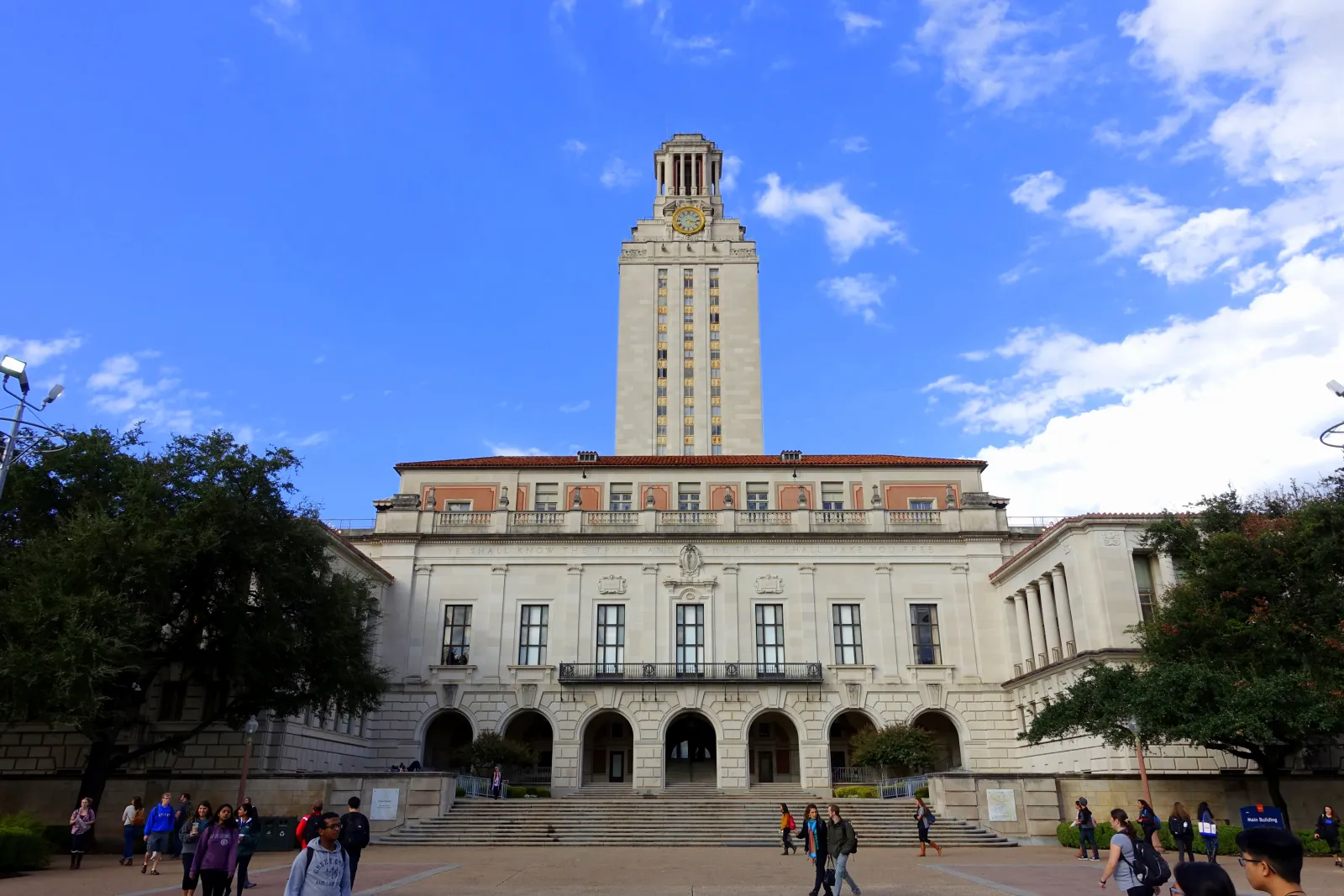

University of Texas at Austin
Austin, Texas, United States · Established 1883
Official website ↗Total Students
53,864
Intl. Students
9.7%
Setting
Urban
Overview
The University of Texas at Austin was founded in 1883 as the flagship campus of the University of Texas System, and has grown into one of the largest and most comprehensive public research universities in the US, with more than 53,000 students spread across a 431-acre main campus in downtown Austin plus additional research and athletic facilities across a 1,438-acre total footprint. UT Austin is organized into more than a dozen colleges and schools, including the Cockrell School of Engineering, the McCombs School of Business, the Moody College of Communication (home of the Department of Radio-Television-Film, which counts Matthew McConaughey among its alumni), the College of Natural Sciences, and the College of Liberal Arts, giving it genuine strength across engineering, business, computer science, communications, and the humanities rather than a single standout discipline. Austin's status as a major US tech hub (headquarters or large offices for Tesla, Oracle, Apple, and a dense startup ecosystem sit minutes from campus) feeds directly into UT Austin's recruiting pipeline, particularly for its Cockrell School of Engineering and McCombs School of Business, both consistently ranked among the strongest public-university programs in their fields nationally. The university's overall acceptance rate sits in the high-20s to low-30s percent range, but this varies significantly by college — McCombs Business and Computer Science within Engineering are considerably more selective than the university-wide figure. Texas's well-known automatic-admission rule (guaranteeing admission to Texas residents who graduate in a set top percentage of their high school class) applies only to Texas-resident domestic applicants and has no bearing on international admission, which is assessed holistically. For prospective IELTS/TOEFL candidates, UT Austin sets a comparatively accessible English-proficiency floor relative to many private-university peers (IELTS 6.5, TOEFL 79), uses the Common Application for Fall/Summer international applicants (a separate Spring-specific application applies for spring-term entry), and charges a non-refundable $90 application fee with no fee waivers available for international applicants specifically. As a large public university, UT Austin's cost of attendance is meaningfully lower than comparable private research universities even at the international/non-resident tuition rate, though tuition varies by college (Engineering and McCombs Business typically charge differential tuition above the university-wide base rate).
Rankings
US News National Universities · Overall (tied)
#30 (2026)
Times Higher Education (THE) World University Rankings · Overall (Global)
#50 (2026)
Admissions, Requirements & Costs
Requirements, deadlines, and test-score cutoffs differ significantly between undergraduate and graduate/Master's programs — shown separately below.
Undergraduate
Acceptance Rate
29.1%
Application Fee
$90
Documents required: Common Application (Fall/Summer entry) or the Spring App via BeALonghorn (Spring entry), Official transcripts, Essays (Common App personal essay plus UT Austin-specific short-answer topics), SAT or ACT scores (policy may vary by year and applicant pool — confirm current test-optional status), English proficiency scores (TOEFL/IELTS/Duolingo) for international applicants who don't qualify for a waiver, Note: Texas's automatic-admission (Top %) rule applies only to Texas-resident domestic applicants and does not apply to international applicants, who are reviewed holistically
| Term | Deadline | Type |
|---|---|---|
| Fall | October 15 (Early Action / Priority) | Early Action |
| Fall | December 1 (Regular Decision) | Regular Decision |
| Spring | September 1 | Regular Decision |
Test Scores
SAT Range
1230–1480
ACT Range
29–34
IELTS Minimum
6.5
TOEFL Minimum
79 (4 new scale)
IELTS notes: Minimum overall band of 6.5 on the Academic Examination; no separate published component minimums found in this research pass.
TOEFL notes: Minimum of 79 on the 0-120 internet-based scale, or 4 on ETS's new 1-6 CEFR-aligned scale (for tests taken from January 21, 2026 onward).
TOEFL scores shown as: legacy 0–120 scale (new 1.0–6.0 CEFR-aligned scale, effective Jan 2026).
Accepted tests: TOEFL iBT, IELTS Academic, Duolingo English Test
Waiver: Exempt if you are a citizen of, and were educated in, a country where English is the sole official and primary conversational language (including Australia, Canada, Ireland, New Zealand, and the UK, among others), or if you graduated from a US high school or a qualifying country's high school after at least three years of study there. PTE Academic is not listed as an accepted test.
Tuition (Intl.)
$42,554
Tuition (Domestic)
$42,554
Living Expenses/yr
$21,650
Total Cost of Attendance
$64,204
Popular Programs
Gabble Prep Insights
Where applicants lose points: Writing matters most through the UT Austin-specific short-answer essays layered on top of the Common Application essay, which ask applicants to speak concretely about specific programs and fit at a large, decentralized university with many distinct colleges.
Applicants to UT Austin's more selective programs (McCombs Business, Computer Science) should not assume the university-wide acceptance rate reflects their actual odds, since these programs review separately and more competitively than the university-wide average.
Acceptance rate (29.1%) and SAT/ACT middle-50% ranges (SAT 1230-1480, ACT 29-34) are drawn from Wikipedia's aggregation of UT Austin's own reported Fall 2023 figures — a more current official class-profile page could not be confirmed in this research pass, so these should be treated as broadly representative rather than exact for the current cycle. Tuition and cost figures reflect UT Austin's official 2026-27 non-resident/international published range: tuition runs $42,554-$51,106/year and total cost of attendance $64,204-$72,916/year depending on college and program (McCombs Business and Engineering typically sit at the higher end via differential tuition); the lower end of each range is used here as the representative base figure, and living expenses ($21,650) is backed out as the difference between the base tuition and base total cost of attendance figures UT Austin publishes. The $90 application fee has no fee-waiver option for international applicants specifically, per UT Austin's own international-admissions page. Financial aid availability for international undergraduates could not be confirmed from an accessible official page in this research pass and is left null rather than assumed.
Recommended prep timeline: 10 weeks
Graduate (Master's & PhD)
Documents required: Statement of purpose (program-specific), Letters of recommendation, Official transcripts from all institutions attended, CV/resume, English proficiency scores (TOEFL/IELTS) unless waived, GRE or GMAT scores — policy set independently by each graduate program at UT Austin's decentralized Graduate School; not one university-wide rule
| Term | Deadline | Type |
|---|---|---|
| Varies by program (commonly Fall) | Set independently by each graduate program/department | Rolling |
Test Scores
No fixed university-wide score minimum is published — requirements vary by department. See notes below.
IELTS notes: UT Austin's Graduate School generally requires evidence of English proficiency, but the exact minimum is set at the program level rather than published as one university-wide figure in the sources checked in this research pass.
TOEFL notes: Not confirmed at a university-wide level in this research pass — individual graduate programs publish their own minimums; always check the specific program's admissions page.
Accepted tests: TOEFL iBT, IELTS Academic
Popular Programs
Gabble Prep Insights
Where applicants lose points: Not enough program-specific data was confirmed in this research pass to generalize across UT Austin's decentralized graduate admissions.
UT Austin's graduate admissions are run independently by each program under the university's Graduate School, so this dataset could not confirm one official university-wide graduate acceptance rate, application fee, English-proficiency minimum, tuition figure, or cost of attendance in this research pass — all are left null rather than estimated. Applicants should confirm exact requirements and costs directly with their target department (e.g. McCombs MBA, Cockrell School of Engineering, or a specific College of Natural Sciences PhD program).
Programs Offered
BS in Computer Science
Undergraduate · 4 yr
BBA (Business Administration)
Undergraduate · 4 yr
BS in Mechanical Engineering
Undergraduate · 4 yr
BS in Radio-Television-Film
Undergraduate · 4 yr · $42,554/yr
MBA
Masters · 2 yr
PhD (various departments)
PhD · 5 yr
Campus Life
UT Austin's campus culture blends major-college-sports energy (the Longhorns compete in the SEC, one of the most prominent conferences in US college athletics, with football Saturdays a defining feature of student life at Darrell K Royal-Texas Memorial Stadium) with deep ties to Austin's tech and music scenes — the city's dense startup ecosystem and major tech-employer presence (Tesla, Oracle, Apple, and others) give business and engineering students unusually direct access to internships and recruiting minutes from campus. With hundreds of registered student organizations, a large Greek life system, and long-running spirit traditions like the Texas Cowboys and Silver Spurs, student life at UT Austin operates at a scale closer to a small city than a typical university campus, reflecting its 50,000+ student body.
Notable clubs: The Daily Texan — UT Austin's student newspaper, Texas Cowboys and Silver Spurs — long-running UT Austin spirit/service organizations, Longhorn Band ("Showband of the Southwest"), Numerous business case-competition, hackathon, and entrepreneurship clubs tied to Austin's tech and startup scene, Hundreds of registered student organizations spanning academic, cultural, and Greek life
Outcomes
Undergraduate
Graduate
Notable Alumni
Matthew McConaughey — Academy Award-winning actor (Dallas Buyers Club); earned his BSc from UT Austin's Moody College of Communication (Radio-Television-Film) in 1993
James P. Allison — 2018 Nobel Prize in Physiology or Medicine for pioneering cancer immunotherapy research; earned his BS (1969) and PhD (1973) from UT Austin
Rex Tillerson — Former ExxonMobil CEO and US Secretary of State (2017-2018); earned his BSc in Civil Engineering from UT Austin in 1975
Michael Dell — Founder and CEO of Dell Technologies; attended UT Austin (1983-1984) before leaving to build Dell full-time
Visa Interview Prep
UT Austin is SEVP-certified and its International Student and Scholar Services (ISSS) office supports F-1 visa applicants. As with other US institutions, applicants should start the SEVIS fee payment, I-20, and embassy interview process as early as possible given known visa-appointment backlogs in some countries.
- Clarity on the specific program and why UT Austin over other options
- Demonstrating strong ties and credible intent to return home after studies
- Financial sufficiency and clear documentation of funding sources
- Consistency between academic background and chosen field of study
FAQs
What IELTS or TOEFL score do I need to apply to UT Austin?Undergrad
The published minimums are IELTS 6.5 overall (Academic) or TOEFL iBT 79 overall (4 overall on ETS's new 1-6 CEFR-aligned scale for tests taken from January 21, 2026 onward); Duolingo is also accepted with a minimum of 115. PTE is not listed as an accepted test. You're exempt if you're a citizen of and educated in a country where English is the sole official language, or if you completed at least three years of high school in the US or a qualifying English-speaking country.
Does Texas's automatic-admission rule apply to international applicants?Undergrad
No. Texas's well-known Top % automatic-admission rule (guaranteeing admission to Texas residents who graduate in a set top percentage of their high school class) applies only to Texas-resident domestic applicants. International applicants are reviewed holistically through the standard Common Application process regardless of class rank.
Does UT Austin offer fee waivers for the international application fee?Undergrad
No. UT Austin's $90 undergraduate application fee is non-refundable, and the university explicitly states that fee waivers are not available for international applicants, unlike the fee-waiver options many US universities extend more broadly.
Which UT Austin programs are hardest to get into as an international applicant?Undergrad
The university-wide acceptance rate (around 29%) understates the difficulty of UT Austin's most competitive colleges — the McCombs School of Business and Computer Science (whether housed in Engineering or Natural Sciences) are both considerably more selective and reviewed separately from the general applicant pool.
Is the GRE or GMAT required for UT Austin graduate programs?Grad
It depends on the specific program — UT Austin's Graduate School is decentralized, with each department (including the McCombs MBA and individual Computer Science/Engineering master's and PhD programs) setting its own testing policy. There is no single university-wide GRE/GMAT rule, so confirm directly with your target program.
How much does it cost to attend UT Austin as an international student?Undergrad
For 2026-27, non-resident/international tuition runs $42,554-$51,106/year depending on college and program, with total cost of attendance (including fees, housing, food, books, and personal expenses) running $64,204-$72,916/year — meaningfully lower than comparable private research universities even at the non-resident rate. Engineering and McCombs Business typically sit toward the higher end via differential tuition.