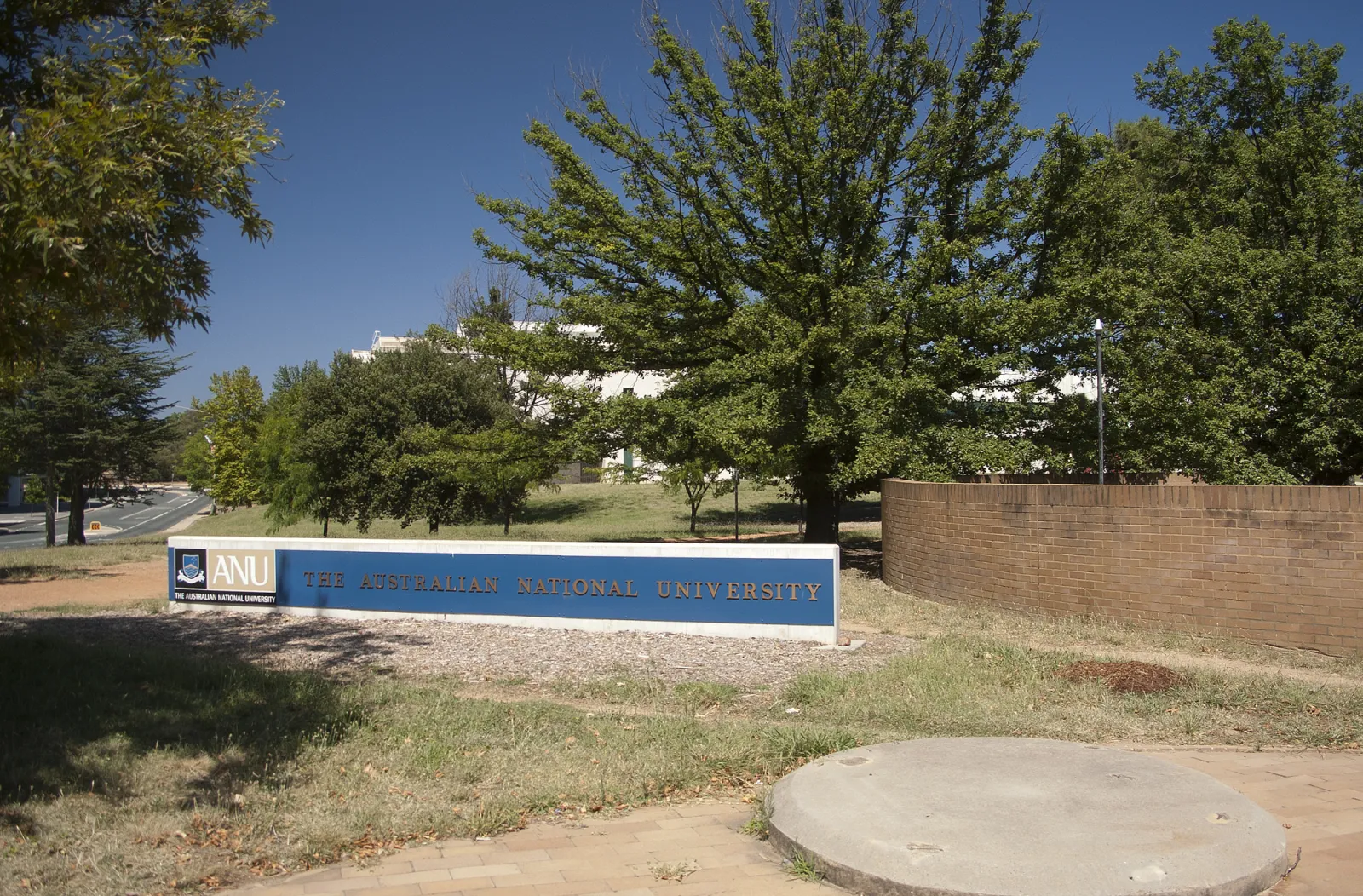

Australian National University
Canberra, Australian Capital Territory, Australia · Established 1946
Official website ↗Total Students
21,000
Intl. Students
25%
Setting
Urban
Overview
Founded by an act of the Australian Parliament in 1946, the Australian National University is Australia's only university created directly by the national government, with an original research-focused mission that still shapes its identity today. ANU is a single-campus institution built around its Acton campus in the national capital, Canberra, a short walk from Parliament House and many of Australia's national research institutions, which the university leverages heavily for research placements, internships, and policy-adjacent study in fields like international relations, public policy, and law. Unlike Oxford or Cambridge's collegiate model, ANU students belong directly to the University and its academic Colleges (broad faculties), though many undergraduates choose to live in one of ANU's residential halls, which provide accommodation and a social community without functioning as separate academic institutions. ANU is particularly well known for International Relations, Politics, Public Policy (its Crawford School of Public Policy is consistently ranked among the world's best), Asian and Pacific Studies (reflecting Australia's regional position and ANU's historic strength in the area), Law, and the physical and natural sciences, including astronomy and astrophysics through the Research School of Astronomy and Astrophysics at Mount Stromlo Observatory. The university counts six Nobel laureates among its faculty and researchers and has educated multiple Australian Prime Ministers and a large number of senior diplomats and public servants, reflecting its close relationship with the national government and public sector. For prospective IELTS or TOEFL candidates, ANU applies one of the more moderate English-language thresholds among the universities in this dataset for standard programs -- IELTS Academic 6.5 overall with no band below 6.0 covers the great majority of undergraduate and postgraduate coursework programs -- though several specific programs, most notably the Doctor of Medicine and Surgery and the Master of Clinical Psychology, require a considerably higher IELTS 7.0 overall (with no band below 6.0 or 7.0 respectively). International applicants apply directly to ANU (not through a UK-style centralised system) and are assessed against ANU's own published equivalency tables for their home country's secondary or tertiary qualification, rather than against A-Levels or the SAT/ACT.
Rankings
Times Higher Education (THE) World University Rankings · Overall (Global)
#73 (2026)
US News Best Global Universities · Overall (Global)
#81 (2027)
Admissions, Requirements & Costs
Requirements, deadlines, and test-score cutoffs differ significantly between undergraduate and graduate/Master's programs — shown separately below.
Undergraduate
Application Fee
$79
Documents required: Direct online application to ANU (no centralised UCAS/Common App-style portal), Certified copies of secondary school transcripts/certificates, English language proficiency test scores (unless exempt), Certified passport copy, Statement of purpose or personal statement for some programs, Portfolio, audition, or additional selection documents for a small number of programs (e.g. Music, some Fine Arts pathways)
| Term | Deadline | Type |
|---|---|---|
| Semester 1 (February) | 15 December of the preceding year for most programs (e.g. 15 December 2026 for Semester 1, 2027 entry); some programs with additional selection criteria, such as Crawford School of Public Policy programs, close earlier | Rolling |
| Semester 2 (July) | Mid-year intake available for a smaller set of programs; check program-specific deadlines | Rolling |
Test Scores
IELTS Minimum
6.5 (Gabble rec. 6.5)
TOEFL Minimum
80 (4 new scale) · Gabble rec. 80 (4 new scale)
PTE Minimum
64
IELTS notes: Standard undergraduate requirement: 6.5 overall with no band below 6.0 in Listening, Reading, Writing, and Speaking. Higher requirement for the Doctor of Medicine and Surgery (MChD): 7.0 overall with no band below 6.0. IELTS Online, IELTS taken via the Home Edition, and other online-proctored variants are not accepted -- only test-centre results.
TOEFL notes: For tests taken before the ETS scale change effective from 2027: 80 overall (Reading 20, Writing 20, Listening 18, Speaking 18). For tests taken from 2027 onward under ETS's revised scoring: 81 overall (Reading 16, Writing 19, Listening 16, Speaking 19). Medicine (MChD) requires the higher postgraduate-equivalent threshold of 100 overall with 22 in each section. ANU does not accept TOEFL iBT Home Edition.
TOEFL scores shown as: legacy 0–120 scale (new 1.0–6.0 CEFR-aligned scale, effective Jan 2026).
Accepted tests: IELTS Academic, TOEFL iBT, Pearson Test of English (PTE) Academic, Cambridge English C1 Advanced
Waiver: Applicants who have completed the equivalent of at least one year of full-time study taught and assessed in English within the last two years (extending the standard 2-year test validity window to 4 years in that case), or who are citizens of and were schooled in a small number of recognised English-majority countries, may be exempt -- confirmed via ANU's English Language Admission Requirements policy rather than a simple nationality-only rule.
Conditional admission: ANU's College of Business and Economics and other colleges work with ANU's affiliated pathway/English-bridging providers for applicants who narrowly miss the required score, allowing a pre-sessional or foundation English pathway to lead into the degree program; availability and the exact score gap this can bridge vary by program and should be confirmed directly with ANU admissions.
Tuition (Intl.)
$40,406
Living Expenses/yr
$18,900
Total Cost of Attendance
$59,306
Scholarships
ANU Chancellor's International Scholarship
A 25% or 50% tuition fee reduction for the full duration of the degree, plus guaranteed first-year accommodation for recipients who choose to take it up
ANU's flagship, no-separate-application international scholarship. All eligible new international undergraduate and postgraduate coursework applicants are automatically considered on admission, with up to around 200 scholarships awarded each year across a number of regional categories.
Eligibility: Automatic consideration for eligible new international applicants meeting ANU's academic entry standards; no separate scholarship application required
Australia Awards and country-specific scholarships
Varies by scheme; the most comprehensive awards cover full tuition, a living allowance, and travel
A range of Australian Government-funded (Australia Awards) and partner-country-specific scholarships that ANU participates in, aimed at students from eligible developing countries in the Indo-Pacific region.
Eligibility: Set by the Australian Government or partner scheme, not ANU directly; typically requires nationality/residency in an eligible country and a separate, competitive application through the relevant government body
Popular Programs
Gabble Prep Insights
Where applicants lose points: Writing tends to be the section applicants come closest to the 6.0 floor on, since ANU's standard 6.5/6.0 requirement is more moderate than many of the other universities in this dataset, but coursework in ANU's flagship International Relations, Politics, and Law programs is still essay- and argument-heavy from first year.
Most applicants meeting ANU's standard 6.5 overall requirement report Reading and Listening as the most comfortable sections, with Writing the most likely to sit closest to the 6.0 per-band floor; applicants to the considerably more demanding Doctor of Medicine and Surgery (7.0 overall, no band below 6.0) should budget meaningfully more preparation time than the standard-program figure below.
Figures above were converted from AUD at approximately 1 AUD = 0.72 USD (September 2026 spot rate). ANU does not set one flat international tuition figure -- fees are set by a Field of Education (FOE) 'band' from ANU's official Schedule of Tuition Fees 2026 (Table 2), ranging from AUD 46,680/year (Band 1: Education, Society & Culture, Creative Arts) to AUD 62,440/year (Band 6: Medical Science). The figure used here, AUD 56,120 (~USD 40,406), is Band 4, the most common band covering Natural & Physical Sciences, Information Technology, Engineering, Agriculture, Health, Management and Commerce, Behavioural Science, and Economics -- always check the specific program's FOE code. The separate Doctor of Medicine and Surgery (MChD) program is priced individually at AUD 99,650/year and is not reflected in the Band 4 figure above. Living costs were estimated from ANU's own official Cost of Living guidance of roughly AUD 24,000-28,500 for the academic year (February-November), midpoint used (~AUD 26,250, ~USD 18,900); this excludes childcare, schooling, and large one-off purchases. ANU does not publish one official aggregate undergraduate acceptance rate, and third-party estimates online vary widely (from roughly 35% to over 70%) depending on methodology, so this dataset leaves acceptanceRate null rather than publish an unverified figure. The application fee is AUD 110 (~USD 79). Home (domestic) tuition figures are not applicable here since this dataset focuses on the international-applicant pathway and ANU's domestic fees are set under a different government-subsidised Commonwealth Supported Place system rather than a comparable 'sticker price.'
Recommended prep timeline: 8 weeks
Graduate (Master's & PhD)
Application Fee
$79
Documents required: Direct online application to ANU, Official transcripts from all previously attended institutions, Statement of purpose (program-dependent), CV/resume, Academic and/or professional references (program-dependent), English language proficiency test scores (unless exempt), Research proposal for PhD and other Higher Degree by Research (HDR) applicants
| Term | Deadline | Type |
|---|---|---|
| Semester 1 (February) | 15 December of the preceding year for most taught coursework programs; PhD/HDR applications are accepted year-round on a rolling basis, subject to supervisor and funding availability | Rolling |
| Semester 2 (July) | Mid-year intake available for many coursework programs; check program-specific deadlines | Rolling |
Test Scores
IELTS Minimum
6.5 (Gabble rec. 6.5)
TOEFL Minimum
100 (5 new scale) · Gabble rec. 100 (5 new scale)
PTE Minimum
70
IELTS notes: Standard postgraduate coursework requirement: 6.5 overall with no band below 6.0, identical to the undergraduate standard requirement. Considerably higher requirements apply to specific programs: the Master of Clinical Psychology and Master of Professional Psychology require 7.0 overall with no band below 7.0, and the PhD in Clinical Psychology requires the same 7.0/7.0 standard.
TOEFL notes: Standard postgraduate coursework requirement: 100 overall with 22 in each of Reading, Writing, Listening, and Speaking (higher than the undergraduate 80/81 TOEFL threshold). The Master of Clinical/Professional Psychology and the PhD in Clinical Psychology require further elevated component scores (PhD in Clinical Psychology: Reading 24, Writing 27, Listening 24, Speaking 23).
TOEFL scores shown as: legacy 0–120 scale (new 1.0–6.0 CEFR-aligned scale, effective Jan 2026).
Accepted tests: IELTS Academic, TOEFL iBT, Pearson Test of English (PTE) Academic, Cambridge English C1 Advanced
Waiver: Applicants who have completed the equivalent of at least one year of full-time study taught and assessed in English within the last two years, or who are citizens of and were schooled in a small number of recognised English-majority countries, may be exempt -- confirmed via ANU's English Language Admission Requirements policy.
Conditional admission: ANU's affiliated pathway/English-bridging providers offer pre-sessional English programs for postgraduate offer-holders who narrowly miss the required score; availability and the exact score gap this can bridge vary by program and should be confirmed directly with ANU admissions.
Tuition (Intl.)
$40,406
Living Expenses/yr
$18,900
Total Cost of Attendance
$59,306
Scholarships
ANU Chancellor's International Scholarship (postgraduate)
A 25% or 50% tuition fee reduction for the full duration of the degree, plus guaranteed first-year accommodation for recipients who take it up
The same flagship, no-separate-application scholarship scheme available to eligible new international postgraduate coursework applicants as at undergraduate level.
Eligibility: Automatic consideration for eligible new international applicants meeting ANU's academic entry standards; no separate scholarship application required
Australia Awards and Australian Government Research Training Program (RTP) scholarships
Varies by scheme; RTP scholarships typically cover the full tuition fee offset plus an annual living stipend for the duration of the research degree
Australia Awards support taught postgraduate study for students from eligible Indo-Pacific developing countries, while RTP scholarships fund PhD and other Higher Degree by Research candidates (domestic and a limited number of international places) with a full fee offset and stipend.
Eligibility: Set by the Australian Government or ANU's HDR scholarships committee, not a simple admissions-linked award; competitive, separate application required
Popular Programs
Gabble Prep Insights
Where applicants lose points: Writing carries particular weight for ANU's flagship policy-oriented graduate programs (Crawford School of Public Policy, Coral Bell School of International Relations), where a research-based statement of purpose and extensive policy-brief and essay-based coursework demand sustained, structured academic argument.
Applicants to the standard 6.5/6.0 tier generally clear Reading and Listening comfortably; Writing is the section most likely to sit close to the per-band floor. Applicants to the considerably higher Psychology programs (7.0 overall, no band below 7.0) should treat their preparation timeline as closer to the top end of the range, given the more demanding balanced-score requirement across all four components.
Figures above were converted from AUD at approximately 1 AUD = 0.72 USD (September 2026 spot rate). ANU does not publish one flat postgraduate tuition figure; the Band 4 fee (AUD 56,120/year, ~USD 40,406) used here is the most common postgraduate coursework band, covering Natural & Physical Sciences, IT, Engineering, Agriculture, Management and Commerce, Economics, and Political Science and Policy Studies (which houses the well-regarded Master of Public Policy) -- other bands range from AUD 46,680 (Band 1: Education, Society & Culture, Creative Arts) to AUD 62,440 (Band 6: Medical Science); always check the specific program's FOE code. Living costs use the same official ANU Cost of Living estimate as the undergraduate figure. ANU does not publish one official aggregate postgraduate acceptance rate, so that field is left null. GRE/GMAT: ANU's graduate coursework programs generally do not require a GRE or GMAT score; this dataset found no evidence of a standard GRE/GMAT requirement even for business-adjacent master's programs, so avgScore and the required flags are left as not required/null rather than assumed.
Recommended prep timeline: 8 weeks
Programs Offered
Bachelor of International Relations
Undergraduate · 3 yr
Bachelor of Philosophy, Politics and Economics
Undergraduate · 3 yr
Bachelor of Science
Undergraduate · 3 yr
Bachelor of Engineering (Honours)
Undergraduate · 4 yr
Bachelor of Laws (LLB, combined degrees)
Undergraduate · 5 yr
Master of International Relations
Masters · 2 yr
Master of Public Policy
Masters · 2 yr
Master of Diplomacy
Masters · 1 yr
Doctor of Medicine and Surgery (MChD)
Masters · 4 yr · $71,748/yr
PhD / Higher Degree by Research
PhD · 4 yr
Campus Life
ANU's single Acton campus sits at the edge of Canberra's city centre, giving students easy access to national institutions -- Parliament House, the National Library, the National Gallery, and numerous Commonwealth government departments and agencies -- that ANU actively uses for internships, guest lectures, and research placements, particularly in its International Relations, Law, and Public Policy programs. Most first-year undergraduates live in one of ANU's residential halls or colleges, which provide accommodation, dining, and a built-in social community, though (unlike Oxford or Cambridge) these residences are not separate academic or degree-granting institutions. ANUSA, the student union, runs orientation, clubs and societies, and student advocacy, while Woroni serves as the university's long-running independent student newspaper and media outlet. Given ANU's strong Asia-Pacific academic focus and large international student body, the university supports an unusually wide range of country- and region-specific cultural societies alongside its academic and sporting clubs.
Notable clubs: ANU Students' Association (ANUSA) and Postgraduate and Research Students' Association (PARSA), ANU Observer and Woroni (ANU's independent student media/newspaper), Residential hall communities including Burgmann College, Bruce Hall, Fenner Hall, Ursula Hall, and Toad Hall, each with its own social and sporting traditions, A large number of ANU Sport clubs plus college-affiliated sports competitions, Numerous country- and region-specific student societies reflecting ANU's international and Asia-Pacific-focused student body
Outcomes
Undergraduate
Graduate
Notable Alumni
Kevin Rudd — 26th Prime Minister of Australia and Australian Ambassador to the United States; earned a Bachelor of Arts (Asian Studies) at ANU
Kim Beazley — Former Deputy Prime Minister of Australia, Governor of Western Australia, and Australian Ambassador to the United States; earned a Master's degree at ANU and later served as the university's Chancellor
Peter Doherty — Nobel laureate in Physiology or Medicine (1996); conducted his Nobel Prize-winning immunology research at ANU's John Curtin School of Medical Research
Frank Fenner — Renowned virologist who led global efforts toward the eradication of smallpox; longtime professor and Director of ANU's John Curtin School of Medical Research
Visa Interview Prep
Australia's Student visa process centres on the Confirmation of Enrolment (CoE) that ANU issues once a firm offer is accepted and (for most international students) the required deposit or first-instalment tuition payment is made -- a CoE is required before a Subclass 500 application can be lodged. Applicants must also satisfy the Genuine Student requirement (which replaced the previous Genuine Temporary Entrant test), demonstrating genuine study intent, and show evidence of sufficient funds to cover tuition, travel, and living costs at the Department of Home Affairs' published annual living-cost threshold. International students must also hold Overseas Student Health Cover (OSHC) for the duration of their visa, arranged either through ANU or independently. The Australian Government has periodically adjusted visa processing priorities and financial-capacity thresholds; applicants should confirm current requirements on the Department of Home Affairs website close to their intended application date.
- Australia's Subclass 500 Student visa is assessed primarily from the online application, supporting financial and academic documents, and a written 'Genuine Student' (GS) statement (short, English-language responses, generally around 150 words each, covering study intentions, ties to the home country, and career benefits) -- there is no standard in-person interview requirement built into the process the way the US F-1 visa has
- The Department of Home Affairs may request additional information, documents, or in specific risk-based cases a follow-up interview, but this is the exception rather than the standard path
FAQs
What IELTS score do I need to apply to ANU as an undergraduate?Undergrad
Most ANU undergraduate programs require a minimum overall IELTS Academic score of 6.5, with no band below 6.0 in Listening, Reading, Writing, and Speaking. The Doctor of Medicine and Surgery is a notable exception, requiring 7.0 overall with no band below 6.0.
Does ANU use UCAS or the Common Application?
No. ANU is not part of the UK's UCAS system or the US Common Application -- international applicants apply directly through ANU's own online application portal, and admission is assessed against ANU's published country-specific equivalency tables for the applicant's home secondary or tertiary qualification.
Will I need to attend a visa interview to study at ANU?
Almost certainly not. Australia's Subclass 500 Student visa is generally assessed from the online application, supporting documents, and a short written 'Genuine Student' statement rather than a routine in-person interview, unlike the US F-1 visa. The Department of Home Affairs can request further information or, rarely, an interview in specific cases.
Does ANU require the SAT, ACT, or a specific GPA for international applicants?Undergrad
No. ANU does not use the SAT, ACT, or a single university-wide GPA for international admissions. Applicants are assessed against ANU's own published equivalency requirements for their specific home-country secondary or tertiary qualification.
Is the GRE or GMAT required for ANU graduate programmes?Grad
No standard ANU graduate coursework program was found to require a GRE or GMAT score, including business-adjacent programs -- always confirm directly with the specific program if in doubt, since individual course requirements can change.
Can I get a waiver for the IELTS/TOEFL requirement at ANU?
Yes, in certain cases. You may be exempt if you've completed at least one year of full-time study taught and assessed entirely in English within the last two years (which also extends your test validity window to 4 years), or if you're a citizen of and were schooled in a recognised English-majority country -- confirmed against ANU's English Language Admission Requirements policy rather than a simple nationality rule.
How competitive is ANU for international applicants?
ANU does not publish one official aggregate acceptance rate, and third-party estimates online vary widely (from roughly 35% up to over 70%) depending on methodology and program mix, so this dataset does not cite a specific figure. Admission is assessed program-by-program against ANU's published country-specific equivalency requirements.
How many weeks should I spend preparing for IELTS or TOEFL before applying to ANU?
Given ANU's more moderate standard requirement (IELTS 6.5/TOEFL 80-81), a realistic window is around 8 weeks of focused preparation for most programs, with more time recommended for applicants targeting the considerably higher Medicine or Clinical Psychology thresholds (IELTS 7.0).