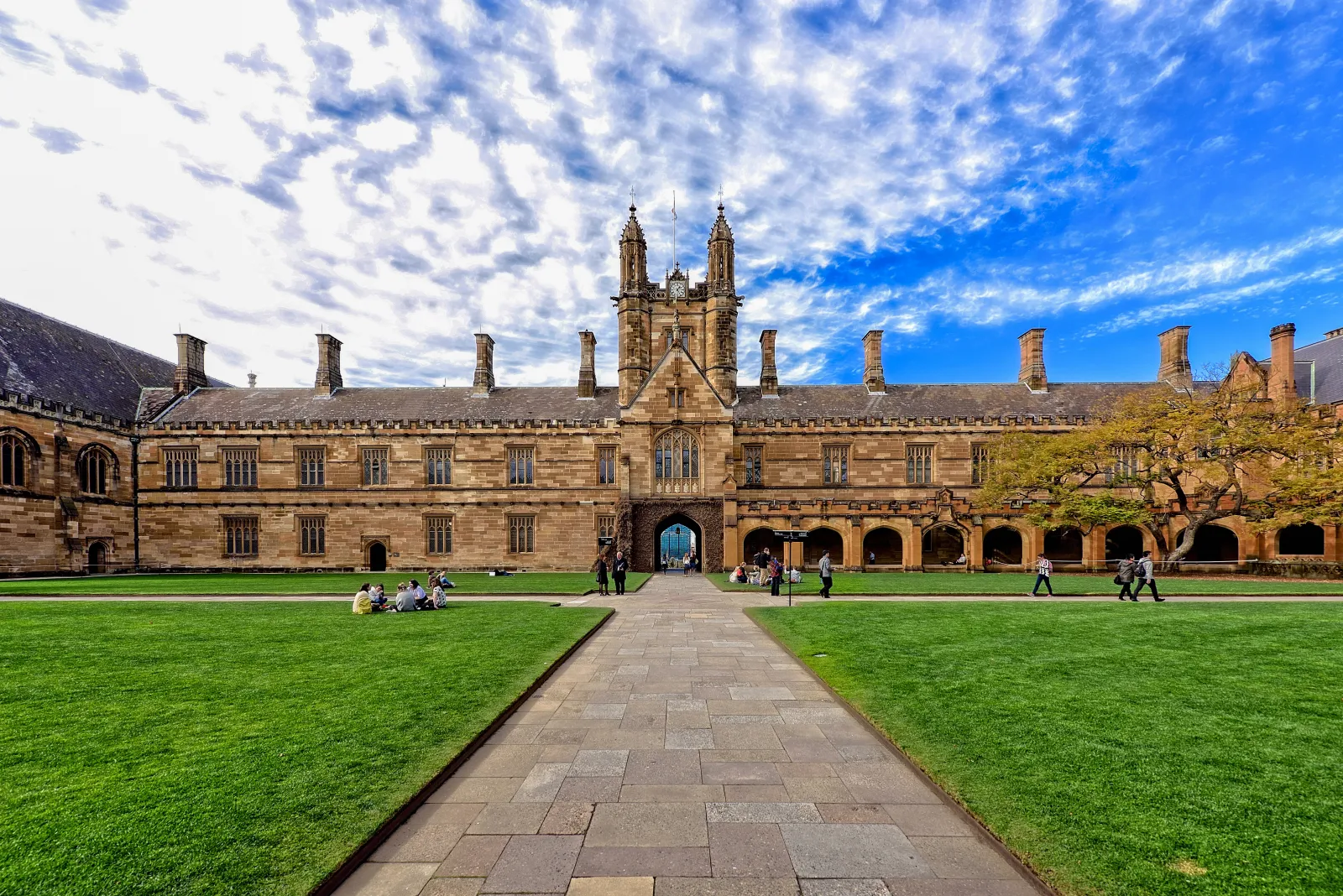
University of Sydney
Sydney, New South Wales, Australia · Established 1850
Official website ↗Total Students
73,000
Intl. Students
38%
Setting
Urban
Overview
Founded in 1850, the University of Sydney is Australia's oldest university and a founding member of the Group of Eight coalition of leading Australian research universities. Its main Camperdown/Darlington campus, anchored by the sandstone Quadrangle building, sits in Sydney's inner-western suburbs a short distance from the CBD. Like other major Australian universities, Sydney does not operate a UK-style federal college system for teaching -- students enrol directly in one of the University's faculties, though several historic residential colleges (such as St Andrew's, St Paul's, and Wesley College) sit adjacent to campus and provide accommodation and pastoral community for some students. Sydney is particularly well known for Medicine, Law, Business (University of Sydney Business School), Engineering, Arts and Social Sciences, and Architecture, and it holds one of the largest and most internationally diverse student bodies of any Australian university. The University has a long list of Nobel laureates and internationally prominent alumni across science, politics, and the arts, and it remains one of the two or three most internationally recognised Australian universities alongside Melbourne and ANU. For prospective IELTS or TOEFL candidates, University of Sydney's international undergraduate admissions process, like UNSW's, does not run through a UK-style centralised portal -- most international applicants apply directly to the University or through an authorised education agent, with entry assessed against country-specific secondary-qualification equivalency tables rather than a UK A-Level-style offer. Sydney's standard IELTS requirement is 6.5 overall with no band below 6.0 for most undergraduate programmes, with Medicine, Law, and a small number of other programmes requiring higher. Like the UK and other Australian universities, the Australian Student visa (subclass 500) process generally does not require an in-person interview for most applicants.
Rankings
Times Higher Education (THE) World University Rankings · Overall (Global)
#53 (2026)
Admissions, Requirements & Costs
Requirements, deadlines, and test-score cutoffs differ significantly between undergraduate and graduate/Master's programs — shown separately below.
Undergraduate
Application Fee
$108
Documents required: Direct online application to the University of Sydney (or via an authorised education agent), Academic transcripts and certificates for the relevant secondary qualification, English language proficiency test scores (IELTS/TOEFL) for applicants who do not qualify for a waiver, UCAT and interview for Medicine applicants; portfolio for select Architecture/Design programmes, Financial capacity documentation, required later for the Australian Student visa application rather than at the admissions stage
| Term | Deadline | Type |
|---|---|---|
| Semester 1 (February/March) | Rolling, with a commonly cited closing date around mid-January for the main round; Sydney advises applying well ahead of intake to allow time for visa processing | Rolling |
| Semester 2 (July) | Rolling, with a commonly cited closing date around late June for a smaller set of programmes offering mid-year intake | Rolling |
Test Scores
IELTS Minimum
6.5 (Gabble rec. 7)
TOEFL Minimum
85 (4 new scale)
PTE Minimum
64
IELTS notes: Most undergraduate programmes require 6.5 overall with no band below 6.0. Medicine, Law, and a small number of other programmes require higher, with correspondingly higher component minimums. Always confirm the exact requirement on the specific programme's entry requirements page.
TOEFL notes: Widely reported as 85 overall (TOEFL iBT, Australia-specific test centres only -- TOEFL iBT Home Edition is generally not accepted) for most undergraduate programmes; this dataset treats the exact figure as approximate pending confirmation on Sydney's live English-requirements page, which could not be fetched directly during research.
TOEFL scores shown as: legacy 0–120 scale (new 1.0–6.0 CEFR-aligned scale, effective Jan 2026).
Accepted tests: IELTS Academic, TOEFL iBT, PTE Academic, Cambridge English (C1 Advanced / C2 Proficiency)
Waiver: Applicants who are citizens of, and have completed their secondary or tertiary education in, a small set of English-majority countries (including the UK, US, Canada, Ireland, and New Zealand, among others) are generally exempt, as are those who have completed a qualification taught and assessed entirely in English at an approved institution within the relevant timeframe -- exact country and course lists are published on Sydney's English-requirements page.
Conditional admission: The University of Sydney's affiliated Sydney International College and Centre for English Teaching offer pre-sessional and pathway English preparation for offer-holders whose score falls short of the direct-entry requirement; exact eligibility and the score gap this can bridge vary by programme.
Tuition (Intl.)
$30,960
Living Expenses/yr
$21,600
Total Cost of Attendance
$52,560
Scholarships
Sydney Scholars International Scholarship / Vice-Chancellor's International Scholarship
Typically a percentage reduction (commonly 10-50%) of the annual international tuition fee for the duration of the course
A set of merit-based, partial-fee scholarships for high-achieving international undergraduate applicants, assessed alongside or shortly after the standard admissions process.
Eligibility: Assessed based on academic merit; specific thresholds vary by intake and faculty, and in many cases no separate application is required
Popular Programs
Gabble Prep Insights
Where applicants lose points: Writing is the section international applicants most often need to work on, since Sydney's coursework across Arts, Law, and Business programmes relies heavily on structured essay- and report-based assessment from the first year.
Applicants meeting the standard 6.5-overall requirement generally do not struggle further, but those targeting Medicine, Law, or other higher-tier programmes should specifically practise Writing and Speaking, since those programmes expect a higher, more even score across all four components.
Figures above were converted from AUD at approximately 1 AUD = 0.72 USD (rate as of September 2026). Sydney does not set one flat international tuition figure; published bands run roughly from AUD 43,000/year for Arts and Social Science programmes up to AUD 63,000+/year for some Engineering, Science, and Business programmes, with Medicine considerably higher -- the figure used here, AUD 43,000 (~USD 30,960), represents a commonly cited lower/mid-range figure across third-party aggregator sources rather than the full published range, since this dataset could not confirm one consolidated official fee table for every faculty during research; always check the specific programme's fee page. Living costs were estimated at roughly AUD 30,000/year (~USD 21,600), within the commonly cited AUD 25,000-35,000/year range for a Sydney-based international student. Sydney does not publish one official aggregate undergraduate acceptance rate; third-party estimates cluster around 30% but are not treated as reliable enough to publish as a specific figure here, so acceptanceRate is left null. The Sydney international application fee is commonly cited at AUD 150 (~USD 108, used above).
Recommended prep timeline: 8 weeks
Graduate (Master's & PhD)
Documents required: Direct online application to the University of Sydney (or via an authorised education agent), Official transcripts from all previously attended institutions, CV/resume, Statement of purpose / research proposal (for research degrees), English language proficiency test scores (if applicable), GMAT is accepted (though not universally required) for the University of Sydney's MBA
| Term | Deadline | Type |
|---|---|---|
| Semester 1 (February/March) | Rolling, course-specific; Sydney advises applying several months ahead of intake to allow time for visa processing | Rolling |
| Semester 2 (July) | Rolling, mid-year intake available for many taught master's programmes | Rolling |
Test Scores
IELTS Minimum
6.5 (Gabble rec. 7)
TOEFL Minimum
85 (4 new scale)
PTE Minimum
64
IELTS notes: Most taught master's programmes require 6.5 overall with no band below 6.0; some Law, Business, Education, and Media-adjacent programmes require 7.0 or higher. Always confirm the exact requirement on the specific programme's entry requirements page.
TOEFL notes: Widely reported as around 85-100 overall depending on programme; this dataset treats the figure as approximate pending confirmation on the specific programme's page.
TOEFL scores shown as: legacy 0–120 scale (new 1.0–6.0 CEFR-aligned scale, effective Jan 2026).
Accepted tests: IELTS Academic, TOEFL iBT, PTE Academic, Cambridge English (C1 Advanced / C2 Proficiency)
Waiver: Applicants who are citizens of, and have completed their secondary or tertiary education in, a small set of English-majority countries are generally exempt, as are those who have completed a qualification taught and assessed entirely in English at an approved institution within the relevant timeframe.
Conditional admission: The University of Sydney's affiliated pathway providers offer pre-sessional English preparation for graduate offer-holders whose score falls short of the direct-entry requirement; eligibility and the size of the gap this can bridge vary by programme.
Tuition (Intl.)
$33,120
Living Expenses/yr
$21,600
Total Cost of Attendance
$54,720
Scholarships
Sydney Scholars International Research Scholarship / University of Sydney International Strategic Scholarship
Varies considerably by award; PhD scholarships can cover full tuition plus a living stipend, while taught master's scholarships are typically a partial tuition reduction
A mix of fully funded PhD scholarships (covering tuition and a living stipend) for research candidates, and partial merit-based scholarships for taught master's students, varying by faculty.
Eligibility: PhD scholarships are competitive and assessed alongside the research-degree application; taught master's scholarships typically require a separate application after an offer
Popular Programs
Gabble Prep Insights
Where applicants lose points: Writing is consistently the toughest section for graduate applicants, since a research-focused statement of purpose and coursework-heavy taught master's assessment both demand sustained, well-organised academic argument.
Applicants to quantitative Engineering and IT courses tend to clear Reading and Listening comfortably but sometimes underprepare Writing for the report and project-based assessment common across Sydney's taught master's courses.
Figures above were converted from AUD at approximately 1 AUD = 0.72 USD. Sydney does not set one flat postgraduate tuition figure; the representative figure used here, roughly AUD 46,000 (~USD 33,120), reflects a commonly cited mid-range taught master's fee; the MBA and some specialist programmes are priced considerably higher, so always check the specific course page. Living costs use the same roughly AUD 30,000/year (~USD 21,600) estimate as undergraduate. Sydney does not publish one official aggregate postgraduate acceptance rate or a standard postgraduate application fee figure, so both are left null rather than estimated from unreliable third-party sources.
Recommended prep timeline: 8 weeks
Programs Offered
Bachelor of Commerce
Undergraduate · 3 yr
Bachelor of Engineering Honours
Undergraduate · 4 yr
Bachelor of Laws (LLB)
Undergraduate · 4 yr
Bachelor of Arts
Undergraduate · 3 yr
MBA
Masters · 2 yr
PhD
PhD · 4 yr
Campus Life
The University of Sydney's main Camperdown/Darlington campus is centred on the historic sandstone Quadrangle, a short distance from Sydney's CBD, and is one of the more visually distinctive university campuses in Australia. The University of Sydney Union runs clubs, societies, and student venues across campus, and a number of historic residential colleges sit adjacent to the main campus and provide accommodation and community for some students, though enrolment does not require joining one. Sydney's large and diverse international student population, drawn heavily from China, India, and across Asia, supports a wide range of country- and region-specific student societies.
Notable clubs: University of Sydney Union (USU), running clubs, societies, and campus venues, Sydney University Debating Society, Historic residential colleges (St Andrew's, St Paul's, Wesley, Sancta Sophia, and others) adjacent to campus, 200+ clubs and societies spanning academic, cultural, and hobby interests
Outcomes
Undergraduate
Graduate
Notable Alumni
John O'Sullivan — Radio astronomer and physicist credited as a co-inventor of Wi-Fi wireless networking technology; studied Engineering and completed his PhD at the University of Sydney
Malcolm Turnbull — 29th Prime Minister of Australia; studied Arts and Law at the University of Sydney before becoming a Rhodes Scholar at Oxford
John Howard — 25th Prime Minister of Australia; studied Law at the University of Sydney
John Cornforth — Nobel Prize in Chemistry (1975) for his work on the stereochemistry of enzyme-catalysed reactions; studied Chemistry at the University of Sydney
Visa Interview Prep
The Australian Student visa (subclass 500) process differs from the US F-1 system in similar ways to the UK: there is no routine embassy interview built into the standard process, and the centrepiece document is the Confirmation of Enrolment (CoE), which the University of Sydney issues once a firm offer is accepted and the first instalment of tuition (or an approved alternative) is paid. Applicants must satisfy the Genuine Student (GS) requirement by demonstrating a genuine intention to study and comply with visa conditions, alongside evidence of financial capacity to cover tuition, living costs, and travel for the course duration, and Overseas Student Health Cover (OSHC) for the visa period. International students must also budget separately for the visa application fee, paid directly to the Department of Home Affairs. The Australian government periodically adjusts visa processing priorities and financial-capacity thresholds; applicants should check current guidance close to their intended application date.
- Australian Student visa (subclass 500) applicants generally do NOT attend a routine in-person interview the way US F-1 applicants do -- most applications are assessed from the online form, the Confirmation of Enrolment (CoE) the University issues once a firm offer is accepted and fees are paid or arranged, financial capacity evidence, and the Genuine Student (GS) requirement
- The Department of Home Affairs may request additional documents or, in specific risk-based cases, an interview or further evidence focused on genuine intent to study and return, and financial sufficiency
FAQs
What IELTS score do I need to apply to Sydney as an undergraduate?Undergrad
Most undergraduate programmes require 6.5 overall with no band below 6.0. Medicine, Law, and a small number of other programmes require higher. Always check the specific programme's entry requirements page for the exact figure.
Does the University of Sydney use a centralised application system like UCAS?Undergrad
No. Most international applicants apply directly to the University online or through an authorised education agent, rather than through a national portal. Entry is assessed against Sydney's published equivalency tables for your specific country's secondary qualification, not a UK-style A-Level offer.
Will I need to attend a visa interview to study at Sydney?
Almost certainly not for the standard process. The Australian Student visa (subclass 500) generally does not require a routine in-person interview; your application is assessed from the online form, the Confirmation of Enrolment (CoE) the University issues, financial evidence, and the Genuine Student requirement. The Department of Home Affairs can request further evidence or an interview in specific cases.
How competitive is the University of Sydney for international applicants?
Sydney does not publish one official aggregate undergraduate acceptance rate. Third-party estimates suggest a relatively accessible overall rate compared to the most selective US or UK universities, though Medicine and Law are understood to be considerably more selective than the university-wide average.
Can I get a waiver for the IELTS/TOEFL requirement at Sydney?
Yes, in certain cases. You're generally exempt if you're a citizen of, and completed your education in, a recognised English-majority country, or if you've completed a qualifying degree taught and assessed entirely in English at an approved institution within the recognised timeframe.
How many weeks should I spend preparing for IELTS or TOEFL before applying to Sydney?
A realistic window is 6-8 weeks for the standard 6.5-overall requirement, or longer for higher-tier programmes like Medicine and Law.