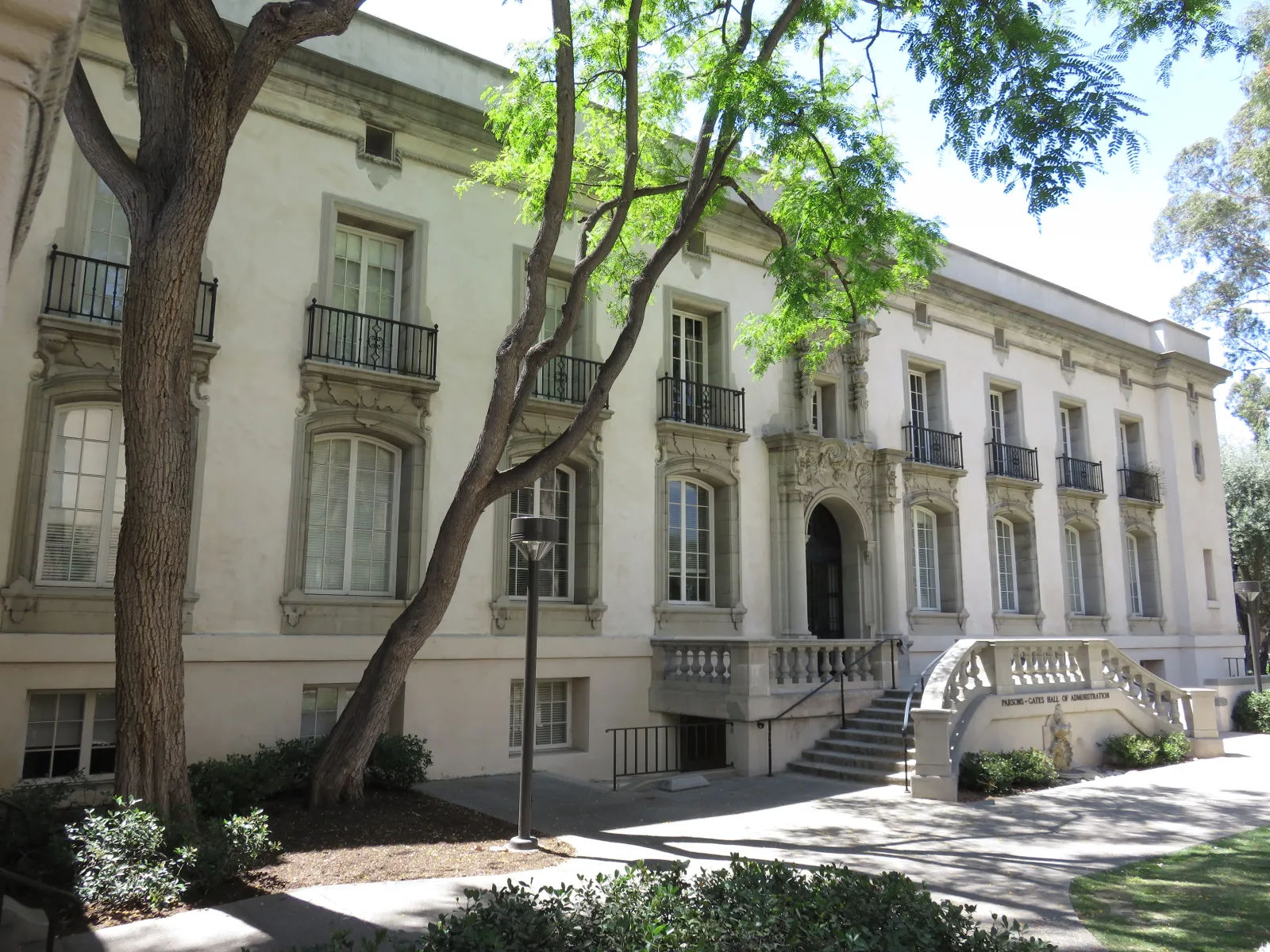

California Institute of Technology
Pasadena, California, United States · Established 1891
Official website ↗Total Students
2,400
Student:Faculty
3:1
Setting
Suburban
Overview
Caltech traces its roots to a small vocational school founded in Pasadena in 1891 (Throop University, later Throop College of Technology), which was reshaped into a serious science and engineering institute in the 1910s and 1920s under figures including astronomer George Ellery Hale, chemist Arthur Amos Noyes, and physicist Robert Millikan, and renamed the California Institute of Technology in 1920. Today it is a deliberately small, STEM-only research university: roughly 1,000 undergraduates and 1,400 graduate students share a compact Pasadena campus, giving Caltech one of the lowest student-faculty ratios and highest research-output-per-student figures of any US university. There are no undergraduate majors in business, law, or the humanities in the professional-school sense — Caltech organizes itself into six academic divisions (Biology and Biological Engineering; Chemistry and Chemical Engineering; Engineering and Applied Science; Geological and Planetary Sciences; Humanities and Social Sciences; and Physics, Mathematics and Astronomy), and even Caltech's Division of the Humanities and Social Sciences exists primarily to support scientists and engineers with a well-rounded education rather than to grant standalone humanities degrees to non-scientists. Caltech manages NASA's Jet Propulsion Laboratory (JPL) under contract, and its faculty and alumni have been central to discoveries from the structure of DNA's chemical bonds (Linus Pauling) to the detection of gravitational waves (Kip Thorne, LIGO) and the invention of the integrated-circuit-scale thinking behind Moore's Law (Gordon Moore). Undergraduate life at Caltech centers on a distinctive House system — eight small residential Houses, each with its own culture and traditions, similar in spirit to Oxbridge's colleges but built around a shared, famously rigorous core curriculum (all undergraduates take a common set of math, physics, and chemistry classes regardless of eventual major) rather than a separate academic track per House. The undergraduate acceptance rate sits below 4% for recent classes, among the lowest of any US university, and admitted students' SAT/ACT scores cluster extremely close to the maximum. For prospective IELTS/TOEFL candidates, Caltech applies one consistent English-proficiency bar at both undergraduate and graduate level (IELTS 7.0 or TOEFL 100 minimum, tests not required for tests taken/degrees earned in a country where English is the primary language of instruction), applies via the Common Application or QuestBridge at undergraduate level (not a Caltech-specific portal), and — unusually among elite US private universities — is need-aware rather than need-blind for international undergraduate applicants because Caltech's international financial-aid budget is limited; admitted international students who are offered aid have that need fully met, but requesting aid can be a factor in a borderline admission decision, and aid must be requested with the initial application.
Rankings
Times Higher Education (THE) World University Rankings · Overall (Global)
#7 (2026)
US News Best Global Universities · Overall (Global)
#23 (2026)
Admissions, Requirements & Costs
Requirements, deadlines, and test-score cutoffs differ significantly between undergraduate and graduate/Master's programs — shown separately below.
Undergraduate
Acceptance Rate
3.78%
Application Fee
$85
Documents required: Common Application or QuestBridge Application, School report from counselor, Official transcripts (grades 9-11), Mid-Year Report, Two teacher recommendation letters (one STEM, one humanities/social sciences), SAT or ACT scores (required, unlike many US peers that have gone test-optional), AP/IB scores if taken, English proficiency scores (IELTS/TOEFL/Duolingo) for international applicants who don't qualify for a waiver
| Term | Deadline | Type |
|---|---|---|
| Fall | November 1 (Restrictive Early Action) | Early Action |
| Fall | January 4 | Regular Decision |
Test Scores
SAT Range
1540–1580
ACT Range
35–36
IELTS Minimum
7
TOEFL Minimum
100 (5 new scale)
IELTS notes: Overall minimum of 7, with a per-section minimum of 7 as well (i.e. no single component may fall below the overall requirement).
TOEFL notes: For tests taken before January 21, 2026 (0-120 scale): overall 100, with a per-section minimum of 25. For tests taken on or after January 21, 2026, on ETS's new 1-6 CEFR-aligned scale: overall 5, per-section minimum 5.
TOEFL scores shown as: legacy 0–120 scale (new 1.0–6.0 CEFR-aligned scale, effective Jan 2026).
Accepted tests: IELTS, TOEFL, Duolingo English Test
Waiver: Required of all international applicants unless the applicant's native language is English or English was the primary language of instruction at their secondary school.
Tuition (Intl.)
$71,229
Tuition (Domestic)
$71,229
Living Expenses/yr
$27,393
Total Cost of Attendance
$98,622
Scholarships
Caltech Institutional Need-Based Grant Aid
Varies by demonstrated need; can cover tuition, housing, dining, books, fees, and personal expenses in full for the most financially need-based cases
Caltech's core undergraduate financial aid program, meeting 100% of demonstrated financial need for every admitted student who is offered aid, with no loans in the standard aid package. Families earning under roughly $100,000/year are generally not expected to pay tuition or fees.
Eligibility: Available to admitted undergraduates who apply for aid with their initial application; Caltech is need-aware (not need-blind) for international applicants because international aid funding is limited, and aid must be requested at first application — students who don't request aid as first-years generally cannot request it later in their Caltech career
Popular Programs
Gabble Prep Insights
Where applicants lose points: Writing carries outsized weight for Caltech applicants relative to peer STEM schools, since the Common Application essays and Caltech-specific short-answer prompts are the main non-quantitative signal in a review process where nearly every applicant already has a near-perfect SAT/ACT math score and a demonstrated record of independent research or competition results.
International applicants strong in STEM coursework typically clear Reading and Listening comfortably, since Caltech's own coursework assumes fluent technical English from day one; Writing is the section most likely to sit closest to the 7.0/100 floor, particularly for applicants whose secondary schooling emphasized problem sets over long-form academic writing.
SAT range (1540-1580) and acceptance rate (3.78%, 427 admitted of 11,285 applicants) are Caltech's own published Class of 2029 figures. The ACT middle-50% range (35-36) is not confirmed from a single live-fetched official Caltech page in this research pass — it is drawn from third-party aggregation of Caltech's Common Data Set and should be treated as approximate. Cost of attendance figures (tuition $68,574 + fees $2,655 + housing $12,711 + food $9,285 + books $1,428 + personal $3,969 = $98,622 total) are Caltech's own official 2026-27 on-campus estimate, excluding the optional $5,388 student health insurance plan. Caltech does not publish one official aggregate international-student headcount/percentage on the pages checked in this pass, so internationalStudents/internationalPercentage are left null rather than estimated.
Recommended prep timeline: 10 weeks
Graduate (Master's & PhD)
Application Fee
$100
Documents required: Statement of purpose, Three letters of recommendation, Official transcripts from all institutions attended, CV/resume, GRE General Test scores — policy varies significantly by program/option; e.g. required by the Chemistry and Chemical Engineering option and some Humanities and Social Sciences PhD programs, not required by many others, always check the specific option's page, English proficiency scores (IELTS/TOEFL) for applicants without a degree from an English-medium institution
| Term | Deadline | Type |
|---|---|---|
| Fall | December 1 to December 15, varies by academic division/option; Caltech admits for Fall entry only | Regular Decision |
Test Scores
IELTS Minimum
7
TOEFL Minimum
100 (5 new scale)
IELTS notes: Same overall standard as undergraduate: 7.0 minimum, not formally required for admission decisions in every case but expected as evidence of strong English capability for applicants without an English-medium degree.
TOEFL notes: Same as undergraduate: 100 overall on the legacy 0-120 scale (before January 21, 2026) or 5 overall on ETS's new 1-6 CEFR-aligned scale (tests taken on/after that date).
TOEFL scores shown as: legacy 0–120 scale (new 1.0–6.0 CEFR-aligned scale, effective Jan 2026).
Accepted tests: IELTS, TOEFL
Waiver: Not formally required for admission for applicants whose native language is English or who hold a degree from an institution where English is the primary language of instruction; self-reported scores are otherwise expected as evidence of English capability rather than enforced as a hard pass/fail bar.
Tuition (Intl.)
$71,022
Tuition (Domestic)
$71,022
Living Expenses/yr
$31,774
Total Cost of Attendance
$102,796
Scholarships
Guaranteed PhD Funding Package
Full tuition and fees plus a 12-month stipend, increasing to $50,000/year effective September 1, 2026
Every PhD student in good academic standing is offered financial support covering full tuition and mandatory fees plus a living stipend, sourced from a mix of fellowships, teaching assistantships, and research assistantships, for as long as they remain enrolled full-time and make satisfactory progress.
Eligibility: Automatic for admitted PhD students; work authorization is generally required since most funding sources are compensation-based, so matriculation typically requires evidence of work authorization
Popular Programs
Gabble Prep Insights
Where applicants lose points: Writing is the main non-technical differentiator in a Caltech PhD application, since the statement of purpose has to convincingly connect an applicant's research background to a specific faculty advisor's work in a famously small, lab-fit-driven admissions process.
Applicants from strong research backgrounds typically clear Reading and Listening easily; gaps more often show up in Speaking during faculty interviews (common for competitive options like Physics and Chemical Engineering) than on the English test itself.
Tuition and fees figure ($71,022) and the incoming Sept 2026 stipend rate ($50,000/12 months) are Caltech Graduate Studies Office's own published 2026-27 figures. Living expenses ($31,774) use Caltech's own 2025-26 estimated 4-bedroom shared on-campus housing budget (housing/utilities, food, books, insurance, personal expenses) as a representative single-student figure, since a more current 2026-27 breakdown was not found in this research pass and Caltech states its stipend is specifically designed to cover this cost. GRE policy is option-specific (required by some, e.g. Chemistry and Chemical Engineering and some Humanities and Social Sciences PhD programs; not required by many others) rather than one university-wide rule, so gre.required is left false at the general level with this note rather than asserting a single policy; no official minimum/average GRE or GMAT score is published, so those fields are left null. Caltech does not publish one official aggregate graduate acceptance rate, so that field is left null rather than estimated.
Recommended prep timeline: 8 weeks
Programs Offered
BS in Physics
Undergraduate · 4 yr · $71,229/yr
BS in Chemical Engineering
Undergraduate · 4 yr · $71,229/yr
BS in Computer Science
Undergraduate · 4 yr · $71,229/yr
BS in Mechanical Engineering
Undergraduate · 4 yr · $71,229/yr
PhD in Physics
PhD · 5 yr · $71,022/yr
PhD in Chemical Engineering
PhD · 5 yr · $71,022/yr
Campus Life
With only about 1,000 undergraduates, Caltech's social life is unusually concentrated around its eight residential Houses, which students join through a mutual-selection process called Rotation rather than a lottery, and where most students live for all four years rather than moving off-campus. Because the university is so small and STEM-focused, clubs and student life tend to be technical and project-driven (robotics, rocketry, hackathons) rather than built around a large Greek or big-sports culture; Caltech competes in NCAA Division III athletics, a notably lower-profile athletic tier than most peer research universities. The Honor Code ("No member of the Caltech community shall take unfair advantage of any other member of the Caltech community") underpins an unusually high-trust academic culture, including take-home, unproctored exams in many courses.
Notable clubs: The eight undergraduate Houses (Avery, Blacker, Dabney, Fleming, Lloyd, Page, Ricketts, Ruddock) — Caltech's distinctive residential system, central to undergraduate social life, Caltech Y — the university's main student-run community-service and outdoor-programs organization, The California Tech — Caltech's student newspaper, ASCIT (Associated Students of the California Institute of Technology) — undergraduate student government, Numerous small technical clubs (robotics, rocketry, competitive programming) reflecting the STEM-only student body
Outcomes
Undergraduate
Graduate
Notable Alumni
Kip Thorne — 2017 Nobel Prize in Physics for the LIGO detection of gravitational waves; earned his BS in Physics from Caltech in 1962
Gordon Moore — Co-founder of Intel and formulator of "Moore's Law"; earned his PhD in Chemistry from Caltech in 1954
Linus Pauling — Only person to win two unshared Nobel Prizes (Chemistry, 1954; Peace, 1962); earned his PhD in Chemistry from Caltech in 1925
Frank Capra — Academy Award-winning film director (It's a Wonderful Life, It Happened One Night); graduated from Caltech (then Throop College of Technology) in 1918
Visa Interview Prep
Caltech is SEVP-certified and its international student office supports F-1 visa applicants across undergraduate and graduate programs. Because Caltech is need-aware rather than need-blind for international undergraduates, applicants planning to rely on institutional aid to fund their I-20/visa financial documentation should request aid at first application, since aid generally cannot be requested for the first time in a later year. As with other US institutions, applicants should start the SEVIS fee payment, I-20, and embassy interview process as early as possible given known visa-appointment backlogs in some countries.
- Clarity on the specific research area/lab and why Caltech specifically, given its small, research-intensive scale
- Demonstrating strong ties and credible intent to return home after studies
- Financial sufficiency and clear documentation of funding sources (especially important given Caltech's need-aware international undergraduate aid policy)
- Consistency between academic/research background and chosen field of study
FAQs
What IELTS or TOEFL score do I need to apply to Caltech?
Caltech applies the same minimum at both undergraduate and graduate level: IELTS 7.0 overall (with no component below 7) or TOEFL 100 overall on the legacy 0-120 scale (5 overall on ETS's new 1-6 CEFR-aligned scale for tests taken from January 21, 2026 onward). Duolingo is also accepted at undergraduate level, with a minimum of 130. The requirement is waived if your native language is English or your secondary/degree instruction was primarily in English.
How competitive is Caltech admission?Undergrad
Extremely. Caltech's own published Class of 2029 figures show 427 students admitted from 11,285 applicants, a 3.78% acceptance rate — among the lowest of any US university — and the middle 50% SAT range for admits runs 1540-1580, with the math section clustering almost entirely at 790-800.
Is Caltech need-blind for international applicants?Undergrad
No — Caltech is need-aware (not need-blind) specifically for international undergraduate applicants, because its international financial-aid budget is limited, unlike its need-blind policy for domestic applicants. Once admitted, international students who are offered aid have 100% of demonstrated need met with no loans, but aid must be requested with the initial application; you generally cannot request aid for the first time in a later year at Caltech.
Does Caltech require the SAT or ACT?Undergrad
Yes — unlike many peer US universities that have gone test-optional, Caltech requires either SAT or ACT scores from all first-year applicants. The middle 50% range for recently admitted students is 1540-1580 on the SAT and roughly 35-36 on the ACT.
Is the GRE required for a Caltech PhD?Grad
It depends on the specific academic option (department). Some, like Chemistry and Chemical Engineering and certain Humanities and Social Sciences PhD programs, do require the GRE General Test; many others do not. Caltech does not have one single university-wide GRE policy, so always confirm with your target option's admissions page.
Is a Caltech PhD fully funded for international students?Grad
Yes. Every PhD student in good academic standing — domestic or international — is guaranteed financial support covering full tuition and mandatory fees plus a living stipend (rising to $50,000 for 12 months from September 1, 2026), funded through fellowships, teaching assistantships, and research assistantships. Because most funding sources are compensation-based, matriculation generally requires evidence of work authorization.
What makes Caltech's House system different from a typical dorm?Undergrad
Caltech's roughly 1,000 undergraduates are sorted into one of eight residential Houses through a mutual-selection process called Rotation (not a random lottery), and most students live in their House for all four years. Each House has its own distinct culture and traditions, similar in spirit to a small Oxbridge college, though academics remain centralized through Caltech's shared core curriculum rather than House-specific teaching.
What is Caltech's Honor Code?
"No member of the Caltech community shall take unfair advantage of any other member of the Caltech community." It underpins an unusually high-trust academic culture, including take-home, unproctored exams in many courses, and is central to Caltech's student self-governance.