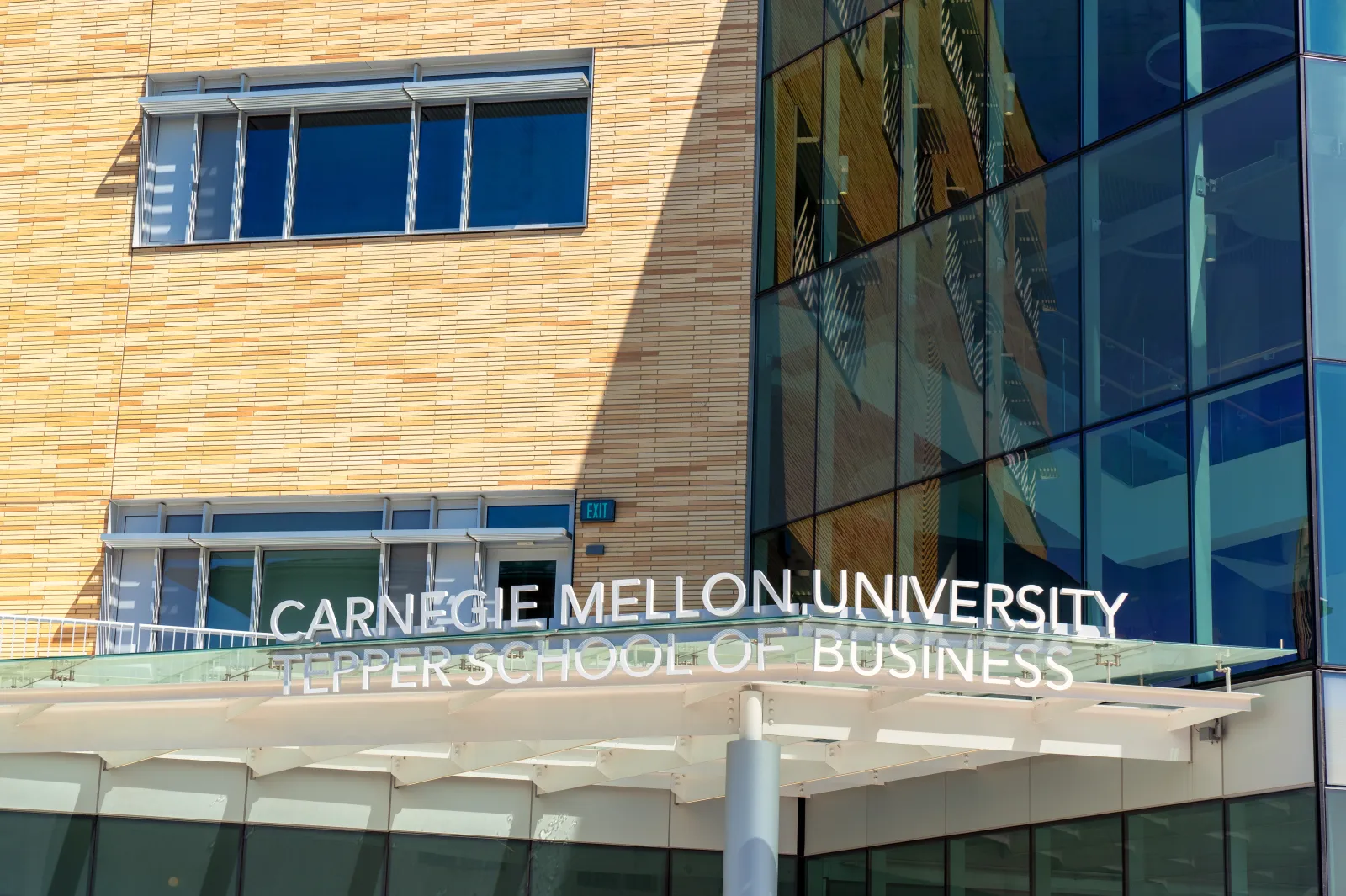

Carnegie Mellon University
Pittsburgh, Pennsylvania, United States · Established 1900
Official website ↗Total Students
16,676
Setting
Urban
Overview
Carnegie Mellon University was founded in 1900 by industrialist Andrew Carnegie as the Carnegie Technical Schools, a vocational institute for the sons and daughters of Pittsburgh's working class, and merged in 1967 with the Mellon Institute of Industrial Research (funded by the Mellon banking family) to form the university's present name and structure. From those practical, industry-facing roots, CMU grew into one of the most research-intensive universities in computing and the arts specifically: its School of Computer Science is consistently ranked among the top two or three CS programs in the world, its College of Fine Arts trains actors, designers, and musicians alongside engineers on the same Pittsburgh campus, and its Tepper School of Business, College of Engineering, and Dietrich College of Humanities and Social Sciences round out a university that deliberately blends technical and creative disciplines more than most peer research universities. CMU enrolled roughly 16,700 students as of the most recently reported figures, split close to evenly between undergraduate (about 7,700) and graduate (about 8,900) — an unusually large graduate population relative to undergraduate size, driven by the scale of its master's programs in computer science, engineering, and business. Selectivity varies enormously by school: CMU's own admissions office describes acceptance rates ranging from as low as roughly 3% for the School of Drama to roughly 30% for the School of Architecture, so a single university-wide acceptance rate understates how competitive specific programs (especially Computer Science and Drama) actually are. The university's Scottish heritage (from Carnegie's own background) shows up in its tartan-plaid branding, the Kiltie Band, and Scotty the Scottie Dog mascot, alongside student traditions like the annual Spring Carnival Buggy race. For prospective IELTS/TOEFL candidates, CMU applies a single, comparatively high general English-proficiency floor to international applicants (IELTS 7.5, TOEFL 102 on the legacy scale) that sits above what most peer US universities require, uses the Common Application (not a CMU-specific undergraduate portal) with a binding Early Decision option, and — distinctively among elite US private universities — does not offer any need-based financial aid to international undergraduate students, so international families should budget for the full cost of attendance. Graduate admissions at CMU are fully decentralized: each school and department runs its own admissions process, deadlines, and English-proficiency/GRE policy, so applicants should always confirm requirements directly with their target program rather than assume one university-wide rule.
Rankings
US News National Universities · Overall (tied)
#20 (2026)
Times Higher Education (THE) World University Rankings · Overall (Global)
#24 (2026)
Admissions, Requirements & Costs
Requirements, deadlines, and test-score cutoffs differ significantly between undergraduate and graduate/Master's programs — shown separately below.
Undergraduate
Acceptance Rate
11%
Documents required: Common Application, School Report and counselor recommendation, Official transcripts, Two teacher recommendation letters, SAT or ACT scores, Program-specific supplements (e.g. portfolio for design/art, audition for drama/music, additional essays by college), English proficiency scores (IELTS/TOEFL/TOEFL Essentials/Duolingo/Cambridge English) for international applicants who don't qualify for a waiver
| Term | Deadline | Type |
|---|---|---|
| Fall | November 2 (Early Decision, binding); December 1 for the School of Drama and School of Music | Early Decision |
| Fall | January 4 | Regular Decision |
Test Scores
SAT Range
1490–1570
ACT Range
34–35
IELTS Minimum
7.5
TOEFL Minimum
102 (5 new scale)
IELTS notes: Minimum overall band of 7.5, with subscores of 7.5 or above expected across components.
TOEFL notes: For tests before January 21, 2026 (0-120 scale): overall 102, with per-section subscores of 25 or above. For tests on/after that date, on ETS's new 1-6 CEFR-aligned scale: overall 5, with per-section subscores of 5 or above.
TOEFL scores shown as: legacy 0–120 scale (new 1.0–6.0 CEFR-aligned scale, effective Jan 2026).
Accepted tests: IELTS Academic, TOEFL iBT, TOEFL Essentials, Duolingo English Test, Cambridge English
Waiver: International students must meet the same undergraduate admission requirements and posted deadlines as domestic applicants; CMU does not publish a specific English-proficiency waiver policy on the pages checked in this research pass, unlike some peers that explicitly exempt applicants from English-medium schools.
Tuition (Intl.)
$71,564
Tuition (Domestic)
$71,564
Living Expenses/yr
$22,050
Total Cost of Attendance
$93,614
Popular Programs
Gabble Prep Insights
Where applicants lose points: Writing carries real weight for CMU applicants because of the volume of program-specific supplemental essays (each of CMU's seven colleges asks its own additional questions on top of the Common App essay), and for creative programs like Drama and Design, a portfolio or audition adds a further non-test dimension applicants must prepare for in English.
Applicants to CMU's most quantitative programs (Computer Science, Engineering) typically post strong Reading/Listening scores, but international applicants sometimes underestimate how much Writing matters given CMU's unusually high 7.5 IELTS / 102 TOEFL floor relative to peer US privates.
Acceptance rate (11%, class of 2026: 3,873 admitted of 34,261 applicants) and the SAT/ACT middle-50% ranges (SAT 1490-1570 combining the 720-770 EBRW and 770-800 Math bands; ACT 34-35) are drawn from Wikipedia's aggregation of CMU's own reported figures, not a live-fetched official CMU class-profile page — a specific up-to-date official page could not be reached in this research pass. CMU's own admissions materials state that per-school acceptance rates range from roughly 3% (School of Drama) to roughly 30% (School of Architecture), so the 11% headline figure masks large program-level variation. Cost of attendance figures (tuition $69,702 + mandatory fees $1,862 = $71,564; total resident cost of attendance $93,614, which is CMU's own official 2026-27 figure inclusive of housing, food, books, and estimated loan fees) come from CMU's Student Financial Services office. CMU's international-applicants page explicitly states CMU does not offer financial aid to international students, so scholarships is left empty and needBasedAvailableForInternational is false rather than assumed true as with most peer files in this dataset. Application fee could not be confirmed from an accessible official page in this research pass and is left null rather than estimated.
Recommended prep timeline: 12 weeks
Graduate (Master's & PhD)
Documents required: Statement of purpose (program-specific requirements vary), Letters of recommendation, Official transcripts from all institutions attended, CV/resume, English proficiency scores (IELTS/TOEFL) unless waived, GRE or GMAT scores — policy set independently by each school/department; not one university-wide rule
| Term | Deadline | Type |
|---|---|---|
| Varies by program (commonly Fall, some Spring) | Fully decentralized — each of CMU's schools and departments (School of Computer Science, College of Engineering, Tepper School of Business, etc.) sets its own deadlines independently | Rolling |
Test Scores
IELTS Minimum
7.5
TOEFL Minimum
102 (5 new scale)
IELTS notes: CMU's general international-applicant English-proficiency floor (7.5 overall IELTS) applies broadly, but because graduate admissions is run independently by each school and department, individual graduate programs may set their own additional or different requirements — always confirm with the specific program.
TOEFL notes: Same general floor as undergraduate: 102 overall (legacy 0-120 scale, tests before January 21, 2026) or 5 overall (new 1-6 CEFR-aligned scale, tests from that date). Individual graduate programs may publish their own separate requirement.
TOEFL scores shown as: legacy 0–120 scale (new 1.0–6.0 CEFR-aligned scale, effective Jan 2026).
Accepted tests: IELTS Academic, TOEFL iBT, TOEFL Essentials, Duolingo English Test, Cambridge English
Waiver: Not specified on a single university-wide page in this research pass; CMU's decentralized graduate admissions model means waiver policy, where it exists, is typically set at the department/program level.
Scholarships
PhD funding (departmental)
Varies by department; not a single university-wide figure
CMU states that PhD students are "at least partially funded," with the specific structure (teaching assistantship, research assistantship, fellowship, or a combination) varying by department and program.
Eligibility: Determined at the departmental level as part of PhD admission; international PhD students are generally eligible on the same basis as domestic students, but exact terms vary by program
Popular Programs
Gabble Prep Insights
Where applicants lose points: Writing matters most for the statement of purpose and, for research-focused programs, matching a specific faculty advisor's work — a research-fit-driven admissions process similar to other technical-PhD-heavy universities.
Not enough program-specific data was confirmed in this research pass to generalize a common score gap across CMU's decentralized graduate programs.
Because CMU's graduate admissions are run independently by each of its seven schools/colleges rather than through one central process, this dataset could not confirm a single official university-wide graduate acceptance rate, application fee, tuition figure, or cost-of-attendance figure in this research pass — all are left null rather than estimated or blended from unrelated program-specific figures. GRE/GMAT requirements are set independently by department (for example, the Tepper MBA and some Computer Science programs have their own distinct policies), so gre.required/gmat.required are left false at the general level with this note rather than asserting one rule; no official minimum/average score is published at the university level, so those fields are left null. Applicants should always confirm exact costs, deadlines, and test requirements directly with their target department.
Recommended prep timeline: 10 weeks
Programs Offered
BS in Computer Science
Undergraduate · 4 yr · $71,564/yr
BS in Electrical and Computer Engineering
Undergraduate · 4 yr · $71,564/yr
BS in Business Administration
Undergraduate · 4 yr · $71,564/yr
BFA in Drama
Undergraduate · 4 yr · $71,564/yr
Master of Science in Computer Science
Masters · 2 yr
MBA
Masters · 2 yr
PhD (various departments)
PhD · 5 yr
Campus Life
CMU's Pittsburgh campus blends a technical, project-heavy student culture (frequent hackathons, robotics competitions, and case competitions tied to the School of Computer Science and Tepper School of Business) with a strong creative-arts presence from the College of Fine Arts, including student-run theater (Scotch'n'Soda) and a cappella and dance groups. Spring Carnival, held every April, is CMU's signature tradition, centered on the Sweepstakes "Buggy" race (a decades-old gravity-cart race down a campus hill) alongside a midway of student-built games and booths. Athletically, CMU competes in NCAA Division III as part of the University Athletic Association, a lower-profile tier reflecting the university's primary emphasis on academics and research over varsity sports.
Notable clubs: The Kiltie Band — CMU's Scottish-tartan-uniformed marching band, tied to the university's Andrew Carnegie-linked Scottish heritage, Spring Carnival and the Sweepstakes "Buggy" race — a decades-old CMU tradition combining student-built gravity racers with fraternity/sorority and club team competition, The Tartan — CMU's student newspaper, Scotch'n'Soda Theatre — CMU's century-old student-run musical theater company, Numerous hackathon, robotics, and case-competition clubs reflecting CMU's engineering/CS and business strengths
Outcomes
Undergraduate
Graduate
Notable Alumni
Andy Warhol — Leading figure of the pop art movement; graduated from Carnegie Institute of Technology (CMU's predecessor) in 1949
James Gosling — Computer scientist known as the creator of the Java programming language; earned his PhD from CMU in 1983
Charles Geschke — Co-founder of Adobe Inc.; earned his PhD from CMU in 1973
David Tepper — Founder of Appaloosa Management and owner of the NFL's Carolina Panthers; earned his MS from CMU (Tepper School of Business, named after his donation) in 1982
Ted Danson — Emmy Award-winning actor best known for Cheers; graduated from CMU's School of Drama in 1972
Visa Interview Prep
CMU is SEVP-certified and its Office of International Education supports F-1 visa applicants across undergraduate and graduate programs. Because CMU does not offer financial aid to international undergraduates, applicants and families should have full-cost-of-attendance financial documentation ready well before the visa interview stage. As with other US institutions, applicants should start the SEVIS fee payment, I-20, and embassy interview process as early as possible given known visa-appointment backlogs in some countries.
- Clarity on the specific program and why CMU over other options
- Demonstrating strong ties and credible intent to return home after studies
- Financial sufficiency and clear documentation of funding sources — especially important given CMU does not offer financial aid to international undergraduates
- Consistency between academic background and chosen field of study
FAQs
What IELTS or TOEFL score do I need to apply to CMU?
CMU's general international-applicant floor is IELTS 7.5 overall or TOEFL iBT 102 overall (5 overall on ETS's new 1-6 CEFR-aligned scale for tests taken from January 21, 2026 onward) — notably higher than what many peer US universities require. TOEFL Essentials (minimum 11), Duolingo (minimum 135), and Cambridge English (minimum 191) are also accepted.
Does CMU offer financial aid to international students?Undergrad
No — CMU explicitly states it does not offer financial aid to international undergraduate students, unlike most elite US private universities. International applicants and their families should budget to cover the full cost of attendance (roughly $93,600/year including tuition, fees, housing, and food for 2026-27).
How competitive is CMU, and does it vary by program?Undergrad
CMU's overall undergraduate acceptance rate is around 11%, but this varies enormously by school — CMU's own admissions materials describe rates ranging from roughly 3% for the School of Drama to roughly 30% for the School of Architecture. Computer Science, CMU's flagship program, is understood to be considerably more selective than the university-wide average.
Does CMU have Early Action, or only Early Decision?Undergrad
Only Early Decision, which is binding — if admitted, you're expected to enroll. The Early Decision deadline is November 2 (December 1 for the Schools of Drama and Music), with Regular Decision due January 4.
Is the GRE or GMAT required for CMU graduate programs?Grad
It depends entirely on the specific school and department, since CMU's graduate admissions are fully decentralized — each program (including the Tepper MBA and individual Computer Science programs) sets its own testing policy. There is no single university-wide GRE/GMAT rule, so always check with your target program.
Are CMU PhD students funded?Grad
CMU states that PhD students are "at least partially funded," typically through a combination of teaching assistantships, research assistantships, and fellowships, though the specific package varies by department. Applicants should confirm funding details directly with their target program, since CMU does not publish one university-wide PhD funding guarantee the way some peer universities do.
What is CMU's Scottish connection, and what is the Buggy race?
CMU's Scottish branding (tartan plaid, the Kiltie Band, Scotty the Scottie Dog mascot) traces to founder Andrew Carnegie's Scottish heritage. Spring Carnival, held every April, centers on the Sweepstakes "Buggy" race — a decades-old tradition where teams build and race small, human-powered/gravity carts down a hill on campus — alongside a student-run midway of games and booths.