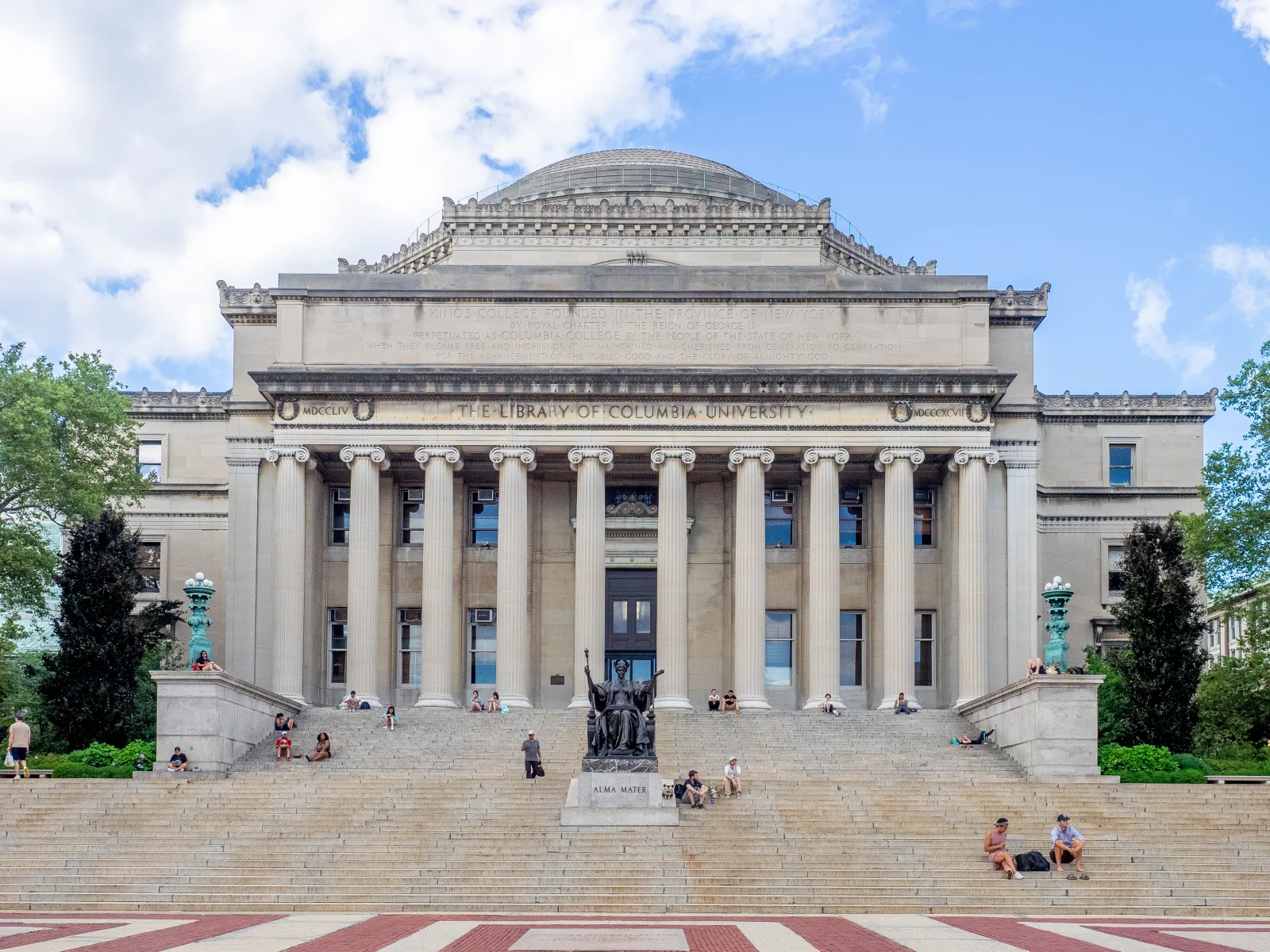

Columbia University
New York, New York, United States · Established 1754
Official website ↗Total Students
34,700
Intl. Students
31%
Student:Faculty
6:1
Setting
Urban
Overview
Columbia University, founded in 1754 as King's College under royal charter from King George II, is the oldest institution of higher education in New York State and the fifth-oldest in the United States, and a member of the Ivy League. Undergraduates apply to one of two schools -- Columbia College (liberal arts) or the Fu Foundation School of Engineering and Applied Science (SEAS) -- both of which share the university's signature Core Curriculum, a set of required humanities, literature, and science courses every undergraduate completes regardless of major. Columbia's Morningside Heights campus sits on the Upper West Side of Manhattan, giving students a genuinely urban, non-residential-college campus experience with the city itself functioning as an extension of classroom and internship life. Beyond Columbia College and SEAS, the university comprises 18 additional schools including the Graduate School of Arts and Sciences (GSAS), Columbia Business School, Columbia Law School, the School of International and Public Affairs (SIPA), and the Graduate School of Journalism, making it one of the most comprehensive research universities in the country. Columbia is a founding member of the Ivy League and is particularly well known for political science, journalism, international affairs, law, and its finance-adjacent programs, all of which benefit from proximity to Wall Street, the United Nations, and major media and publishing headquarters. For prospective international students, Columbia is one of the most selective universities in the US, admitting under 5% of applicants for its most recent undergraduate class, and international financial aid works differently than at need-blind peers like Harvard or Princeton: Columbia reviews international applicants on a need-aware basis (financial need can be a factor in the admission decision itself), though it meets 100% of demonstrated need, in grants rather than loans, for every international student it does admit. Graduate and professional school English-proficiency requirements, testing policy, and funding vary considerably by school -- GSAS sets an explicit TOEFL/IELTS bar, while Columbia Business School evaluates GMAT/GRE scores as part of a holistic MBA review -- so applicants should treat Columbia, like Harvard, as a federation of schools rather than one uniform set of graduate admissions rules.
Rankings
US News National Universities
#15 (2026)
Times Higher Education (THE) World University Rankings · Overall (Global)
#20 (2026)
QS World University Rankings by Subject · Law
#8 (2026)
Times Higher Education (THE) World University Rankings by Subject · Law
#4 (2026)
Admissions, Requirements & Costs
Requirements, deadlines, and test-score cutoffs differ significantly between undergraduate and graduate/Master's programs — shown separately below.
Undergraduate
Acceptance Rate
4.9%
Application Fee
$85
Documents required: Common Application or Coalition Application, Columbia-specific supplemental essays and short-answer questions, Secondary School Report and counselor recommendation, Two Teacher Recommendation Letters, Midyear School Report, Final School Report and official transcript, SAT or ACT scores (test-optional through the 2026-27 cycle, the final confirmed test-optional year), Application Fee or Fee Waiver Request
| Term | Deadline | Type |
|---|---|---|
| Fall | November 1 (Early Decision, binding) | Early Decision |
| Fall | January 1 | Regular Decision |
Test Scores
SAT Range
1510–1560
ACT Range
34–36
IELTS Minimum
7.5 (Gabble rec. 7.5)
TOEFL Minimum
100 (5 new scale) · Gabble rec. 100 (5 new scale)
TOEFL notes: Columbia states this as TOEFL iBT 5.5 on the new 1-6, CEFR-aligned scale ETS introduced for tests taken on or after 21 January 2026; on the legacy 0-120 scale used throughout this dataset, that corresponds to a score in roughly the 107-113 band, so 100 (the previously published legacy-scale minimum) is shown here as a conservative reference point -- confirm the current official figure on Columbia's English Proficiency Requirements page before relying on either scale.
TOEFL scores shown as: legacy 0–120 scale (new 1.0–6.0 CEFR-aligned scale, effective Jan 2026).
Accepted tests: IELTS Academic, TOEFL iBT, Duolingo English Test, Cambridge English (C1 Advanced / C2 Proficiency)
Waiver: Waived if the primary language of instruction for your secondary education was English, if you have completed at least two semesters of English composition coursework at an accredited US, UK, Australian, Canadian, or New Zealand institution, or if you are a citizen of a recognized English-speaking country.
Tuition (Intl.)
$72,800
Tuition (Domestic)
$72,800
Living Expenses/yr
$26,974
Total Cost of Attendance
$99,774
Scholarships
Columbia need-based grant aid
Varies by demonstrated need; can cover up to full cost of attendance
Columbia meets 100% of demonstrated financial need for every admitted first-year and transfer student, domestic or international, entirely through grants and student work -- no loans are included in the initial aid package.
Eligibility: Available to admitted first-year and transfer students who apply for aid; international applicants are reviewed need-aware (financial need can factor into the admission decision itself), unlike domestic need-blind review
Columbia Global Scholars Program
Varies by award
A merit-linked scholars program within the Columbia Undergraduate Scholars Program specifically oriented toward international students, providing community, mentoring, and programming alongside financial support.
Eligibility: International first-year applicants identified through the standard admissions process; no separate application required
Popular Programs
Gabble Prep Insights
Where applicants lose points: Since Columbia remains test-optional through 2026-27, the highest-leverage preparation is the Common Application essay and Columbia's own supplemental short-answer questions (including the distinctive Columbia-specific list-based questions), which are scrutinized closely under an acceptance rate below 5%.
International applicants who do submit English test scores tend to be strong on Reading and Listening but should not assume a high IELTS/TOEFL score meaningfully offsets a weaker overall academic and essay profile -- Columbia's review is holistic, and the English test is a threshold requirement, not a differentiator, for the majority of applicants who clear it comfortably.
Figures above reflect Columbia College and SEAS combined, using the final Class of 2029 acceptance rate (4.9%, 2,946 admits from roughly 60,000 applications) rather than the earlier 4.29% Ivy Day figure, since additional offers were made after the initial release. Tuition is calculated from the published 2026-27 per-term rate (USD 36,400 x 2 terms); total cost of attendance (USD 99,774) and the derived living-expenses figure are Columbia's own published sticker-price estimate and will differ from a student's actual aid-adjusted cost. Columbia's official English Proficiency Requirements page (undergrad.admissions.columbia.edu) could not be fetched directly during this update due to the site blocking automated access; the IELTS 7.5, TOEFL, and Duolingo 135 figures are cross-referenced from multiple third-party sources citing that same official page and should be reconfirmed directly before relying on them.
Recommended prep timeline: 10 weeks
Graduate (Master's & PhD)
Application Fee
$125
Documents required: Statement of purpose, Academic transcripts from all institutions attended, Letters of recommendation (typically 2-3), GRE or GMAT scores (required for Columbia Business School's MBA; most GSAS PhD programs do not require either), TOEFL or IELTS scores (required by GSAS and most other schools unless waived), Resume/CV, Application fee or fee waiver request
| Term | Deadline | Type |
|---|---|---|
| Fall | Varies by school and program; GSAS deadlines typically fall between December and January, Columbia Business School runs several staged rounds through the admissions cycle | Regular Decision |
Test Scores
Avg. GMAT
734
IELTS Minimum
7.5 (Gabble rec. 7.5)
TOEFL Minimum
100 (5 new scale) · Gabble rec. 100 (5 new scale)
TOEFL notes: GSAS states this as TOEFL iBT 5.5 on ETS's new 1-6, CEFR-aligned scale for tests taken on or after 21 January 2026; 100 is the legacy 0-120 scale figure GSAS previously published. Scores are valid for two years from the test date.
TOEFL scores shown as: legacy 0–120 scale (new 1.0–6.0 CEFR-aligned scale, effective Jan 2026).
Accepted tests: IELTS Academic, TOEFL iBT
Waiver: Required of all international applicants whose native language is not English and whose undergraduate degree was not earned at an institution where English is the official language of instruction; other schools within Columbia (e.g. Columbia Business School) set their own, sometimes broader, waiver policies.
Tuition (Intl.)
$76,212
Tuition (Domestic)
$76,212
Living Expenses/yr
$31,773
Total Cost of Attendance
$107,985
Scholarships
GSAS PhD Funding Package
Full tuition plus fees and a living stipend for the funding period (typically 5 years)
Full funding package for GSAS PhD students covering tuition, mandatory fees, and a living stipend, funded through a mix of fellowships, teaching, and research assistantships; applies equally to domestic and international students, who also have their student visa-related fees covered.
Eligibility: Automatically provided to all admitted GSAS PhD students; not a separate application
Columbia Business School merit fellowships
Varies considerably, from partial to substantial tuition awards
A range of merit-based fellowships awarded to admitted MBA candidates, assessed automatically as part of the standard application review with no separate application required.
Eligibility: Automatically considered for all admitted MBA applicants
Popular Programs
Gabble Prep Insights
Where applicants lose points: Writing carries particular weight for graduate applicants across Columbia's social-science and journalism-adjacent programs, where a tightly argued statement of purpose and, for SIPA and Journalism, writing samples are scrutinized closely alongside academic record.
GSAS applicants who are strong on Reading and Listening sometimes underprepare Speaking for Columbia's seminar-heavy graduate teaching style, while Columbia Business School applicants -- who face a holistic, interview-inclusive process -- often need targeted practice on spontaneous, structured spoken reasoning rather than test-format speaking alone.
Because each Columbia graduate/professional school sets its own English-test policy, GRE/GMAT requirement, and score thresholds, applicants should confirm the exact rules for their target program rather than assume a university-wide standard. Graduate tuition and living-cost figures use GSAS's published 2026-27 cost of attendance (a representative MA/MSc program tuition rate and GSAS's own 9-month indirect-cost estimate) as the representative figure; professional schools including the MBA, JD, and MD set substantially different, generally higher, tuition. GMAT avgScore (734) reflects Columbia Business School's MBA Class of 2027 profile specifically, not a university-wide average; GSAS PhD applicants are generally not required to submit GRE scores at all.
Recommended prep timeline: 10 weeks
Programs Offered
BA in Political Science
Undergraduate · 4 yr · $72,800/yr
BA in Economics
Undergraduate · 4 yr · $72,800/yr
BS in Computer Science
Undergraduate · 4 yr · $72,800/yr
MBA
Masters · 2 yr · $137,571/yr
Master of International Affairs
Masters · 2 yr
JD
Certificate · 3 yr
PhD (various departments)
PhD · 5 yr
Campus Life
Columbia's Morningside Heights campus places students directly in Manhattan, so student life blends traditional campus organizations with the resources of New York City itself -- internships, cultural institutions, and a large alumni and professional network are all a subway ride away rather than a defining feature of the campus itself. With roughly 500 registered student organizations and NCAA Division I Ivy League athletics, students have a wide range of extracurricular options, and Columbia's large graduate and professional-school population (more than two-thirds of total enrollment) gives undergraduates unusually close proximity to law, business, journalism, and international-affairs programming most peer universities keep more separate.
Notable clubs: Columbia Daily Spectator (independent student newspaper), Columbia International Relations Council and Association (Model UN), Varsity Show (Columbia's annual student-written musical, running since 1894), Columbia University Marching Band, Columbia Political Union
Outcomes
Undergraduate
Graduation Rate
96%
Graduate
Notable Alumni
Barack Obama — 44th President of the United States; BA in Political Science from Columbia College, 1983
Alexander Hamilton — Founding Father and first US Secretary of the Treasury; attended King's College, Columbia's predecessor institution
Franklin D. Roosevelt — 32nd President of the United States; attended Columbia Law School
Warren Buffett — Investor and CEO of Berkshire Hathaway; MS in Economics from Columbia Business School
Lou Gehrig — Hall of Fame baseball player for the New York Yankees; attended Columbia College on an athletic scholarship
Visa Interview Prep
Columbia's International Students and Scholars Office (ISSO) issues Form I-20s and supports F-1 visa applicants across all of Columbia's schools. As with other high-volume US universities, applicants should begin the SEVIS/I-20 and embassy interview process as early as possible once they accept an offer, given known visa-appointment backlogs in some countries and the F-1 visa's standard in-person consular interview requirement.
- Clarity on the specific program and why Columbia specifically, over comparable options
- Demonstrating strong ties and credible intent to return home after studies
- Financial sufficiency and clear documentation of funding sources
- Consistency between academic background and chosen field of study
FAQs
What IELTS or TOEFL score do I need to apply to Columbia as an undergraduate?Undergrad
Columbia's published undergraduate minimums are IELTS Academic 7.5 or TOEFL iBT around the equivalent of 100 on the legacy scale (5.5 on ETS's new 1-6 scale for tests from 21 January 2026 onward), or Duolingo English Test 135. Waivers are available for applicants whose secondary education was taught in English, among other conditions -- confirm the current figures directly on Columbia's official English Proficiency Requirements page before applying.
Is Columbia need-blind for international applicants?Undergrad
No, unlike some Ivy League peers such as Harvard and Princeton, Columbia reviews international first-year applicants on a need-aware basis, meaning demonstrated financial need can be a factor in the admission decision itself. However, Columbia does meet 100% of demonstrated need, in grants rather than loans, for every international student it admits.
How competitive is Columbia for international applicants?
Very. Columbia's Class of 2029 was admitted at an overall rate of about 4.9% (2,946 admits from roughly 60,000 applications), among the lowest of any US university, though the initial Ivy Day release showed a slightly lower 4.29% before additional offers were made.
Does Columbia require the SAT or ACT?Undergrad
Columbia College and SEAS remain test-optional through the 2026-27 admissions cycle, the final confirmed year of that policy. Applicants who do submit scores had a middle-50% range of roughly 1510-1560 on the SAT and 34-36 on the ACT for recently enrolled classes.
Will I need to attend a visa interview to study at Columbia?
Yes. Columbia is SEVP-certified and issues Form I-20s for the F-1 student visa, which includes the standard US consular interview process. Columbia's International Students and Scholars Office (ISSO) supports applicants through this process, but interview scheduling and timelines are set by the US government, not the university.
Is the GRE or GMAT required for Columbia graduate programmes?Grad
It depends entirely on the school and program. Most GSAS PhD programs do not require the GRE at all, while Columbia Business School's MBA evaluates GMAT or GRE scores as part of a holistic review -- the Class of 2027 averaged a GMAT of 734. Always confirm the specific program's current testing policy.
What is Columbia's undergraduate tuition and total cost of attendance?Undergrad
For 2026-27, Columbia College tuition is USD 36,400 per term (USD 72,800/year), with a total published cost of attendance -- including housing, food, and other living costs -- of roughly USD 99,774/year before any financial aid is applied.
Can I get conditional admission to Columbia if my English score is below the requirement?
No. Columbia College, SEAS, and GSAS do not offer conditional admission or an English-language bridge program. If a program you're applying to sets a minimum English test score, you generally need to meet it, or qualify for an explicit waiver, at the time you apply.
What is Columbia's Core Curriculum, and does it affect international applicants differently?Undergrad
The Core Curriculum is a set of required humanities, literature, writing, and science courses every Columbia College (and, in a lighter form, SEAS) undergraduate completes regardless of major. It applies identically to international and domestic students and is frequently cited by admissions as central to what Columbia is looking for in an applicant's intellectual curiosity.
How many weeks should I spend preparing for IELTS or TOEFL before applying to Columbia?
A realistic window is 8-10 weeks of focused preparation, since Columbia's English-test bar (IELTS 7.5) sits meaningfully above the minimum many other US universities set, though well-prepared applicants with strong secondary English instruction often need less.