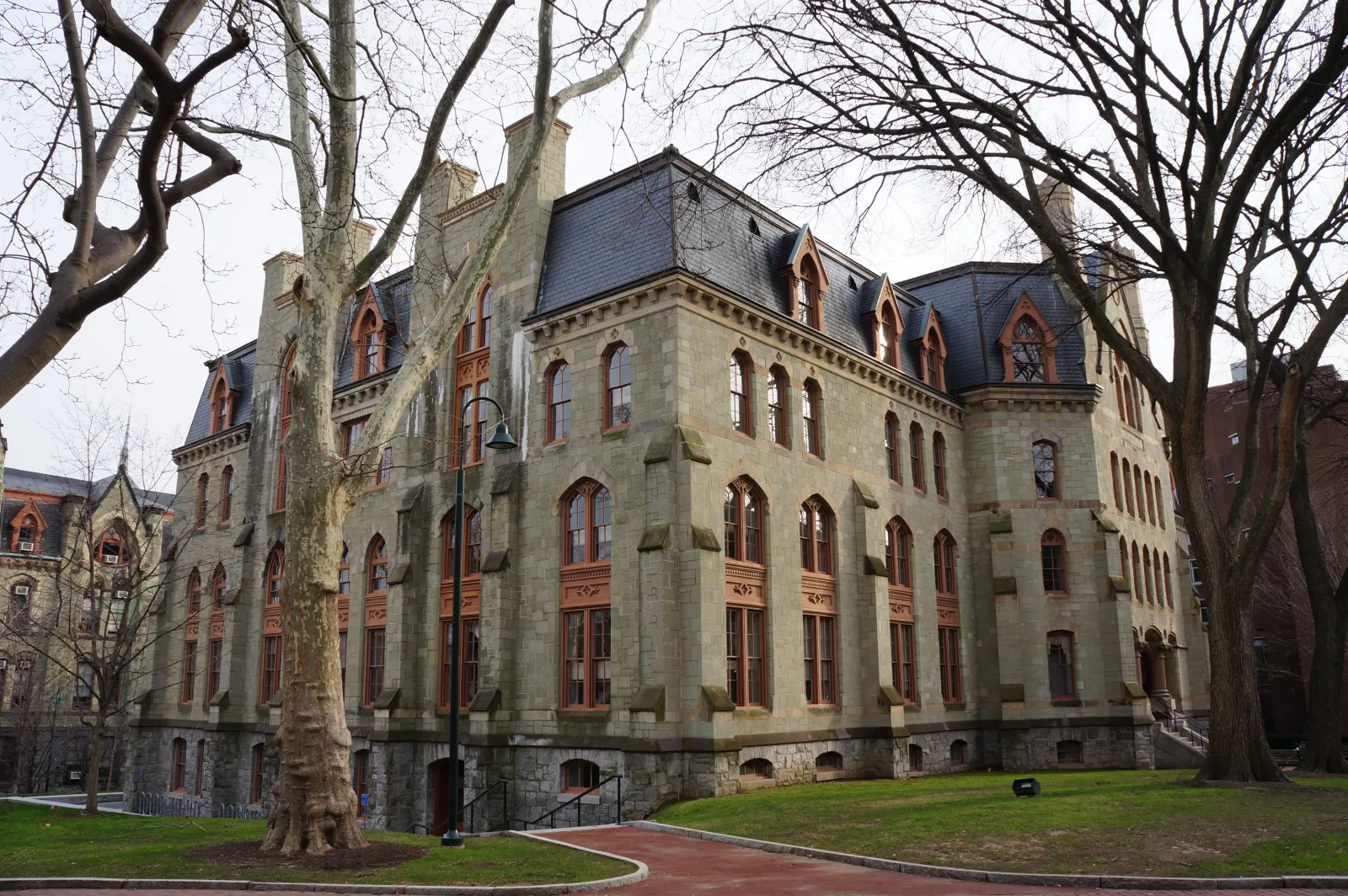

University of Pennsylvania
Philadelphia, Pennsylvania, United States · Established 1740
Official website ↗Total Students
29,384
Intl. Students
23%
Student:Faculty
8:1
Setting
Urban
Overview
The University of Pennsylvania is a private Ivy League research university in Philadelphia founded in 1740, with a claim to being the first American institution to describe itself as a university rather than a college. It is organized into four undergraduate schools -- the College of Arts and Sciences, the School of Engineering and Applied Science, the School of Nursing, and the Wharton School of business -- alongside twelve graduate and professional schools, which gives Penn an unusually integrated structure where undergraduates can combine coursework across business, engineering, nursing, and the liberal arts through dual-degree and cross-school programs. Penn is best known internationally for Wharton, the world's first collegiate business school, but it also carries deep strength in biomedical research, nursing, communication, and computer science, backed by one of the largest private-university research budgets and endowments in the country. For prospective international applicants, Penn combines an extremely low acceptance rate with a need-aware admissions process for non-citizens, though admitted international students who qualify for aid have their full demonstrated financial need met. The main campus sits in West Philadelphia along the Schuylkill River, a short walk or subway ride from Center City Philadelphia, giving students access to a major East Coast city while the campus itself remains compact, walkable, and largely self-contained. Penn enrolls a large international population across its undergraduate and graduate schools, supported by International Student and Scholar Services (ISSS) for visa, immigration, and cultural-adjustment guidance.
Rankings
US News National Universities
#7 (2026)
US News Best Global Universities · Overall (Global)
#17 (2026)
US News Best Business Programs · Undergraduate Business (Wharton)
#1 (2026)
US News Best Business Schools (MBA) · Graduate MBA (Wharton)
#2 (2026)
Admissions, Requirements & Costs
Requirements, deadlines, and test-score cutoffs differ significantly between undergraduate and graduate/Master's programs — shown separately below.
Undergraduate
Acceptance Rate
4.9%
Application Fee
$75
Documents required: Common Application or Coalition Application, Official Secondary School Transcript / School Report, Letters of Recommendation (teacher and counselor), Personal Essay and Penn-specific supplement, Standardized Test Scores (SAT or ACT), English Proficiency Test (TOEFL/IELTS/Duolingo) for non-exempt applicants, Mid-Year and Final School Reports
| Term | Deadline | Type |
|---|---|---|
| Fall | November 1 | Early Decision |
| Fall | January 5 | Regular Decision |
Test Scores
SAT Range
1510–1570
ACT Range
34–36
IELTS Minimum
7 (Gabble rec. 7.5)
TOEFL Minimum
100 (5 new scale) · Gabble rec. 105 (5 new scale)
TOEFL notes: No official per-section minimum is published, but Penn Admissions notes that the most competitive applicants show consistency across all four sections (reading, listening, speaking, writing) rather than a high composite propped up by one section.
TOEFL scores shown as: legacy 0–120 scale (new 1.0–6.0 CEFR-aligned scale, effective Jan 2026).
Accepted tests: IELTS, TOEFL, Duolingo
Waiver: Waived if English is the applicant's native and first language, or if English has been the primary language of instruction for the entirety of the applicant's secondary schooling.
Tuition (Intl.)
$65,670
Tuition (Domestic)
$65,670
Living Expenses/yr
$20,604
Total Cost of Attendance
$94,582
Scholarships
Penn Undergraduate Financial Aid Grant
Varies by demonstrated need, up to full cost of attendance
Penn does not award undergraduate merit scholarships; all undergraduate aid is need-based and delivered primarily as grants rather than loans, with need-based packages typically covering 100% of assessed need for admitted students who qualify.
Eligibility: Demonstrated financial need as assessed through CSS Profile and supporting international financial documentation
Endowed and Named International Scholarships
Varies
A number of donor-funded, endowed scholarship funds at Penn are earmarked specifically to support financial aid for admitted international undergraduates, supplementing the general need-based aid budget.
Eligibility: Admitted international undergraduates with demonstrated financial need; recipients are typically identified automatically during the financial aid review rather than through a separate application
Popular Programs
Gabble Prep Insights
Where applicants lose points: Speaking is typically the weakest section for Penn-bound applicants, since strong secondary-school preparation in most feeder countries builds reading and writing fluency far more than spontaneous spoken English, and Penn's emphasis on consistency across sections punishes an isolated low speaking score more than a slightly lower composite would suggest.
Applicants with otherwise elite academic profiles sometimes underestimate the English test because their in-class English is strong, but timed, high-pressure sections like TOEFL Speaking or IELTS Writing Task 2 expose gaps that classroom English does not, so a 3-4 point section gap relative to their overall band is common and worth targeted practice.
Because Penn wants consistency across all four TOEFL sections rather than just a high composite, applicants should diagnose their weakest section early and dedicate a disproportionate share of prep time to it rather than spreading effort evenly. A 10-week runway comfortably allows for one diagnostic test, focused skill-building on the weak section, and a second attempt before the November 1 Early Decision or January 5 Regular Decision deadlines.
Recommended prep timeline: 10 weeks
Graduate (Master's & PhD)
Application Fee
$95
Documents required: Official or unofficial transcripts from every post-secondary institution attended, Two to three letters of recommendation (three for CIS PhD and BE PhD Medical Physics), Statement of Purpose / MBA application essays, Resume / CV, GRE or GMAT scores (required, either test, for Wharton MBA; optional for most SEAS master's and PhD programs), English Proficiency Test scores (TOEFL/IELTS/PTE/Duolingo) for non-exempt international applicants, Application fee
| Term | Deadline | Type |
|---|---|---|
| Fall | September 8 (Wharton MBA Round 1) | Priority |
| Fall | January 5 (Wharton MBA Round 2) | Regular Decision |
| Fall | March 31 (Wharton MBA Round 3) | Rolling |
| Fall | December 15 (SEAS PhD) | Priority |
| Fall | February 1 (SEAS Master's, regular) | Regular Decision |
Test Scores
Avg. GRE
325
GMAT Range
680–770
IELTS Minimum
7 (Gabble rec. 7.5)
TOEFL Minimum
100 (5 new scale) · Gabble rec. 100 (5 new scale)
TOEFL notes: Penn Engineering strongly recommends a TOEFL iBT of 100 or higher for all master's and PhD applicants; the Master of Liberal Arts program requires no subscore below 24, with listening and speaking at 25 or higher. Wharton MBA publishes no strict minimum, but the average TOEFL among admitted students who were required to test was 115 -- notably higher than Penn's undergraduate composite.
TOEFL scores shown as: legacy 0–120 scale (new 1.0–6.0 CEFR-aligned scale, effective Jan 2026).
Accepted tests: IELTS, TOEFL, PTE, Duolingo
Waiver: Waived for applicants who have graduated (or will graduate by matriculation) from a program in the United States, from an institution in a country where English is the official language, or from an institution where English was the sole medium of instruction, as reflected on the transcript. Individual professional schools (e.g., Wharton) apply similar degree-based waiver criteria.
Tuition (Intl.)
$87,970
Tuition (Domestic)
$87,970
Living Expenses/yr
$42,433
Total Cost of Attendance
$135,441
Scholarships
Joseph Wharton Fellowship
Approximately $40,000-$80,000 per year
A merit-based fellowship named for Wharton's founder, awarded automatically upon MBA application review (no separate application) to roughly one-third of each incoming class; covers partial to full tuition.
Eligibility: Wharton MBA admits with a strong record of academic and professional achievement; open to domestic and international students
Emerging Markets Fellowship
Varies
A Wharton MBA fellowship aimed at students from developing economies, intended to diversify the class and support students from underrepresented regions.
Eligibility: Wharton MBA admits from designated emerging-market countries
Penn Engineering PhD Funding Package
Full tuition, fees, and stipend
All admitted PhD students, including international students, receive full funding for the duration of the program (in good academic standing), covering tuition, fees, health/dental insurance, and an annual living stipend.
Eligibility: Admitted Penn Engineering PhD students; automatic upon admission
Popular Programs
Gabble Prep Insights
Where applicants lose points: For Wharton MBA applicants, the GMAT/GRE quantitative section combined with concise, high-impact essay writing is typically the biggest hurdle; for SEAS master's and PhD applicants, spoken English under timed conditions (TOEFL/IELTS Speaking) remains the weakest area, now judged against a materially higher bar (100+ TOEFL, 7.5 IELTS, 135 Duolingo) with far less room for a single low section to be offset by a strong composite than at the undergraduate level.
International applicants who cleared undergraduate-level English thresholds elsewhere are sometimes surprised that Penn's graduate schools recommend materially higher scores (e.g., SEAS's 135 recommended Duolingo minimum vs. Penn undergrad's 120, or Wharton's reported average admitted TOEFL of 115 vs. Penn undergrad's 100 recommended), so an undergraduate-level score should not be assumed sufficient for graduate admission.
Penn does not publish one blended graduate acceptance rate; per-school figures range from roughly 18-21% (Engineering, Wharton MBA, Arts & Sciences) down to about 2-4% for Perelman Medicine and for international applicants overall, up to 60%+ for Nursing -- so acceptanceRate is intentionally left null rather than implying a single Penn-wide figure. Cost and GRE/GMAT figures above are drawn from the Wharton MBA program as Penn's most internationally recognizable graduate degree; SEAS master's programs instead bill per course unit ($8,825/c.u. for 2026-27) and can cost meaningfully less than the two-year MBA depending on course load and duration. The $95 application fee reflects the standard Penn Engineering graduate fee; Wharton MBA charges $275 per application.
Recommended prep timeline: 12 weeks
Programs Offered
Economics (Wharton)
Undergraduate · 4 yr · $65,670/yr
Computer Science
Undergraduate · 4 yr · $65,670/yr
Nursing (BSN)
Undergraduate · 4 yr · $65,670/yr
Economics (College)
Undergraduate · 4 yr · $65,670/yr
Biology
Undergraduate · 4 yr · $65,670/yr
Master of Business Administration (MBA)
Masters · 2 yr · $87,970/yr
Master of Science in Engineering, Computer and Information Science
Masters · 2 yr · $35,300/yr
Master of Science in Nursing
Masters · 2 yr
PhD in Computer and Information Science
PhD · 5 yr
PhD in Economics
PhD · 5 yr
Campus Life
Penn requires first- and second-year undergraduates to live on campus, anchoring social life around residential College Houses before students move into off-campus housing in Center City or West Philadelphia. With several hundred registered student organizations spanning pre-professional, cultural, performing arts, and service interests, plus 33 varsity teams competing in the Ivy League and historic Franklin Field, campus life mixes an urban, big-city backdrop with a fairly traditional Ivy League residential and extracurricular culture.
Notable clubs: Penn Glee Club, Wharton Undergraduate Consulting Club, Penn International Affairs Association, Mask and Wig Club, Penn Model United Nations
Outcomes
Undergraduate
Graduation Rate
97%
Employed within 6mo
74%
Avg. Starting Salary
$95,000
Graduate
Employed within 6mo
87%
Avg. Starting Salary
$185,000
Notable Alumni
Elon Musk — Co-founder and CEO of Tesla and SpaceX
Warren Buffett — Chairman and CEO of Berkshire Hathaway (attended Wharton for two years)
Sundar Pichai — CEO of Alphabet and Google (MS in Materials Science and Engineering)
Elizabeth Banks — Actress, director, and producer
John Legend — Grammy, Oscar, Tony, and Emmy-winning musician
Visa Interview Prep
Penn's ISSS office issues the I-20 and provides pre-departure and visa guidance once a deposit is paid; because Penn is need-aware rather than need-blind for international applicants, admitted students on financial aid should be ready to show both the official Penn aid award letter and family financial documentation at the F-1 interview.
- Clarity and specificity about the chosen program and why Penn in particular
- Ability to demonstrate financial sufficiency for the roughly $94,500 annual cost of attendance
- Ties to home country and credible intent to return after completing studies
- Consistency between the visa interview answers and the documented academic and financial profile in the I-20
FAQs
What IELTS or TOEFL score do I need to get into UPenn?
Penn does not publish a strict cutoff, but competitive international applicants generally submit an IELTS score of 7.0 or higher, or a TOEFL iBT composite of 100 or above with consistent performance across all four sections rather than one weak area dragging down a strong average.
Can I apply to UPenn without taking an English proficiency test?
Only if English is your native and first language, or if English has been the sole language of instruction throughout your entire secondary education. Otherwise, TOEFL, IELTS, or Duolingo is required and self-reported scores are not accepted.
Does UPenn offer financial aid to international undergraduates?Undergrad
Yes. Penn's admissions process is need-aware for international applicants, meaning ability to pay can factor into the admissions decision, but admitted international students who are awarded aid have 100% of their demonstrated financial need met, typically through grants rather than loans.
Is UPenn test-optional for SAT or ACT?Undergrad
No. Penn reinstated a test-required policy starting with the 2025-26 admissions cycle, so applicants must generally submit SAT or ACT scores unless they qualify for a documented testing hardship waiver.
What are UPenn's application deadlines for international students?Undergrad
Early Decision is due November 1 with decisions released mid-December, and Regular Decision is due January 5 with decisions released in early-to-mid April. International applicants follow the same timeline as domestic applicants, and Early Decision is binding.
How much does it cost to study at UPenn as an international student?Undergrad
The total estimated cost of attendance for 2026-27 is about $94,582, including roughly $65,670 in tuition plus fees, housing, and meals. Tuition is the same for domestic and international students; the difference is in financial aid eligibility, not sticker price.
How many weeks should I prepare for IELTS or TOEFL before applying to UPenn?Undergrad
A realistic runway is about 10 weeks: enough time to take a diagnostic test, identify your weakest section (often speaking), drill it intensively, and sit for the real test with a buffer before the November 1 or January 5 deadline.
What visa will I need if I'm admitted to UPenn, and what does the interview focus on?
Most admitted international students enter the US on an F-1 student visa after Penn's ISSS office issues an I-20. Visa officers typically probe your specific reasons for choosing your program, proof of financial sufficiency, and your intent to return home after graduation.
What TOEFL or IELTS score do I need for a Penn master's program like Wharton MBA or Penn Engineering?Grad
There's no single Penn-wide graduate minimum. Penn Engineering strongly recommends a TOEFL iBT of 100+ (or IELTS 7.5+, Duolingo 135+) for master's and PhD applicants, which is higher than Penn's undergraduate recommendation. Wharton MBA sets no official minimum, but admitted students who were required to test averaged a TOEFL of 115.
Is the GRE or GMAT required for Penn's graduate programs?Grad
It depends on the school. Wharton MBA requires either the GMAT or GRE (no minimum score, but recent admits averaged a 732 GMAT or roughly 163 Verbal / 162 Quant on the GRE), while most Penn Engineering master's and PhD programs make the GRE fully optional and evaluate applications holistically.
What is Penn's acceptance rate for graduate and professional programs?Grad
Penn does not publish one overall graduate acceptance rate; it varies enormously by school -- roughly 18-21% for Engineering, Wharton MBA, and Arts & Sciences, about 2-4% for Perelman Medicine and for international applicants overall, and over 60% for the School of Nursing.