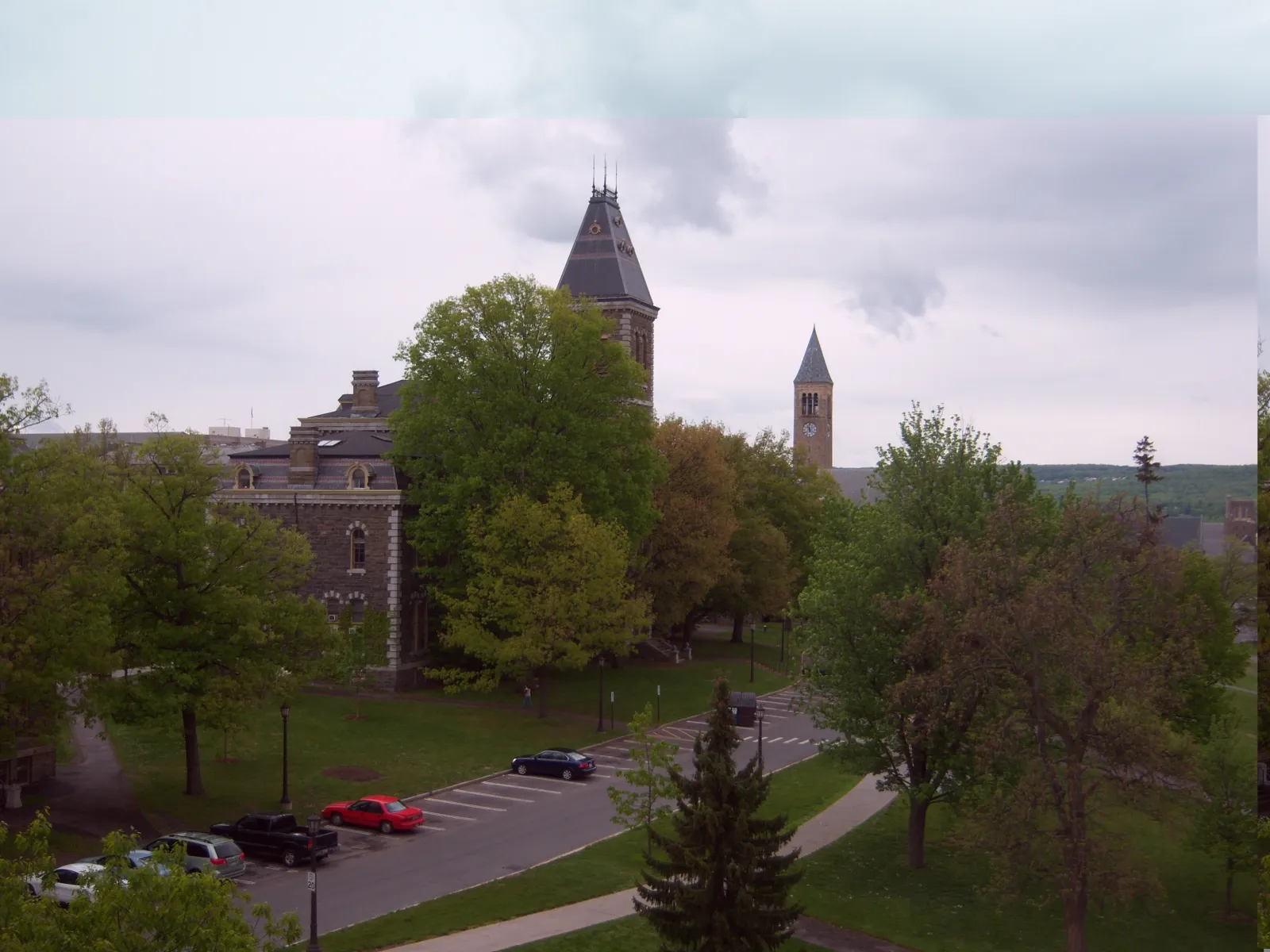

Cornell University
Ithaca, New York, United States · Established 1865
Official website ↗Total Students
26,100
Intl. Students
24.5%
Student:Faculty
9:1
Setting
Suburban
Overview
Cornell University was founded in 1865 by Ezra Cornell and Andrew Dickson White on the principle -- unusual for its era -- of an institution 'where any person can find instruction in any study,' a founding ethos that still shapes Cornell's unusually broad academic range today. Cornell is a member of the Ivy League and is structured as a hybrid: it includes both privately endowed colleges (including Arts and Sciences, Engineering, and the SC Johnson College of Business) and statutory, state-supported colleges operated as New York's land-grant institution (including Agriculture and Life Sciences and Human Ecology), which gives in-state New York residents a lower published tuition rate in those specific colleges while international applicants generally pay the endowed-college rate regardless of which college they apply to. Cornell's main Ithaca campus sits above Cayuga Lake in the Finger Lakes region of upstate New York, an unusually rural, expansive setting compared to most Ivy League peers, and the university also operates Cornell Tech, a graduate-only applied technology campus on Roosevelt Island in New York City, alongside Weill Cornell Medicine in Manhattan. Cornell is particularly well known for engineering, hotel administration (through the SC Johnson College of Business), agriculture and life sciences, architecture, and its College of Arts and Sciences, and its 100+ undergraduate majors across seven undergraduate colleges make it one of the most academically diverse Ivy League universities. For prospective international students, Cornell is highly selective but meaningfully less so than Harvard, Columbia, or Princeton, admitting around 8% of applicants for its most recent class, with acceptance rates varying considerably by college and by Early Decision versus Regular Decision round. Cornell is need-blind and meets full demonstrated need for domestic applicants; unlike some peer Ivies, its need-blind and full-need policies extend to international applicants as well as of recent admissions cycles, though applicants should confirm the current policy, since need-aware review for international students has historically been more common practice across Cornell's peer group.
Rankings
US News National Universities
#12 (2026)
US News Best Global Universities · Overall (Global)
#13 (2026)
Times Higher Education (THE) World University Rankings · Overall (Global)
#18 (2026)
Admissions, Requirements & Costs
Requirements, deadlines, and test-score cutoffs differ significantly between undergraduate and graduate/Master's programs — shown separately below.
Undergraduate
Acceptance Rate
8.4%
Application Fee
$85
Documents required: Common Application or Coalition Application, plus Cornell-specific college-level supplement (Cornell requires applying to one of seven specific undergraduate colleges, not the university broadly), Secondary School Report and counselor recommendation, Teacher recommendation letter(s), Midyear School Report, Final School Report and official transcript, SAT or ACT scores (test-optional policy; check current-cycle status by college), English Language Proficiency documentation for applicants whose first language is not English and who do not qualify for an exemption, Application Fee or Fee Waiver Request
| Term | Deadline | Type |
|---|---|---|
| Fall | November 1 (Early Decision, binding) | Early Decision |
| Fall | January 2 | Regular Decision |
Test Scores
SAT Range
1490–1550
ACT Range
33–35
IELTS Minimum
7.5 (Gabble rec. 7.5)
TOEFL Minimum
100 (5 new scale) · Gabble rec. 100 (5 new scale)
TOEFL notes: Cornell states the requirement as TOEFL iBT 100 for tests taken before January 2026, and 5.0 (recommended 5.5) on ETS's new 1-6, CEFR-aligned scale for tests taken from January 2026 onward. Cambridge English C1 Advanced/C2 Proficiency is separately accepted with a minimum score of 191.
TOEFL scores shown as: legacy 0–120 scale (new 1.0–6.0 CEFR-aligned scale, effective Jan 2026).
Accepted tests: IELTS Academic, TOEFL iBT, Duolingo English Test, Cambridge English (C1 Advanced / C2 Proficiency)
Waiver: Not required if English is the applicant's native language or if English has been the primary language of instruction throughout secondary school. Self-reported scores via the Common Application are accepted, with updated scores submittable through Cornell's English Language Proficiency Form in the applicant portal.
Tuition (Intl.)
$73,946
Tuition (Domestic)
$73,946
Living Expenses/yr
$25,788
Total Cost of Attendance
$99,734
Scholarships
Cornell need-based grant aid
Varies by demonstrated need; can cover up to full cost of attendance
Cornell states a need-blind, full-need financial aid policy for undergraduate admissions that its official financial aid materials describe as extending to international applicants as well as domestic ones -- applicants should confirm the current-cycle policy directly, since this differs from several peer Ivies that remain need-aware for international students.
Eligibility: Available to admitted students who apply for aid via the CSS Profile and, for international students, the International Student Financial Aid Application
College-specific merit and endowed scholarships
Varies considerably by award
Individual Cornell colleges (e.g. Engineering, Arts and Sciences, SC Johnson College of Business) hold their own rotating set of endowed, merit-linked, and country- or background-specific scholarships.
Eligibility: Varies by scholarship; typically requires an offer of admission to the relevant college
Popular Programs
Gabble Prep Insights
Where applicants lose points: Writing carries particular weight because Cornell requires applicants to apply directly to one of seven distinct undergraduate colleges, each with its own supplemental essay prompts focused on fit and intended field of study, so a generic personal statement performs worse here than at universities with a single unified application.
International applicants who clear Cornell's above-average IELTS 7.5 / TOEFL 100 requirement comfortably on Reading and Listening sometimes underprepare Writing for Cornell's college-specific supplemental essays, which are read closely as evidence of genuine interest in that specific college's curriculum.
Acceptance rate (8.4% overall, 18.8% Early Decision vs 6.7% Regular Decision for the Class of 2029) and SAT/ACT ranges reflect Cornell's own published Class of 2029 statistics but vary considerably by undergraduate college -- Computer Science within Engineering and the SC Johnson College of Business run considerably more selective than the university-wide average. Tuition (USD 73,946) is the 2026-27 endowed-college rate, which applies to essentially all international undergraduates regardless of college; New York State residents in Cornell's statutory (land-grant) colleges pay a lower published rate that does not apply to international students. Total cost of attendance (USD 99,734) is Cornell's own published on-campus estimate; the derived living-expenses figure includes room, board, and other estimated personal costs beyond housing and food alone.
Recommended prep timeline: 10 weeks
Graduate (Master's & PhD)
Application Fee
$105
Documents required: Statement of purpose, Academic transcripts from all institutions attended, Letters of recommendation (typically 3), GRE or GMAT scores (required for the Johnson MBA and some professional master's programs; most Graduate School PhD fields do not set a hard requirement), TOEFL or IELTS scores (required by the Graduate School unless exempted), Resume/CV, Application fee or fee waiver request
| Term | Deadline | Type |
|---|---|---|
| Fall | Varies by field/program; Graduate School fields commonly close between December and January, Johnson MBA runs several staged rounds through the cycle | Regular Decision |
Test Scores
GMAT Range
660–740
IELTS Minimum
7 (Gabble rec. 7)
TOEFL notes: Cornell's Graduate School publishes component minimums rather than a single overall figure: Reading 20, Writing 20, Listening 15, and Speaking 22 (out of 30 each). This dataset leaves the overall minScore null rather than estimating a total from the component minimums -- confirm the current overall figure directly on the Graduate School's English Language Proficiency Requirement page.
Accepted tests: IELTS Academic, TOEFL iBT
Waiver: Standing exemptions apply to applicants whose primary/secondary education was conducted in English or who are citizens of recognized English-speaking countries; individual graduate fields may set additional or stricter requirements.
Tuition (Intl.)
$20,800
Tuition (Domestic)
$20,800
Living Expenses/yr
$37,418
Total Cost of Attendance
$58,218
Scholarships
Cornell Graduate School PhD Funding Package
Full tuition, fees, health insurance, and a stipend (approximately USD 35,661/year at the 2025-26 nine-month rate, prorated for summer support)
Nearly all Cornell PhD students (99% per the Graduate School's own figures) are fully funded through a combination of fellowships, research assistantships, and teaching assistantships, generally covering tuition, fees, health insurance, and a living stipend.
Eligibility: Automatically provided to essentially all admitted PhD students in fields offering full funding; applies equally to international students
Johnson MBA merit scholarships
Varies considerably by award
Merit-based scholarships awarded to admitted Johnson MBA candidates, assessed automatically as part of the standard application review.
Eligibility: Automatically considered for all admitted MBA applicants
Popular Programs
Gabble Prep Insights
Where applicants lose points: Speaking is the section most likely to trip up strong-on-paper applicants, since Cornell's Graduate School sets its highest component minimum on Speaking (22/30) relative to Reading and Listening, reflecting the discussion- and defense-heavy format of Cornell's graduate seminars and qualifying exams.
Applicants to quantitative and engineering fields tend to clear Reading and Listening well but occasionally fall short specifically on the Speaking component; applicants to Johnson MBA and Cornell Tech's applied, presentation-heavy programs most often need broader, balanced preparation across all four skills.
Cornell's Graduate School does not publish one official aggregate PhD/master's acceptance rate, so that field is left null. GMAT figures (median 710, middle-80% range 660-740) reflect the Johnson MBA Class of 2027 specifically, not a university-wide average; Johnson does not set a hard minimum GMAT/GRE score. Graduate tuition (USD 20,800/year, 2025-26 rate, the most recent confirmed figure at time of writing) reflects the Graduate School's PhD/research master's rate; professional master's programs (MBA, MEng, Cornell Tech) are priced substantially higher and should be checked on the specific program page. Living-expenses figure (USD 37,418) is the Graduate School's own published 2026-27 estimate.
Recommended prep timeline: 10 weeks
Programs Offered
BA in Computer Science
Undergraduate · 4 yr · $73,946/yr
BS in Biological Sciences
Undergraduate · 4 yr · $73,946/yr
BS in Hotel Administration
Undergraduate · 4 yr · $73,946/yr
MBA
Masters · 2 yr
Master of Engineering
Masters · 1 yr
PhD (various fields)
PhD · 5 yr · $20,800/yr
Campus Life
Cornell's Ithaca campus, set above Cayuga Lake amid gorges and waterfalls, gives students a far more traditional, expansive residential-campus feel than most Ivy League peers, with more than 1,000 registered student organizations spanning academic, cultural, and recreational interests. Cornell fields NCAA Division I Ivy League teams across more than 35 varsity sports, and its unusually large number of distinct undergraduate colleges (seven) creates a correspondingly wide range of college-specific traditions, clubs, and academic societies. International students benefit from a large, well-established international community and dedicated programming through Cornell's Office of Global Learning.
Notable clubs: The Cornell Daily Sun (independent student newspaper), Cornell University Glee Club, Cornell Model United Nations, Cornell Outdoor Education, Big Red Marching Band
Outcomes
Undergraduate
Graduation Rate
95%
Graduate
Notable Alumni
Ruth Bader Ginsburg — US Supreme Court Justice; graduated Phi Beta Kappa from Cornell with a degree in Government
Bill Nye — Mechanical engineer and science communicator; BS in Mechanical Engineering from Cornell
Hans Bethe — Nobel laureate physicist (1967, stellar nucleosynthesis); longtime Cornell physics professor
Kurt Vonnegut — Novelist and author of Slaughterhouse-Five; studied biochemistry at Cornell before World War II service
Ratan Tata — Former Chairman of Tata Sons; studied architecture and structural engineering at Cornell
Visa Interview Prep
Cornell's Office of Global Learning issues Form I-20s and supports F-1 visa applicants. International graduate students admitted with a student visa additionally pay a one-time, non-refundable Visa Document Processing Fee (USD 6.50) alongside the standard SEVIS fee paid to the US government. As with other US universities, applicants should begin the SEVIS/I-20 and embassy interview process as early as possible after accepting an offer, given known visa-appointment backlogs in some countries.
- Clarity on the specific program and college, and why Cornell specifically
- Demonstrating strong ties and credible intent to return home after studies
- Financial sufficiency and clear documentation of funding sources
- Consistency between academic background and chosen field of study
FAQs
What IELTS or TOEFL score do I need to apply to Cornell as an undergraduate?Undergrad
Cornell's published undergraduate minimums are IELTS Academic 7.5, TOEFL iBT 100 (for tests before January 2026) or 5.0 on ETS's new 1-6 scale (5.5 recommended) for tests from January 2026 onward, or Duolingo English Test 130. Cambridge C1 Advanced/C2 Proficiency is accepted with a minimum of 191.
Do I apply to Cornell as a whole, or to a specific college?Undergrad
You apply directly to one of Cornell's seven distinct undergraduate colleges (such as Arts and Sciences, Engineering, or the SC Johnson College of Business), each with its own supplemental essays and, in some cases, different acceptance rates. You cannot apply to Cornell generally without selecting a college.
How competitive is Cornell for international applicants?
Cornell's Class of 2029 was admitted at an overall rate of about 8.4% (roughly 6,077 admits from about 72,500 applications), with Early Decision running considerably higher (18.8%) than Regular Decision (6.7%). Selectivity also varies notably by undergraduate college.
Is Cornell need-blind for international applicants?Undergrad
Cornell's official financial aid materials describe its need-blind, full-need policy as extending to international undergraduate applicants, which differs from several peer Ivies (including Columbia and Cornell's own graduate schools) that remain need-aware for international students. Always confirm the current-cycle policy directly, since this is an area that shifts across admissions cycles industry-wide.
Will I need to attend a visa interview to study at Cornell?
Yes. Cornell is SEVP-certified and issues Form I-20s for the F-1 student visa, which includes the standard US consular interview process. Cornell's Office of Global Learning supports applicants through this process, but interview scheduling and timelines are set by the US government.
Is the GRE or GMAT required for Cornell graduate programmes?Grad
It depends on the program. Most Cornell Graduate School PhD fields do not set a hard GRE requirement, while the Johnson MBA requires GMAT or GRE scores as part of a holistic review without a stated minimum -- the Class of 2027 posted a median GMAT of 710 (middle 80% range 660-740). Always confirm the specific program's current testing policy.
What is Cornell's undergraduate tuition and total cost of attendance?Undergrad
For 2026-27, Cornell's endowed-college tuition (which applies to essentially all international students) is USD 73,946/year, with a total published on-campus cost of attendance of roughly USD 99,734/year before financial aid.
Are Cornell PhD students fully funded, including international students?Grad
Yes, for the great majority: Cornell's Graduate School reports that 99% of PhD students are fully funded through fellowships, research assistantships, or teaching assistantships covering tuition, fees, health insurance, and a living stipend, applying equally to international and domestic students in fields offering full funding.
What's the difference between Cornell's endowed and statutory colleges for international students?Undergrad
Cornell includes both privately endowed colleges (e.g. Arts and Sciences, Engineering) and state-supported statutory colleges that serve as New York's land-grant institution (e.g. Agriculture and Life Sciences, Human Ecology). New York State residents pay a lower published tuition rate in statutory colleges; this discount does not apply to international students, who generally pay the endowed-college rate regardless of which college they attend.
How many weeks should I spend preparing for IELTS or TOEFL before applying to Cornell?
A realistic window is 8-10 weeks of focused preparation, given Cornell's above-average IELTS 7.5 requirement, with particular attention to Writing given how closely Cornell's college-specific supplemental essays are read.