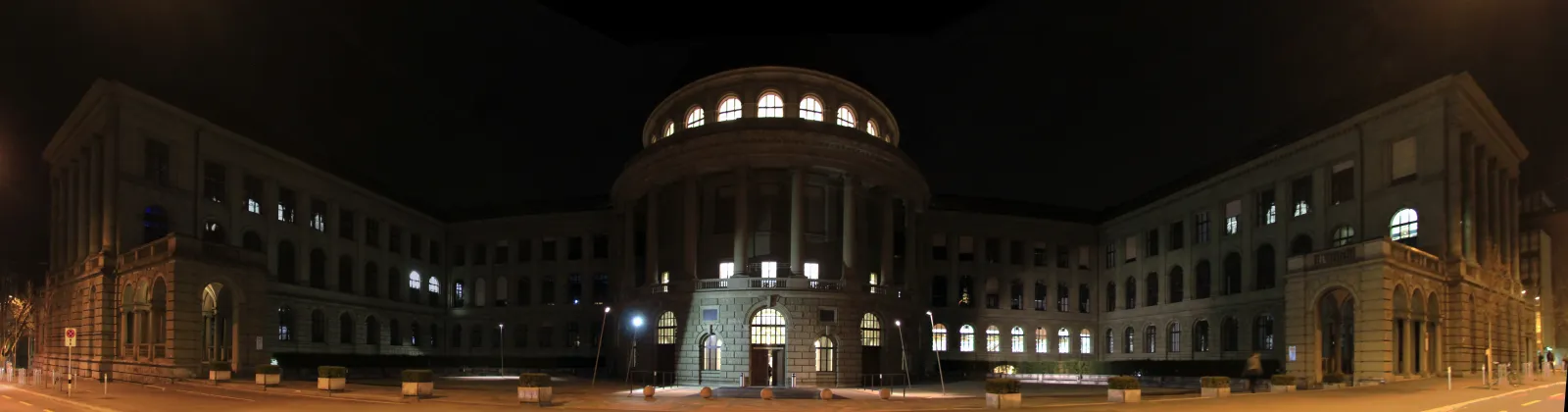

ETH Zurich
Zurich, , Switzerland · Established 1855
Official website ↗Total Students
26,942
Intl. Students
35%
Setting
Urban
Overview
ETH Zurich (the Swiss Federal Institute of Technology Zurich) is Switzerland's leading public technical university, founded in 1855 and consistently ranked among the top handful of universities in the world for engineering, natural sciences, and technology. Unlike Oxford, Cambridge, or the US universities in this dataset, ETH is not primarily an English-medium institution: the main teaching language for nearly all Bachelor's degree programmes is German, and admission at Bachelor's level is credential-based rather than a holistic-review admissions competition — applicants with a non-Swiss school-leaving qualification are assessed individually by ETH's Admissions Office, and many are required to sit ETH's own entrance examination (a reduced 4-subject or comprehensive 8-subject exam) if their diploma doesn't grant direct admission. At Master's level, the picture changes substantially: most Master's degree programmes at ETH are taught fully in English, some require both English and German, and a smaller number remain German-only, so applicants should always confirm a specific programme's teaching language before applying. English-taught Master's programmes span Computer Science, Data Science, Robotics, Systems and Control, Cyber Security (a joint degree with EPFL), and Management, Technology, and Economics (MTEC), among others, reflecting ETH's core strength across engineering, computing, and the physical sciences. ETH also has an unusually concentrated Nobel Prize history: Albert Einstein earned his diploma in physics and mathematics at ETH in 1900 and later taught there, and more than 20 Nobel laureates have studied or worked at the institution. For prospective IELTS or TOEFL candidates, the single most important thing to understand is that these tests are relevant almost exclusively to English-taught Master's and PhD programmes at ETH, not to Bachelor's admission, where German proficiency and the underlying school-leaving qualification matter far more. A separately important and genuinely distinctive feature of ETH for international students is its tuition: even after ETH's 2025 fee increase, non-Swiss/EU students pay a still-remarkably-low CHF 2,190 per semester (roughly CHF 4,380/year) — a small fraction of comparable US, UK, or Australian tuition — though Zurich's cost of living is among the highest of any city in this dataset, so total cost of attendance is driven far more by living expenses than by tuition.
Rankings
QS World University Rankings · Overall (Global)
#7 (2026)
QS World University Rankings · Overall (Continental Europe)
#1 (2027)
Admissions, Requirements & Costs
Requirements, deadlines, and test-score cutoffs differ significantly between undergraduate and graduate/Master's programs — shown separately below.
Undergraduate
Application Fee
$170
Documents required: eApply online application, Secondary school-leaving certificate/diploma (assessed against ETH's country-specific admission requirements list), Proof of German language proficiency (the main teaching language for nearly all Bachelor's programmes), ETH entrance examination (reduced or comprehensive), only if ETH's Admissions Office determines your diploma does not grant direct admission, CHF 150 non-refundable application fee per programme applied to
| Term | Deadline | Type |
|---|---|---|
| Fall (Autumn semester) | 31 March for the following autumn semester (non-Swiss school-leaving qualification applicants) | Regular Decision |
Test Scores
No fixed university-wide score minimum is published — requirements vary by department. See notes below.
IELTS notes: ETH's Bachelor's programmes are taught almost entirely in German, so IELTS/TOEFL are not the primary language test that matters at this level — German proficiency (assessed as part of the country-specific admission requirements) is what's actually evaluated. A small number of specific Bachelor's tracks may reference English requirements separately; always confirm on your specific programme's page.
TOEFL notes: Not applicable at Bachelor's level for the reason above — see ielts.sectionMinimums.
Accepted tests: Not primarily applicable — German is the main teaching language at Bachelor's level
Waiver: Not applicable in the IELTS/TOEFL sense at Bachelor's level; German-language proficiency requirements are assessed as part of ETH's country- and certificate-specific admission criteria rather than through an English test waiver system.
Tuition (Intl.)
$4,950
Tuition (Domestic)
$1,650
Living Expenses/yr
$25,990
Total Cost of Attendance
$30,940
Scholarships
ETH Zurich Foundation scholarships (Bachelor's, need-based)
Varies by assessed need; typically a partial contribution toward living costs
A small number of need-based scholarships administered through the ETH Zurich Foundation for Bachelor's students facing financial hardship, generally intended to supplement rather than fully replace family or other funding.
Eligibility: Open to enrolled ETH Bachelor's students (including international students) who can demonstrate financial need; requires a separate application, generally after at least one semester of enrollment
Popular Programs
Gabble Prep Insights
Where applicants lose points: Not applicable in the IELTS/TOEFL sense — the practical hardest hurdle for international Bachelor's applicants is German-language proficiency and, for many applicants, ETH's own entrance examination, not an English test.
Not applicable; see hardestSkillForApplicants.
ETH Zurich does not publish a Bachelor's acceptance rate in the way US or UK universities do, since admission is not a holistic numbers-based competition — applicants either meet the credential-based admission criteria for their country/qualification (with direct admission) or are required to sit ETH's entrance examination, so acceptanceRate is left null rather than estimated. Tuition figures use ETH's official 2025-effective rate: CHF 730/semester (CHF 1,460/year) for students who qualify for the lower Swiss/EU-linked rate, converted here at approximately 1 CHF = 1.13 USD to $1,650 (tuitionPerYear), and CHF 2,190/semester (CHF 4,380/year, the 'threefold' international rate) to $4,950 (tuitionInternationalPerYear). Living costs use ETH's own official guidance of CHF 20,000-26,000/year for combined living and individual study costs; the midpoint (CHF 23,000, ~$25,990) is used here as livingExpensesPerYear — Zurich is consistently ranked among the most expensive cities in the world to live in, so this figure, not tuition, dominates ETH's total cost of attendance for international students.
Graduate (Master's & PhD)
Application Fee
$170
Documents required: eApply online application, Bachelor's degree transcript and diploma (assessed against programme-specific admission criteria; some programmes require a closely related Bachelor's field), IELTS Academic or TOEFL iBT scores for English-taught programmes (programme-specific minimum; German proficiency required instead or in addition for German-taught or bilingual programmes), CHF 150 non-refundable application fee per programme applied to, Motivation letter and/or CV, required by some (not all) departments
| Term | Deadline | Type |
|---|---|---|
| Fall (Autumn semester) | 1-30 November for the following autumn semester (applicants with a Bachelor's degree from outside Switzerland) | Regular Decision |
Test Scores
IELTS Minimum
7 (Gabble rec. 7)
TOEFL Minimum
100 (5 new scale) · Gabble rec. 100 (5 new scale)
IELTS notes: A commonly required standard for English-taught Master's programmes is 7.0 overall with no band below 6.5, but ETH does not publish one single university-wide minimum — each Master's programme sets and publishes its own required score on its own admission page, so always confirm the exact figure for your specific programme rather than assuming this applies universally.
TOEFL notes: A commonly required standard for English-taught Master's programmes is 100 overall with no section below 23, but as with IELTS, ETH sets this per programme rather than as one university-wide figure — confirm on your specific programme's page. IELTS General Training is not accepted; only IELTS Academic is valid.
TOEFL scores shown as: legacy 0–120 scale (new 1.0–6.0 CEFR-aligned scale, effective Jan 2026).
Accepted tests: IELTS Academic, TOEFL iBT, Cambridge English (C1 Advanced / C2 Proficiency)
Waiver: Applicants who hold a Bachelor's or Master's degree taught and examined entirely in English, or who are nationals of certain English-speaking countries, are generally exempt from the English-test requirement for English-taught programmes; exact criteria are set per programme.
Tuition (Intl.)
$4,950
Tuition (Domestic)
$1,650
Living Expenses/yr
$25,990
Total Cost of Attendance
$30,940
Scholarships
ETH Zurich Excellence Scholarship & Opportunity Programme (ESOP)
Full tuition waiver plus CHF 12,000/semester (roughly $13,560/semester at the conversion rate used elsewhere in this profile)
ETH's flagship Master's scholarship, covering full tuition plus a CHF 12,000/semester stipend for living and study expenses, for the regular duration of the Master's programme (typically three to four semesters); around 60 scholarships are awarded per intake.
Eligibility: Open to applicants who rank in the top 10% of their Bachelor's degree cohort and meet their chosen Master's programme's standard admission requirements; requires a separate application submitted alongside the Master's application by 30 November
Popular Programs
Gabble Prep Insights
Where applicants lose points: Writing carries significant weight for English-taught Master's applicants, since ETH's research-intensive programmes expect a clear, well-structured motivation letter and, for many programmes, subsequent thesis-level academic writing — a bare-minimum test score does not by itself signal readiness for that.
Applicants to technical programmes (Computer Science, Data Science, Robotics) tend to clear Reading and Listening comfortably given generally strong quantitative academic backgrounds, but some underprepare Speaking and Writing relative to the discussion- and report-heavy project culture common in ETH's Master's programmes.
Tuition and living-cost figures are identical to the undergraduate figures above, since ETH charges the same CHF 730/1,460-per-year (Swiss/EU-linked) and CHF 2,190/4,380-per-year (international) semester fee structure at Master's level, with the same official CHF 20,000-26,000/year living-cost guidance. ETH does not publish a single university-wide Master's acceptance rate (admission is decided per programme against programme-specific criteria), so that field is left null. GRE/GMAT are not standard requirements for ETH Master's programmes generally; a small number of management-adjacent programmes may reference GMAT as one optional element, but ETH does not publish a required or average score, so those fields are left null rather than estimated.
Recommended prep timeline: 10 weeks
Programs Offered
BSc Mechanical Engineering
Undergraduate · 3 yr
BSc Computer Science
Undergraduate · 3 yr
BSc Physics
Undergraduate · 3 yr
MSc Computer Science
Masters · 2 yr
MSc Data Science
Masters · 2 yr
MSc Robotics, Systems and Control
Masters · 2 yr
Master in Management, Technology, and Economics (MTEC)
Masters · 1.5 yr
PhD (various departments)
PhD · 4 yr
Campus Life
ETH Zurich's main campus sits on Rämistrasse in central Zurich, with a large second campus (Hönggerberg) on the city's outskirts for several science and engineering departments; both are well connected by Zurich's tram and rail network. VSETH, ETH's central student association, coordinates over 100 affiliated student clubs spanning academic, cultural, political, and hobby interests, and students share access to Zurich's Academic Sports Association (ASVZ) facilities with University of Zurich students. With students from around 120-130 countries and roughly 35% of the overall student body international (rising to 42% at Master's level), ETH has an unusually international campus culture layered onto its Swiss academic traditions, and its central Zurich location gives students direct access to Switzerland's largest city and financial center.
Notable clubs: VSETH (Verband der Studierenden an der ETH Zürich), ETH's central student association, Academic Sports Association Zurich (ASVZ), shared with the University of Zurich, Over 100 student clubs registered through VSETH spanning academic, cultural, and hobby interests, AMIV, ETH's association for students of computer science, electrical engineering, and information technology
Outcomes
Undergraduate
Graduate
Notable Alumni
Albert Einstein — Physicist and Nobel laureate; earned his diploma in physics and mathematics at ETH in 1900 and later taught theoretical physics there
Felix Bloch — Nobel laureate in Physics (1952) for developing nuclear magnetic resonance measurement methods; studied at ETH
Rudolf Kálmán — Engineer and mathematician; inventor of the Kalman filter, foundational to modern navigation and aerospace systems; held a professorship and honorary connections to ETH's research community
Jacques Herzog and Pierre de Meuron — Pritzker Prize-winning architects and founders of Herzog & de Meuron (designers of the Tate Modern and Beijing National Stadium); both studied architecture at ETH
Visa Interview Prep
Non-EU/EFTA international students admitted to ETH must apply for a Swiss National (Type D) long-stay visa at a Swiss embassy or consulate in their home country, following a two-step process: the relevant Zurich canton authority first grants residence-permit pre-approval, after which the student applies for the Type D visa using that approval. This combined process can take 6-12 weeks or longer given quota and security checks, so ETH recommends applying as soon as an admission decision is confirmed. Once in Switzerland, students must register with the local residents' registration office within 8 days of arrival and subsequently obtain their residence permit card (Permit B for students) from the cantonal migration office. EU/EFTA students follow a simpler registration-only process and do not need a Type D visa.
- Switzerland's non-EU/EFTA student visa process is not built around a routine in-person interview the way the US F-1 process is; it is driven primarily by cantonal residence-permit pre-approval and financial/academic documentation
- Proof of sufficient funds for the full period of study and confirmation of enrollment (ETH admission confirmation) are the core requirements assessed
FAQs
Do I need IELTS or TOEFL to apply to ETH Zurich as an undergraduate?Undergrad
Generally no. Almost all Bachelor's degree programmes at ETH are taught in German, so what actually matters for undergraduate admission is German-language proficiency and your underlying school-leaving qualification, not an English test. IELTS/TOEFL become relevant mainly at Master's level, for ETH's English-taught programmes.
What IELTS or TOEFL score do I need for an ETH Zurich Master's programme?Grad
A commonly required standard for English-taught Master's programmes is IELTS 7.0 overall (no band below 6.5) or TOEFL iBT 100 (no section below 23), but ETH does not publish one single university-wide minimum — each Master's programme sets its own required score, so always confirm the exact figure on your specific programme's own admission page.
Is ETH Zurich really as cheap as people say?
Tuition, yes — even after a 2025 fee increase, international students pay only about CHF 2,190/semester (roughly $4,950/year at typical exchange rates), a fraction of comparable US, UK, or Australian tuition. Total cost of attendance is a different story: Zurich is one of the most expensive cities in the world to live in, and ETH's own guidance suggests budgeting CHF 20,000-26,000/year (roughly $23,000-29,000) for combined living and study costs, meaning living expenses, not tuition, dominate the real cost of studying at ETH.
Do I need to sit an entrance examination to get into ETH Zurich?Undergrad
It depends on your qualification. Applicants with a Swiss Matura are admitted directly. Applicants with a non-Swiss school-leaving qualification are assessed individually by ETH's Admissions Office against country-specific criteria; if your diploma alone doesn't grant direct admission, you'll be required to sit either a reduced (4-subject) or comprehensive (8-subject) ETH entrance examination.
Will I need to attend a visa interview to study at ETH Zurich?
Not in the routine, in-person sense of the US F-1 process. Non-EU/EFTA students go through a two-step process: cantonal residence-permit pre-approval, followed by a Swiss National (Type D) long-stay visa application at a Swiss embassy or consulate, based mainly on documentation rather than a standard interview. The combined process can take 6-12 weeks or longer, so apply as soon as your admission is confirmed.
Is the GRE or GMAT required for ETH Zurich Master's programmes?Grad
No, not as a standard requirement. ETH Master's programmes generally do not require GRE or GMAT scores; a small number of management-adjacent programmes may reference GMAT as an optional supporting element, but ETH does not publish a required or average score for any of its programmes.
What is the ETH Zurich Excellence Scholarship?Grad
The Excellence Scholarship & Opportunity Programme (ESOP) is ETH's flagship Master's scholarship: it covers full tuition plus CHF 12,000/semester for living and study costs, for the full regular duration of a Master's programme. Around 60 scholarships are awarded per intake to applicants who rank in the top 10% of their Bachelor's cohort and meet their target Master's programme's standard admission requirements; it requires a separate application submitted alongside the Master's application.
How international is ETH Zurich's student body?
Around 35% of ETH's roughly 27,000 students are international, drawn from about 120-130 countries, though this varies significantly by level: only around 20% of new Bachelor's students are international (mostly from Germany and Austria), while 42% of Master's students are international, reflecting how much more accessible ETH's English-taught Master's programmes are to a global applicant pool than its German-taught Bachelor's programmes.