
Imperial College London
London, England, United Kingdom · Established 1907
Official website ↗Total Students
22,525
Intl. Students
61%
Student:Faculty
12:1
Setting
Urban
Overview
Imperial College London was established by Royal Charter in 1907 through the merger of the Royal College of Science, the Royal School of Mines, and City and Guilds College, all clustered around the South Kensington district that Prince Albert had originally envisioned as a hub for science, industry, and culture. For most of its history Imperial operated as a specialist science, engineering, and medicine college within the federal University of London before becoming a fully independent university in its own right in 2007. Today it is organised into four faculties -- Engineering, Natural Sciences, Medicine, and Imperial College Business School -- and has expanded well beyond its original South Kensington site to include the White City innovation campus, the Hammersmith and St Mary's medical campuses, and the Silwood Park ecology campus near Ascot. Unlike Oxford, Cambridge, or most large UK universities, Imperial does not teach humanities or social sciences (outside its business school), which lets it concentrate almost entirely on STEM and clinical disciplines -- a specialisation that shows up clearly in its subject rankings in engineering, computing, and medicine. The university's applicant pool is unusually international: well over half of its student body holds a non-UK passport, drawn from more than 140 countries, and undergraduate cohorts in departments like Computing or Electrical Engineering routinely see international students in the majority. For prospective IELTS or TOEFL candidates, this means Imperial's English-medium instruction sits inside one of the most globally mixed classrooms in the UK, alongside genuinely demanding technical coursework. Admission to Imperial is handled through the UK's centralised UCAS system for undergraduates, with A-Levels, the International Baccalaureate, or equivalent qualifications forming the academic bar rather than the SAT/ACT-plus-GPA model used in the US. Postgraduate admissions, by contrast, are decentralised across departments and the Business School, each running its own deadlines, English-language thresholds, and (for the Business School specifically) GMAT/GRE expectations. Imperial is consistently ranked among the top handful of universities worldwide for research power and graduate employability, reflecting its close ties to London's finance, biotech, and engineering industries and to the NHS through its affiliated teaching hospitals.
Rankings
Times Higher Education (THE) World University Rankings · Overall (Global)
#8 (2026)
US News Best Global Universities · Overall (Global)
#14 (2026)
QS World University Rankings by Subject · Chemical Engineering
#4 (2026)
QS World University Rankings by Subject · Medicine
#7 (2026)
THE World University Rankings by Subject · Medical & Health
#4 (2026)
THE World University Rankings by Subject · Engineering
#12 (2026)
Admissions, Requirements & Costs
Requirements, deadlines, and test-score cutoffs differ significantly between undergraduate and graduate/Master's programs — shown separately below.
Undergraduate
Acceptance Rate
17.6%
Application Fee
$38
Documents required: UCAS application and personal statement, Academic reference from school/college, Predicted or achieved A-Level, IB, or equivalent qualification grades, Official secondary school transcripts, Admissions test scores where required by the course (e.g. TMUA for some Mathematics/Computing courses), English language proficiency test scores (IELTS/TOEFL/PTE/Duolingo) for non-native speakers not otherwise exempt
| Term | Deadline | Type |
|---|---|---|
| Fall (September/October) | UCAS: October 15, 18:00 UK time for Medicine (MBBS); January (equal consideration deadline, typically mid-January) for all other undergraduate courses | Regular Decision |
Test Scores
IELTS Minimum
6.5 (Gabble rec. 7)
TOEFL Minimum
92 (4.5 new scale) · Gabble rec. 100 (5 new scale)
PTE Minimum
62
IELTS notes: Standard level: 6.5 overall with at least 6.0 in each component; Higher level (required by Business School and Medicine courses): 7.0 overall with at least 6.5 in each component
TOEFL notes: Standard level: 92 overall with at least 20 in each section; Higher level: 100 overall with at least 22 in each section
TOEFL scores shown as: legacy 0–120 scale (new 1.0–6.0 CEFR-aligned scale, effective Jan 2026).
Accepted tests: IELTS, TOEFL, PTE Academic, Duolingo English Test
Waiver: Applicants are typically exempt if they hold (or will hold before enrolment) a qualification gained from at least two years of full-time study, taught and examined in English, in a small list of majority English-speaking countries Imperial recognises (including the UK, USA, Canada, Australia, New Zealand, and Ireland).
Conditional admission: Imperial's Centre for Academic English runs pre-sessional English programmes of varying lengths for admitted students who narrowly miss the required score, letting them reach the threshold before term starts; this route is generally not available for Business School-affiliated undergraduate options.
Tuition (Intl.)
$56,146
Tuition (Domestic)
$13,119
Living Expenses/yr
$24,120
Total Cost of Attendance
$80,266
Scholarships
President's Undergraduate Scholarship
£1,000 per year of undergraduate study (non-renewable beyond the standard course length)
A merit-based scholarship recognising outstanding academic achievement among newly admitted undergraduates, with up to 50 awarded each year across departments.
Eligibility: Open to applicants of any nationality who receive an offer by the January equal consideration deadline and show the highest level of academic achievement; awarded by nomination, not separate application
Faculty and departmental international scholarships
Varies by scholarship, typically a partial tuition contribution
Individual departments and the College's central scholarships search tool list a rotating set of merit- and country-specific awards (for example, need- or merit-based awards tied to particular regions or subjects) that partially offset the overseas fee.
Eligibility: Varies; most require an offer of admission and separate application through Imperial's scholarships search portal
Popular Programs
Gabble Prep Insights
Where applicants lose points: Speaking is typically the section where applicants to Imperial's heavily technical courses underperform, since STEM-focused secondary curricula in many countries emphasise reading comprehension and written problem sets far more than spontaneous spoken English.
Applicants often clear the Reading and Listening thresholds comfortably given the technical/scientific vocabulary overlap with their A-Level or IB coursework, but Writing scores lag behind because Imperial's course-based assessment expects structured, discipline-specific argument rather than the general essay style most test-prep courses teach.
Figures above were converted from GBP at approximately 1 GBP = 1.34 USD. The Home (UK-domiciled) tuition fee is £9,790/year, unchanged across all undergraduate courses. Overseas fees are set per course rather than as one university-wide figure; published 2025-26/2026-27 ranges run from roughly £31,750 (Natural Sciences) to £55,800+ (Medicine), so the £41,900 figure converted here is a representative mid-range Engineering/Science fee, not a fixed rate -- always check the specific course page. The UCAS application fee for 2026-27 entry is £28.50 (covers up to five course choices). Living costs were estimated from Imperial's own guidance of roughly £1,400-£2,200/month (here annualised at approximately £18,000).
Recommended prep timeline: 10 weeks
Graduate (Master's & PhD)
Acceptance Rate
30%
Application Fee
$121
Documents required: Statement of purpose / personal statement, Two academic references, Official transcripts from all previously attended institutions, CV/resume, English language proficiency test scores (if applicable), GMAT or GRE scores (required for the MBA and some Business School master's programmes; not generally required for most taught science/engineering master's), Portfolio or written work sample (for select programmes)
| Term | Deadline | Type |
|---|---|---|
| Fall (October) | Rolling and department-specific; most taught master's open around October/November of the prior year and close once full -- highly competitive programmes such as MSc Computing or Business School MScs often fill by December-February | Rolling |
Test Scores
Avg. GRE
312
Avg. GMAT
666
IELTS Minimum
6.5 (Gabble rec. 7)
TOEFL Minimum
92 (4.5 new scale) · Gabble rec. 100 (5 new scale)
PTE Minimum
62
IELTS notes: Standard level: 6.5 overall with at least 6.0 in each component; Higher level (required by the Business School and most Medicine postgraduate courses): 7.0 overall with at least 6.5 in each component
TOEFL notes: Standard level: 92 overall with at least 20 in each section; Higher level: 100 overall with at least 22 in each section
TOEFL scores shown as: legacy 0–120 scale (new 1.0–6.0 CEFR-aligned scale, effective Jan 2026).
Accepted tests: IELTS, TOEFL, PTE Academic, Duolingo English Test
Waiver: Applicants are typically exempt if they hold a degree from at least two years of full-time study, taught and examined in English, in a country Imperial recognises as majority English-speaking (UK, USA, Canada, Australia, New Zealand, Ireland, among others).
Conditional admission: The Centre for Academic English's pre-sessional programmes are open to admitted postgraduate students below the required score, though Imperial Business School does not accept pre-sessional completion in place of a qualifying direct test score.
Tuition (Intl.)
$61,640
Tuition (Domestic)
$18,090
Living Expenses/yr
$24,120
Total Cost of Attendance
$85,760
Scholarships
President's PhD Scholarships
Home-rate tuition fees plus a stipend of approximately £26,500/year and a £2,000/year consumables fund
A competitive doctoral scholarship covering tuition fees at the Home rate plus a stipend and consumables allowance, open to outstanding applicants regardless of nationality.
Eligibility: Exceptional academic record and research potential; international recipients may need to secure additional funding to cover the Home-Overseas fee difference
Imperial Business School merit scholarships (MBA/MSc)
Varies, from partial awards up to a significant share of tuition
A set of merit-based scholarships awarded to incoming MBA and MSc students at the Business School based on academic excellence, leadership, or diversity criteria.
Eligibility: Automatically considered from the admitted applicant pool for most awards; a few require a separate short application
Popular Programs
Gabble Prep Insights
Where applicants lose points: Writing tends to be the weakest section for graduate applicants, since a research-oriented statement of purpose and (for many programmes) a technical writing sample demand a register well above conversational or exam-style English.
Applicants to technical MSc/MRes programmes often post strong Reading/Listening scores but need extra Speaking practice if their course includes group project defences or lab presentations, while Business School applicants tend to need the most Writing polish given the case-study and essay-heavy MBA application process.
Figures above were converted from GBP at approximately 1 GBP = 1.34 USD. Imperial does not publish one university-wide postgraduate acceptance rate -- overall taught postgraduate offer rates have been cited around 30% in recent cycles, but individual programmes vary enormously (Computing and Statistics run below 11%, with AI/Machine Learning cited as low as ~4%, while some niche master's exceed 40%). Home postgraduate taught tuition (~£13,500 used here) and the MSc Computing overseas fee (£46,000) are representative figures rather than fixed university-wide rates -- always check the individual course page. The standard postgraduate taught application fee is £90, rising to £125 for Business School MSc applications and £150 for the MBA. GMAT/GRE figures (GMAT minimum 600, average 666; GRE average around 312) reflect Imperial Business School's MBA cohort specifically and were NOT derived by summing separate Verbal/Quant sub-score ranges -- the GRE avgScore is a real, published combined-score average.
Recommended prep timeline: 12 weeks
Programs Offered
Computing (BEng/MEng)
Undergraduate · 3 yr
Mechanical Engineering (MEng)
Undergraduate · 4 yr
Medicine (MBBS/BSc)
Undergraduate · 6 yr
Physics (MSci)
Undergraduate · 4 yr
Chemical Engineering (MEng)
Undergraduate · 4 yr
MSc Computing (Artificial Intelligence and Machine Learning)
Masters · 1 yr · $61,640/yr
Full-Time MBA
Masters · 1 yr · $104,520/yr
MSc Finance
Masters · 1 yr
MEng Electrical and Electronic Engineering
Undergraduate · 4 yr
PhD in Engineering
PhD · 4 yr
Campus Life
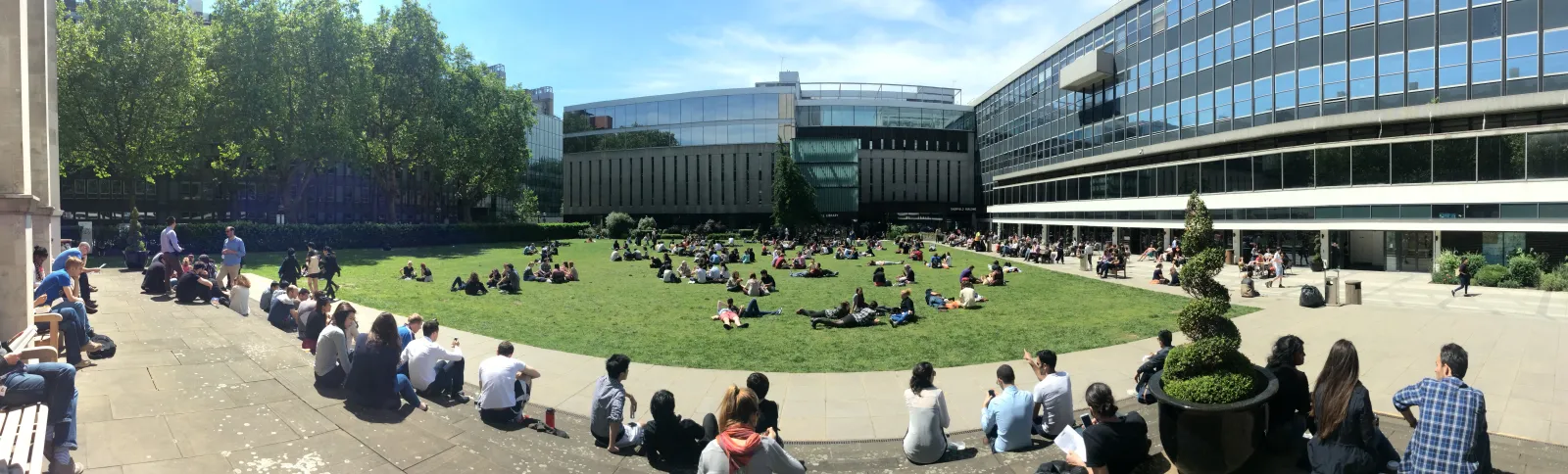
Campus life at Imperial is inseparable from being a student in central London: rather than a self-contained residential quad, the South Kensington campus sits directly beside the Natural History Museum, the Science Museum, the Victoria and Albert Museum, and Hyde Park, and most halls of residence are a short bus or Tube ride away rather than on-site. Imperial College Union runs more than 370 clubs, societies, and projects -- from over 90 sports clubs to academic, cultural, and creative groups -- and is unusually active in supporting the university's large international population through country- and region-specific societies. Because Imperial has no humanities faculty of its own, its social and extracurricular scene skews heavily toward technical and entrepreneurial interests, reinforced by the White City campus's startup incubators and close links to London's finance, biotech, and consulting employers.
Notable clubs: Imperial College Union, Imperial College Boat Club, Imperial Consulting Society, Imperial Entrepreneurs, Imperial College Symphony Orchestra
Outcomes
Undergraduate
Employed within 6mo
85%
Avg. Starting Salary
$54,806
Graduate
Employed within 6mo
90%
Notable Alumni
Sir Alexander Fleming — Discovered penicillin; shared the 1945 Nobel Prize in Physiology or Medicine
Brian May — Queen guitarist who later completed a PhD in astrophysics at Imperial
H. G. Wells — Author of 'The War of the Worlds' and 'The Time Machine'; studied at Imperial's founding institution, the Normal School of Science
Abdus Salam — Shared the 1979 Nobel Prize in Physics for work on the electroweak theory
Rajiv Gandhi — Former Prime Minister of India; studied mechanical engineering at Imperial
Visa Interview Prep
The UK Student visa process is procedurally quite different from the US F-1 system: there is no SEVP certification or embassy visa-interview requirement built into the standard process, and the centrepiece document is the CAS issued by Imperial once a firm offer, financial evidence, and (where required) English test scores are confirmed. Applicants should apply for their Student visa as soon as the CAS is issued -- Imperial recommends international offer-holders finalise their UCAS or postgraduate decision well before the end of June for a September start to leave time for visa processing, tuberculosis testing (for applicants from certain countries), and pre-arrival logistics.
- UK Student visa applicants typically do NOT attend an in-person visa interview the way US F-1 applicants do -- most applications are decided from the online form, supporting documents, and the CAS (Confirmation of Acceptance for Studies) issued by Imperial
- UKVI may conduct a short credibility interview (in person or by video) in specific risk-based cases, focused on genuine intent to study, course knowledge, and financial means
FAQs
What IELTS score do I need to apply to Imperial College London as an undergraduate?Undergrad
Most courses require the Standard level: 6.5 overall with at least 6.0 in each of the four components. Business School-affiliated and Medicine courses require the Higher level: 7.0 overall with at least 6.5 in each component. Always confirm the exact figure on your specific course page, since some departments set their own thresholds.
Does Imperial use the Common Application like US universities?Undergrad
No. Imperial only accepts applications through UCAS, the UK's centralised undergraduate admissions service, where you list up to five course choices with one shared personal statement (or, from certain cycles, course-specific statements). There is no Imperial-specific supplemental essay portal the way many US schools require.
Will I have to attend a visa interview to study at Imperial, like the US F-1 process?
Almost certainly not. The UK Student visa route generally does not require an in-person interview; your application is assessed from the online form, financial documents, and the CAS (Confirmation of Acceptance for Studies) Imperial issues after you accept your offer. UKVI reserves the right to request a short credibility interview in specific cases, but this is the exception, not the standard process.
What A-Level or IB grades do I need instead of an SAT/ACT score?Undergrad
Imperial does not use the SAT or ACT for admissions decisions. Undergraduate offers are typically expressed as A-Level grade requirements (commonly A*AA to A*A*A depending on course) or an IB total (often 38-42 points with specific higher-level subject scores), alongside any course-specific admissions test such as the TMUA for some Mathematics and Computing courses.
Is the GRE or GMAT required for Imperial's master's programmes?Grad
It depends on the programme. Most taught science and engineering master's degrees do not require the GRE or GMAT. Imperial Business School's Full-Time MBA generally expects a GMAT score (minimum around 600, average around 666) or an equivalent GRE score, though waivers are considered for candidates with exceptionally strong academic or quantitative backgrounds.
Can I get a waiver for the IELTS/TOEFL requirement?
Yes, if you have completed (or will complete before enrolling) at least two years of full-time study taught and examined entirely in English in a country Imperial recognises as majority English-speaking, such as the UK, USA, Canada, Australia, or Ireland. Waivers are assessed as part of the standard application rather than through a separate process.
Does Imperial offer conditional admission if my English score is slightly below the requirement?
Yes, for most faculties. Imperial's Centre for Academic English runs pre-sessional programmes of varying lengths that let admitted students reach the required score before their course starts. Imperial Business School is the main exception -- it does not accept pre-sessional completion in place of a qualifying direct test score.
How competitive is Imperial for international applicants?
Very competitive, though it varies sharply by department. International undergraduate applicants have historically been offered admission at roughly 17-18%, while at the postgraduate level some taught master's (Computing and Statistics especially) have offer rates below 11%, with certain specialisms like AI and Machine Learning admitting only a small fraction of applicants.
How many weeks should I spend preparing for IELTS or TOEFL before applying to Imperial?
A realistic window is 10-12 weeks of focused preparation. Undergraduate applicants to technical courses often need the most work on Speaking, since STEM-heavy secondary curricula rarely include spontaneous spoken English practice, while graduate applicants -- especially to research-based or Business School programmes -- tend to need extra time on Writing.
As an international student, can I get need-based financial aid at Imperial?
Imperial's central financial support for international students is almost entirely merit-based (such as the President's Undergraduate Scholarship or Business School merit awards) rather than need-based. International students generally cannot access the UK government's need-based support schemes reserved for Home-fee students, so most fund their studies through family resources, external scholarships, or study-abroad loans.