
London School of Economics and Political Science
London, England, United Kingdom · Established 1895
Official website ↗Total Students
12,500
Intl. Students
70%
Student:Faculty
12:1
Setting
Urban
Overview
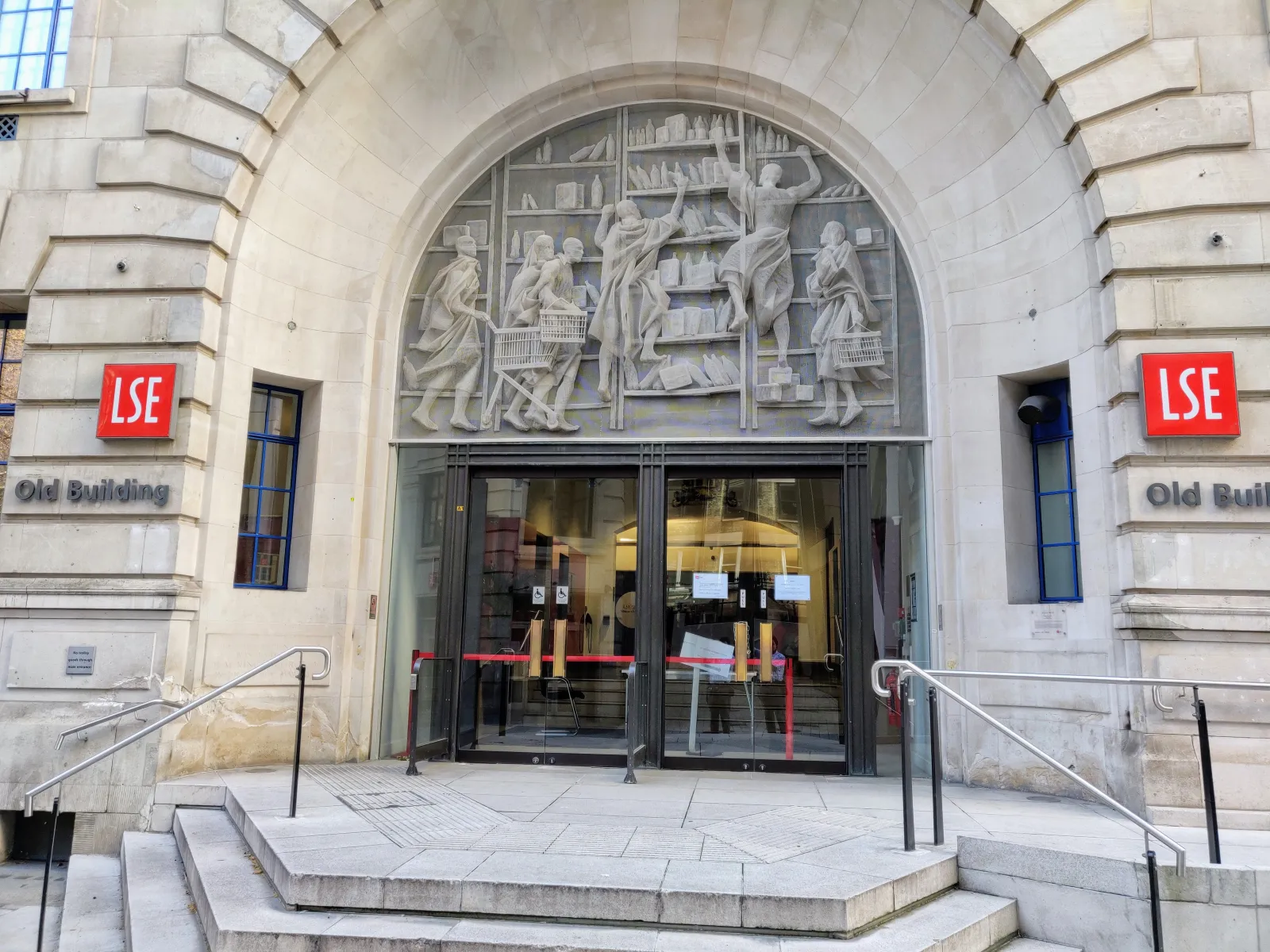
Founded in 1895 by Fabian Society members Sidney and Beatrice Webb, along with Graham Wallas and George Bernard Shaw, the London School of Economics and Political Science was established with a specific mission: the betterment of society through the rigorous study of economics, politics, and the social sciences. Unlike Oxford and Cambridge's broad, collegiate model, LSE is a single-campus, specialist social science institution located in the heart of central London, a few minutes' walk from the Royal Courts of Justice and the West End. LSE does not run a college system -- students belong directly to the School, are taught by academic departments rather than tutors attached to residential colleges, and the university's compact Holborn campus places nearly all teaching, libraries, and student facilities within a short walk of each other. LSE's academic offering concentrates almost entirely on the social sciences: Economics (LSE is consistently ranked among the very top handful of Economics departments worldwide, and has produced numerous Nobel laureates among its faculty and alumni), Law, International Relations, Government, Management, Finance, Accounting, Sociology, and Anthropology sit alongside newer, more technical programmes in Data Science and Statistics. This specialisation means LSE's overall global university rankings (which blend in factors like STEM research output that a specialist social-science school does not compete on) sit noticeably lower than Oxford's or Cambridge's, even though LSE's subject-specific standing in Economics, Politics, and the broader Social Sciences and Management category places it among the world's top 5-10 institutions in those fields specifically -- a distinction prospective applicants should understand before comparing LSE's overall rank directly against Oxbridge. For prospective IELTS or TOEFL candidates, LSE differs from Oxford and Cambridge in two practical ways. First, LSE applies one unified English-language standard across all undergraduate courses rather than a tiered system: IELTS Academic 7.0 overall with 7.0 in every component, or TOEFL iBT 100 overall (component minimums of Writing 27, Reading 25, Listening 24, Speaking 24) -- both of which LSE continues to accept, unlike Cambridge, which has been phasing TOEFL out. Second, LSE follows the standard UK-wide UCAS deadline (mid-January for the following September's entry) rather than Oxford and Cambridge's unusually early mid-October deadline, and LSE does not typically interview undergraduate applicants -- decisions are made holistically from the UCAS form, predicted/achieved grades, personal statement, and reference, with admissions tests required only for a small number of courses.
Rankings
Times Higher Education (THE) World University Rankings · Overall (Global)
#52 (2026)
QS World University Rankings by Subject · Social Sciences and Management
#5 (2026)
QS World University Rankings by Subject · Economics and Econometrics
#8 (2026)
The Guardian University Guide · Overall (UK)
#4 (2026)
Admissions, Requirements & Costs
Requirements, deadlines, and test-score cutoffs differ significantly between undergraduate and graduate/Master's programs — shown separately below.
Undergraduate
Acceptance Rate
6%
Application Fee
$38
Documents required: UCAS application and personal statement, Academic reference from school/college, Predicted or achieved A-Level, IB, or equivalent qualification grades, LNAT for LLB in Laws applicants, English language proficiency test scores (IELTS or TOEFL iBT) for applicants who do not qualify for a waiver, LSE does not typically interview undergraduate applicants; decisions are made holistically from the UCAS application, contextual data, and predicted/achieved grades
| Term | Deadline | Type |
|---|---|---|
| Fall (September/October) | UCAS equal-consideration deadline, mid-January (e.g. 13 January 2027 for September 2027 entry) -- LSE follows the standard UK-wide UCAS deadline, not Oxford and Cambridge's earlier mid-October deadline | Regular Decision |
Test Scores
IELTS Minimum
7 (Gabble rec. 7)
TOEFL Minimum
100 (5 new scale) · Gabble rec. 100 (5 new scale)
PTE Minimum
70
IELTS notes: LSE applies a single unified standard for all undergraduate courses rather than a tiered system: 7.0 overall with a minimum of 7.0 in each of Listening, Reading, Writing, and Speaking, from a single sitting.
TOEFL notes: 100 overall, with component minimums of Writing 27, Reading 25, Listening 24, and Speaking 24. Unlike Cambridge, LSE has not announced plans to discontinue TOEFL; it remains an accepted test alongside IELTS.
TOEFL scores shown as: legacy 0–120 scale (new 1.0–6.0 CEFR-aligned scale, effective Jan 2026).
Accepted tests: IELTS Academic, TOEFL iBT, Cambridge English (C1 Advanced / C2 Proficiency), Pearson Test of English (PTE) Academic, Trinity College London Integrated Skills in English (ISE) III
Waiver: Applicants who are nationals of Canada or a UKVI-recognised majority English-speaking country with English as a first language are generally exempt, as are those who have completed an undergraduate degree (3+ years), a postgraduate taught degree (1+ year), or a PhD taught and assessed entirely in one of those countries.
Conditional admission: LSE's Language Centre runs pre-sessional intensive English courses (including a 5-week standard course) for offer-holders whose English score falls short of the requirement; availability and the exact score gap this can bridge vary and should be confirmed directly with LSE's Language Centre.
Tuition (Intl.)
$41,138
Tuition (Domestic)
$13,119
Living Expenses/yr
$18,693
Total Cost of Attendance
$59,831
Scholarships
LSE Undergraduate Support Scheme
Varies by assessed need; typically in the range of GBP 15,000-25,000/year for the most significant awards
LSE's principal need-based bursary for undergraduates, including international students, providing means-tested financial support toward tuition and living costs for those who can demonstrate they could not otherwise afford to study at LSE.
Eligibility: Assessed through a separate financial-need application after receiving an offer; open to Home and Overseas fee-status undergraduates, though criteria and evidence required differ by fee status
Country- and department-specific undergraduate scholarships
Varies considerably by award; typically a partial tuition contribution
A rotating set of donor-funded scholarships tied to specific countries, regions, or subjects, searchable through LSE's central undergraduate scholarships search tool.
Eligibility: Varies by scholarship; most require an offer of admission and a separate scholarship application
Popular Programs
Gabble Prep Insights
Where applicants lose points: Writing carries particular weight for LSE applicants, since LSE's admissions decisions and later coursework both lean heavily on structured essay-based argument -- the personal statement is scrutinised closely in the absence of an interview for most courses, and LSE's Writing requirement (7.0 IELTS / 27 TOEFL, both above the corresponding overall score) sits deliberately high relative to the overall band.
Because LSE requires 7.0 in every IELTS component rather than allowing a lower score in one section to be offset by a higher one elsewhere, applicants who are strong overall but uneven across sections (commonly Writing or Speaking trailing Reading and Listening) are more likely to fall just short of LSE's requirement than at universities using an averaged overall-only threshold.
Figures above were converted from GBP at approximately 1 GBP = 1.34 USD, consistent with the conversion rate used elsewhere on this site. The Home (UK-domiciled) undergraduate fee is fixed government-wide at GBP 9,790/year for 2026-27, identical to Oxford's and Cambridge's Home rate since it is set by government regulation. LSE does not set one university-wide Overseas undergraduate fee; instead each course sits in one of several bands, from GBP 28,900/year (most Humanities, Geography, History, Politics, and Social Anthropology courses) up to GBP 39,900/year (BSc Economics, BSc Econometrics and Mathematical Economics) -- the figure used here, GBP 30,700 (~USD 41,138), is one of the most common Overseas tiers across LSE's course list (covering, among others, Actuarial Science, International Relations, and Politics and Economics), chosen as representative rather than the higher Economics/Finance-adjacent outlier; always check the specific course page (source: LSE's official '2026/27 Fee Levels' Table of Fees). Living costs were estimated from LSE's own official monthly budget guidance of GBP 1,550 (covering accommodation, food, travel, and personal expenses), applied over a 9-month undergraduate term-time year (GBP 13,950); LSE states this is a broad estimate that varies by individual circumstances. The 6% acceptance rate reflects LSE's own widely reported 2025-cycle figure of roughly 1,900 places from around 30,000 UCAS applications; LSE's offer rate (offers made, as distinct from places ultimately filled) runs meaningfully higher, close to 16%, and both figures mask large course-by-course variation -- Philosophy, Politics and Economics and Politics and International Relations run considerably more selective than the average. The UCAS application fee (GBP 28.50 for the 2026 cycle, covering up to five course choices) is paid to UCAS, not directly to LSE; LSE itself does not charge a separate undergraduate application fee.
Recommended prep timeline: 12 weeks
Graduate (Master's & PhD)
Application Fee
$127
Documents required: Statement of purpose, Two academic and/or professional references, Official transcripts from all previously attended institutions, CV/resume, Research proposal (for MPhil/PhD and MRes/PhD applicants), English language proficiency test scores (if applicable), GMAT or GRE score, accepted (though not universally required) for some Finance, Management, and Economics-related courses -- check the specific course page, Relevant professional work experience documentation, expected for several Executive Master's and MPA programmes
| Term | Deadline | Type |
|---|---|---|
| Fall (September/October) | Rolling, course-specific deadlines through the admissions cycle; the most competitive taught master's courses (including MSc Economics and several Finance and Management programmes) typically fill well ahead of any final advertised deadline, so early application is strongly recommended | Rolling |
Test Scores
IELTS Minimum
7 (Gabble rec. 7.5)
TOEFL Minimum
100 (5 new scale) · Gabble rec. 100 (5 new scale)
PTE Minimum
70
IELTS notes: LSE applies two named graduate tiers: 'Standard,' used by most taught master's courses, requires 7.0 overall with no element below 6.5; 'Higher,' used by a smaller set of writing- and language-intensive courses (including MSc Media and Communications, MSc Global Media and Communications, and select LLM specialisations), requires 8.0 overall with no element below 7.5. Always confirm which tier applies to your specific course.
TOEFL notes: LSE's graduate Standard tier is understood to align closely with the undergraduate TOEFL requirement (100 overall, with a Writing sub-score of at least 24 commonly cited), while Higher-tier courses require a meaningfully higher score; this dataset treats the graduate TOEFL figure as approximate and recommends confirming the exact component minimums on the specific course's English-language requirements page, since LSE does not publish one single consolidated table.
TOEFL scores shown as: legacy 0–120 scale (new 1.0–6.0 CEFR-aligned scale, effective Jan 2026).
Accepted tests: IELTS Academic, TOEFL iBT, Cambridge English (C1 Advanced / C2 Proficiency), Pearson Test of English (PTE) Academic
Waiver: Applicants who are nationals of Canada or a UKVI-recognised majority English-speaking country with English as a first language are generally exempt, as are those who have completed an undergraduate degree (3+ years), a postgraduate taught degree (1+ year), or a PhD taught and assessed entirely in one of those countries.
Conditional admission: LSE's Language Centre offers pre-sessional English courses for offer-holders whose English score falls short of their course's requirement; exact eligibility and the size of the score gap this can bridge vary by course and should be confirmed directly with LSE's Language Centre.
Tuition (Intl.)
$40,736
Tuition (Domestic)
$24,522
Living Expenses/yr
$24,924
Total Cost of Attendance
$65,660
Scholarships
LSE Graduate Support Scheme (GSS)
Typically GBP 5,000-20,000, depending on assessed need
LSE's flagship need-based master's scholarship scheme, distributing roughly GBP 3 million annually to diploma and taught master's students of any nationality (Home or Overseas fee status) who can demonstrate financial need.
Eligibility: Open to offer-holders on eligible taught master's or diploma courses; assessed through a separate need-based application, generally submitted after an offer is received
Country- and department-specific graduate scholarships
Varies considerably by award; from partial tuition contributions up to full-cost awards for the most competitive schemes
A rotating set of donor-funded scholarships tied to specific countries, regions, or subjects (including several dedicated South Asia, Africa, and Commonwealth-linked awards), searchable through LSE's central graduate scholarships search tool.
Eligibility: Varies by scholarship; most require an offer of admission and a separate scholarship application, often nationality- or subject-specific
Popular Programs
Gabble Prep Insights
Where applicants lose points: Writing is consistently the toughest section for LSE graduate applicants, since a research-focused, tightly argued statement of purpose and, for most social-science and Humanities master's courses, extensive essay-based coursework and dissertations demand sustained academic argument well beyond conversational English.
Applicants to quantitative courses such as MSc Data Science, MSc Statistics, or MSc Financial Mathematics tend to clear Reading and Listening comfortably but sometimes underprepare Writing for the dissertation and research-proposal components common across LSE graduate study, while applicants to Higher-tier courses (Media and Communications, several LLM specialisations) most often need focused extra preparation across all four components to reach the 8.0/7.5 threshold.
Figures above were converted from GBP at approximately 1 GBP = 1.34 USD. LSE does not set one university-wide graduate tuition figure; fees vary enormously by course, and unusually, a large number of LSE's most popular taught master's programmes (including MSc Economics, MSc Finance, MSc Management and Strategy, and MSc Data Science) charge an identical fee to Home and Overseas students rather than the Home/Overseas differential typical elsewhere -- for example, MSc Economics is GBP 41,000/year and MSc Finance is GBP 51,000/year for all students regardless of fee status. The figures used here, GBP 18,300 Home (~USD 24,522) / GBP 30,400 Overseas (~USD 40,736), represent the single most common fee pairing across LSE's course list (used for many Social Sciences, Gender, Development, Culture, and Sociology-adjacent master's), chosen as a representative modal figure rather than the higher Economics/Finance/Management outliers noted above; always check the specific course page (source: LSE's official '2026/27 Fee Levels' Table of Fees). Living costs were estimated from LSE's own official monthly budget guidance of GBP 1,550, applied over a 12-month graduate year (GBP 18,600); LSE states this is a broad estimate that varies by individual circumstances. GMAT/GRE: LSE does not require a GRE/GMAT score for the great majority of graduate courses; a small number of Finance, Management, and Economics-related courses accept, but do not universally require, a GMAT or GRE score, and LSE does not publish one official aggregate average score, so avgScore is left null. LSE does not publish one official aggregate postgraduate acceptance rate, so that field is left null rather than estimated from unreliable third-party sources. The graduate application assessment fee is GBP 95 (~USD 127, used above), per LSE's official online store listing.
Recommended prep timeline: 12 weeks
Programs Offered
BSc Economics
Undergraduate · 3 yr
BSc Politics and International Relations
Undergraduate · 3 yr
LLB in Laws
Undergraduate · 3 yr
BSc Management
Undergraduate · 3 yr
BSc Data Science
Undergraduate · 3 yr
MSc Economics
Masters · 1 yr · $54,940/yr
MSc Finance (Full Time)
Masters · 1 yr · $68,340/yr
Master of Public Administration (MPA)
Masters · 1 yr
Master of Laws (LLM)
Masters · 1 yr
PhD
PhD · 4 yr
Campus Life
LSE's compact, single campus sits in central London around Houghton Street, a short walk from Covent Garden and the Royal Courts of Justice, which shapes a distinctly urban, non-residential campus culture compared to the collegiate model at Oxford and Cambridge -- most students live in university-managed halls or private accommodation across London rather than in a residential college. The LSE Students' Union runs more than 200 recognised student societies and sports clubs, spanning academic, cultural, political, and hobby interests, reflecting a highly international, politically engaged student body drawn from well over 140 countries. The Beaver, LSE's independent student newspaper founded in 1949, is one of the longest-running student publications in the UK. Given the School's social science focus, LSE's public events programme -- regularly featuring heads of state, Nobel laureates, and leading public intellectuals as guest speakers -- is a distinctive feature of student life, with most talks free and open to students.
Notable clubs: LSE Students' Union (LSESU) and its Athletics Union (AU), LSESU Debate Society, The Beaver, LSE's independent student newspaper, LSE Students' Union Rugby, Football, and Boat clubs among 200+ recognised societies, LSE Economics Society and LSE SU Finance Society
Outcomes
Undergraduate
Graduate
Notable Alumni
George Soros — Financier and philanthropist; studied at LSE under philosopher Karl Popper
Ursula von der Leyen — President of the European Commission; completed part of her economics studies at LSE
Ed Miliband — Former Leader of the UK Labour Party and Cabinet minister; holds a Master's in Economics from LSE
Amartya Sen — Nobel laureate economist; studied and later held a professorship at LSE
Thomas Piketty — Economist and author of Capital in the Twenty-First Century; completed his PhD in Economics at LSE
Pierre Trudeau — Former Prime Minister of Canada; undertook postgraduate studies at LSE
Visa Interview Prep
The UK Student visa process differs procedurally from the US F-1 system: there is no SEVP certification or routine embassy interview requirement built into the standard route, and the centrepiece document is the CAS, which LSE issues once a firm offer is accepted and all academic and financial conditions are met. Applicants must show they hold the required funds -- broadly the tuition amount shown on the CAS for the first year of the course, plus living-cost funds calculated using UKVI's published monthly rate for inner/outer London (LSE sits within the higher inner-London maintenance requirement band) -- always confirm the current published figure before applying. A CAS is valid for use in a visa application for 6 months from the date it is issued. International students must also budget separately for the visa application fee and the Immigration Health Surcharge (IHS), which are paid upfront to UKVI and are not included in LSE's living-cost estimates. LSE recommends applying for the Student visa as soon as the CAS is issued so that UKVI processing times and any pre-arrival requirements (such as a tuberculosis test for applicants from certain countries) can be built into the timeline before a September/October start. The UK government has at times applied temporary restrictions affecting nationals of specific countries; applicants should check current guidance close to their intended application date.
- UK Student visa applicants typically do NOT attend an in-person visa interview the way US F-1 applicants do -- most applications are decided from the online form, supporting financial and academic documents, and the CAS (Confirmation of Acceptance for Studies) LSE issues once a firm, unconditional offer is held
- UKVI may conduct a short credibility interview (in person or by video) in specific risk-based cases, focused on genuine intent to study, knowledge of the course, and financial means
FAQs
What IELTS score do I need to apply to LSE as an undergraduate?Undergrad
LSE undergraduate applicants need a minimum overall IELTS Academic score of 7.0, with 7.0 required in every component (Listening, Reading, Writing, and Speaking) from a single sitting. Unlike some universities, LSE does not allow a lower score in one component to be offset by a higher score elsewhere.
Does LSE still accept TOEFL?
Yes. LSE accepts TOEFL iBT for both undergraduate and graduate applications and has not announced plans to discontinue it, unlike Cambridge, which is phasing TOEFL out. The undergraduate requirement is 100 overall with component minimums of Writing 27, Reading 25, Listening 24, and Speaking 24.
Does LSE interview undergraduate applicants like Oxford and Cambridge?Undergrad
No. LSE does not typically interview undergraduate applicants. Decisions are made holistically based on the UCAS application form -- predicted and achieved grades, the personal statement, the school reference, and contextual data -- rather than through an interview process.
What's LSE's UCAS deadline?Undergrad
LSE follows the standard UK-wide UCAS equal-consideration deadline in mid-January (for example, 13 January 2027 for September 2027 entry), which is notably later than Oxford and Cambridge's earlier mid-October deadline.
Will I need to attend a visa interview to study at LSE, the way US F-1 applicants do?
Almost certainly not. The UK Student visa route generally does not build in a routine in-person interview; your application is assessed from the online form, financial evidence, and the CAS (Confirmation of Acceptance for Studies) LSE issues once you hold a firm, unconditional offer. UKVI can request a short credibility interview in specific cases, but this is the exception, unlike the US F-1 visa's standard consular interview.
Why does LSE's overall world ranking look lower than Oxford's or Cambridge's if it's so prestigious for Economics?
LSE is a specialist social-science institution with no engineering, medicine, or natural-sciences faculties, so overall global rankings (which weigh broad research output and STEM metrics heavily) place it well behind comprehensive universities like Oxford and Cambridge. Judged on its own specialism, though, LSE ranks among the world's top 5-10 institutions for Economics and the Social Sciences and Management category specifically.
Is the GRE or GMAT required for LSE graduate programmes?Grad
Most LSE master's and PhD courses do not require a GRE or GMAT score at all. A small number of Finance, Management, and Economics-related courses accept, but do not universally require, a GMAT or GRE score -- always check the specific course page for current policy.
Can I get a waiver for the IELTS/TOEFL requirement at LSE?
Yes, in certain cases. You're generally exempt if you're a national of Canada or a UKVI-recognised majority English-speaking country with English as a first language, or if you've completed a qualifying degree (undergraduate, postgraduate taught, or PhD) taught and examined entirely in English in one of those countries.
How competitive is LSE for international applicants?
Very. LSE's widely reported 2025-cycle figures show roughly 1,900 undergraduate places filled from around 30,000 UCAS applications, an overall acceptance rate close to 6%, though LSE's offer rate (as distinct from places ultimately filled) runs closer to 16%. Both figures mask large course-by-course variation -- Philosophy, Politics and Economics and Politics and International Relations run considerably more selective than the average.
How many weeks should I spend preparing for IELTS or TOEFL before applying to LSE?
A realistic window is 10-12 weeks of focused preparation, with particular attention to Writing, since LSE requires an even 7.0 across every IELTS component (or the equivalent balanced TOEFL profile) rather than allowing a strong overall score to offset a weaker single section.