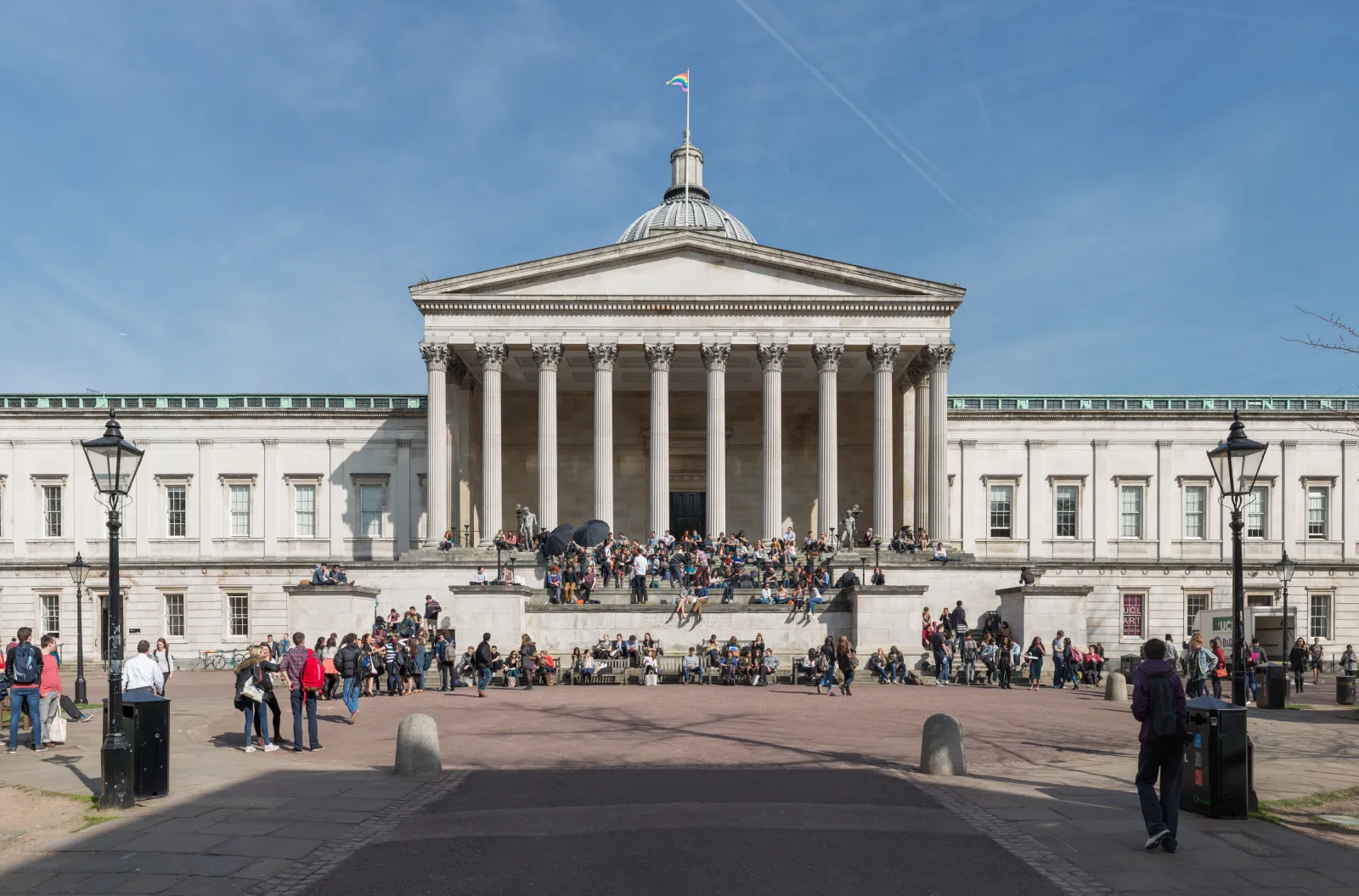

University College London
London, England, United Kingdom · Established 1826
Official website ↗Total Students
51,793
Intl. Students
52%
Student:Faculty
10.9:1
Setting
Urban
Overview
University College London was founded in 1826 as "London University," the capital's first university institution and, notably, the first in England to admit students without regard to their religion at a time when Oxford and Cambridge still required allegiance to the Church of England. In 1878 it became one of the earliest UK universities to admit women on equal terms with men. For most of its history UCL operated as a constituent college of the federal University of London, a relationship that formally ended in 2008 when UCL became an independent degree-awarding university in its own right, free to set its own academic strategy while keeping the University College London name. What distinguishes UCL from many of its research-intensive UK peers is sheer breadth: unlike Imperial College London or the London School of Economics, UCL spans essentially every discipline, from the Bartlett Faculty of the Built Environment and the UCL Institute of Education (both ranked first in the world for their subjects) to the Faculty of Laws, the Slade School of Fine Art, and a large Faculty of Medical Sciences tracing back to some of London's oldest teaching hospitals. UCL added a dedicated business school, the UCL School of Management, in 2016, based partly at Canary Wharf among London's financial institutions, and in the early 2020s opened an entirely new campus, UCL East, on Queen Elizabeth Olympic Park in Stratford, alongside its historic Bloomsbury home in central London. The university is closely associated with Jeremy Bentham, whose preserved "Auto-Icon" is displayed on campus and whose utilitarian philosophy is often cited as UCL's intellectual inspiration, even though he took no direct part in founding it. UCL's applicant pool is thoroughly international -- slightly more than half of its roughly 52,000 students come from outside the UK, drawn from well over 150 countries, making it one of the largest and most globally mixed research universities in Europe. Undergraduate admission runs through the UK's centralised UCAS system, evaluated against A-Level, International Baccalaureate, or equivalent qualification grades rather than the SAT/ACT-and-GPA model familiar to US applicants. Postgraduate admissions are decentralised by department, with English-language thresholds, application fees, and (for a handful of quantitative or business programmes) GRE/GMAT expectations that vary considerably across UCL's eleven faculties. For prospective IELTS or TOEFL candidates, this combination of academic breadth and international density means UCL classrooms routinely mix native and non-native English speakers across every subject, not just STEM fields.
Rankings
Times Higher Education (THE) World University Rankings · Overall (Global)
#22 (2026)
US News Best Global Universities · Overall (Global)
#9 (2027)
QS World University Rankings by Subject · Education
#1 (2026)
QS World University Rankings by Subject · Architecture & Built Environment
#1 (2026)
QS World University Rankings by Subject · Medicine
#6 (2026)
QS World University Rankings by Subject · Archaeology
#3 (2026)
Admissions, Requirements & Costs
Requirements, deadlines, and test-score cutoffs differ significantly between undergraduate and graduate/Master's programs — shown separately below.
Undergraduate
Acceptance Rate
43.4%
Application Fee
$39
Documents required: UCAS application and personal statement, Academic reference from school/college, Predicted or achieved A-Level, IB, or equivalent qualification grades, Official secondary school transcripts and GCSE (or equivalent) results, including grade B/6 or above in English Language and Mathematics, Course-specific admissions test where required (e.g. LNAT for Law, UCAT for Medicine), English language proficiency test scores (IELTS/TOEFL/PTE/Duolingo) for applicants who do not qualify for a waiver
| Term | Deadline | Type |
|---|---|---|
| Fall (September) | UCAS: mid-October (18:00 UK time) for Medicine, Dentistry, and Oxbridge-equivalent early-deadline courses; mid-January (18:00 UK time, equal consideration deadline) for the large majority of other undergraduate courses | Regular Decision |
Test Scores
IELTS Minimum
6.5 (Gabble rec. 7)
TOEFL Minimum
92 (4.5 new scale) · Gabble rec. 100 (5 new scale)
PTE Minimum
62
IELTS notes: UCL uses five internal 'levels': Level 1 (Standard) 6.5 overall with 6.0 in each component covers most undergraduate courses; Level 2 requires 7.0 overall with 6.5 in each component; Levels 3-5 (7.0/7.0, 7.5/7.0, and 8.0/8.0) apply to a smaller number of more demanding courses. IELTS General Training is not accepted -- only IELTS Academic.
TOEFL notes: Standard level: 92 overall (Reading 24, Listening 20, Writing 24, Speaking 20); Good level: 100 overall with the same section floors; Advanced level (for the most demanding courses): 109 overall with a higher Writing requirement of 30.
TOEFL scores shown as: legacy 0–120 scale (new 1.0–6.0 CEFR-aligned scale, effective Jan 2026).
Accepted tests: IELTS Academic, TOEFL iBT, PTE Academic, Duolingo English Test
Waiver: Applicants who are nationals of, and have been resident throughout the preceding two years in, a UK Home Office-recognised majority English-speaking country are generally exempt, as are those completing an undergraduate degree taught and assessed in English in a small list of recognised countries immediately before applying.
Conditional admission: UCL's Centre for Languages & International Education (CLIE) runs pre-sessional English courses of varying lengths for admitted students who narrowly miss the required score, allowing them to reach the threshold before their course begins.
Tuition (Intl.)
$62,578
Tuition (Domestic)
$13,119
Living Expenses/yr
$22,063
Total Cost of Attendance
$84,641
Scholarships
UCL Global Undergraduate Scholarship
Full tuition fees for the standard duration of the degree; a smaller subset of awards also include a maintenance/living allowance
A need-based scholarship for international undergraduate applicants from lower-income backgrounds, offering either full tuition plus a maintenance allowance or full tuition alone, awarded competitively across a fixed number of places each cycle.
Eligibility: Open to applicants of any non-UK nationality applying for a full-time undergraduate degree who meet UCL's household income threshold (guided at roughly GBP 42,875 or below) and have their fee status confirmed as Overseas; requires a separate scholarship application alongside the UCAS application
Faculty and departmental undergraduate scholarships
Varies by award, typically a partial tuition contribution
Individual faculties and UCL's central scholarships search tool list a rotating set of merit- and country-specific awards that partially offset the overseas fee for particular subjects or regions.
Eligibility: Varies by scholarship; most require an offer of admission and a separate application through UCL's scholarships search portal
Popular Programs
Gabble Prep Insights
Where applicants lose points: Speaking tends to be the weakest section for undergraduate applicants, particularly to Law and Medicine, where UCL's admissions tests (LNAT, UCAT) and interviews reward quick, articulate spoken reasoning that many secondary curricula outside English-medium systems do not directly train.
Applicants from strong academic backgrounds usually clear Reading and Listening comfortably, since UCL's five-level IELTS/TOEFL system is calibrated close to what a capable A-Level or IB student would need anyway, but Writing scores often lag because UCL's essay-based humanities and social science courses expect sustained argument-building that differs from general-purpose exam writing practice.
Figures above were converted from GBP at approximately 1 GBP = 1.34 USD. The Home (UK-domiciled) undergraduate fee is fixed government-wide at GBP 9,790/year for 2026-27. Overseas fees are set per course rather than as one university-wide figure: published 2026-27 ranges run from roughly GBP 32,000-36,000 for many Arts/Humanities and Social Science courses up to GBP 46,700 for laboratory-based science courses like Computer Science BSc (used here as the representative figure) and above GBP 50,000-57,300 for Medicine MBBS -- always check the specific course page. The UCAS application fee for 2026 entry is GBP 28.95 (covers up to five course choices). Living costs were estimated by combining UCL's own stated non-accommodation essentials estimate (GBP 3,985 for a 39-week academic year) with an average undergraduate halls rate of roughly GBP 320/week, which is a guide only -- UCL explicitly states this is not a full cost-of-living estimate and excludes discretionary spending. UCL's overall undergraduate acceptance rate is not published as one figure; 43.4% reflects a recent aggregate offer rate (offers/applications), but this varies enormously by course -- LLB Law has run as low as 6-9%, while less oversubscribed courses run much higher.
Recommended prep timeline: 10 weeks
Graduate (Master's & PhD)
Acceptance Rate
38%
Application Fee
$121
Documents required: Statement of purpose / personal statement, Two academic (or academic plus professional) references, Official transcripts from all previously attended institutions, CV/resume, English language proficiency test scores (if applicable), GRE or GMAT scores (only required by a small number of quantitative or Business School-affiliated programmes, e.g. MSc Economics; not required for most taught master's or the UCL MBA), Portfolio, writing sample, or additional test scores for select programmes (e.g. UCL School of Management, Slade School of Fine Art)
| Term | Deadline | Type |
|---|---|---|
| Fall (September) | Rolling and department-specific; most taught master's open around October/November of the prior year and close once full, with competitive programmes (e.g. Business School MSc/MBA and Computer Science) often filling by December-March | Rolling |
Test Scores
IELTS Minimum
6.5 (Gabble rec. 7)
TOEFL Minimum
92 (4.5 new scale) · Gabble rec. 96 (5 new scale)
PTE Minimum
62
IELTS notes: UCL's five-level system applies at postgraduate level too: Level 1 (Standard) is 6.5 overall with 6.0 in each component; the UCL School of Management and a number of other departments require Level 2 (7.0 overall, 6.5 in each component) or higher.
TOEFL notes: Standard level: 92 overall with at least 20-24 per section; the UCL School of Management's MBA specifies 96 overall (Reading/Writing 24, Listening/Speaking 22); some departments require the higher Advanced level (109) with a 30 Writing floor.
TOEFL scores shown as: legacy 0–120 scale (new 1.0–6.0 CEFR-aligned scale, effective Jan 2026).
Accepted tests: IELTS Academic, TOEFL iBT, PTE Academic, Duolingo English Test
Waiver: Applicants who are nationals of, and resident throughout the preceding two years in, a UK Home Office-recognised majority English-speaking country are generally exempt, as are those who completed a degree taught and examined in English in a recognised country immediately before applying.
Conditional admission: UCL's Centre for Languages & International Education runs pre-sessional English programmes for admitted postgraduate students below the required score; some departments, including the UCL School of Management, restrict or do not accept this route in place of a qualifying direct test score.
Tuition (Intl.)
$57,238
Tuition (Domestic)
$28,810
Living Expenses/yr
$30,603
Total Cost of Attendance
$87,841
Scholarships
UCL Global Master's Scholarship
GBP 15,000 toward one year of study
A need-based scholarship for international (Overseas fee status) students starting a full-time taught master's degree, aimed at widening access for applicants from lower-income backgrounds who would otherwise struggle to afford UCL.
Eligibility: Overseas fee status, full-time taught master's applicants (in-person only, not distance learning) who can demonstrate financial need; requires a complete admissions application including references before applying
International Masters Awards / faculty postgraduate scholarships
Varies by award, typically a partial tuition contribution
A wider set of merit- and department-specific awards, coordinated through UCL's scholarships search tool, that partially offset postgraduate taught tuition for students from a range of backgrounds and countries.
Eligibility: Varies; most require an offer of admission and a separate scholarship application
Popular Programs
Gabble Prep Insights
Where applicants lose points: Writing is typically the weakest section for graduate applicants, since a research-oriented statement of purpose and, for many programmes, a technical or academic writing sample demand a level of structured written English well beyond conversational or general exam-prep fluency.
Applicants to quantitative MSc programmes (Computer Science, Data Science, Economics) tend to post strong Reading/Listening scores but need extra Speaking practice for group project work or interviews, while UCL School of Management applicants (MBA, MSc Finance/Management) most often need additional Writing polish given the essay- and case-study-heavy application process.
Figures above were converted from GBP at approximately 1 GBP = 1.34 USD, using MSc Computer Science (GBP 21,500 Home / GBP 42,700 Overseas, 2026-27) as a representative taught master's course, since UCL does not publish one university-wide postgraduate tuition figure -- published 2026-27 Overseas ranges for taught master's run from roughly GBP 26,200 up to GBP 57,700 depending on course. The standard postgraduate taught application fee is GBP 90, rising to GBP 160 for four specific UCL School of Management programmes (Business Analytics, Finance, Management, and Project & Enterprise Management MSc). GMAT/GRE: the UCL MBA explicitly does NOT require a GMAT, GRE, or equivalent standardised test score, so no combined score range is published for it. GRE is required for one specific quantitative programme, MSc Economics, which asks for a Quantitative Reasoning score of at least 162 -- this is a section (sub-)score on the 130-170 GRE Quant scale, not a combined overall score (260-340 scale), so per this dataset's rule we have left the combined gre.min/max/avgScore fields null rather than fabricate a combined figure from a single section requirement. UCL's overall postgraduate taught acceptance rate is not published as one figure; 38% reflects a recent aggregate offer rate that varies enormously by course (some specialised MSc programmes run near 6-8%, while the part-time/flexible MBA runs far higher).
Recommended prep timeline: 12 weeks
Programs Offered
Computer Science BSc
Undergraduate · 3 yr
Economics BSc (Econ)
Undergraduate · 3 yr
Medicine MBBS BSc
Undergraduate · 6 yr
Architecture BSc
Undergraduate · 3 yr
Natural Sciences BSc
Undergraduate · 3 yr
Law LLB
Undergraduate · 3 yr
Computer Science MSc
Masters · 1 yr · $57,238/yr
MBA / UCL Flex MBA
Masters · 1 yr
Finance MSc
Masters · 1 yr · $64,675/yr
PhD (MPhil/PhD)
PhD · 4 yr
Campus Life
UCL's historic home is the Bloomsbury campus in central London, a short walk from the British Museum and the British Library, and central to daily student life alongside teaching buildings, libraries, and the Students' Union's cafes, bars, and shop. Since the early 2020s UCL has expanded onto a second site, UCL East, on Queen Elizabeth Olympic Park in Stratford, adding new teaching and research space for engineering, design, and interdisciplinary programmes without displacing the original Bloomsbury base. Students' Union UCL runs more than 300 clubs and societies spanning sport, academic and cultural interests, and performing arts, including some of the country's oldest student groups, and is unusually active in supporting UCL's large international population through country- and region-specific societies. A distinctive fixture of campus culture is the preserved Auto-Icon of Jeremy Bentham, displayed in the UCL Student Centre as a nod to the philosopher long linked to the university's founding ideals.
Notable clubs: Students' Union UCL, The Debating Society (founded 1829 as the Literary and Philosophical Society), UCL Film & TV Society (founded 1948), UCL Rowing Club, Bloomsbury Theatre student productions
Outcomes
Undergraduate
Employed within 6mo
87%
Avg. Starting Salary
$45,560
Graduate
Employed within 6mo
87%
Avg. Starting Salary
$46,900
Notable Alumni
Mahatma Gandhi — Leader of the Indian independence movement; studied law at UCL's Faculty of Laws
Francis Crick — Co-discoverer of the structure of DNA; shared the 1962 Nobel Prize in Physiology or Medicine
Alexander Graham Bell — Inventor of the telephone; attended lectures at UCL's medical school
Christopher Nolan — Film director known for 'Inception,' 'Interstellar,' and 'Oppenheimer'; studied English Literature at UCL
Ricky Gervais — Comedian, actor, and writer known for 'The Office'; studied Philosophy at UCL
Visa Interview Prep
The UK Student visa process differs procedurally from the US F-1 system: there is no SEVP certification or embassy interview requirement built into the standard route, and the centrepiece document is the CAS UCL issues once a firm offer is accepted, the tuition deposit (where required) is paid, and any conditions are met. Applicants must also show they hold the required funds -- broadly the first year's tuition fee shown on the CAS plus living cost funds of roughly GBP 1,334 per month (up to 9 months, i.e. up to about GBP 12,006) for courses in London. UCL recommends international offer-holders complete the CAS request process and apply for their Student visa as early as possible once their CAS is issued, since UKVI processing times and any pre-arrival requirements (such as a tuberculosis test for applicants from certain countries) need to be built into the timeline before a September start.
- UK Student visa applicants typically do NOT attend an in-person visa interview the way US F-1 applicants do -- most applications are decided from the online form, supporting financial and academic documents, and the CAS (Confirmation of Acceptance for Studies) issued by UCL
- UKVI may conduct a short credibility interview (in person or by video) in specific risk-based cases, focused on genuine intent to study, knowledge of the course, and financial means
FAQs
What IELTS score do I need to apply to UCL as an undergraduate?Undergrad
Most undergraduate courses ask for UCL's Standard level: 6.5 overall with at least 6.0 in each of the four components. A smaller number of courses set higher internal levels (up to 7.0-8.0 overall). Only IELTS Academic is accepted -- IELTS General Training is not -- and you should always confirm the exact requirement on your specific course page.
Does UCL use the Common Application like US universities?Undergrad
No. UCL only accepts undergraduate applications through UCAS, the UK's centralised admissions service, where you list up to five course choices alongside one personal statement. There is no UCL-specific supplemental essay portal comparable to the additional essays many US universities require.
Will I need to attend a visa interview to study at UCL, like the US F-1 process?
Almost certainly not. The UK Student visa route generally does not build in an in-person interview requirement; your application is assessed from the online form, financial evidence, and the CAS (Confirmation of Acceptance for Studies) UCL issues once you accept your offer. UKVI reserves the right to request a short credibility interview in specific cases, but this is the exception rather than the standard process, unlike the US F-1 visa's routine consular interview.
What A-Level or IB grades do I need instead of an SAT/ACT score?Undergrad
UCL does not use the SAT or ACT for admissions decisions. Undergraduate offers are expressed as A-Level grade requirements (commonly ranging from A*AA to ABB depending on course and context) or an IB total (often around 39 points with specific Higher Level subject scores), alongside GCSE English Language and Mathematics at grade B/6 or above, and any course-specific admissions test such as the LNAT for Law or UCAT for Medicine.
Is the GRE or GMAT required for UCL's master's programmes?Grad
Only for a small number of courses. The UCL MBA explicitly does not require a GMAT, GRE, or equivalent test score. MSc Economics is a notable exception and requires a GRE Quantitative Reasoning score of at least 162. Most other taught master's programmes at UCL do not require either test.
Can I get a waiver for the IELTS/TOEFL requirement at UCL?
Yes, if you are a national of (and have lived in, for the two years before applying) a UK Home Office-recognised majority English-speaking country, or you completed a qualifying degree taught and examined in English in a recognised country immediately before applying. Waivers are assessed as part of your standard application.
Does UCL offer conditional admission if my English score is slightly below the requirement?
Yes, in most cases. UCL's Centre for Languages & International Education runs pre-sessional English courses of varying lengths that let admitted students reach the required score before their course starts. Some departments, including the UCL School of Management, do not accept pre-sessional completion in place of a qualifying direct test score, so always check your specific department's policy.
How competitive is UCL for international applicants?
It varies sharply by course. UCL's aggregate undergraduate offer rate has recently run around 43%, but this masks huge variation -- LLB Law has run as low as 6-9% -- while postgraduate taught offer rates average around 38% overall, with some specialised MSc programmes admitting a much smaller share of applicants and others admitting far more.
How many weeks should I spend preparing for IELTS or TOEFL before applying to UCL?
A realistic window is 10-12 weeks of focused preparation. Undergraduate applicants, especially to Law and Medicine, often need the most work on Speaking given UCL's admissions tests and interviews, while graduate applicants -- particularly to research-based or Business School programmes -- tend to need extra time on Writing.
As an international student, can I get need-based financial aid at UCL?
Yes, to a greater extent than at many UK universities. UCL runs the Global Undergraduate Scholarship and the Global Master's Scholarship specifically for international (Overseas fee status) students from lower-income backgrounds, both awarded on demonstrated financial need rather than academic merit alone, alongside a wider set of merit-based departmental awards.