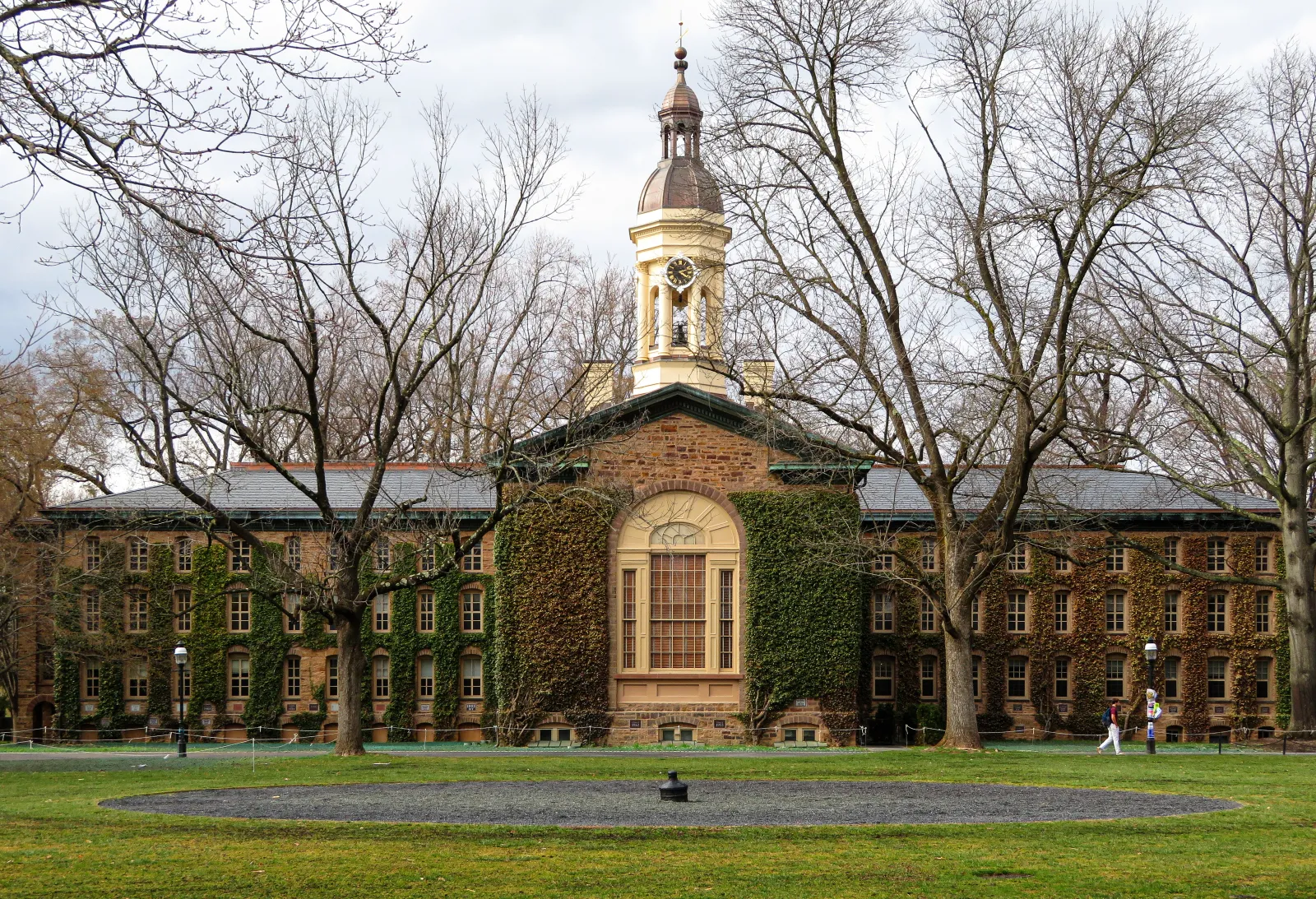

Princeton University
Princeton, New Jersey, United States · Established 1746
Official website ↗Total Students
9,137
Intl. Students
24%
Student:Faculty
5:1
Setting
Suburban
Overview
Princeton University is a private Ivy League research university in Princeton, New Jersey, founded in 1746 as the College of New Jersey, making it the fourth-oldest institution of higher education in the United States. It is organized around undergraduate liberal arts education delivered through 37 departmental concentrations plus dozens of interdisciplinary certificate programs, alongside a comparatively small but highly selective Graduate School offering master's and doctoral study across the humanities, social sciences, natural sciences, and engineering (via the School of Engineering and Applied Science). Unlike several Ivy peers, Princeton has no law, medical, or business school, which keeps its overall enrollment small relative to its research output and endowment. For prospective international applicants, Princeton is notable for its need-blind admission policy that extends to every applicant regardless of citizenship, and for meeting full demonstrated financial need without loans for admitted students. Academically it is consistently ranked at or near the top of US national university rankings, with particular strength in economics, public policy, mathematics, physics, and computer science. The undergraduate class size is deliberately kept small, producing one of the lowest student-faculty ratios among major research universities. The campus sits in the suburban town of Princeton, roughly an hour from both New York City and Philadelphia, giving students access to major internship and career markets while retaining a self-contained, walkable college-town environment. International students make up a meaningful share of both the undergraduate and graduate populations, with a dedicated Davis International Center supporting visa, cultural, and academic transition needs.
Rankings
US News National Universities
#1 (2026)
QS World University Rankings · Overall (USA)
#11 (2026)
QS World University Rankings by Subject · Economics and Econometrics
#5 (2026)
QS World University Rankings by Subject · Computer Science and Information Systems
#14 (2025)
US News Best Graduate Schools · Graduate - Economics (tied with Harvard, MIT, Stanford, Chicago, Yale)
#1 (2025)
US News Best Graduate Schools · Graduate - Public Affairs (SPIA)
#11 (2025)
Admissions, Requirements & Costs
Requirements, deadlines, and test-score cutoffs differ significantly between undergraduate and graduate/Master's programs — shown separately below.
Undergraduate
Acceptance Rate
4.4%
Application Fee
$70
Documents required: Common Application or Coalition Application, Official Transcripts / School Report, Two Teacher Recommendations, Counselor Recommendation, Graded Written Paper, Standardized Test Scores (test-optional through the 2026-27 cycle), English Proficiency Test (TOEFL/IELTS/PTE/Duolingo) for applicants whose first language is not English
| Term | Deadline | Type |
|---|---|---|
| Fall | November 1 | Early Action |
| Fall | January 1 | Regular Decision |
Test Scores
SAT Range
1510–1580
ACT Range
34–35
Accepted tests: IELTS, TOEFL, PTE, Duolingo
Waiver: The test is waived if English is the applicant's native language, or if the applicant has completed at least three years of full-time secondary education at a school where English was the primary language of instruction.
Tuition (Intl.)
$65,210
Tuition (Domestic)
$65,210
Living Expenses/yr
$25,508
Total Cost of Attendance
$90,718
Scholarships
Princeton Need-Based Financial Aid Grant
Varies by demonstrated need, up to full cost of attendance
Princeton does not offer merit scholarships; all undergraduate financial aid is need-based and awarded as grants that do not need to be repaid, funded largely by the university's endowment.
Eligibility: Demonstrated financial need, assessed identically for domestic and international applicants under need-blind admission
Popular Programs
Gabble Prep Insights
Where applicants lose points: Speaking tends to be the weakest section for Princeton-bound undergraduate applicants, since most come from academically strong schools with solid reading and writing instruction but limited practice with spontaneous, unscripted spoken English under time pressure.
Because Princeton sets no official minimum undergraduate test score, many strong applicants under-prepare for English tests relative to their academic profile, then submit a middling score that does nothing to strengthen an otherwise excellent file.
Since Princeton has no published undergraduate English-test floor, applicants should treat a high score as a way to remove doubt entirely rather than merely clear a bar. A 12-week runway gives enough time to close a speaking or writing gap without cramming, and it also fits neatly before the November 1 early-action or January 1 regular-decision deadlines when back-planned from a September test date.
Recommended prep timeline: 12 weeks
Graduate (Master's & PhD)
Acceptance Rate
6.2%
Application Fee
$75
Documents required: Online Graduate School Application, Statement of Academic Purpose, Résumé / CV, Three Letters of Recommendation, Official Transcripts from all post-secondary institutions, GRE General Test scores (only where the specific department/program requires it, e.g. SPIA's MPA), English Proficiency Test scores (TOEFL/IELTS/Duolingo) for non-exempt applicants, $75 non-refundable application fee
| Term | Deadline | Type |
|---|---|---|
| Fall | Varies by department, typically mid-November to mid-December (e.g. SPIA's MPA: December 15) | Regular Decision |
Test Scores
No fixed university-wide score minimum is published — requirements vary by department. See notes below.
IELTS notes: The Graduate School sets no university-wide IELTS minimum. Individually, some departments (e.g. Computer Science) require a Speaking sub-score of at least 8.0 for Master's applicants, and any admit scoring below 8.0 on Speaking is typically required to take an English course after enrolling.
TOEFL notes: The Graduate School sets no university-wide TOEFL minimum; requirements are set department by department. As a reference point, recently admitted Computer Science PhD applicants averaged a combined iBT score of 108 (Reading 29, Listening 28, Speaking 24, Writing 27), and Master's applicants in departments that require TOEFL typically need at least 28 on Speaking.
Accepted tests: TOEFL, IELTS, Duolingo (DET)
Waiver: The same native-English-language or three-years-of-English-medium-secondary-education exemption used for undergraduates applies at the graduate level; individual departments may still expect a strong score from otherwise-exempt applicants.
Tuition (Intl.)
$65,210
Tuition (Domestic)
$65,210
Living Expenses/yr
$38,610
Total Cost of Attendance
$103,820
Scholarships
Graduate School Full Funding (University Fellowship / First-Year Fellowship)
Full tuition and health fees, plus a base stipend (estimated at $38,610 for 2025-26)
Princeton guarantees full funding to all regularly-enrolled PhD candidates for the duration of their program, through a combination of internal fellowships, teaching/research assistantships, and external fellowships. This covers tuition, the student health plan, and a base living-expense stipend.
Eligibility: All admitted, regularly-enrolled PhD candidates
SPIA Full Funding (MPA / MPP / PhD)
Full tuition and fees, plus a need-based living stipend
The School of Public and International Affairs fully funds tuition and required fees for all of its degree students and additionally offers a need-based stipend toward living expenses for MPA and MPP students.
Eligibility: Admitted SPIA MPA, MPP, and PhD students
External and Named Fellowships
Varies by award
PhD students may separately hold competitive external fellowships (e.g. the Ford Foundation Predoctoral Fellowship) that count toward or supplement their guaranteed funding package.
Eligibility: Competitive; open to eligible PhD applicants and enrolled students
Popular Programs
Gabble Prep Insights
Where applicants lose points: Speaking is the most scrutinized section for graduate applicants, since several departments (e.g. Computer Science) impose an explicit Speaking sub-score floor (28/30 on TOEFL, 8.0 on IELTS) even though the Graduate School itself sets no official aggregate minimum.
Because the Graduate School sets no floor, applicants often benchmark against the wrong number; the meaningful comparison is a target department's admitted-student average (e.g. ~108 combined TOEFL for recent Computer Science PhD admits), not a university-wide cutoff.
Princeton's graduate acceptance rate (roughly 6.2% for the 2025-26 cycle, based on about 22,479 applicants and 1,396 admits) is best read as an aggregate across more than 45 decentralized departments and schools rather than a single admissions funnel -- Princeton has no business, medical, or law school. GRE policy is similarly fragmented: it is not accepted at all by Computer Science, optional for SPIA's PhD and MPP, required for SPIA's MPA, and optional (with GMAT also accepted) for the Master in Finance. GMAT itself is not required anywhere. Because of this variance, applicants should always confirm requirements on their specific department's Fields of Study page rather than relying on a university-wide figure. On funding: PhD study is essentially fully funded (tuition, health fees, and a living stipend), and SPIA fully funds its Master's and PhD students, but other Master's programs -- notably the Master of Engineering (MEng) -- receive no institutional funding and require applicants to demonstrate full external financial support.
Recommended prep timeline: 14 weeks
Programs Offered
Computer Science
Undergraduate · 4 yr · $65,210/yr
Economics
Undergraduate · 4 yr · $65,210/yr
Public and International Affairs
Undergraduate · 4 yr · $65,210/yr
Operations Research and Financial Engineering
Undergraduate · 4 yr · $65,210/yr
Molecular Biology
Undergraduate · 4 yr · $65,210/yr
Master in Public Affairs (MPA)
Masters · 2 yr · $65,210/yr
Master in Finance
Masters · 1 yr · $65,210/yr
PhD in Computer Science
PhD · 5 yr · $65,210/yr
PhD in Economics
PhD · 5 yr · $65,210/yr
PhD in Physics
PhD · 5 yr · $65,210/yr
Campus Life
Princeton runs a residential college system that houses most undergraduates on campus for all four years, anchoring social life around six residential colleges before students join upperclass eating clubs or independent dining options. With more than 500 student-run organizations spanning the arts, service, cultural affinity groups, and pre-professional interests, plus 38 varsity teams competing in the Ivy League and dozens of club and intramural sports, the University supports a dense extracurricular culture within a compact, walkable campus that keeps academics, athletics, and social life close together.
Notable clubs: Triangle Club, Princeton University Orchestra, International Relations Council / Model UN, Business Today, Princeton Debate Panel
Outcomes
Undergraduate
Graduation Rate
97%
Employed within 6mo
60.5%
Avg. Starting Salary
$95,600
Graduate
Notable Alumni
Michelle Obama — Former First Lady of the United States and author
Jeff Bezos — Founder and Executive Chairman of Amazon
James Madison — Fourth President of the United States, principal architect of the U.S. Constitution
Woodrow Wilson — 28th President of the United States, later Princeton's own president
Sonia Sotomayor — Associate Justice of the U.S. Supreme Court
Visa Interview Prep
Because Princeton is need-blind and meets full demonstrated need for international admits, visa officers reviewing financial documentation will typically see a combination of the university's own aid award and family contribution rather than the full sticker cost, which can simplify the financial-proof portion of the F-1 interview.
- Clarity on choice of program and field of study
- Ability to demonstrate financial sufficiency for the roughly $90,000 annual cost of attendance
- Ties to home country and credible intent to return after completing studies
- Specific, accurate knowledge of Princeton's academic offerings and why the applicant chose them
FAQs
Does Princeton set a minimum IELTS or TOEFL score for international applicants?
No. Princeton does not publish a university-wide minimum score for IELTS, TOEFL, PTE, or Duolingo at either the undergraduate or graduate level. Individual graduate departments may look for stronger scores in practice (and some, like Computer Science, set a Speaking sub-score floor), but there is no official cutoff at the undergraduate college, so applicants should aim for a strong, well-rounded score rather than a specific pass mark.
Can I skip the English proficiency test if I studied in English?
Yes, at both the undergraduate and graduate level. Princeton waives the requirement if English is your native language or if you completed at least three years of full-time secondary schooling at a school where English was the primary language of instruction.
Is Princeton test-optional for SAT and ACT?Undergrad
Princeton remains test-optional through the 2026-27 admission cycle for undergraduate applicants. It has announced a return to requiring SAT or ACT scores starting with applicants entering in fall 2028.
Is financial aid actually available to international students, or only U.S. citizens?Undergrad
Princeton is one of the few U.S. universities that is need-blind and meets full demonstrated financial need for every admitted undergraduate, including international applicants, using grants rather than loans.
What are Princeton's undergraduate application deadlines for international students?Undergrad
Single-choice early action is due November 1 with decisions released mid-December, and regular decision is due January 1 with decisions released by late March. International applicants follow the same deadlines as domestic applicants.
How much does it cost to attend Princeton as an undergraduate international student per year?Undergrad
The total cost of attendance for 2025-26 is approximately $90,718, including tuition of $65,210 plus housing, food, fees, and personal expenses. Tuition is identical for domestic and international students.
What visa will I need, and what should I prepare for the interview?
Admitted international students, undergraduate or graduate, typically enter on an F-1 student visa. Interviewers commonly ask about your specific choice of program, financial sufficiency, and intent to return home after your studies, so being able to speak clearly and specifically about Princeton and your plans matters.
How many weeks should I spend preparing for IELTS or TOEFL before applying to Princeton College?Undergrad
A realistic runway is about 12 weeks, which allows time to diagnose weak sections (often speaking), build consistent practice, and sit the test with enough buffer before the November 1 or January 1 undergraduate application deadlines.
What GRE or GMAT score does Princeton's Graduate School require?Grad
There is no university-wide requirement -- policy is set department by department. Computer Science does not require or accept the GRE at all; SPIA requires the GRE for its MPA but makes it optional for the MPP and PhD; and the Master in Finance treats both the GRE and GMAT as optional, with the GRE preferred. GMAT is not required by any Princeton graduate program. Always confirm the current policy on your specific department's Fields of Study page before applying.
Are Princeton PhD students fully funded, including international students?Grad
Yes. Princeton guarantees full funding -- tuition, the student health plan, and a base living stipend (about $38,610 for 2025-26) -- to all regularly-enrolled PhD candidates for the length of their program, regardless of citizenship. This is separate from need-based undergraduate financial aid. Master's-only programs are not automatically covered: SPIA fully funds its MPA and MPP students, but self-funded programs like the Master of Engineering (MEng) provide no institutional funding, and applicants must show they can cover the full cost independently.
What TOEFL or IELTS score should I target for a Princeton master's or PhD program?Grad
Since there is no official graduate-wide minimum, target your specific department's typical admitted-student profile rather than a generic benchmark. As a data point, recently admitted Computer Science PhD applicants averaged a combined iBT TOEFL score of 108 (with Speaking around 24), and departments that do require a test often set an explicit Speaking floor (28/30 TOEFL, or 8.0 IELTS) even without a published overall minimum.