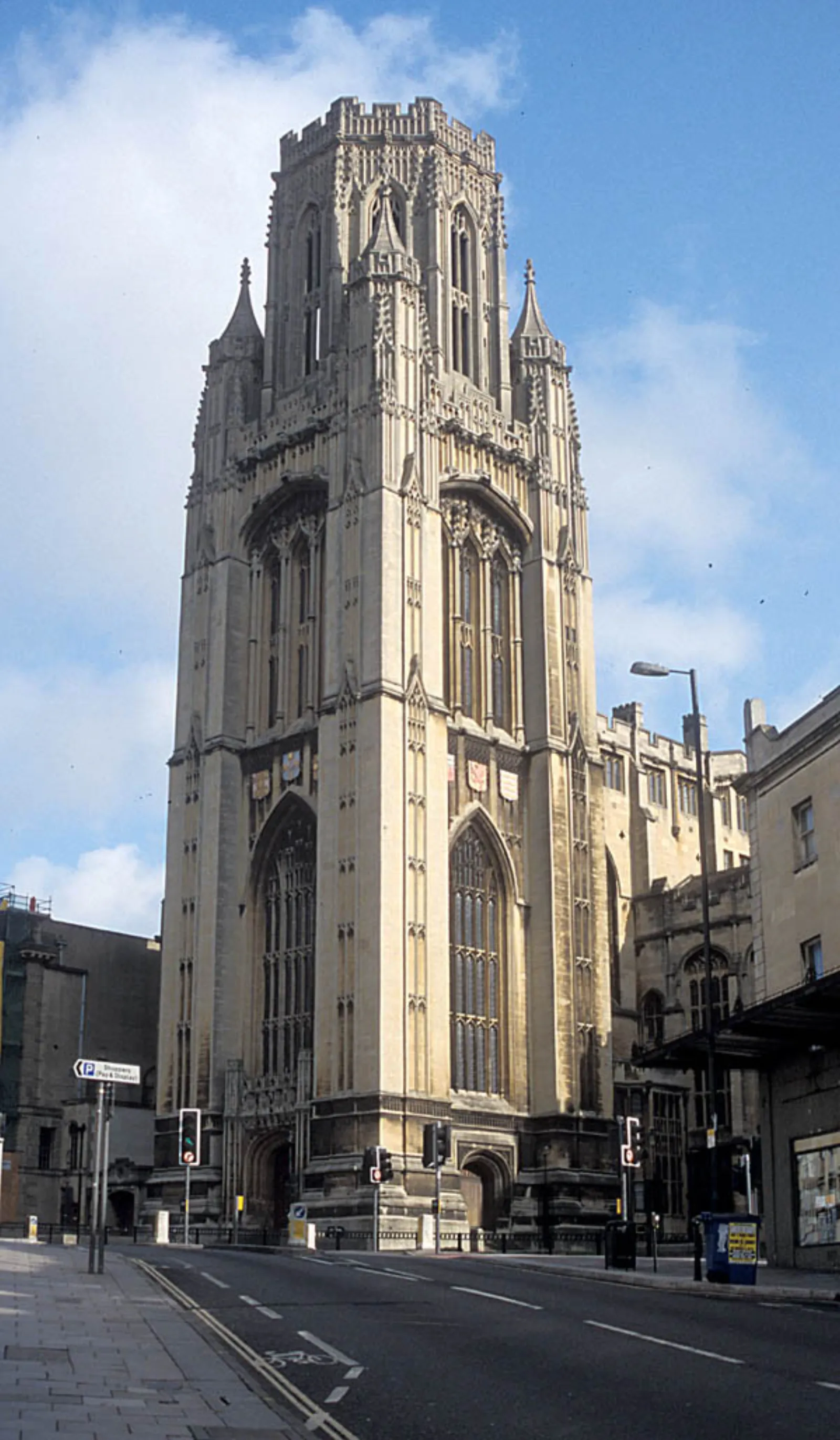
University of Bristol
Bristol, England, United Kingdom · Established 1909
Official website ↗Total Students
32,435
Intl. Students
31%
Setting
Urban
Overview
The University of Bristol traces its roots to University College, Bristol, founded in 1876, and received its royal charter as a full university in 1909, making it one of England's older civic ('redbrick') universities. Unlike Oxford or Cambridge, Bristol is not collegiate -- students belong directly to the University and one of its six faculties (Arts, Humanities and Law; Engineering; Health and Life Sciences; Science; Social Sciences and Law's business/economics-adjacent departments) rather than to a residential college, with teaching concentrated in the University Precinct near Tyndall's Park in central Bristol. A member of the Russell Group of UK research-intensive universities, Bristol is particularly well known for Engineering (with strong aerospace and robotics research ties to the local aerospace industry, including Airbus and Rolls-Royce facilities near Bristol), Law, Medicine (Bristol Medical School), Economics, and Psychology, and it produced Nobel laureate physicist Paul Dirac among its most celebrated alumni. Bristol sits solidly among the UK's upper-middle tier of research universities in global rankings -- inside the world's top 60-80 on most major tables -- while ranking more strongly on UK-specific league tables. It is a large university by UK standards, enrolling over 32,000 students in total (roughly 24,000 undergraduate, 8,500 postgraduate), with international students making up close to a third of the student body. Admission is competitive but noticeably less selective in aggregate than Oxbridge or Imperial, with an overall undergraduate offer rate historically above 50%, though individual popular courses (Medicine, Law, and several Engineering programmes) run considerably more selective than that headline figure. For prospective IELTS or TOEFL candidates, Bristol uses an unusually granular English-language system: rather than a simple Standard/Higher split, it assigns each course to one of eight lettered 'language profiles' (Profile A through H), each with its own IELTS/TOEFL/PTE thresholds ranging from roughly IELTS 6.0 up to 7.5 overall depending on the specific course's demands -- applicants must check their specific course page to find which profile applies to them, since there is no single university-wide minimum. Bristol follows the standard UK-wide UCAS equal-consideration deadline in mid-January (not Oxbridge's earlier October deadline), and does not typically interview undergraduate applicants outside of a small number of specific courses such as Medicine and Veterinary Science.
Rankings
Times Higher Education (THE) World University Rankings · Overall (Global)
#80 (2026)
The Times and The Sunday Times Good University Guide · Overall (UK)
#10 (2026)
Admissions, Requirements & Costs
Requirements, deadlines, and test-score cutoffs differ significantly between undergraduate and graduate/Master's programs — shown separately below.
Undergraduate
Acceptance Rate
52%
Application Fee
$38
Documents required: UCAS application and personal statement, Academic reference from school/college, Predicted or achieved A-Level, IB, or equivalent qualification grades, English language proficiency test scores (IELTS/TOEFL/PTE) matched to your course's specific 'language profile' (A-H), for applicants who do not qualify for a waiver, Additional admissions test or interview for a small number of courses (e.g. the UCAT for Medicine, an audition for some Music/Drama courses)
| Term | Deadline | Type |
|---|---|---|
| Fall (September) | UCAS equal-consideration deadline, mid-January (standard UK-wide UCAS date, not an early Oxbridge-style October deadline); Medicine and Dentistry follow the earlier 15 October UCAS deadline | Regular Decision |
Test Scores
IELTS Minimum
7.5 (Gabble rec. 7.5)
TOEFL Minimum
103 (5 new scale) · Gabble rec. 103 (5 new scale)
PTE Minimum
78
IELTS notes: Bristol assigns every course to one of eight lettered 'language profiles' (A through H) rather than a single university-wide minimum; profiles range from roughly 6.0 up to 7.5 overall. The figure shown here is Profile A (7.5 overall, minimum 7.0 in every component), used for many of Bristol's more competitive and language-intensive courses; a commonly-cited mid-range example, Profile D, requires only 6.5 overall (7.0 in Reading and Writing, 6.0 in Listening and Speaking). Always check your specific course page for its applicable profile letter.
TOEFL notes: Profile A (the higher end of Bristol's range): TOEFL iBT 103 overall for tests taken up to 20 January 2026 (Reading 24, Listening 22, Speaking 25, Writing 24). For tests taken from 21 January 2026 onward, Bristol quotes the new ETS 1-6 CEFR-aligned scale directly as 5.5 overall with a minimum of 5.0 in every component for Profile A. Lower-lettered profiles (e.g. Profile D: 88 overall on the legacy scale) apply to many other courses -- check your specific course's profile.
TOEFL scores shown as: legacy 0–120 scale (new 1.0–6.0 CEFR-aligned scale, effective Jan 2026).
Accepted tests: IELTS Academic, TOEFL iBT, Pearson Test of English (PTE) Academic, Cambridge English (C1 Advanced / C2 Proficiency)
Waiver: Applicants who are nationals of a UK Visas and Immigration-recognised majority English-speaking country are generally exempt from providing a separate English test score.
Conditional admission: Bristol offers a pre-sessional English language course for offer-holders whose score falls short of their course's required profile; English language qualifications must be obtained within 2 years of the programme's start date.
Tuition (Intl.)
$37,788
Tuition (Domestic)
$13,119
Scholarships
Think Big Undergraduate Scholarships
GBP 6,500 or GBP 13,000 per year, for up to 4 years
Bristol's flagship merit-based scholarship for new international undergraduates, open to any eligible undergraduate programme except Bristol Medical School and Bristol Dental School.
Eligibility: International (overseas fee status) students who have submitted a Bristol application; a separate scholarship application with an application ID is required
Think Big about Science and Engineering / Think Big about Business Scholarships
GBP 6,500 per year
Subject-specific companion awards to the main Think Big scheme, for international undergraduates in Chemistry or Physics (Faculty of Science and Engineering) or any eligible Business School programme.
Eligibility: International (overseas fee status) students admitted to an eligible Science/Engineering or Business School programme
Popular Programs
Gabble Prep Insights
Where applicants lose points: Because Bristol's language-profile system can require up to 7.5 overall with 7.0 in every component for its most demanding courses, Writing and Speaking are the sections most likely to sit below a higher profile's requirement, particularly for applicants aiming at Bristol's more competitive, essay- and discussion-heavy Arts, Law, and Social Sciences courses.
Applicants to courses using a lower-lettered profile (broadly Profile D-H, roughly IELTS 6.0-6.5) usually clear the bar without much extra preparation, while applicants aiming at Profile A/B courses (roughly IELTS 7.0-7.5) most often need focused extra work on Writing, since that component's minimum sits at or above the overall score requirement in several of Bristol's profiles.
Figures above were converted from GBP at approximately 1 GBP = 1.34 USD. The Home (UK-domiciled) undergraduate fee is fixed government-wide at GBP 9,790/year for 2026-27. Overseas undergraduate fees are set in five bands for 2026-27: GBP 25,500 (most modern-languages and some humanities/social-science courses), GBP 28,200 (many combined humanities/economics-adjacent courses, used here as the representative figure), GBP 31,300 (most STEM subjects and some performance arts), GBP 33,400 (premium lab-/computing-intensive STEM courses), and separately-priced professional courses -- Medicine (MBChB) GBP 45,800, Veterinary Science (BVSc) GBP 41,900, Dental Surgery (BDS) GBP 49,700 -- always check the specific course page. Bristol does not publish a single official living-cost estimate on its central finance pages, so livingExpensesPerYear and totalCostOfAttendance are left null rather than estimated; UKCISA's general guidance and comparable Bristol-area estimates commonly cite a range in the GBP 1,100-1,400/month bracket, but this is not an official University of Bristol figure. The 52% acceptance rate is Wikipedia-cited from Bristol's 2022 admissions cycle (the most recent aggregate figure found) and, as with most UK universities, masks large course-by-course variation -- Medicine, Law, and several Engineering courses run considerably more selective than this headline average.
Recommended prep timeline: 10 weeks
Graduate (Master's & PhD)
Documents required: Statement of purpose / personal statement, Academic and/or professional references, Official transcripts from all previously attended institutions, CV/resume, English language proficiency test scores matched to your course's language profile (if applicable), Research proposal (for PhD and some research master's applications)
| Term | Deadline | Type |
|---|---|---|
| Fall (September) | Rolling, course-specific deadlines through the admissions cycle | Rolling |
Test Scores
IELTS Minimum
6.5 (Gabble rec. 7)
IELTS notes: As at undergraduate level, Bristol assigns graduate courses to the same lettered profile system (A-H); most taught master's courses cluster around Profile C/D (roughly 6.5-7.0 overall), while some Law, Humanities, and Social Sciences master's courses use the higher Profile A/B (7.0-7.5 overall). Always confirm your specific course's profile.
TOEFL notes: Varies by course's assigned language profile (A-H); this dataset does not publish one graduate-wide TOEFL figure given the course-by-course variation -- see the undergraduate englishProficiency notes above for the profile system and confirm your specific course's requirement directly.
Accepted tests: IELTS Academic, TOEFL iBT, Pearson Test of English (PTE) Academic, Cambridge English (C1 Advanced / C2 Proficiency)
Waiver: Applicants who are nationals of a UK Visas and Immigration-recognised majority English-speaking country are generally exempt from providing a separate English test score.
Conditional admission: Bristol offers a pre-sessional English language course for offer-holders whose score falls short of their course's required profile.
Popular Programs
Gabble Prep Insights
Bristol does not publish one consolidated graduate/postgraduate tuition figure, application fee, or acceptance rate the way it does for undergraduate admissions -- fees, English-language profile requirements, and application fees (where charged) vary considerably by specific master's or research course, so those fields are left null here rather than estimated from an unrepresentative single example. Applicants should check their specific course page on bristol.ac.uk directly.
Recommended prep timeline: 10 weeks
Programs Offered
Aerospace Engineering
Undergraduate · 3 yr
Law (LLB)
Undergraduate · 3 yr
Medicine (MBChB)
Undergraduate · 5 yr · $45,800/yr
Economics (BSc)
Undergraduate · 3 yr
Computer Science
Undergraduate · 3 yr
MSc Finance
Masters · 1 yr
PhD
PhD · 4 yr
Campus Life
Bristol is not a collegiate university and has no single central campus; teaching, libraries, and student facilities are concentrated in the University Precinct near Tyndall's Park in central Bristol, with most students living in University-managed halls (guaranteed for most first-years) or private accommodation across the city thereafter. Bristol SU runs several hundred recognised clubs and societies spanning academic, cultural, political, and hobby interests, alongside a strong University-wide sports programme. Bristol's location gives it an unusually strong local aerospace and engineering industry connection (Airbus and other aerospace employers have a significant regional presence near the city), which shapes a notably strong Engineering student culture and industry-linked societies.
Notable clubs: Bristol Students' Union (Bristol SU) and its 300+ clubs and societies, Bristol University Debating Union, Epigram, Bristol's independent student newspaper, Bristol University Boat Club and other University-wide sports clubs
Outcomes
Undergraduate
Graduate
Notable Alumni
Paul Dirac — Nobel Prize in Physics (1933) for foundational contributions to quantum mechanics; studied Electrical Engineering and Mathematics at Bristol
Simon Pegg — Actor, writer, and comedian (Shaun of the Dead, Star Trek); studied Drama at Bristol
James Blunt — Singer-songwriter; studied Sociology at Bristol
Susanna Reid — Broadcast journalist and Good Morning Britain / BBC Breakfast presenter; studied English at Bristol
Visa Interview Prep
The UK Student visa process differs procedurally from the US F-1 system: there is no SEVP certification or routine embassy interview requirement built into the standard route, and the centrepiece document is the CAS, which Bristol issues once a firm offer is accepted and all academic and financial conditions are met. Applicants must show they hold the required funds -- broadly the tuition amount shown on the CAS for the first year of the course, plus living-cost funds calculated at UKVI's published monthly rate for study outside London (Bristol is not in the higher inner-London band) -- always confirm the current published figure before applying. A CAS is valid for use in a visa application for 6 months from the date it is issued. International students must also budget separately for the visa application fee and the Immigration Health Surcharge (IHS), paid upfront to UKVI. Bristol recommends applying for the Student visa as soon as the CAS is issued so that UKVI processing times and any pre-arrival requirements can be built into the timeline before a September start.
- UK Student visa applicants typically do NOT attend an in-person visa interview the way US F-1 applicants do -- most applications are decided from the online form, supporting financial and academic documents, and the CAS (Confirmation of Acceptance for Studies) Bristol issues once a firm, unconditional offer is held
- UKVI may conduct a short credibility interview (in person or by video) in specific risk-based cases, focused on genuine intent to study, knowledge of the course, and financial means
FAQs
What IELTS score do I need to apply to Bristol as an undergraduate?Undergrad
It depends on your specific course. Bristol assigns every course to one of eight lettered English-language 'profiles' (A-H), ranging from roughly 6.0 up to 7.5 overall. The most demanding profile (A) requires 7.5 overall with at least 7.0 in every component; a commonly-cited mid-range profile (D) requires only 6.5 overall. Check your specific course page for its applicable profile.
Does Bristol have an early UCAS deadline like Oxford or Cambridge?Undergrad
No, except for Medicine and Dentistry, which follow the earlier 15 October UCAS deadline. Every other Bristol undergraduate course follows the standard UK-wide UCAS equal-consideration deadline in mid-January.
Will I need to attend a visa interview to study at Bristol, the way US F-1 applicants do?
Almost certainly not. The UK Student visa route generally does not build in a routine in-person interview; your application is assessed from the online form, financial evidence, and the CAS (Confirmation of Acceptance for Studies) Bristol issues once you hold a firm, unconditional offer. UKVI can request a short credibility interview in specific cases, but this is the exception, unlike the US F-1 visa's standard consular interview.
How competitive is Bristol for international applicants?Undergrad
Bristol's most recently available aggregate figure (2022 admissions cycle) put the overall undergraduate offer rate at around 52%, noticeably less selective in aggregate than Oxbridge or Imperial, though individual popular courses -- Medicine, Law, and several Engineering programmes -- run considerably more selective than this headline average.
Does Bristol offer scholarships for international students?Undergrad
Yes. The flagship Think Big Undergraduate Scholarship offers GBP 6,500 or GBP 13,000 per year (up to 4 years) to eligible international undergraduates outside Medicine and Dentistry, alongside subject-specific companion awards for Science, Engineering, and Business School applicants.
How many weeks should I spend preparing for IELTS or TOEFL before applying to Bristol?
A realistic window is 8-10 weeks for most courses, extending toward 12 weeks for courses using Bristol's higher language profiles (A/B, roughly IELTS 7.0-7.5), where Writing in particular often needs focused extra preparation since its minimum sits at or above the overall score requirement.