University of Edinburgh
Edinburgh, Scotland, United Kingdom · Established 1583
Official website ↗Total Students
47,000
Intl. Students
40%
Setting
Urban
Overview
Founded in 1583, the University of Edinburgh is one of Scotland's four ancient universities and the sixth-oldest university in the English-speaking world, with a history that includes Charles Darwin studying medicine there and Alexander Graham Bell attending as an undergraduate. Unlike Oxford and Cambridge, Edinburgh is not a federal collegiate institution -- students belong directly to the University and to one of its three main Colleges (Arts, Humanities and Social Sciences; Science and Engineering; Medicine and Veterinary Medicine), which are further organised into Schools, rather than to a residential college that provides teaching. The University's campus is spread across several distinct precincts in and around the city of Edinburgh, including the historic Old College and central campus, the King's Buildings science and engineering campus, and the Easter Bush veterinary campus. Edinburgh is particularly well known internationally for Medicine, Law, Informatics and Computer Science (its Informatics programme is consistently ranked among the strongest in Europe), Biological Sciences, Business, and Politics, and it holds Scotland's leading position in most global league tables. As a Russell Group research-intensive university, Edinburgh draws a large international student body -- reflecting the city of Edinburgh's own draw as the host of the world's largest arts festival (the Edinburgh Festival Fringe) every August. For prospective IELTS or TOEFL candidates, Edinburgh applies a subject-dependent English-language threshold rather than one flat university-wide score: most undergraduate programmes require IELTS Academic 6.5 overall with at least 5.5 in each component, Business, Accounting and Finance programmes require a higher 7.0 overall with at least 6.0 in each component, and Medicine and Veterinary Medicine require 7.0 overall given the clinical communication demands of those degrees. Like most UK universities outside Oxford and Cambridge, Edinburgh follows the standard UK-wide UCAS equal-consideration deadline in mid-January rather than an early-October deadline, and it does not typically interview undergraduate applicants outside a small number of programmes (such as some Medicine and Veterinary Medicine places).
Rankings
Times Higher Education (THE) World University Rankings · Overall (Global)
#29 (2026)
Admissions, Requirements & Costs
Requirements, deadlines, and test-score cutoffs differ significantly between undergraduate and graduate/Master's programs — shown separately below.
Undergraduate
Application Fee
$38
Documents required: UCAS application and personal statement, Academic reference from school/college, Predicted or achieved A-Level, IB, or equivalent qualification grades, UCAT required for Medicine applicants, English language proficiency test scores (IELTS/TOEFL) for applicants who do not qualify for a waiver, A small number of programmes (including some Medicine and Veterinary Medicine places) invite shortlisted applicants to interview
| Term | Deadline | Type |
|---|---|---|
| Fall (September) | UCAS equal-consideration deadline, mid-January (e.g. 13 January 2027 for September 2027 entry); Medicine has an earlier deadline of 15 October, in line with the UCAS-wide early deadline for Medicine | Regular Decision |
Test Scores
IELTS Minimum
6.5 (Gabble rec. 7)
TOEFL Minimum
92 (4.5 new scale) · Gabble rec. 100 (5 new scale)
IELTS notes: Most undergraduate programmes require 6.5 overall with at least 5.5 in each of Listening, Reading, Writing, and Speaking. Business, Accounting and Finance programmes require a higher 7.0 overall with at least 6.0 in each component. Medicine and Veterinary Medicine require 7.0 overall due to clinical communication demands. Always confirm the exact requirement on the specific programme's Degree Finder page, since it is set course-by-course rather than university-wide.
TOEFL notes: Widely reported as 92 overall with a minimum of 20 in each section for most undergraduate programmes (higher for Business/Medicine, mirroring the IELTS tiers above); this dataset treats the exact TOEFL figure as approximate since Edinburgh's own English-language requirements page directs applicants to the programme-specific Degree Finder for confirmed component minimums rather than publishing one consolidated table. ETS introduced a new 1-6 CEFR-aligned TOEFL iBT scale for tests taken from 21 January 2026 onward; Edinburgh states it specifies both old and new scales in its Degree Finder entries.
TOEFL scores shown as: legacy 0–120 scale (new 1.0–6.0 CEFR-aligned scale, effective Jan 2026).
Accepted tests: IELTS Academic, TOEFL iBT, PTE Academic, Cambridge English (C1 Advanced / C2 Proficiency), Oxford ELLT / Oxford Test of English Advanced, Trinity ISE
Waiver: Applicants who are nationals of, and have been resident for the relevant period in, a UK Home Office-recognised majority English-speaking country are generally exempt, as are those who have completed a qualification taught and examined entirely in English within the recognised validity window (2 years for most tests, 3.5 years for Cambridge C1/C2 and A-Level English).
Conditional admission: Edinburgh's English Language Education unit runs pre-sessional English courses for offer-holders whose score falls short of their programme's requirement; exact eligibility and the score gap this can bridge vary by programme and should be confirmed directly with the University.
Tuition (Intl.)
$35,510
Tuition (Domestic)
$13,119
Living Expenses/yr
$14,472
Total Cost of Attendance
$49,982
Scholarships
Edinburgh Global Undergraduate Learning Partnership Scholarships / Edinburgh Global Undergraduate Excellence Awards
Varies by award; typically a partial reduction of the overseas tuition fee for the duration of the course
A set of merit-based, partial-fee scholarships for high-achieving international undergraduate applicants, varying by country and college, administered centrally by Edinburgh Global.
Eligibility: Assessed alongside or shortly after the standard admissions process; most require an offer of admission and a separate scholarship application
Popular Programs
Gabble Prep Insights
Where applicants lose points: Writing is the section most likely to sit below Edinburgh's component minimums, particularly for the higher Business/Accounting/Finance and Medicine tiers (6.0/6.0 or above per component), since Edinburgh's coursework leans on structured academic essay writing from the first year.
Applicants to the standard 6.5-overall tier usually clear the bar without difficulty if their overall proficiency is solid, but those targeting Business or Medicine should specifically practise Writing to reach the higher 6.0-7.0 component floor those tiers require.
Figures above were converted from GBP at approximately 1 GBP = 1.34 USD, consistent with the conversion rate used elsewhere on this site. The Home (UK-domiciled, including Scottish-domiciled students who pay no tuition) undergraduate fee shown here uses the RUK (Rest of UK) rate as a stand-in at GBP 9,790/year, since Scottish-domiciled students are fee-exempt and there is no single 'Home' figure that applies UK-wide. Edinburgh's international undergraduate tuition varies by subject band from roughly GBP 26,500/year (most Arts, Humanities, and Social Science courses, used as the representative figure here) up to GBP 37,500/year for laboratory- and clinically-intensive courses; always check the specific course page, as this dataset could not confirm an exact 2026-27 published table for every band. Living costs were estimated at roughly GBP 1,200/month applied over a 9-month academic year (GBP 10,800); this is an estimate rather than an Edinburgh-published figure. Edinburgh does not publish one official aggregate undergraduate acceptance rate, and third-party estimates for it vary enormously (from roughly 10% to over 40% depending on the source and methodology), so that field is left null rather than picking an unreliable estimate. The UCAS application fee (GBP 28.50 for the 2026 cycle) is paid to UCAS, not directly to Edinburgh.
Recommended prep timeline: 10 weeks
Graduate (Master's & PhD)
Documents required: Statement of purpose, Two academic and/or professional references, Official transcripts from all previously attended institutions, CV/resume, Research proposal (for PhD and some research master's applications), English language proficiency test scores (if applicable)
| Term | Deadline | Type |
|---|---|---|
| Fall (September) | Rolling, course-specific deadlines through the admissions cycle; competitive taught master's courses often fill ahead of any final advertised deadline | Rolling |
Test Scores
IELTS Minimum
7 (Gabble rec. 7.5)
TOEFL Minimum
100 (5 new scale)
IELTS notes: Most taught master's programmes require 7.0 overall with at least 6.5 in each component; a smaller number of writing-intensive courses require higher. Always confirm the exact requirement on the specific programme's Degree Finder page.
TOEFL notes: Widely reported as 100 overall for most taught master's programmes; this dataset treats the figure as approximate pending confirmation on the specific programme page.
TOEFL scores shown as: legacy 0–120 scale (new 1.0–6.0 CEFR-aligned scale, effective Jan 2026).
Accepted tests: IELTS Academic, TOEFL iBT, PTE Academic, Cambridge English (C1 Advanced / C2 Proficiency)
Waiver: Applicants who are nationals of, and have been resident for the relevant period in, a UK Home Office-recognised majority English-speaking country are generally exempt, as are those who have completed a qualification taught and examined entirely in English within the recognised validity window.
Conditional admission: Edinburgh's English Language Education unit runs pre-sessional English courses for graduate offer-holders whose score falls short of their programme's requirement; eligibility and the size of the gap this can bridge vary by programme.
Tuition (Intl.)
$39,730
Living Expenses/yr
$19,296
Total Cost of Attendance
$59,026
Scholarships
Edinburgh Global Research Scholarship / Edinburgh Global Master's Awards
Varies considerably by award; from partial tuition contributions up to fully funded PhD studentships for the most competitive schemes
A set of merit-based scholarships for international postgraduate applicants, varying by college, subject, and award, administered centrally by Edinburgh Global.
Eligibility: Assessed through a separate scholarship application after an offer is received; criteria vary by scholarship
Popular Programs
Gabble Prep Insights
Where applicants lose points: Writing is consistently the toughest section for graduate applicants, since a research-focused statement of purpose and extensive essay- or dissertation-based coursework demand sustained academic argument well beyond conversational English.
Applicants to quantitative courses (Data Science, AI) tend to clear Reading and Listening comfortably but sometimes underprepare Writing for the dissertation component common across Edinburgh's taught master's courses.
Figures above were converted from GBP at approximately 1 GBP = 1.34 USD. Edinburgh does not set one university-wide postgraduate tuition figure; fees vary by course. The representative figure used here, roughly GBP 29,650 (~USD 39,730), reflects a commonly cited mid-range taught master's fee across Arts/Social-Science-adjacent programmes; Business School and some STEM/clinical programmes are priced considerably higher, so always check the specific course page. Living costs were estimated at roughly GBP 1,200/month applied over a 12-month graduate year (GBP 14,400). Edinburgh does not publish one official aggregate postgraduate acceptance rate or a standard postgraduate application fee figure, so both are left null rather than estimated from unreliable third-party sources.
Recommended prep timeline: 10 weeks
Programs Offered
Medicine (MBChB)
Undergraduate · 6 yr
Law (LLB)
Undergraduate · 4 yr
Informatics
Undergraduate · 4 yr
Business
Undergraduate · 4 yr
MSc Artificial Intelligence
Masters · 1 yr
PhD
PhD · 4 yr
Campus Life
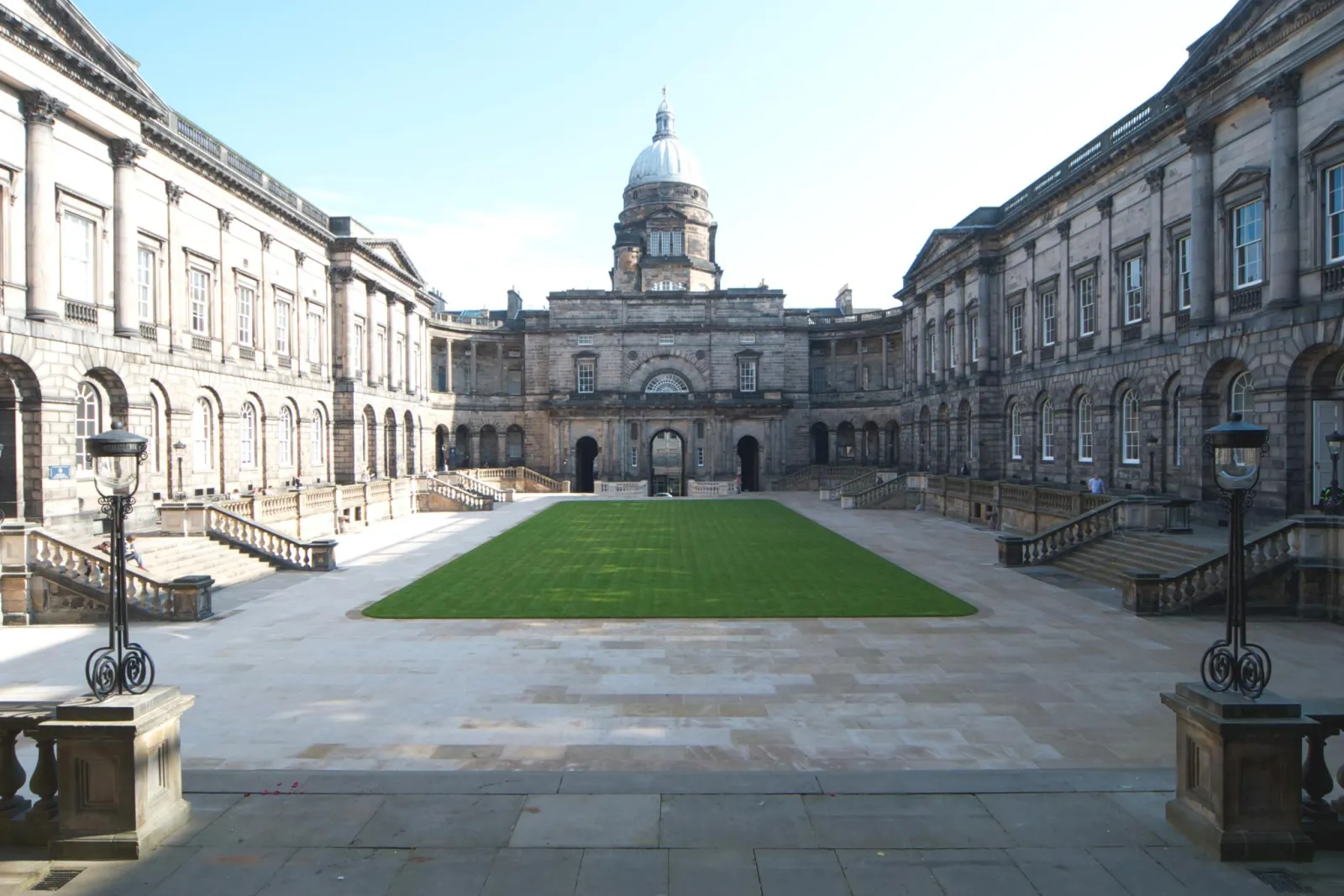
Edinburgh's campus is spread across several precincts in the city, anchored by the historic Old College and central campus near the Meadows, with dedicated science/engineering (King's Buildings) and veterinary (Easter Bush) campuses elsewhere in the city. The Edinburgh University Students' Association runs hundreds of societies and sports clubs. Student life in Edinburgh is also shaped by the city itself, which hosts the world's largest annual arts festival, the Edinburgh Festival Fringe, every August, alongside the Edinburgh International Festival and Hogmanay New Year celebrations.
Notable clubs: Edinburgh University Students' Association (EUSA), The Edinburgh Union (debating society), Edinburgh University Athletic Union and 60+ sports clubs, Edinburgh University Students' Association societies spanning academic, cultural, and hobby interests
Outcomes
Undergraduate
Graduate
Notable Alumni
Charles Darwin — Naturalist; studied Medicine at Edinburgh before transferring to Cambridge
Alexander Graham Bell — Inventor of the telephone; attended the University of Edinburgh
Arthur Conan Doyle — Author of the Sherlock Holmes stories; studied Medicine at Edinburgh
Gordon Brown — Former UK Prime Minister; studied History at Edinburgh
J.M. Barrie — Author of Peter Pan; studied at the University of Edinburgh
Visa Interview Prep
The UK Student visa process differs procedurally from the US F-1 system: there is no SEVP certification or routine embassy interview requirement built into the standard route, and the centrepiece document is the CAS, which Edinburgh issues once a firm offer is accepted and all academic and financial conditions are met. Applicants must show they hold the required funds -- broadly the tuition amount shown on the CAS for the first year of the course, plus living-cost funds calculated using UKVI's published monthly rate for outside-London study (Edinburgh sits outside the higher inner-London maintenance band) -- always confirm the current published figure before applying. A CAS is valid for use in a visa application for 6 months from the date it is issued. International students must also budget separately for the visa application fee and the Immigration Health Surcharge (IHS), which are paid upfront to UKVI. The UK government has at times applied temporary restrictions affecting nationals of specific countries; applicants should check current guidance close to their intended application date.
- UK Student visa applicants typically do NOT attend an in-person visa interview the way US F-1 applicants do -- most applications are decided from the online form, supporting financial and academic documents, and the CAS (Confirmation of Acceptance for Studies) Edinburgh issues once a firm, unconditional offer is held
- UKVI may conduct a short credibility interview (in person or by video) in specific risk-based cases, focused on genuine intent to study, knowledge of the course, and financial means
FAQs
What IELTS score do I need to apply to Edinburgh as an undergraduate?Undergrad
It depends on the course: most undergraduate programmes require 6.5 overall with at least 5.5 in each component, Business/Accounting/Finance programmes require 7.0 overall with at least 6.0 in each component, and Medicine and Veterinary Medicine require 7.0 overall. Always check the specific programme's Degree Finder entry.
Does Edinburgh have the same early UCAS deadline as Oxford and Cambridge?Undergrad
No. Edinburgh follows the standard UK-wide UCAS equal-consideration deadline in mid-January, not the early mid-October deadline used by Oxford and Cambridge. The exception is Medicine, which shares the UCAS-wide 15 October deadline used for Medicine, Dentistry, and Veterinary Medicine applications everywhere in the UK.
Will I need to attend a visa interview to study at Edinburgh, the way US F-1 applicants do?
Almost certainly not. The UK Student visa route generally does not build in a routine in-person interview; your application is assessed from the online form, financial evidence, and the CAS your Edinburgh school issues once you hold a firm, unconditional offer. UKVI can request a short credibility interview in specific cases, but this is the exception.
How competitive is Edinburgh for international applicants?
Edinburgh does not publish one official aggregate undergraduate acceptance rate, and third-party estimates vary widely depending on methodology and course. Medicine, Law, and Informatics are understood to be significantly more selective than the university-wide average.
Can I get a waiver for the IELTS/TOEFL requirement at Edinburgh?
Yes, in certain cases. You're generally exempt if you're a national of, and have been resident for the qualifying period in, a UK Home Office-recognised majority English-speaking country, or if you've completed a qualifying degree taught and examined entirely in English within the recognised validity window.
How many weeks should I spend preparing for IELTS or TOEFL before applying to Edinburgh?
A realistic window is 8-10 weeks for the standard 6.5-overall tier, or longer for the higher Business/Medicine tiers (7.0 overall), with particular attention to Writing since several tiers require a 6.0+ per-component floor.