
University of Chicago
Chicago, Illinois, United States · Established 1890
Official website ↗Total Students
18,566
Intl. Students
32%
Student:Faculty
5:1
Setting
Urban
Overview
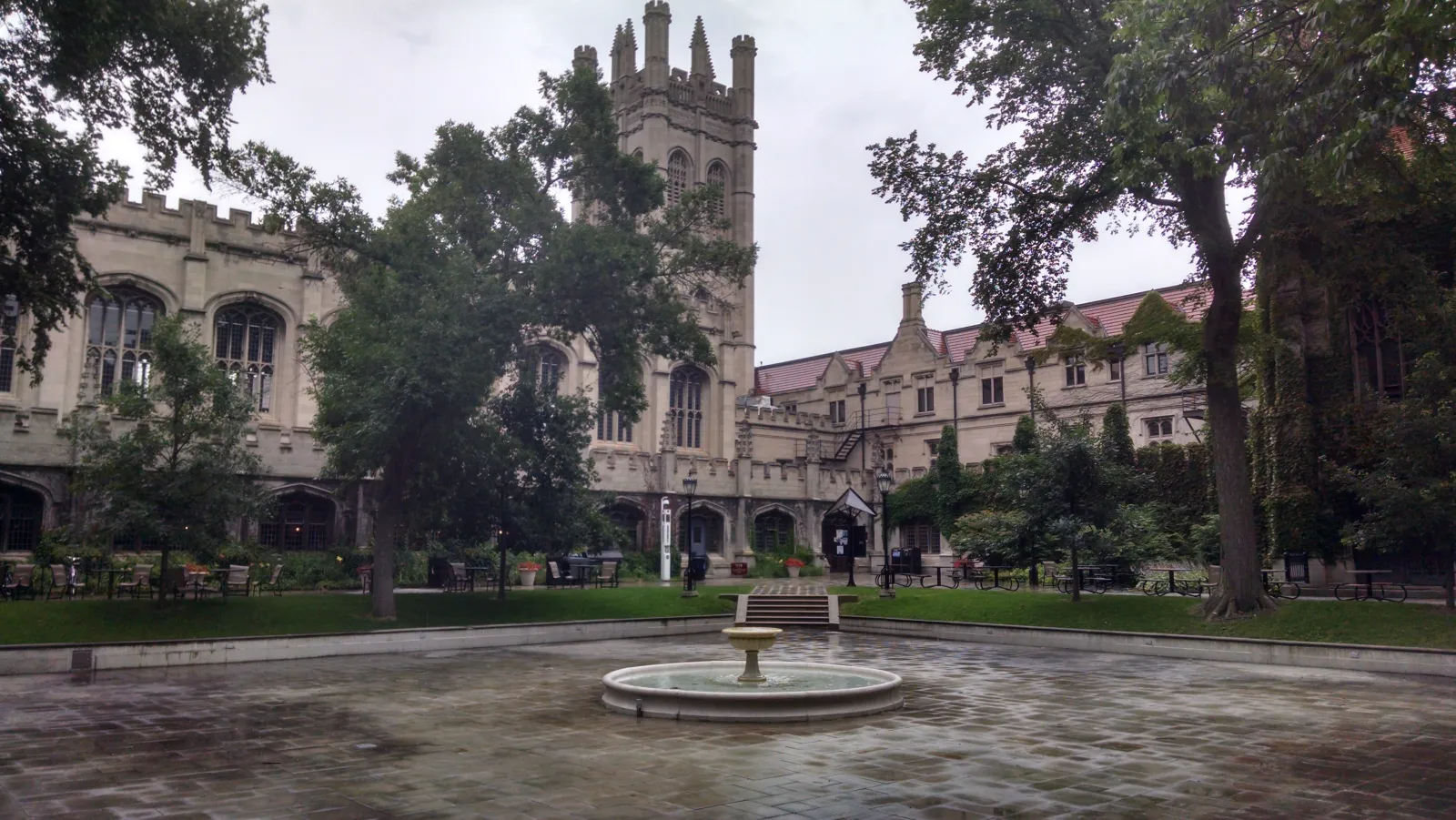
The University of Chicago is a private research university founded in 1890 with support from the American Baptist Education Society and a major gift from John D. Rockefeller. Its main campus sits in the Hyde Park neighborhood on Chicago's South Side, about eight miles from the Loop, and is known for Gothic quadrangles alongside newer research and residential buildings. The university is organized around an undergraduate College and a set of graduate and professional divisions, including the Booth School of Business, the Law School, the Harris School of Public Policy, the Pritzker School of Molecular Engineering, and the Biological Sciences, Physical Sciences, Social Sciences, and Humanities divisions. UChicago is widely associated with its rigorous, discussion-based 'Core' curriculum, which requires undergraduates to engage broadly across humanities, sciences, and social sciences before specializing in a major. This has produced an outsized academic reputation relative to its size, particularly in economics (home to the 'Chicago School' of economic thought), law, and the social sciences, alongside strong and growing programs in computer science, molecular engineering, and data science. The university has produced or employed more than 90 Nobel laureates across its history. For international applicants, UChicago is one of the most selective universities in the United States, admitting under 5% of applicants for recent first-year classes. It is need-blind for both domestic and international first-year applicants and commits to meeting 100% of demonstrated financial need with loan-free aid packages, which distinguishes it from many peer institutions that reserve need-blind admission for domestic students only. At the graduate level, admission standards and requirements vary substantially by division and program — the Booth MBA, Harris MPP, and the Biological/Physical/Social Sciences PhD programs each run independent, differently structured admissions processes.
Rankings
US News National Universities
#6 (2026)
US News Best Business Schools · Graduate - MBA (Booth)
#3 (2026)
Admissions, Requirements & Costs
Requirements, deadlines, and test-score cutoffs differ significantly between undergraduate and graduate/Master's programs — shown separately below.
Undergraduate
Acceptance Rate
4.48%
Application Fee
$75
Documents required: Common Application or Coalition Application with UChicago Supplement, Letters of Recommendation, Official Transcripts, School Report and Counselor Recommendation, Standardized Test Scores (optional, test-flexible policy), English Proficiency Scores (self-reported, if applicable), Application Fee or Fee Waiver
| Term | Deadline | Type |
|---|---|---|
| Fall | November 3 | Early Action |
| Fall | November 3 | Early Decision |
| Fall | January 5 | Early Decision |
| Fall | January 5 | Regular Decision |
Test Scores
SAT Range
1510–1560
ACT Range
34–35
Accepted tests: IELTS, TOEFL, Duolingo English Test, PTE Academic
Waiver: The College does not set a fixed minimum English test score. Applicants may self-report any English proficiency exam of their choice, or omit scores entirely if English fluency is otherwise evident in the application (transcripts, recommendations, essays). Official score reports are required only if the applicant enrolls.
Tuition (Intl.)
$73,266
Tuition (Domestic)
$73,266
Living Expenses/yr
$25,035
Total Cost of Attendance
$98,301
Scholarships
International Merit Scholarships
$10,000–$30,000 per year, renewable for up to four years
Merit-based awards for outstanding international first-year applicants, recognizing academic achievement, leadership, and community engagement. Awarded automatically with the admissions application; no separate application required.
Eligibility: International first-year applicants; not available to international transfer students
UChicago Empower Initiative
Up to full cost of attendance, income-dependent
Expanded undergraduate financial aid program offering free tuition and, for lower-income families, free tuition plus fees, room, and board, based on family income and assets.
Eligibility: Admitted undergraduate students who apply for need-based aid; primarily benefits domestic applicants given US federal aid data requirements
Odyssey Scholarship
Varies with demonstrated need
No-loan, need-based financial aid package for undergraduates from high-financial-need backgrounds, replacing loans with grants.
Eligibility: Admitted undergraduates with significant demonstrated financial need
Popular Programs
Gabble Prep Insights
Where applicants lose points: Because UChicago's Core curriculum and 'life of the mind' culture revolve around fast-paced, discussion-heavy seminars, the Speaking section is usually the hardest gap to close — applicants often have strong Reading and Listening scores but freeze up when asked to argue a position spontaneously, which is exactly what a UChicago seminar demands on day one.
We routinely see students clear the overall band comfortably (7.0+ IELTS or 104+ TOEFL) while quietly under-performing on Writing or Speaking relative to Reading — a gap that doesn't block admission at a test-flexible school like UChicago but does show up later in seminar discussions and in the quality of self-reported supplemental materials.
UChicago's test-flexible policy for SAT/ACT can lull international applicants into under-preparing for English proficiency exams, since scores are technically optional and self-reported for the College. In practice, a strong self-reported IELTS or TOEFL score still functions as a credibility signal alongside famously unconventional UChicago supplemental essays, so we advise treating English test prep as seriously as the essays themselves rather than as an afterthought.
Recommended prep timeline: 10 weeks
Graduate (Master's & PhD)
Application Fee
$90
Documents required: Statement of Purpose / Motivation Statement, Official Transcripts, 2–3 Letters of Recommendation, Resume/CV, English Proficiency Scores (IELTS/TOEFL), if applicable, GRE or GMAT scores (required, waivable, or optional depending on program), Application Fee or Fee Waiver
| Term | Deadline | Type |
|---|---|---|
| Fall | December–January (typical for PhD and most Divisional master's programs; varies by department) | Regular Decision |
| Fall | April 30 priority (Harris MPP); rolling thereafter until capacity is reached | Priority |
| Fall | September 15 / January 7 / April 1 (Booth Full-Time MBA Rounds 1–3) | Rolling |
Test Scores
GMAT Range
690–770
IELTS Minimum
7 (Gabble rec. 7)
TOEFL Minimum
104 (5 new scale) · Gabble rec. 104 (5 new scale)
IELTS notes: 7.0 overall with no less than 7.0 on each section for most divisions (Arts & Humanities, Biological Sciences, Crown Family School, Divinity School, Graham School, Social Sciences). The Law School requires 7.5 overall with a 7.0 minimum per section. Booth (MBA) and some Physical Sciences programs set their own, separate requirements.
TOEFL notes: Historically ~104 total on the legacy TOEFL iBT scale for most divisions. TOEFL changed to a shorter test format in January 2026, and several divisions have since published minimums on the new scale (e.g., Biological Sciences ~5.0 reading/writing, 5.5 listening, 4.5 speaking; Harris ~5.0 overall; Physical Sciences ~4.5–5.0 depending on program). Applicants should confirm the current scale against their specific division's page.
TOEFL scores shown as: legacy 0–120 scale (new 1.0–6.0 CEFR-aligned scale, effective Jan 2026).
Accepted tests: IELTS, TOEFL
Waiver: Many divisions waive formal English testing for applicants who completed a substantial degree program taught in English or several years of secondary/higher education in English-medium instruction; policies and documentation requirements vary by department, so applicants should check the specific program page. PTE and Duolingo are not listed as accepted alternatives by most graduate divisions — IELTS and TOEFL remain the standard.
Tuition (Intl.)
$87,354
Tuition (Domestic)
$87,354
Living Expenses/yr
$37,209
Total Cost of Attendance
$124,563
Scholarships
Chicago Booth Merit Fellowships
Varies, partial to significant tuition support
Automatic merit-based scholarships for Full-Time MBA admits; no separate application required, awarded based on the strength of the admissions file.
Eligibility: Admitted Full-Time MBA students, domestic and international
Booth Global Innovator & Regional Fellowships (e.g., Zonis Fellowship)
Varies by fellowship
Fellowships targeted at international MBA students, including students from emerging markets or specific regions such as India, Mexico, and Israel.
Eligibility: International Full-Time MBA admits meeting specific fellowship criteria
Doctoral Fellowship & Stipend Package
2026–27 stipend approximately $47,741/year plus tuition and health insurance (Social Sciences Division figure; varies slightly by division)
Standard funding package for PhD students across most divisions, covering full tuition, the University Student Health Insurance Plan (U-SHIP) premium, and an annual living stipend, generally for the full expected duration of the program regardless of citizenship.
Eligibility: Admitted PhD students in good academic standing
Harris MPP Merit & Need-Based Fellowships
Varies
Merit scholarships awarded automatically at admission; additional need-based aid available by request for MPP students, including international applicants.
Eligibility: Admitted MPP students
Popular Programs
Gabble Prep Insights
Where applicants lose points: Graduate applicants, especially PhD candidates, tend to underestimate Writing — UChicago's graduate divisions expect an academic register (structured argumentation, precise hedging, citation-appropriate tone) that is closer to a research statement than a general-purpose essay, and this is where marginal IELTS/TOEFL Writing scores most often fall short of the stated section minimums.
We frequently see Master's and PhD applicants clear the overall IELTS 7.0 / TOEFL 104 threshold while narrowly missing a specific section minimum (commonly Speaking or Writing), which can trigger an outright rejection at divisions with hard per-section floors — unlike the undergraduate College, where the overall score matters more than any one section.
UChicago does not publish a single blended graduate acceptance rate — admission is decentralized by division and program, and the range is enormous: Booth's Full-Time MBA admits roughly 29% of applicants, while many PhD programs (e.g., Statistics) admit closer to 10–20% and some are considerably more selective. Treat any single 'UChicago grad acceptance rate' figure found elsewhere online with skepticism. Similarly, TOEFL's January 2026 format change means published minimums are in flux across divisions — applicants should verify against the specific program page rather than relying on a cached number.
Recommended prep timeline: 12 weeks
Programs Offered
BA in Economics
Undergraduate · 4 yr · $73,266/yr
BS in Computer Science
Undergraduate · 4 yr · $73,266/yr
BA/BS in Molecular Engineering
Undergraduate · 4 yr · $73,266/yr
BA in Public Policy Studies
Undergraduate · 4 yr · $73,266/yr
Full-Time MBA
Masters · 2 yr · $87,354/yr
Master in Public Policy (MPP)
Masters · 2 yr
MA in Social Sciences (MAPSS)
Masters · 1 yr
MS in Applied Data Science
Masters · 1 yr · $76,608/yr
PhD in Economics
PhD · 5 yr
PhD in Molecular Engineering
PhD · 5 yr
Campus Life
Nearly all undergraduates live in one of UChicago's residential 'Houses' for at least their first two years, a system designed to mirror the intensity of the Core curriculum with close-knit, faculty-linked living communities. Student life outside the classroom runs through more than 400 recognized student organizations, a strong tradition of intramural and club sports (the university fields 20 NCAA Division III varsity teams as a founding member of the University Athletic Association), and quirky, long-running traditions like the Scavenger Hunt and Kuviasungnerk/Kangeiko. Hyde Park itself, a historic lakefront neighborhood, gives students access to the Museum of Science and Industry, the DuSable Lake Shore Drive parks, and a short commute into downtown Chicago.
Notable clubs: University Theater, UChicago Model United Nations, UChicago Debate Society, The Chicago Maroon (student newspaper), Fusion Dance Company
Outcomes
Undergraduate
Graduation Rate
95%
Graduate
Avg. Starting Salary
$175,000
Notable Alumni
Milton Friedman — Nobel laureate economist and leading figure of the Chicago School of Economics
Saul Bellow — Novelist; Nobel Prize in Literature and multiple National Book Award winner
Satya Nadella — CEO of Microsoft (MBA, Booth School of Business)
Eugene Fama — Nobel laureate economist, known as the 'father of modern finance'
Harry Markowitz — Nobel laureate economist, originator of modern portfolio theory
Visa Interview Prep
UChicago's Office of International Affairs (OIA) issues I-20s and advises admitted students on the F-1 visa process, but the visa interview itself is conducted independently at a US embassy or consulate; strong, unscripted spoken English performance during the interview mirrors the discussion-based classroom style applicants will face on campus.
- Clarity on why UChicago specifically, beyond general prestige
- Financial sufficiency to cover the full cost of attendance
- Ties to home country and credible post-graduation plans
- Ability to speak spontaneously and independently in English, without a memorized script
FAQs
Does the University of Chicago require IELTS or TOEFL for undergraduate admission?Undergrad
Not strictly. The College treats English proficiency scores as optional and self-reported for first-year applicants — you can submit any English test you feel represents your ability, or omit scores if your proficiency is already clear elsewhere in your application. Official reports are only required if you're admitted and choose to enroll.
What IELTS or TOEFL score should I realistically aim for?
Even though scores are optional for undergraduates, most competitive self-reported submissions land around IELTS 7.0+ or TOEFL iBT 104+, which is also the typical minimum many UChicago graduate programs set explicitly. Aiming for that range keeps your application consistent whether you're applying to the College or a graduate division.
Does UChicago accept Duolingo English Test or PTE Academic?
For most graduate programs, no — UChicago's graduate divisions state they accept only TOEFL iBT and IELTS Academic. The undergraduate College is more flexible and will consider self-reported scores from other exams, but IELTS and TOEFL remain the safest, most universally accepted choices.
Is UChicago need-blind for international applicants?Undergrad
Yes, at the undergraduate level. UChicago is need-blind in undergraduate admissions for both domestic and international first-year applicants, and it commits to meeting 100% of demonstrated financial need with loan-free aid packages for admitted students who apply for aid at the time they apply for admission. Graduate financial aid works differently and varies by program — PhD programs are typically fully funded with stipends, while professional master's programs like the MBA and MPP rely mainly on merit scholarships and loans.
How selective is UChicago for international students?Undergrad
At the undergraduate level, extremely selective — the overall acceptance rate has fallen to under 5% in recent cycles, driven heavily by binding Early Decision rounds. International applicants compete in the same holistic, unified applicant pool as domestic students, with no separate quota.
Can my English test scores be waived?
Many graduate divisions waive formal English testing if you completed a substantial portion of your education in English-medium instruction; policies vary by department, so check the specific program page. Undergraduate applicants generally aren't required to submit a formal waiver request since the test itself is optional.
How long are IELTS/TOEFL scores valid for a UChicago application?
Two years from the test date. If your scores are older than that by your application deadline, most divisions will consider them expired and ask you to retest.
How much prep time should I budget for IELTS/TOEFL before applying?Undergrad
We generally recommend about 8-10 focused weeks for undergraduate applicants, longer if Speaking or Writing is your weaker skill. Because UChicago's culture rewards articulate, spontaneous discussion, it's worth over-investing in Speaking practice specifically, even if your target band score is already within reach on paper.
Is the GRE or GMAT required for UChicago graduate programs?Grad
It depends entirely on the program. Most PhD programs in the Physical Sciences, Biological Sciences, and Social Sciences divisions have made the GRE optional or do not consider it at all. Harris's MPP requires the GRE (or an accepted substitute like the GMAT, LSAT, or MCAT) unless you qualify for one of several waiver criteria, such as five or more years of relevant work experience. Booth's Full-Time MBA accepts either the GMAT or GRE, and roughly 56% of the current class submitted GMAT scores versus 38% GRE.
Are UChicago PhD programs fully funded, including for international students?Grad
In most divisions, yes. Doctoral students typically receive a funding package covering full tuition, the university's student health insurance plan, and an annual living stipend for the expected duration of the program, regardless of citizenship. For example, the Division of the Social Sciences funds all of its PhD students for the length of their program, and the 2026-27 stipend baseline across several divisions is roughly $47,741 per year plus health insurance and fees. Funding terms still vary by division, so confirm specifics with the individual program.
Why doesn't UChicago publish one overall graduate acceptance rate?Grad
Because graduate admissions at UChicago are fully decentralized — each division and program (Booth MBA, Harris MPP, and dozens of individual PhD and master's programs across the sciences, social sciences, and humanities) runs its own admissions process with its own applicant pool and selectivity. Booth's Full-Time MBA, for instance, admits around 29% of applicants, while many PhD programs admit well under 20%. Any single blended 'UChicago grad acceptance rate' you see quoted online should be treated with caution.