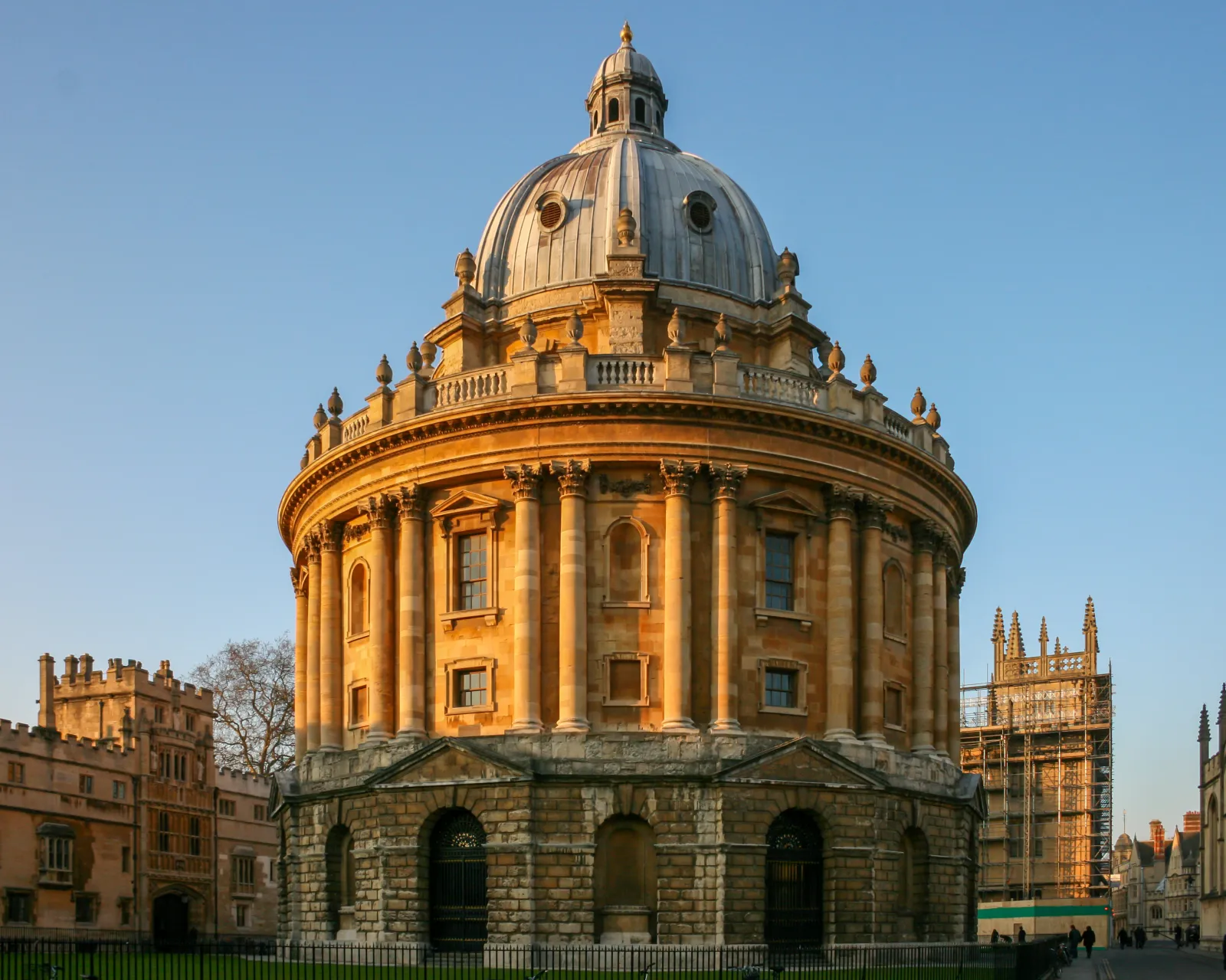
University of Oxford
Oxford, England, United Kingdom · Established 1096
Official website ↗Total Students
26,025
Intl. Students
43%
Student:Faculty
11:1
Setting
Urban
Overview
Oxford's exact founding date is unknown, but there is documented evidence of teaching at Oxford as far back as 1096, and the university grew rapidly after 1167 when Henry II barred English students from studying at the University of Paris, pushing scholars back to Oxford instead. That makes it the oldest university in the English-speaking world and one of the oldest continuously operating universities anywhere, predating the Aztec Empire by centuries. Unlike a typical campus university, Oxford is a federal, collegiate institution: the central university sets academic standards, runs central examinations, and awards degrees, while 39 constituent colleges (plus a handful of Permanent Private Halls) act as the smaller residential and social communities where undergraduates actually live, eat, and receive much of their small-group teaching through the university's distinctive tutorial system. Every Oxford student belongs to both the university and a college simultaneously, and prospective applicants quickly discover that college choice -- while it can influence day-to-day life, accommodation, and tutorial group size -- does not usually change the academic course content or the degree awarded, which is set centrally by the relevant academic department or faculty. Oxford teaches across four broad academic divisions -- Humanities, Mathematical, Physical and Life Sciences (MPLS), Medical Sciences, and Social Sciences -- spanning subjects from Classics and Philosophy, Politics and Economics (PPE) to Engineering Science, Experimental Psychology, and Jurisprudence. Saïd Business School, established in 1996, is comparatively young by Oxford standards but has become one of the most globally recognised business schools, home to the one-year, GMAT/GRE-requiring Oxford MBA. The university has topped the Times Higher Education World University Rankings for ten consecutive years running, reflecting its research intensity across essentially every discipline it teaches, and it draws students from well over 170 countries -- making the mix of collegiate tradition and genuinely international student body one of the more distinctive combinations in UK higher education. For prospective IELTS or TOEFL candidates, Oxford's admissions process is unusually demanding relative to most UK universities: undergraduate applicants apply through UCAS by a strict mid-October deadline (far earlier than the typical UK deadline), often sit a written admissions test, and if shortlisted are invited to one or more subject interviews conducted by college tutors -- a format that rewards articulate, structured spoken reasoning well beyond what a standard secondary-school English class typically covers. English-language score requirements sit at or near the top of the UK sector too, with undergraduate applicants required to meet Oxford's 'Higher' level (IELTS 7.5 overall, TOEFL iBT 110) regardless of course, while graduate applicants face either the 'Standard' or 'Higher' level depending on department.
Rankings
Times Higher Education (THE) World University Rankings · Overall (Global)
#1 (2026)
US News Best Global Universities · Overall (Global)
#4 (2027)
QS World University Rankings by Subject · Modern Languages
#1 (2026)
QS World University Rankings by Subject · Geography
#1 (2026)
QS World University Rankings by Subject · Anthropology
#1 (2026)
QS World University Rankings by Subject · Anatomy & Physiology
#1 (2026)
QS World University Rankings by Broad Subject Area · Arts & Humanities
#1 (2026)
Admissions, Requirements & Costs
Requirements, deadlines, and test-score cutoffs differ significantly between undergraduate and graduate/Master's programs — shown separately below.
Undergraduate
Acceptance Rate
14%
Application Fee
$38
Documents required: UCAS application and personal statement, Academic reference from school/college, Predicted or achieved A-Level, IB, or equivalent qualification grades, Course-specific written admissions test where required (most courses now use UAT-UK-administered tests such as the successor tests to the MAT and TSA; Medicine uses the UCAT and Law uses the LNAT), Two pieces of recent school/college-marked written work for most humanities and some social science courses, English language proficiency test scores (IELTS/TOEFL) for applicants who do not qualify for a waiver, Shortlisted candidates are invited to one or more subject interviews with college tutors, usually held in December
| Term | Deadline | Type |
|---|---|---|
| Fall (October) | UCAS: 6:00pm UK time, 15 October, for all Oxford undergraduate courses (this early deadline applies to every course, not just Medicine and Oxbridge-style early-deadline subjects) | Regular Decision |
Test Scores
IELTS Minimum
7.5 (Gabble rec. 7.5)
TOEFL Minimum
110 (5.5 new scale) · Gabble rec. 110 (5.5 new scale)
PTE Minimum
76
IELTS notes: Oxford applies only its 'Higher' level to undergraduate applicants: 7.5 overall with a minimum of 7.0 in each of Listening, Reading, Speaking, and Writing, all from a single sitting. Oxford does not offer a lower 'Standard' level for undergraduate courses the way it does for some graduate programmes, and some especially writing-heavy courses (e.g. English Literature) expect applicants comfortably above the minimum in Writing.
TOEFL notes: Higher level: 110 overall, with component minimums of Listening 22, Reading 24, Writing 24, and Speaking 25 from a single test administration. ETS introduced a new 1-6, CEFR-aligned TOEFL iBT scale for tests taken from 21 January 2026 onward; check Oxford's English-language pages for how the new scale maps to these thresholds before booking a test.
TOEFL scores shown as: legacy 0–120 scale (new 1.0–6.0 CEFR-aligned scale, effective Jan 2026).
Accepted tests: IELTS Academic, TOEFL iBT, Cambridge English (C1 Advanced / C2 Proficiency), Oxford Test of English Advanced
Waiver: Applicants who are citizens of, and have always been primarily resident in, a UKVI-recognised majority English-speaking country are exempt, as are those completing (or who completed within the last 2 years) a full degree-level course taught and assessed entirely in English at a recognised institution. A discretionary waiver based on at least 2 years of substantial professional experience conducted daily in English is also available, subject to departmental approval.
Conditional admission: Oxford's Language Centre runs a 6-week intensive pre-sessional Academic English course, open to holders of a conditional or unconditional Oxford offer, that can be built directly into a conditional offer for applicants who narrowly miss the required IELTS score (generally within about 0.5 overall and 1.0 per component of the required threshold).
Tuition (Intl.)
$50,089
Tuition (Domestic)
$13,119
Living Expenses/yr
$20,864
Total Cost of Attendance
$70,953
Scholarships
Reach Oxford Scholarship
Full university and college fees plus a living-cost grant and one return airfare per year
A small number of full scholarships for outstanding undergraduate applicants from developing countries who, for political or financial reasons, or a lack of suitable facilities, cannot otherwise study for a degree in their home country.
Eligibility: Undergraduate applicants who are nationals of and ordinarily resident in an eligible developing country, assessed alongside the standard admissions process; a separate scholarship application is required
Oxford and college-specific undergraduate bursaries and scholarships
Varies considerably by award; typically a partial contribution toward tuition or living costs rather than a full-fee waiver
Individual Oxford colleges and departments hold a rotating set of country-specific, subject-specific, and merit-based undergraduate scholarships that partially offset the overseas fee, searchable through the university's central fees, funding and scholarship search tool once an applicant has an offer.
Eligibility: Varies by scholarship; most require an offer of admission and a separate scholarship application submitted after the offer is made
Popular Programs
Gabble Prep Insights
Where applicants lose points: Writing and Speaking are both under unusual pressure for Oxford undergraduate applicants: the required 'Higher' IELTS/TOEFL level (7.5/110) already sits above what most UK universities ask for, and it sits alongside Oxford's own written admissions tests and, for shortlisted candidates, live subject interviews with college tutors that demand fast, structured spoken reasoning under academic pressure -- a format international secondary curricula rarely train directly.
Strong secondary-school applicants usually clear Reading and Listening with room to spare, since Oxford's own coursework assumes native-level comprehension of dense academic text. Writing is the section most likely to fall short of 7.0-7.5, particularly for STEM applicants less used to extended academic essay-writing, while Speaking gaps tend to surface less on the test itself and more once candidates reach the interview stage, where quick, articulate two-way academic discussion is expected.
Figures above were converted from GBP at approximately 1 GBP = 1.34 USD. The Home (UK-domiciled) undergraduate fee is fixed government-wide at GBP 9,790/year for 2026-27. Overseas fees are set per course rather than as one university-wide figure: published 2026-27 rates run from GBP 37,380 for most classroom-based Humanities and Social Science courses (used here as the representative figure) up to GBP 62,820 for laboratory- and computing-intensive courses, with Medicine set separately at roughly GBP 49,400/year for the pre-clinical years and roughly GBP 65,250/year for the clinical years -- always check the specific course page. Living costs were estimated from Oxford's own official monthly guidance of roughly GBP 1,425-2,035 (midpoint used) applied over a 9-month undergraduate year; Oxford states this is a planning guide, not a guaranteed minimum or maximum, and it excludes the separately-paid visa fee and Immigration Health Surcharge. The 14% acceptance rate is Oxford's own published aggregate figure from its Annual Admissions Statistical Report (3,302 admitted from 23,329 applicants for 2025 entry) but masks enormous course-by-course variation -- Economics and Management and Computer Science run considerably below this figure, while some Humanities courses run well above it. A-Level/IB equivalency: typical conditional offers range from AAA to A*A*A at A-Level and roughly 38-40 IB points overall, but exact thresholds and required subjects are set individually by each undergraduate course -- see Oxford's course-listing pages. The UCAS application fee (GBP 28.50 for the 2026 cycle, covering up to five course choices) is paid to UCAS, not directly to Oxford.
Recommended prep timeline: 14 weeks
Graduate (Master's & PhD)
Application Fee
$100
Documents required: Statement of purpose / personal statement, Three references (academic and/or professional, depending on course), Official transcripts from all previously attended institutions, CV/resume, Research proposal (for DPhil and some research master's applications), English language proficiency test scores (if applicable), GMAT or GRE score, required specifically for the Saïd Business School MBA and accepted (though not required by most other departments) for a small number of Economics-related and quantitative courses, Relevant professional work experience documentation, required for the MBA (typically at least 2 years) and the Executive MBA (typically at least 8-10 years in a management/leadership role)
| Term | Deadline | Type |
|---|---|---|
| Fall (September/October) | Rolling and department-specific, published as a series of staged deadlines (commonly around November, January, and March) for most taught master's and DPhil courses; the Oxford MBA runs several distinct application rounds through the admissions cycle and, like most competitive courses, tends to fill ahead of its final deadline | Rolling |
Test Scores
Avg. GMAT
690
IELTS Minimum
7 (Gabble rec. 7.5)
TOEFL Minimum
100 (5 new scale) · Gabble rec. 110 (5.5 new scale)
PTE Minimum
76
IELTS notes: Oxford applies a two-tier system at graduate level: 'Standard' level is 7.0 overall with a minimum of 6.5 in each component, and 'Higher' level is 7.5 overall with a minimum of 7.0 in each component. Most Humanities and Law master's courses require the Higher level, while many MPLS, Social Sciences, and Medical Sciences courses use the Standard level -- always confirm on the specific course page.
TOEFL notes: Standard level: 100 overall (Listening 22, Reading 24, Writing 24, Speaking 25 minimum). Higher level: 110 overall, with the same component minimums (Listening 22, Reading 24, Writing 24, Speaking 25). As at undergraduate level, ETS moved TOEFL iBT to a new 1-6 CEFR-aligned scale for tests from 21 January 2026 -- confirm the current mapping before booking.
TOEFL scores shown as: legacy 0–120 scale (new 1.0–6.0 CEFR-aligned scale, effective Jan 2026).
Accepted tests: IELTS Academic, TOEFL iBT, Cambridge English (C1 Advanced / C2 Proficiency), Oxford Test of English Advanced
Waiver: Applicants who are citizens of, and have always been primarily resident in, a UKVI-recognised majority English-speaking country are exempt, as are those who completed (within the last 2 years) a full degree-level course taught and assessed entirely in English. A discretionary professional-experience waiver is also available for candidates with at least 2 years of daily English-language professional work, subject to departmental approval.
Conditional admission: Graduate applicants who fall within about 0.5 IELTS overall (and no more than 1.0 point below the requirement in any single component) of their course's threshold may be able to use Oxford's 6-week pre-sessional Academic English course to satisfy the condition instead of resitting a test; some departments restrict or do not accept this route, so check department-specific policy.
Tuition (Intl.)
$53,600
Tuition (Domestic)
$53,600
Living Expenses/yr
$28,220
Total Cost of Attendance
$81,820
Scholarships
Clarendon Scholarship
Full tuition and college fees plus a living-cost grant for the full duration of the course
Oxford's flagship graduate scholarship scheme, funded by Oxford University Press, supporting over 400 scholars on-course at any time from around 70 countries across all full-time and part-time master's and DPhil courses, with no restriction by nationality or field of study.
Eligibility: Automatically considered for applicants to an eligible graduate course who apply by the relevant Oxford graduate deadline and meet the academic bar; no separate application required
Rhodes Scholarship
University and college fees, an annual stipend (GBP 20,400 for 2025-26), visa and Immigration Health Surcharge costs, and two economy flights
A prestigious, externally administered (Rhodes Trust) fully funded postgraduate scholarship, established in 1902, awarded by country/region-specific selection committees to outstanding candidates for full-time graduate study at Oxford.
Eligibility: Set by the Rhodes Trust rather than Oxford directly; typically requires nationality/residency in an eligible Rhodes constituency, an outstanding academic record, and a separate, highly competitive application and interview process
Saïd Business School Foundation, Oxford Black Leaders, and Skoll Scholarships (MBA)
Varies by award; several cover up to GBP 30,000 of tuition, while the Skoll Scholarship covers full tuition plus a living allowance
A set of merit- and background-linked scholarships specific to the Oxford MBA at Saïd Business School, ranging from partial tuition awards to fully funded places with a living stipend for candidates focused on social impact leadership.
Eligibility: Open to admitted or applying Oxford MBA candidates; most require a separate scholarship application alongside or shortly after the MBA application
Popular Programs
Gabble Prep Insights
Where applicants lose points: Writing tends to be the toughest section for graduate applicants overall, since a research-focused statement of purpose, and for many Humanities, Law, and Social Sciences master's courses a full written sample, demand sustained, well-organised academic argument well beyond conversational or general-purpose exam English.
Applicants to MPLS and Medical Sciences courses, which more often sit at Oxford's Standard (7.0) level, tend to clear the bar comfortably on Reading and Listening but sometimes underprepare Speaking for the discussion-heavy seminar and viva format used across Oxford graduate study. Applicants to Humanities, Law, and Saïd Business School courses, which more often require the Higher (7.5) level, most commonly need extra Writing practice given the dissertation- and case-study-heavy assessment style typical of Oxford's graduate humanities, law, and business programmes.
Figures above were converted from GBP at approximately 1 GBP = 1.34 USD, using GBP 40,000/year as a representative figure for a typical Oxford taught master's Overseas course fee within the GBP 37,380-62,820 headline 2026-27 range Oxford publishes, since Oxford does not set one university-wide graduate tuition figure. Two notable outliers sit well above this representative figure: the one-year Oxford MBA is priced separately at GBP 88,800 for 2026-27 entry (~USD 118,992), and the MSc Financial Economics at GBP 62,920 (~USD 84,313) -- always check the specific course page. Living costs were estimated from Oxford's own official graduate monthly guidance of roughly GBP 1,405-2,105 (midpoint used) applied over a 12-month graduate year. GMAT/GRE: across Oxford's graduate courses generally, a GRE/GMAT score is not required unless a specific course page says otherwise; the clearest exception is the Saïd Business School MBA, which requires either a valid GMAT or GRE score and does not offer a waiver. Saïd's own published MBA class profile figures cite a median GMAT of 690 (used here as avgScore), which this dataset treats as reasonably reliable since it is consistently reproduced from the school's own class profile materials; no official minimum or maximum GMAT range is published, so those fields are left null rather than estimated from third-party 'competitive range' commentary. Saïd also states average incoming GRE sub-scores of around 160 Verbal and 160 Quantitative, but per this dataset's rule those two section averages are never summed into a fabricated combined GRE figure -- Oxford does not itself publish one official combined average GRE score, so gre.avgScore is left null. Oxford does not publish one official aggregate graduate/postgraduate acceptance rate, so that field is left null rather than estimated from unreliable third-party sources. The standard taught graduate application fee is GBP 75 (~USD 100, used above); the research-course application fee is lower, at GBP 20 (~USD 27).
Recommended prep timeline: 12 weeks
Programs Offered
Philosophy, Politics and Economics (PPE)
Undergraduate · 3 yr
Medicine (BM BCh)
Undergraduate · 6 yr
Jurisprudence (Law)
Undergraduate · 3 yr
Computer Science
Undergraduate · 3 yr
Physics (MPhys)
Undergraduate · 4 yr
Economics and Management
Undergraduate · 3 yr
MBA
Masters · 1 yr · $118,992/yr
MSc Financial Economics
Masters · 1 yr · $84,313/yr
Bachelor of Civil Law (BCL)
Masters · 1 yr
DPhil (PhD)
PhD · 4 yr
Campus Life
Oxford is not a single-campus university; its 39 colleges and academic departments are spread across the city of Oxford, and each college functions as a residential and social home base, typically guaranteeing accommodation for first-year (and often final-year) undergraduates, with its own dining hall, library, and common rooms (JCR for undergraduates, MCR for graduates). Beyond college life, the University's Register of Student Clubs lists 400+ recognised societies spanning academic, cultural, political, and hobby interests, alongside roughly 85 University-wide sports clubs and 200+ college-level teams competing everywhere from rowing on the Isis to the historic Oxford-Cambridge Boat Race. The Oxford Union, founded in 1823, is one of the most famous student debating societies in the world and regularly hosts high-profile international speakers, separate from the University's own student union. With well over 170 countries represented in the student body, Oxford also supports a large number of country- and region-specific societies alongside its academic clubs.
Notable clubs: The Oxford Union (debating society and one of the world's most prominent student societies), Oxford University Student Union (SU) and 39 individual college JCRs/MCRs, Around 85 University-wide sports clubs plus 200+ college sports clubs, Oxford University Dramatic Society (OUDS) and Oxford Revue, Oxford University Boat Club (organiser of the annual Oxford-Cambridge Boat Race)
Outcomes
Undergraduate
Graduate
Notable Alumni
Margaret Thatcher — First female UK Prime Minister; read Chemistry at Somerville College, Oxford
Bill Clinton — 42nd President of the United States; studied at Oxford as a Rhodes Scholar
Stephen Hawking — Theoretical physicist and cosmologist; completed his undergraduate degree in Physics at University College, Oxford, before his graduate work at Cambridge
Dorothy Hodgkin — Nobel Prize in Chemistry (1964) for pioneering X-ray crystallography techniques; studied and later taught at Oxford
Aung San Suu Kyi — Nobel Peace Prize laureate and former State Counsellor of Myanmar; studied Philosophy, Politics and Economics at St Hugh's College, Oxford
Indira Gandhi — First female Prime Minister of India; studied at Somerville College, Oxford
Visa Interview Prep
The UK Student visa process differs procedurally from the US F-1 system: there is no SEVP certification or routine embassy interview requirement built into the standard route, and the centrepiece document is the CAS, which Oxford's colleges (for undergraduates and visiting students) or academic departments (for graduate students) issue once a firm offer is accepted and all academic and financial conditions are met. Applicants must also show they hold the required funds -- broadly the tuition amount shown on the CAS for the first year of the course, plus living-cost funds of roughly GBP 1,483 per month (up to 9 months) for courses in London-adjacent fee bands or the applicable rate for Oxford specifically, which UKVI periodically updates -- always confirm the current published figure before applying. A CAS is valid for use in a visa application for 6 months from the date it is issued. International students must also budget separately for the visa application fee and the Immigration Health Surcharge (IHS), which are paid upfront to UKVI and are not included in Oxford's living-cost estimates. Oxford recommends applying for the Student visa as soon as the CAS is issued so that UKVI processing times and any pre-arrival requirements (such as a tuberculosis test for applicants from certain countries) can be built into the timeline before a September/October start. The UK government has at times applied temporary restrictions affecting nationals of specific countries; applicants should check current guidance close to their intended application date.
- UK Student visa applicants typically do NOT attend an in-person visa interview the way US F-1 applicants do -- most applications are decided from the online form, supporting financial and academic documents, and the CAS (Confirmation of Acceptance for Studies) Oxford issues once a firm, unconditional offer is held
- UKVI may conduct a short credibility interview (in person or by video) in specific risk-based cases, focused on genuine intent to study, knowledge of the course, and financial means
FAQs
What IELTS score do I need to apply to Oxford as an undergraduate?Undergrad
All Oxford undergraduate courses require the 'Higher' level: 7.5 overall with a minimum of 7.0 in each of Listening, Reading, Speaking, and Writing, taken in a single sitting of IELTS Academic. Oxford does not offer a lower threshold for undergraduate applicants the way some other UK universities do.
Does Oxford use the Common Application like US universities?Undergrad
No. Oxford undergraduate applications go entirely through UCAS, the UK's centralised admissions service, and Oxford has one of the earliest deadlines in the UCAS calendar -- 15 October, 6:00pm UK time, for every undergraduate course, not just Medicine. There is no US-style supplemental essay portal; instead, most courses require a written admissions test and, for shortlisted applicants, one or more interviews with college tutors.
Will I need to attend a visa interview to study at Oxford, the way US F-1 applicants do?
Almost certainly not. The UK Student visa route generally does not build in a routine in-person interview; your application is assessed from the online form, financial evidence, and the CAS (Confirmation of Acceptance for Studies) your Oxford college or department issues once you hold a firm, unconditional offer. UKVI can request a short credibility interview in specific cases, but this is the exception, unlike the US F-1 visa's standard consular interview.
What A-Level or IB grades do I need instead of an SAT/ACT score?Undergrad
Oxford does not use the SAT or ACT for admissions decisions. Conditional undergraduate offers are expressed as A-Level grades (commonly AAA to A*A*A depending on course) or an IB total (typically 38-40 points, with specific Higher Level subject scores), alongside a course-specific written admissions test for most subjects and, for Medicine and Law, the UCAT and LNAT respectively.
What exactly is Oxford's college system, and do I need to pick a college?
Oxford is a federal, collegiate university: the central university sets the curriculum, runs exams, and awards your degree, while one of Oxford's 39 colleges is your smaller residential and social home, providing accommodation, meals, and a share of your small-group tutorial teaching. Undergraduate applicants either name a preferred college on their UCAS form or apply 'open,' in which case Oxford allocates them to a college; either way, admission is ultimately decided by the relevant academic department, and your degree subject and content do not change based on which college you attend.
Is the GRE or GMAT required for Oxford graduate programmes?Grad
It depends on the course. Most Oxford master's and DPhil courses do not require a GRE or GMAT score at all. The clear exception is the Saïd Business School MBA, which requires a valid GMAT or GRE score (no waivers) as part of every application -- Saïd's published class profile cites a median incoming GMAT of 690. A small number of other Economics-related and quantitative courses accept, but do not require, a GRE score.
Can I get a waiver for the IELTS/TOEFL requirement at Oxford?
Yes, in certain cases. You're generally exempt if you're a citizen of, and have always been primarily resident in, a UKVI-recognised majority English-speaking country, or if you completed a full degree-level course taught and examined entirely in English within the last two years. A discretionary waiver based on substantial English-language professional experience is also available at some departments' discretion.
Does Oxford offer conditional admission if my English score is slightly below the requirement?
Yes, in many cases. Oxford's Language Centre runs a 6-week intensive pre-sessional Academic English course, open to holders of a conditional or unconditional offer, that can be written directly into your conditional offer if your IELTS score is close to (generally within about 0.5 overall) the required threshold. Policies vary by department, so always confirm with your specific course.
How competitive is Oxford for international applicants?
Very. Oxford's own published Annual Admissions Statistical Report puts the overall undergraduate success rate at around 14% (roughly 3,300 places from over 23,000 applications for 2025 entry), but this masks huge course-by-course variation -- Economics and Management and Computer Science run considerably more selective than the average, while some Humanities courses run less so. Oxford does not publish one official aggregate postgraduate acceptance rate.
How many weeks should I spend preparing for IELTS or TOEFL before applying to Oxford?
Given Oxford's above-average English-language thresholds, a realistic window is 12-14 weeks of focused preparation. Undergraduate applicants typically need the most work on Writing and interview-style Speaking practice given Oxford's tutorial-based teaching, while graduate applicants -- especially to Humanities, Law, and Saïd Business School courses that use the Higher (7.5) level -- tend to need extra time on Writing for dissertation- and case-study-style assessment.