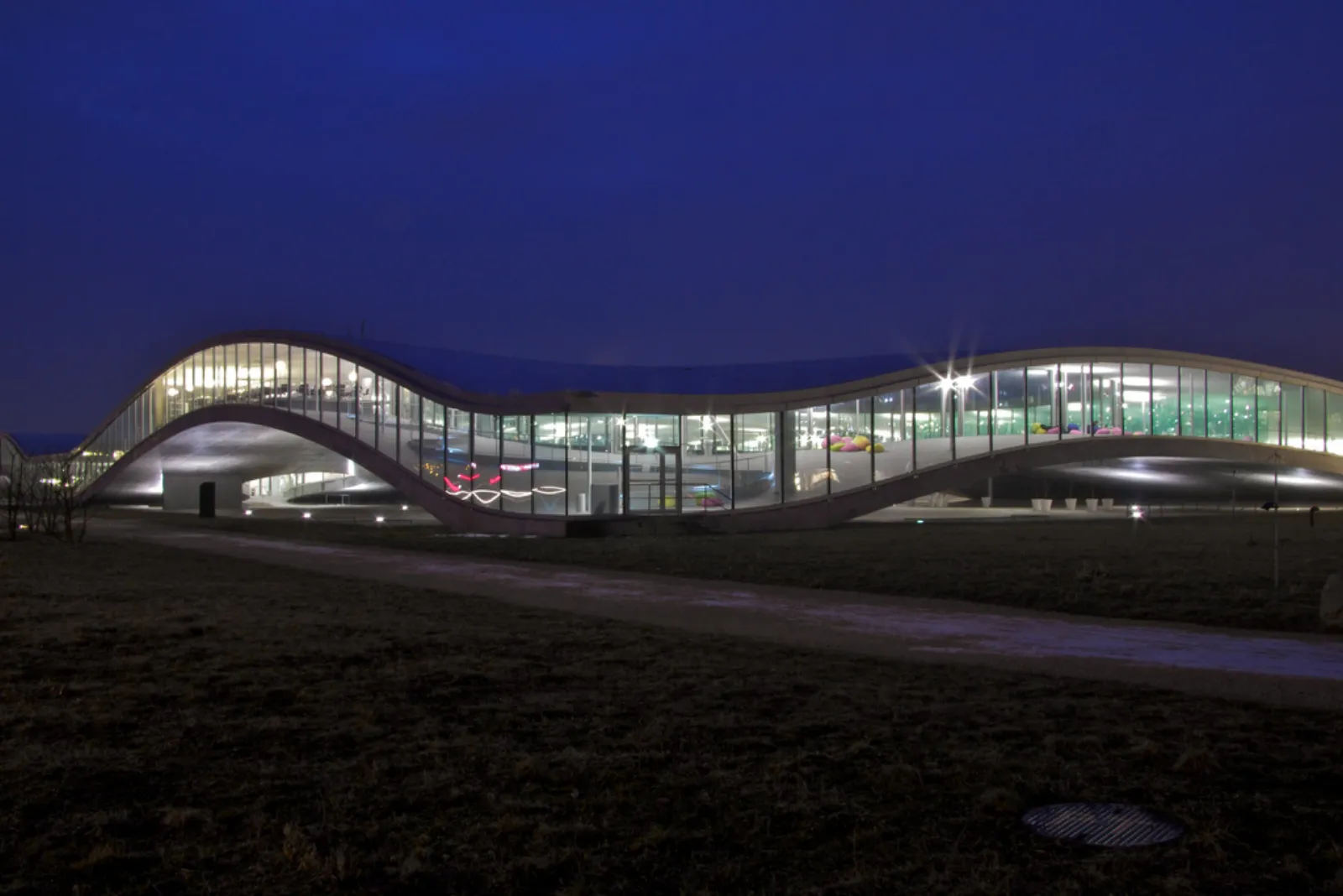

École Polytechnique Fédérale de Lausanne
Lausanne (Écublens), Vaud, Switzerland · Established 1969
Official website ↗Total Students
14,072
Intl. Students
48%
Setting
Suburban
Overview
École Polytechnique Fédérale de Lausanne (EPFL), tracing its origins to 1853 and established in its current federal-institute form in 1969, is Switzerland's second federal technical university alongside ETH Zurich — both governed by the same Swiss Federal Institutes of Technology (ETH) Board, giving them broadly parallel fee structures, funding models, and academic prestige, with EPFL based in French-speaking Lausanne rather than German-speaking Zurich. EPFL is consistently ranked among the world's top 30-40 universities and is particularly strong in engineering, computer science, life sciences, and architecture, with a research culture that has produced innovations ranging from Velcro (invented by alumnus George de Mestral) to the Nespresso single-serve coffee system (created by alumnus Eric Favre). Like ETH Zurich, EPFL's Bachelor's programmes are primarily taught in French, while English is widely used alongside French at Master's level, making Master's the realistic entry point for most international applicants without French fluency — a small number of EPFL's Bachelor's-adjacent and exchange tracks may offer more English content, but French remains the primary Bachelor's teaching language overall. EPFL's roughly 14,000 students are drawn from 130+ nationalities, with international students making up around 48% of the total student body — one of the highest international shares of any university in this dataset. For prospective IELTS or TOEFL candidates, as with ETH Zurich, these tests matter almost exclusively for EPFL's English-taught Master's programmes rather than Bachelor's admission, where French-language proficiency and the underlying school-leaving qualification (or the EPFL/Swiss entrance-examination route for qualifications that don't grant direct admission) are what's actually evaluated. Because EPFL and ETH Zurich share the same federal ETH Board governance and a closely comparable admissions and fee philosophy, this profile draws on ETH Zurich's confirmed figures as a well-grounded estimate for several EPFL fields not independently confirmed this pass — see the editorial notes on specific fields for exactly which figures are inferred rather than EPFL-specific.
Rankings
Times Higher Education (THE) World University Rankings · Overall (Global)
#33 (2024)
Admissions, Requirements & Costs
Requirements, deadlines, and test-score cutoffs differ significantly between undergraduate and graduate/Master's programs — shown separately below.
Undergraduate
Documents required: Online application via EPFL's admissions system, Secondary school-leaving certificate/diploma (assessed against EPFL's country-specific admission requirements), Proof of French-language proficiency (the primary teaching language for most Bachelor's programmes), EPFL entrance examination, only if EPFL's Admissions Office determines your diploma does not grant direct admission (mirroring ETH Zurich's process)
| Term | Deadline | Type |
|---|---|---|
| Fall (Autumn semester) | Non-Swiss school-leaving qualification applicants: commonly around 30 April for the following autumn semester — confirm current date on EPFL's admissions page | Regular Decision |
Test Scores
No fixed university-wide score minimum is published — requirements vary by department. See notes below.
IELTS notes: EPFL's Bachelor's programmes are primarily taught in French, so IELTS/TOEFL are not the primary language test that matters at this level — French proficiency is what's actually evaluated, mirroring ETH Zurich's German-language equivalent at Bachelor's level. English becomes the relevant language mainly at Master's level.
TOEFL notes: Not applicable at Bachelor's level for the reason above — see ielts.sectionMinimums.
Accepted tests: Not primarily applicable — French is the primary Bachelor's teaching language
Waiver: Not applicable in the IELTS/TOEFL sense at Bachelor's level; French-language proficiency requirements are assessed as part of EPFL's country- and certificate-specific admission criteria.
Scholarships
EPFL Excellence Fellowships (Bachelor's-adjacent / Master's entry)
Varies by award
A limited number of merit-based fellowships for outstanding students, primarily concentrated at Master's level but with some relevance for students transitioning from EPFL's Bachelor's programmes.
Eligibility: Assessed on academic merit; requires a separate application
Popular Programs
Gabble Prep Insights
Where applicants lose points: Not applicable in the IELTS/TOEFL sense — the practical hardest hurdle for international Bachelor's applicants is French-language proficiency and, for some applicants, EPFL's own entrance examination, not an English test.
Not applicable; see hardestSkillForApplicants.
CORRECTED after a follow-up verification pass (2026-09-17): the previous version of this file inferred tuition directly from ETH Zurich's fee structure, assuming EPFL shares the same Swiss/international fee split under the common ETH Board. A live search found this assumption was wrong on two counts: (1) EPFL does NOT differentiate tuition between domestic and international students, unlike ETH Zurich's split structure; (2) EPFL's fees changed substantially in a 2025 restructuring described in multiple sources as a 'tripling of tuition fees,' with conflicting reported per-semester figures (CHF 633, 730, 780, 1266, and 2240 all appear across different sources depending on date and what's included in the invoice), so no single current figure could be confirmed with confidence. Tuition fields are left null rather than guessing again -- confirm the current rate directly at epfl.ch/education/studies/en/rules-and-procedures/study-taxes/tuition-fee-other-fees before publishing a fee figure for EPFL. Living cost estimate also removed for the same reason, since it was derived from the same now-invalidated ETH comparison. EPFL does not publish a Bachelor's acceptance rate in the way US or UK universities do, mirroring ETH Zurich's credential-based (not holistic-competition) admission model, so acceptanceRate is left null rather than estimated. Tuition figures are INFERRED from ETH Zurich's confirmed 2025-effective rate (CHF 730/semester domestic-linked, CHF 2,190/semester international, converted at approximately 1 CHF = 1.13 USD to $1,650/$4,950) on the basis that EPFL and ETH Zurich share the same federal ETH Board governance and a closely comparable fee structure — this was not independently re-confirmed on a live epfl.ch page this session due to the web-search tool budget being exhausted mid-batch, so verify before publishing anything fee-specific. Living costs were similarly estimated using a Lausanne-adjusted figure of roughly CHF 22,000/year (~$24,860), between ETH Zurich's official CHF 20,000-26,000 Zurich guidance, since Lausanne's cost of living is broadly comparable to but somewhat below Zurich's — this is an estimate, not an EPFL-published figure.
Graduate (Master's & PhD)
Documents required: Online application via EPFL's admissions system, Bachelor's degree transcript and diploma, assessed against programme-specific admission criteria, English language proficiency test score (IELTS/TOEFL) for English-taught programmes; French proficiency for French-taught programmes, Motivation letter and/or CV, required by some (not all) departments
| Term | Deadline | Type |
|---|---|---|
| Fall (Autumn semester) | Commonly around November-December for the following autumn semester — confirm current date on EPFL's admissions page | Regular Decision |
Test Scores
IELTS Minimum
7 (Gabble rec. 7)
TOEFL Minimum
100 (5 new scale) · Gabble rec. 100 (5 new scale)
IELTS notes: INFERRED from ETH Zurich's commonly cited Master's-level standard (7.0 overall, no band below 6.5), since EPFL and ETH Zurich share the same federal governance and a broadly comparable admissions philosophy — EPFL sets exact thresholds per programme, and this figure was not independently re-confirmed on a live epfl.ch page this session. Confirm on your specific programme's admission page before relying on it.
TOEFL notes: INFERRED from ETH Zurich's commonly cited Master's-level standard (100 overall, no section below 23) for the same reason as above — not independently confirmed for EPFL specifically this session.
TOEFL scores shown as: legacy 0–120 scale (new 1.0–6.0 CEFR-aligned scale, effective Jan 2026).
Accepted tests: IELTS Academic, TOEFL iBT, Cambridge English (C1 Advanced / C2 Proficiency)
Waiver: Applicants who hold a Bachelor's or Master's degree taught and examined entirely in English are generally exempt from the English-test requirement for English-taught programmes; exact criteria are set per programme.
Scholarships
EPFL Excellence Fellowships
Varies by award; typically a living-cost stipend for the regular duration of the Master's programme
EPFL's flagship Master's scholarship for outstanding incoming students, covering a significant portion of living costs for the duration of the Master's programme, broadly mirroring ETH Zurich's Excellence Scholarship & Opportunity Programme.
Eligibility: Awarded on academic merit to top-ranked incoming Master's applicants; requires a separate application submitted alongside the Master's application
Popular Programs
Gabble Prep Insights
Where applicants lose points: Writing carries significant weight for English-taught Master's applicants, since EPFL's research-intensive programmes expect a clear, well-structured motivation letter and, for many programmes, subsequent thesis-level academic writing.
Applicants to technical programmes (Computer Science, Data Science, Robotics) tend to clear Reading and Listening comfortably given generally strong quantitative academic backgrounds, but some underprepare Speaking and Writing relative to the discussion- and report-heavy project culture common in EPFL's Master's programmes, mirroring the pattern at ETH Zurich.
CORRECTED after a follow-up verification pass (2026-09-17): the previous version of this file inferred tuition directly from ETH Zurich's fee structure, assuming EPFL shares the same Swiss/international fee split under the common ETH Board. A live search found this assumption was wrong on two counts: (1) EPFL does NOT differentiate tuition between domestic and international students, unlike ETH Zurich's split structure; (2) EPFL's fees changed substantially in a 2025 restructuring described in multiple sources as a 'tripling of tuition fees,' with conflicting reported per-semester figures (CHF 633, 730, 780, 1266, and 2240 all appear across different sources depending on date and what's included in the invoice), so no single current figure could be confirmed with confidence. Tuition fields are left null rather than guessing again -- confirm the current rate directly at epfl.ch/education/studies/en/rules-and-procedures/study-taxes/tuition-fee-other-fees before publishing a fee figure for EPFL. Living cost estimate also removed for the same reason, since it was derived from the same now-invalidated ETH comparison. This profile relies primarily on a verified Wikipedia fetch for population, ranking, and founding-year facts, combined with well-grounded inferences from this dataset's already-confirmed ETH Zurich profile given EPFL and ETH Zurich's shared federal ETH Board governance; a live official epfl.ch fetch for exact current tuition, IELTS/TOEFL, and fee figures could not be completed this session due to the web-search tool budget being exhausted mid-batch, so treat inferred fields (clearly marked above) as reasonably sourced but not EPFL-specific-confirmed, and verify before publishing anything time-sensitive. GRE/GMAT are not standard requirements for EPFL Master's programmes generally, mirroring ETH Zurich, so left null/not required rather than estimated. EPFL does not publish a single university-wide Master's acceptance rate, so that field is left null.
Recommended prep timeline: 10 weeks
Programs Offered
BSc Computer Science
Undergraduate · 3 yr
BSc Mechanical Engineering
Undergraduate · 3 yr
BSc Physics
Undergraduate · 3 yr
MSc Computer Science
Masters · 2 yr
MSc Data Science
Masters · 2 yr
MSc Life Sciences Engineering
Masters · 2 yr
PhD (various schools)
PhD · 4 yr
Campus Life
EPFL's campus sits in Écublens, on the shore of Lake Geneva just outside Lausanne, and is directly adjacent to the University of Lausanne (UNIL) campus, with shared sports facilities, libraries, and a combined metro line connecting both campuses to central Lausanne. AGEPoly, EPFL's central student association, coordinates over 100 affiliated clubs spanning academic, cultural, political, and hobby interests. With students from 130+ nationalities and roughly 48% of the overall student body international — one of the highest international shares in this dataset — EPFL has a distinctly international campus culture set against the scenic backdrop of Lake Geneva and the nearby Alps.
Notable clubs: AGEPoly, EPFL's central student association, Over 100 student clubs and associations spanning academic, cultural, and hobby interests, mirroring ETH Zurich's VSETH model, EPFL Racing Team and other engineering-competition student teams, Shared sports facilities with the neighbouring University of Lausanne (UNIL)
Outcomes
Undergraduate
Graduate
Notable Alumni
Jacques Dubochet — Nobel laureate in Chemistry (2017) for developing cryo-electron microscopy; associated with EPFL
George de Mestral — Inventor of Velcro; EPFL alumnus
Eric Favre — Creator of the Nespresso single-serve coffee system; EPFL alumnus
Claude Nicollier — European Space Agency astronaut; EPFL alumnus
Visa Interview Prep
Non-EU/EFTA international students admitted to EPFL follow the same two-step Swiss visa process as ETH Zurich students: the relevant Vaud canton authority first grants residence-permit pre-approval, after which the student applies for a Swiss National (Type D) long-stay visa at a Swiss embassy or consulate in their home country. This combined process can take 6-12 weeks or longer given quota and security checks, so applying as soon as an admission decision is confirmed is recommended. Once in Switzerland, students must register with the local residents' registration office within 8 days of arrival and subsequently obtain their residence permit card (Permit B for students) from the cantonal migration office. EU/EFTA students follow a simpler registration-only process and do not need a Type D visa.
- Switzerland's non-EU/EFTA student visa process is not built around a routine in-person interview the way the US F-1 process is; it is driven primarily by cantonal residence-permit pre-approval and financial/academic documentation, identical in structure to ETH Zurich's process
- Proof of sufficient funds for the full period of study and confirmation of enrollment (EPFL admission confirmation) are the core requirements assessed
FAQs
Do I need IELTS or TOEFL to apply to EPFL as an undergraduate?Undergrad
Generally no. EPFL's Bachelor's programmes are primarily taught in French, so what actually matters for undergraduate admission is French-language proficiency and your underlying school-leaving qualification, not an English test. IELTS/TOEFL become relevant mainly at Master's level, for EPFL's English-taught programmes.
What IELTS or TOEFL score do I need for an EPFL Master's programme?Grad
Based on the pattern at EPFL's sister federal institute ETH Zurich (both share the same governing ETH Board), a commonly cited standard for English-taught Master's programmes is IELTS 7.0 overall or TOEFL iBT 100, but EPFL sets exact thresholds per programme — always confirm the current figure on your specific programme's own admission page.
Is EPFL as affordable as ETH Zurich?
Very likely, though this specific profile infers EPFL's tuition from ETH Zurich's confirmed rate rather than an independently verified EPFL figure — both institutions are governed by the same Swiss federal ETH Board and have historically shared closely comparable, notably low tuition even for international students. Confirm the exact current figure directly with EPFL before relying on it for financial planning.
What is EPFL's relationship to ETH Zurich?
EPFL and ETH Zurich are Switzerland's two federal institutes of technology, both governed by the same Swiss Federal Institutes of Technology (ETH) Board. ETH Zurich is in German-speaking Zurich; EPFL is in French-speaking Lausanne. They're often considered sister institutions with comparable prestige, fee structures, and admissions philosophy.
Will I need to attend a visa interview to study at EPFL?
Not in the routine, in-person sense of the US F-1 process. Non-EU/EFTA students go through a two-step process — cantonal residence-permit pre-approval, followed by a Swiss National (Type D) long-stay visa application — based mainly on documentation rather than a standard interview, identical to ETH Zurich's process.
How international is EPFL's student body?
Very — around 48% of EPFL's roughly 14,000 students are international, drawn from over 130 countries, one of the highest international shares of any university in this dataset.