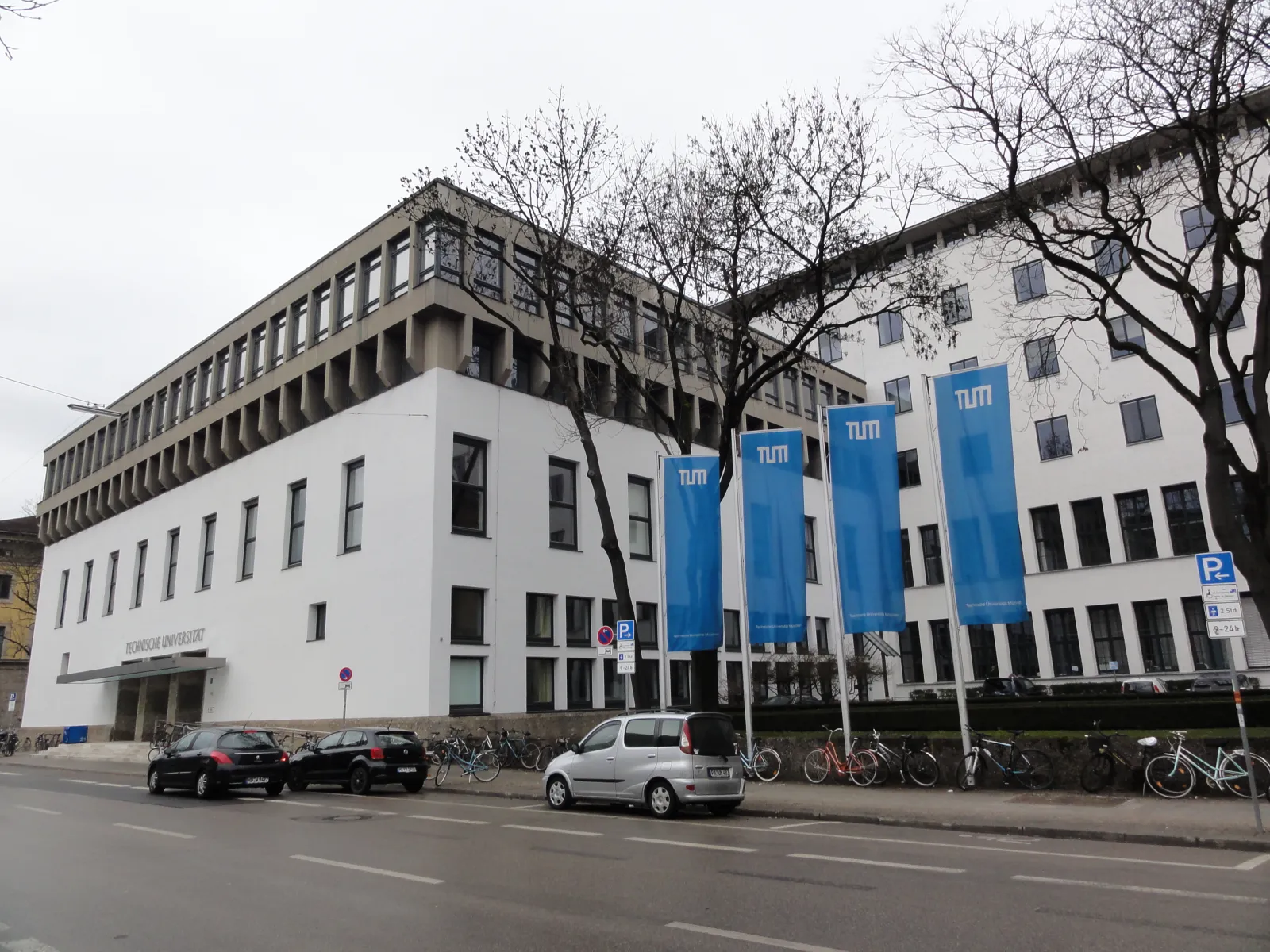

Technical University of Munich
Munich, Bavaria, Germany · Established 1868
Official website ↗Total Students
51,954
Intl. Students
45%
Setting
Urban
Overview
The Technical University of Munich (TUM), founded in 1868, is consistently ranked Germany's #1 or #2 university overall and a top-3 European technical university, anchored in Munich — Germany's highest-paying job market and home to BMW, Siemens, and Allianz. TUM organises teaching across schools including the TUM School of Computation, Information and Technology (one of the largest computer science faculties in Europe), the TUM School of Engineering and Design, and the TUM School of Management, which has particularly close ties to Munich's startup ecosystem. Like most German public universities, TUM does not charge tuition fees to international (non-EU) students at either Bachelor's or Master's level — only a modest per-semester administrative contribution (roughly €144-152) that also covers a public transport pass and student services, making TUM one of the most cost-efficient routes to a globally respected engineering or CS degree anywhere in this dataset. The trade-off is language: most Bachelor's programmes at TUM remain German-taught, so the large majority of international applicants enter at Master's level, where TUM offers a substantial and growing catalogue of English-taught programmes across engineering, computer science, data science, robotics, and management. For prospective IELTS or TOEFL candidates, TUM does not publish one single university-wide English-proficiency threshold — requirements are set per Master's programme, commonly clustering around IELTS 6.5 (TOEFL iBT 88), with TUM School of Management programmes (such as MSc Management & Innovation) sometimes requiring up to IELTS 7.0/TOEFL 95. Applicants typically use Germany's centralised uni-assist portal or TUM's own TUMonline system to pre-check qualification equivalence before submitting a full application, and should plan for the 'blocked account' (Sperrkonto) required as part of the German student visa process well ahead of their intended start date.
Rankings
QS World University Rankings · Overall (Germany)
#1 (2027)
Times Higher Education (THE) World University Rankings · Overall (Global)
#27 (2026)
Times Higher Education (THE) World University Rankings · Overall (Germany)
#1 (2026)
Admissions, Requirements & Costs
Requirements, deadlines, and test-score cutoffs differ significantly between undergraduate and graduate/Master's programs — shown separately below.
Undergraduate
Documents required: Application via uni-assist (for most international qualifications) or TUM's own TUMonline system, Secondary school-leaving certificate, assessed for German-Abitur equivalence, German language proficiency for the (majority) German-taught Bachelor's programmes; English proficiency for the smaller number of English-taught Bachelor's tracks, Any programme-specific aptitude test or additional selection materials, where applicable
| Term | Deadline | Type |
|---|---|---|
| Winter semester (October) / Summer semester (April) | Varies by programme; commonly mid-January for the following Winter semester and mid-July for Summer semester intake — always confirm on the specific programme's page | Regular Decision |
Test Scores
IELTS Minimum
6.5 (Gabble rec. 6.5)
TOEFL Minimum
88 (4.5 new scale) · Gabble rec. 88 (4.5 new scale)
IELTS notes: Relevant only to TUM's small number of English-taught Bachelor's tracks; the large majority of Bachelor's programmes are German-taught and instead require German-language proficiency. Where an English-taught Bachelor's track exists, requirements broadly mirror TUM's Master's-level thresholds (commonly around 6.5 overall).
TOEFL notes: Relevant only to TUM's small number of English-taught Bachelor's tracks; see ielts.sectionMinimums.
TOEFL scores shown as: legacy 0–120 scale (new 1.0–6.0 CEFR-aligned scale, effective Jan 2026).
Accepted tests: IELTS Academic, TOEFL iBT, Cambridge English (C1 Advanced / C2 Proficiency)
Waiver: Applicants who completed prior education entirely in English may qualify for a waiver on relevant English-taught tracks, subject to programme approval.
Tuition (Intl.)
$345
Tuition (Domestic)
$345
Living Expenses/yr
$20,010
Total Cost of Attendance
$20,355
Scholarships
Deutschlandstipendium (Germany Scholarship)
€300/month for up to one year, renewable based on continued academic performance
A national merit-based scholarship programme, co-funded by government and private sponsors, available to high-performing students at TUM and other German universities, including international students enrolled at TUM.
Eligibility: Awarded on academic merit and, at some faculties, additional criteria such as social engagement; requires a separate application through TUM
Popular Programs
Gabble Prep Insights
Where applicants lose points: Not primarily an IELTS/TOEFL question at Bachelor's level, since most Bachelor's programmes are German-taught — the practical hardest hurdle for most international undergraduate applicants is reaching the required German-language level (commonly C1) rather than an English test.
For the smaller number of English-taught Bachelor's tracks, applicants with strong STEM secondary-school backgrounds generally clear Reading and Listening easily; Writing tends to be the section needing the most extra preparation.
This profile draws on this site's own previously published TU Munich/RWTH Aachen guide (content/blog/tu-munich-rwth-aachen-guide.mdx) plus a verified Wikipedia fetch for population, ranking, and founding-year facts; a live official tum.de fetch for every current figure could not be completed this session due to the web-search tool budget being exhausted mid-batch, so cross-check time-sensitive figures before publishing. TUM does not charge tuition to non-EU international students — only the standard per-semester contribution of roughly €150 (~€300/year), converted at approximately 1 EUR = 1.15 USD to $345/year, which is used here as tuitionInternationalPerYear (identical to the domestic rate, since Bavaria's tuition-free policy applies to all students at TUM regardless of nationality). Living costs were estimated at roughly €1,450/month (€17,400/year, ~$20,010) reflecting Munich's position as one of Germany's most expensive cities to live in — this is a general estimate, not an official TUM-published figure. Student population undergraduate/graduate split (28,600/23,354) is an estimate derived from the confirmed total (51,954) and typical German technical-university enrolment patterns, since the source used did not break this down explicitly. TUM does not publish a single official acceptance rate, so that field is left null.
Recommended prep timeline: 8 weeks
Graduate (Master's & PhD)
Documents required: Application via uni-assist or TUM's own TUMonline system, Bachelor's degree transcript, assessed against the specific Master's programme's subject prerequisites, English language proficiency test score (IELTS/TOEFL/Cambridge English) for English-taught programmes, or German proficiency for German-taught programmes, Motivation letter / statement of purpose, required by some (not all) programmes, CV/resume
| Term | Deadline | Type |
|---|---|---|
| Winter semester (October) / Summer semester (April) | Varies by programme; commonly mid-January for the following Winter semester and mid-July for Summer semester intake — always confirm on the specific programme's page | Regular Decision |
Test Scores
IELTS Minimum
6.5 (Gabble rec. 7)
TOEFL Minimum
88 (4.5 new scale) · Gabble rec. 95 (5 new scale)
IELTS notes: Commonly 6.5 overall for most English-taught engineering/CS Master's programmes (e.g. MSc Informatics, MSc Data Engineering and Analytics, MSc Mechanical Engineering); TUM School of Management programmes such as MSc Management & Innovation commonly require the higher end, around 6.5-7.0. TUM does not publish one single university-wide figure — always confirm on the specific programme's page.
TOEFL notes: Commonly 88 overall for most English-taught engineering/CS Master's programmes; TUM School of Management programmes commonly require 90-95.
TOEFL scores shown as: legacy 0–120 scale (new 1.0–6.0 CEFR-aligned scale, effective Jan 2026).
Accepted tests: IELTS Academic, TOEFL iBT, Cambridge English (C1 Advanced / C2 Proficiency)
Waiver: Applicants who completed a prior degree taught entirely in English may qualify for a waiver, subject to programme approval.
Tuition (Intl.)
$345
Tuition (Domestic)
$345
Living Expenses/yr
$20,010
Total Cost of Attendance
$20,355
Scholarships
Deutschlandstipendium (Germany Scholarship)
€300/month for up to one year, renewable based on continued academic performance
A national merit-based scholarship programme co-funded by government and private sponsors, available to high-performing Master's students at TUM, including international students.
Eligibility: Awarded on academic merit and, at some faculties, additional criteria; requires a separate application through TUM
TUM Global & Alumni Office scholarships and DAAD-linked funding
Varies considerably by specific scholarship
A range of smaller, country- or programme-specific scholarships coordinated through TUM's Global & Alumni Office, alongside external DAAD (German Academic Exchange Service) scholarships that many international TUM Master's students separately apply for.
Eligibility: Varies by scholarship; most require a separate application, some through DAAD directly rather than through TUM
Popular Programs
Gabble Prep Insights
Where applicants lose points: Writing carries real weight for Master's applicants at programmes that require a motivation letter or statement of purpose, since TUM's admissions committees weigh a specific, well-argued rationale over generic statements.
Applicants with strong quantitative undergraduate backgrounds generally clear Reading and Listening comfortably; Speaking tends to be the most commonly underprepared section, since collaborative project work and lab discussion in English is a bigger day-to-day demand at TUM than formal presentation.
Same sourcing caveat as the undergraduate section — this profile relies on this site's own previously published guide plus a verified Wikipedia fetch, not a freshly re-verified live official tum.de page, due to the web-search tool budget being exhausted mid-batch. GRE/GMAT are not standard requirements for TUM Master's admission generally (TUM School of Management programmes may reference GMAT as one optional element for some tracks, but no official required or average score is published), so left null/not required rather than estimated. TUM does not publish a single official Master's acceptance rate, so that field is left null.
Recommended prep timeline: 8 weeks
Programs Offered
BSc Mechanical Engineering
Undergraduate · 3 yr
BSc Informatics
Undergraduate · 3 yr
MSc Informatics
Masters · 2 yr
MSc Data Engineering and Analytics
Masters · 2 yr
MSc Mechanical Engineering
Masters · 2 yr
MSc Management & Innovation
Masters · 2 yr
PhD (various schools)
PhD · 4 yr
Campus Life
TUM's main campus sits in central Munich, with additional campuses in Garching (a major science and technology research park on Munich's outskirts) and Freising-Weihenstephan (life sciences and agriculture). Munich itself is Germany's highest-paying job market and home to a dense cluster of automotive, industrial, and financial employers (BMW, Siemens, Allianz), giving TUM students unusually direct access to internships and graduate roles without needing to relocate. With 45% of the student body international, TUM supports a broad range of international student groups alongside its academic and hobby-focused student clubs, and its TUM Boring and Junior Enterprise-style initiatives give students hands-on engineering and consulting project experience outside formal coursework.
Notable clubs: TUM Studierendenvertretung (student representative body), Faculty-specific student initiatives (e.g. TUM Boring, a student engineering competition team; TUM Junior Enterprise for consulting-style project experience), TUM Hochschulsport (university sports programme with a wide range of clubs), International student associations connected to TUM's Global & Alumni Office
Outcomes
Undergraduate
Graduate
Notable Alumni
Hans Fischer — Nobel laureate in Chemistry (1930) for research on the structure of haemin and chlorophyll; TUM professor
Walther Meissner — Physicist known for co-discovering the Meissner effect in superconductivity; TUM professor
Willy Messerschmitt — Pioneering aircraft designer and founder of the Messerschmitt aircraft company; associated with TUM
Rudolf Diesel — Inventor of the diesel engine; studied at TUM's direct predecessor institution, the Technical University of Munich (TH München)
Visa Interview Prep
Non-EU/EEA students admitted to TUM generally need a German national (Type D) student visa, applied for at a German consulate in their home country, followed by a residence permit obtained after arrival in Germany. A central requirement is the blocked account (Sperrkonto), a designated German bank account into which the student must deposit a set annual amount (used by German immigration authorities as proof of sufficient funds, with a fixed monthly withdrawal limit once in Germany) — this can take time to set up from outside Germany, so TUM and this site's own guide both recommend starting the process well ahead of the intended start date. After arrival, students register their address with the local city registration office (Anmeldung) and then apply for their residence permit at the local Foreigners' Office (Ausländerbehörde). TUM graduates are eligible for Germany's 18-month Job Seeker Visa after graduation, followed by the EU Blue Card once a qualifying job offer is secured, with permanent residency possible in as little as 21 months on the Blue Card with B1-level German.
- Germany's national student visa process is document- and funds-driven rather than built around a routine consular interview in the US F-1 sense, though a short in-person appointment at the German consulate to submit the application and biometrics is standard
- Proof of admission (TUM's admission letter), proof of sufficient funds via a blocked account (Sperrkonto), and health insurance are the core requirements assessed
FAQs
Is TU Munich (TUM) really tuition-free for international students?
Yes — like most German public universities, TUM does not charge tuition fees to non-EU international students at either Bachelor's or Master's level. You'll still pay a modest per-semester administrative contribution of roughly €150, which also covers a public transport pass and student services.
Can I study at TUM in English?
At Master's level, yes — TUM offers a substantial and growing catalogue of English-taught Master's programmes across engineering, computer science, data science, robotics, and management. At Bachelor's level, the large majority of programmes remain German-taught, so most non-German-speaking international applicants apply at Master's level instead.
What IELTS or TOEFL score do I need for a TUM Master's programme?Grad
Requirements are set per programme rather than as one university-wide figure. Most engineering and CS Master's programmes commonly require IELTS 6.5 (TOEFL iBT 88), while TUM School of Management programmes such as MSc Management & Innovation sometimes require up to IELTS 6.5-7.0 (TOEFL 90-95).
How do I apply to TUM?
Most international applicants apply through uni-assist, Germany's centralised portal that pre-checks qualification equivalence, or directly through TUM's own TUMonline system depending on the programme. Deadlines vary by programme, commonly around mid-January for the following Winter semester.
What is a blocked account (Sperrkonto) and why do I need one?
A blocked account is a designated German bank account non-EU students must open and fund with a set annual amount as proof of sufficient funds for the German student visa, with a fixed monthly withdrawal limit once you're in Germany. It's a required part of the visa process and can take time to set up from outside Germany, so start early.
Can I stay in Germany after graduating from TUM?Grad
Yes — TUM graduates are eligible for Germany's 18-month Job Seeker Visa to search for qualifying employment, after which the EU Blue Card becomes available once a qualifying job offer is secured. Permanent residency is possible in as little as 21 months on the Blue Card with B1-level German.