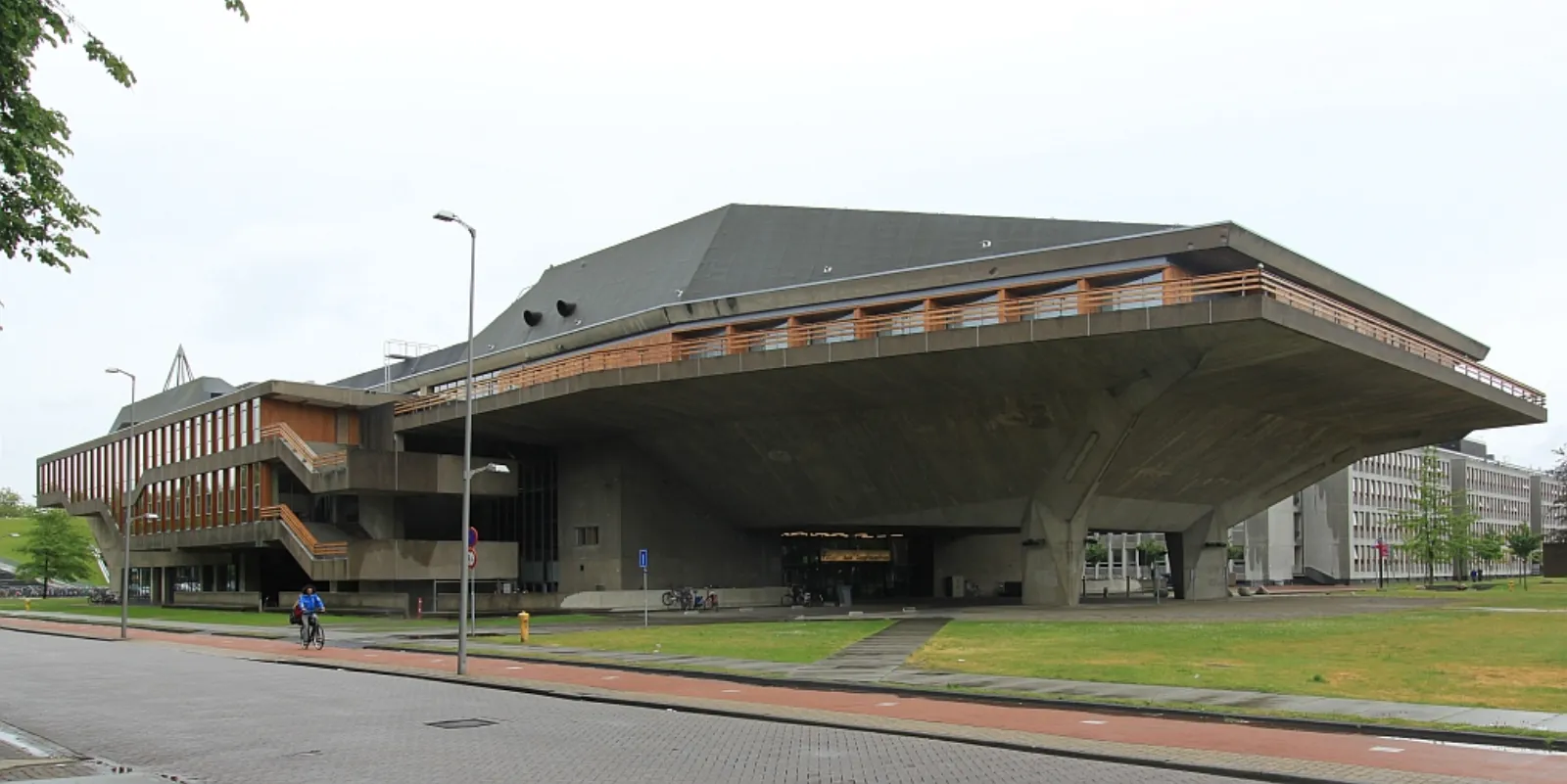

Delft University of Technology
Delft, South Holland, Netherlands · Established 1842
Official website ↗Total Students
26,502
Intl. Students
29%
Setting
Urban
Overview
Delft University of Technology (TU Delft), founded in 1842, is the Netherlands' oldest and largest technical university and is consistently grouped alongside ETH Zurich and Imperial College London as one of Europe's leading technical institutions. Unlike ETH Zurich's mostly German-taught Bachelor's programmes, TU Delft offers a genuinely wide range of fully English-taught Bachelor's degrees (including BSc Computer Science and BSc Aerospace Engineering) alongside an even broader catalogue of English-taught Master's programmes across nearly every engineering discipline — making it unusually accessible to international applicants who don't speak Dutch, relative to many continental European technical universities. TU Delft organises its teaching across eight faculties spanning Aerospace Engineering, Civil Engineering and Geosciences, Electrical Engineering/Mathematics and Computer Science, Mechanical Engineering, Architecture and the Built Environment, Applied Sciences, Technology Policy and Management, and Industrial Design Engineering. The university sits at the centre of a dense Dutch and pan-European engineering employer network — companies including ASML, Shell, and Philips recruit heavily from TU Delft — and its research strength in Architecture and Engineering & Technology subject rankings is a particular draw for applicants targeting those fields specifically, even where TU Delft's broader overall global ranking sits below Oxbridge- or Ivy-tier institutions. For prospective IELTS or TOEFL candidates, TU Delft does not use a single university-wide English-proficiency threshold: Bachelor's programmes generally require IELTS 6.5 overall with no band below 6.0 (TOEFL iBT 90-100), while Master's requirements vary somewhat by programme, commonly in the 6.5-7.0 IELTS range. Admission itself is not run as a single numbers-based holistic-review competition the way US universities operate — TU Delft assesses Master's applicants against defined, programme-specific academic prerequisites (particular prior coursework in areas like linear algebra, thermodynamics, or programming) rather than a fixed acceptance quota, though several Bachelor's programmes do cap intake through the Netherlands' numerus fixus system. Applications run through Studielink, the Dutch national university application portal, not a TU Delft-specific system.
Rankings
QS World University Rankings by Subject · Engineering & Technology
#13 (2024)
Admissions, Requirements & Costs
Requirements, deadlines, and test-score cutoffs differ significantly between undergraduate and graduate/Master's programs — shown separately below.
Undergraduate
Documents required: Studielink national application (the Netherlands' centralised university application portal), Secondary school-leaving diploma/transcript assessed against the specific programme's required subjects and grades, Motivation letter, English language proficiency test score (IELTS/TOEFL/Cambridge English) or an approved English-medium-instruction waiver, Additional numerus fixus selection procedure materials for capped-intake programmes (varies by programme)
| Term | Deadline | Type |
|---|---|---|
| Fall (September) | Non-EU/EEA applicants: generally 1 April for a September start; numerus fixus programmes may set an earlier deadline — always confirm the specific programme's date on Studielink | Regular Decision |
Test Scores
IELTS Minimum
6.5 (Gabble rec. 6.5)
TOEFL Minimum
90 (4.5 new scale) · Gabble rec. 90 (4.5 new scale)
IELTS notes: Commonly 6.5 overall with no band below 6.0 for English-taught Bachelor's programmes; exact thresholds are set per programme, so always confirm on the specific programme's admission page.
TOEFL notes: Commonly 90-100 overall for English-taught Bachelor's programmes, varying by programme; TU Delft does not publish one single university-wide figure.
TOEFL scores shown as: legacy 0–120 scale (new 1.0–6.0 CEFR-aligned scale, effective Jan 2026).
Accepted tests: IELTS Academic, TOEFL iBT, Cambridge English (C1 Advanced / C2 Proficiency)
Waiver: Applicants who completed their prior education entirely in English (an English-medium-instruction waiver) may be exempt from submitting a separate test score, subject to programme-level approval.
Tuition (Intl.)
$24,150
Living Expenses/yr
$18,630
Total Cost of Attendance
$42,780
Scholarships
TU Delft Excellence Scholarships / Justus & Louise van Effen Excellence Scholarships
Varies by award; can range from a partial tuition contribution to full tuition plus a living stipend for the most competitive awards
A limited number of merit-based scholarships for outstanding international students, primarily aimed at Master's applicants but with some Bachelor's-relevant funding available through faculty- and country-specific schemes.
Eligibility: Assessed on academic merit alongside the standard application; most require a separate scholarship application submitted around the same time as the programme application
Popular Programs
Gabble Prep Insights
Where applicants lose points: Writing and Speaking tend to matter less at the bare-admission stage than at many English-primary-market universities, since TU Delft's 6.5 IELTS threshold is comparatively moderate — but international students often underprepare for the sustained academic English demanded once coursework begins, particularly technical report-writing and group-project communication.
Applicants with strong STEM secondary-school backgrounds typically clear Reading and Listening easily; the more common shortfall is Writing, since TU Delft's numerus fixus programmes and competitive Master's tracks (Robotics, AI) increasingly expect a well-argued, specific motivation letter rather than a generic personal statement.
This profile draws primarily on this site's own previously published TU Delft guide (content/blog/tu-delft-guide.mdx) and a verified Wikipedia fetch for population/founding-year facts; a live official tudelft.nl fetch for exact current tuition, IELTS/TOEFL, and ranking figures could not be completed this session due to the web-search tool budget being exhausted mid-batch, so treat the figures below as reasonably sourced but not freshly re-verified against a live official page, and cross-check before publishing anything time-sensitive. Tuition uses a representative mid-range non-EU/EEA rate: €21,000/year for English-taught Bachelor's (from the site's own guide's cited €18,000-24,000 range), converted at approximately 1 EUR = 1.15 USD to $24,150 — actual fees vary meaningfully by specific programme. Living costs were estimated from a general Netherlands student cost-of-living figure of roughly €1,350/month (€16,200/year, ~$18,630), not a TU Delft-specific official figure. TU Delft does not publish a single official acceptance rate — admission for most Master's programmes is assessed against defined academic prerequisites rather than a fixed quota, though several Bachelor's programmes (numerus fixus) do cap total intake — so acceptanceRate is left null rather than estimated. Overall QS/THE global rank could not be confirmed via a live source this pass; only the subject-specific QS 2024 rankings (Architecture, Engineering & Technology) that were confirmed via Wikipedia are included above.
Recommended prep timeline: 8 weeks
Graduate (Master's & PhD)
Documents required: Studielink national application, Bachelor's degree transcript, assessed against the specific Master's programme's prior-coursework requirements, Motivation letter, CV/resume, English language proficiency test score (IELTS/TOEFL/Cambridge English) or an approved waiver, Reference letter(s), required by some (not all) programmes
| Term | Deadline | Type |
|---|---|---|
| Fall (September) | Non-EU/EEA applicants: generally 1 April for a September start; some programmes also offer a February intake with an earlier deadline — confirm on the specific programme's page | Regular Decision |
Test Scores
IELTS Minimum
6.5 (Gabble rec. 7)
TOEFL Minimum
90 (4.5 new scale) · Gabble rec. 100 (5 new scale)
IELTS notes: Commonly 6.5-7.0 overall with no band below 6.0, varying by Master's programme; bridging/pre-master's programmes typically require the higher end, around 7.0 with no band below 6.5.
TOEFL notes: Commonly 90-100 overall, varying by Master's programme; bridging/pre-master's programmes typically require 100.
TOEFL scores shown as: legacy 0–120 scale (new 1.0–6.0 CEFR-aligned scale, effective Jan 2026).
Accepted tests: IELTS Academic, TOEFL iBT, Cambridge English (C1 Advanced / C2 Proficiency)
Waiver: Applicants who completed a prior degree taught entirely in English may qualify for an English-medium-instruction waiver, subject to programme-level approval.
Conditional admission: TU Delft offers bridging/pre-master's programmes for applicants who don't yet meet a specific Master's programme's academic or English-language prerequisites; these typically require the higher IELTS 7.0/TOEFL 100 threshold rather than a discount off the standard Master's requirement.
Tuition (Intl.)
$26,450
Living Expenses/yr
$18,630
Total Cost of Attendance
$45,080
Scholarships
Justus & Louise van Effen Excellence Scholarships
Varies by award; typically a substantial tuition contribution plus a living stipend for the most competitive recipients
TU Delft's flagship Master's scholarship for outstanding international students, covering a significant portion of tuition and living costs for a small cohort of top applicants each year.
Eligibility: Awarded on academic excellence to Master's applicants who are not eligible for Dutch/EU statutory-fee status; requires a separate scholarship application alongside the programme application
Popular Programs
Gabble Prep Insights
Where applicants lose points: Writing carries real weight for Master's applicants specifically through the motivation letter, which TU Delft's admissions committees weigh for a clear, programme-specific rationale rather than a generic 'wanting to study engineering in Europe' statement.
Strong quantitative applicants generally clear Reading and Listening comfortably; Speaking is the section most likely to be underprepared, since group-project and lab-report collaboration in English is a bigger day-to-day demand at TU Delft than formal spoken presentation.
Same sourcing caveat as the undergraduate section: this profile relies on this site's own previously published TU Delft guide plus a verified Wikipedia fetch, not a freshly re-verified live official tudelft.nl page, due to the web-search tool budget being exhausted mid-batch. Tuition uses a representative €23,000/year (from the site's own guide's cited €20,000-26,000 non-EU/EEA Master's range), converted at approximately 1 EUR = 1.15 USD to $26,450; actual fees vary by specific programme. GRE/GMAT are not standard requirements for TU Delft Master's admission generally, so left null/not required rather than estimated. TU Delft does not publish a single official Master's acceptance rate, so that field is left null.
Recommended prep timeline: 8 weeks
Programs Offered
BSc Computer Science
Undergraduate · 3 yr
BSc Aerospace Engineering
Undergraduate · 3 yr
BSc Mechanical Engineering
Undergraduate · 3 yr
MSc Computer Science
Masters · 2 yr
MSc Robotics
Masters · 2 yr
MSc Aerospace Engineering
Masters · 2 yr
PhD (various faculties)
PhD · 4 yr
Campus Life
TU Delft's campus sits within walking and cycling distance of Delft's historic city centre, between Rotterdam and The Hague, with fast rail connections to Amsterdam and the rest of the Netherlands and wider Europe. Dutch university life leans heavily on faculty-specific study associations, which organise academic events, social activities, and career-fair connections to Delft's dense cluster of engineering employers (ASML, Shell, Philips among them). With a substantial and growing international student population, TU Delft also supports a range of international student societies alongside its long-established Dutch study associations.
Notable clubs: DUWO student housing association network (TU Delft-affiliated student accommodation), VSSD and other Delft student associations spanning academic, cultural, and social interests, Study associations per faculty (e.g. W.S.V. 'Simon Stevin' for Civil Engineering, VvTP for Applied Physics), TU Delft Sports Centre and affiliated student sports clubs
Outcomes
Undergraduate
Graduate
Notable Alumni
Jacobus Henricus van 't Hoff — Nobel laureate in Chemistry (1901); associated with TU Delft
Heike Kamerlingh Onnes — Nobel laureate in Physics (1913) for discovering superconductivity; studied at TU Delft
Simon van der Meer — Nobel laureate in Physics (1984) for contributions to the discovery of the W and Z particles; TU Delft alumnus
Martinus Beijerinck — Microbiologist credited with discovering viruses (1898); associated with TU Delft
Visa Interview Prep
Most non-EU/EEA students admitted to TU Delft need an MVV (provisional residence permit, which doubles as an entry visa) and a VVR residence permit for the duration of study; because TU Delft is a recognised sponsor under Dutch immigration rules, it typically submits this combined application to the Immigration and Naturalisation Service (IND) on the student's behalf once a firm offer is accepted, which is faster and less document-heavy for the applicant than a fully self-managed visa process. After arrival, students must register with their local municipality (BRP registration) and collect their residence permit card. TU Delft's international office assists with this process, and graduates of TU Delft degree programmes are eligible for a 1-year Orientation Year (zoekjaar) residence permit after graduation, allowing time to search for qualifying employment in the Netherlands without needing a separate work permit immediately.
- The Dutch student visa/residence-permit process is document- and sponsorship-driven rather than built around a routine in-person consular interview in the US F-1 sense — TU Delft, as a recognised sponsor institution, submits the residence-permit application to the Dutch immigration service (IND) on the student's behalf in most cases
- Proof of admission, proof of sufficient funds for the study period, and valid health insurance are the core requirements assessed
FAQs
Can I study at TU Delft entirely in English?
Yes — unlike many continental European technical universities, TU Delft offers a genuinely wide range of fully English-taught Bachelor's programmes (such as BSc Computer Science and BSc Aerospace Engineering) as well as an even broader set of English-taught Master's programmes across nearly every engineering discipline.
What IELTS or TOEFL score do I need for TU Delft?
Bachelor's programmes commonly require IELTS 6.5 overall with no band below 6.0 (TOEFL iBT 90-100). Master's requirements vary by programme, typically 6.5-7.0 IELTS overall. TU Delft doesn't set one single university-wide threshold, so always confirm the exact figure on your specific programme's page.
How do I apply to TU Delft?
Through Studielink, the Netherlands' centralised national university application portal, not a TU Delft-specific system. Studielink forwards your application to TU Delft, where you complete programme-specific requirements like transcripts, a motivation letter, and English test scores.
How competitive is admission to TU Delft?
TU Delft doesn't publish a single official acceptance rate. Most Master's programmes are assessed against defined academic prerequisites (specific prior coursework) rather than a fixed quota, though several Bachelor's programmes cap total intake through the Dutch numerus fixus system.
What visa do I need to study at TU Delft?
Most non-EU/EEA students need an MVV (provisional residence permit/entry visa) plus a VVR residence permit for study. Because TU Delft is a recognised immigration sponsor, it typically submits this combined application to the Dutch immigration service (IND) on your behalf once you hold a firm offer, which is simpler than a fully self-managed visa process.
Can I stay in the Netherlands after graduating from TU Delft?Grad
Yes — TU Delft graduates are eligible for a 1-year Orientation Year (zoekjaar) residence permit after graduation, which allows time to search for qualifying employment in the Netherlands without needing a separate work permit during that year.