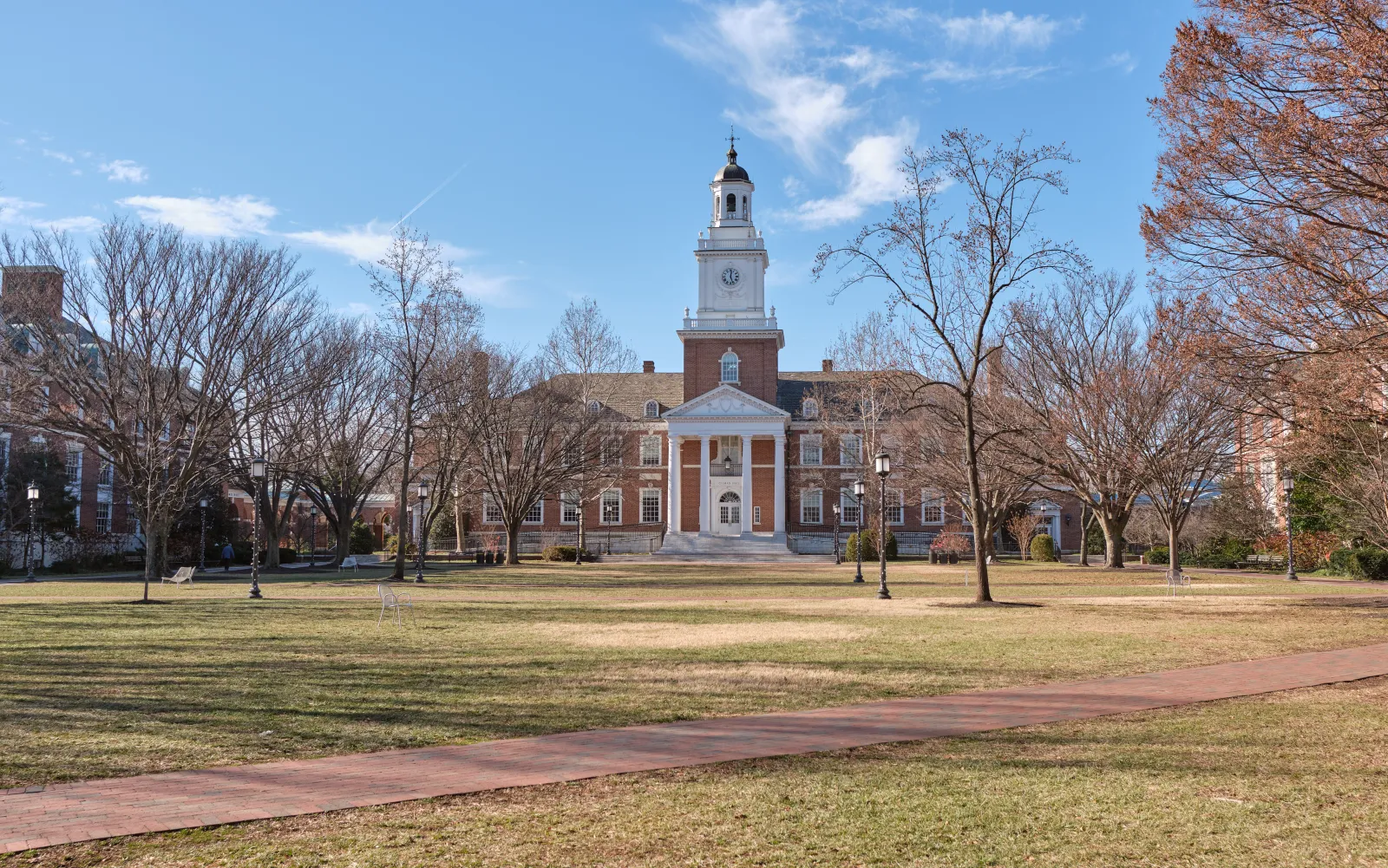

Johns Hopkins University
Baltimore, Maryland, United States · Established 1876
Official website ↗Total Students
30,210
Intl. Students
26.98%
Student:Faculty
6:1
Setting
Urban
Overview
Johns Hopkins University was founded in Baltimore, Maryland in 1876 as the first American research university, built on the German model of combining teaching with original scholarship. Undergraduates take classes at the tree-lined, 140-acre Homewood campus, while the university's professional and graduate divisions — including the Bloomberg School of Public Health, the School of Medicine, the School of Advanced International Studies (SAIS), and the Carey Business School — are spread across Baltimore, Washington DC, and international sites. Hopkins is private, need-blind for domestic undergraduate admissions, and widely known for founding modern American medicine and for consistently topping US research-spending rankings. Academically, Hopkins undergraduates are best known for biomedical engineering (ranked #1 nationally for decades), public health, international studies, computer science, and the natural sciences, supported by close ties to the School of Medicine and the Applied Physics Laboratory. Admission to the undergraduate class is now among the most selective in the country, with acceptance rates settling in the low single digits in recent cycles, driven by a combination of strong applicant growth and a comparatively small entering class of roughly 1,300 students. For prospective international students, Hopkins offers a genuinely global environment — international students make up more than a quarter of the total student body once graduate and professional programs are included — but policies on English-proficiency testing, financial aid, and application documents vary by school. Undergraduate admissions is need-aware for international applicants (unlike the need-blind policy for domestic students), so financial planning and the timing of the aid application matter more for international candidates than for their US counterparts. Graduate and professional admissions are run independently by each school (Whiting Engineering, Krieger Arts & Sciences, Carey Business, Bloomberg Public Health, SAIS, and others), so acceptance rates, testing policies, and deadlines differ significantly by program rather than following one university-wide standard.
Rankings
US News National Universities
#7 (2026)
Times Higher Education World University Rankings · Overall (Global)
#16 (2026)
US News Best Colleges · Biomedical Engineering (Undergraduate)
#1 (2026)
US News Best Graduate Schools · Public Health (Graduate, Bloomberg School) — held #1 since rankings began in 1994
#1 (2026)
Admissions, Requirements & Costs
Requirements, deadlines, and test-score cutoffs differ significantly between undergraduate and graduate/Master's programs — shown separately below.
Undergraduate
Acceptance Rate
5.1%
Application Fee
$70
Documents required: Common Application or Coalition Application, Secondary School Report, Official Transcripts (translated into English if applicable), Two Teacher Letters of Recommendation, Counselor Letter of Recommendation, Personal Essay and Hopkins-specific short answers, Mid-Year Report, Certification of Finances (international applicants), English proficiency test scores (if applicable)
| Term | Deadline | Type |
|---|---|---|
| Fall | November 1 | Early Decision |
| Fall | January 2 | Early Decision |
| Fall | January 2 | Regular Decision |
Test Scores
SAT Range
1530–1570
ACT Range
34–36
IELTS Minimum
7 (Gabble rec. 7.5)
TOEFL Minimum
100 (5 new scale) · Gabble rec. 105 (5 new scale)
PTE Minimum
68
TOEFL scores shown as: legacy 0–120 scale (new 1.0–6.0 CEFR-aligned scale, effective Jan 2026).
Accepted tests: IELTS, TOEFL, PTE, Duolingo, Cambridge English
Waiver: Applicants who hold citizenship in a country where English is the sole official language, or who have completed (or will complete) a bachelor's degree at an institution where English was the language of instruction, can generally waive the English proficiency test requirement.
Tuition (Intl.)
$66,670
Tuition (Domestic)
$66,670
Living Expenses/yr
$22,430
Total Cost of Attendance
$92,000
Scholarships
Hopkins Need-Based Financial Aid
Varies by demonstrated need; average need-based scholarship around $64,000/year
Grant aid built into a student's financial aid package for admitted students who qualify for need-based assistance; not a separate scholarship application for domestic students.
Eligibility: Based on demonstrated financial need via CSS Profile and FAFSA (domestic) or CSS Profile and Certification of Finances (international)
International Student Institutional Scholarship
Varies by demonstrated need and funds available
A limited pool of need- and merit-based institutional scholarship funding set aside specifically for incoming international undergraduates, renewable for up to eight semesters with satisfactory academic progress.
Eligibility: International first-year applicants who indicate need for aid at the time of application; awarded on a funds-available basis (need-aware)
Merit Scholarships (Hodson, Baltimore Scholars, and others)
Varies; several are full or near-full tuition awards
A range of named merit scholarships automatically considered for all applicants based on academic and extracurricular achievement; most are restricted to US citizens or permanent residents.
Eligibility: Automatic consideration upon application; several named awards restricted to domestic applicants
Popular Programs
Gabble Prep Insights
Where applicants lose points: Writing and Speaking tend to be the weakest sections for Hopkins-bound applicants, since the university's essay-heavy application and seminar-style STEM/public-health coursework both reward the ability to construct a clear, well-organized argument quickly, not just recognize correct grammar.
Applicants coming from strong STEM backgrounds often post high Reading and Listening scores but a noticeably lower Speaking or Writing sub-score, which can be a red flag for programs that expect confident spoken and written argumentation in seminars.
Because Hopkins' acceptance rate has fallen into the low single digits, a borderline IELTS/TOEFL score is unlikely to be the single deciding factor for undergraduate applicants, but it can still shape how reviewers read the rest of a holistic file — so treat English test prep as a signal-boosting exercise for the whole application, not a box to check. International applicants should also start financial documentation (Certification of Finances, CSS Profile) in parallel with test prep, since Hopkins undergraduate admissions is need-aware for non-US citizens and financial-aid decisions can influence admission outcomes.
Recommended prep timeline: 10 weeks
Graduate (Master's & PhD)
Documents required: Online application (school-specific portal or SOPHAS for public health programs), Statement of Purpose / Personal Statement, Official transcripts from all post-secondary institutions (with credential evaluation for international degrees), 2-3 Letters of Recommendation, Resume/CV, GRE or GMAT scores (optional at most schools; required or recommended for some Carey Business School programs), English proficiency test scores (if applicable), Certification/proof of funding (international applicants)
| Term | Deadline | Type |
|---|---|---|
| Fall | February 15 | Regular Decision |
| Spring | October 1 | Rolling |
| Fall (PhD) | December 15 | Priority |
| Fall (Carey MBA) | September / October / January / March (four rounds) | Rolling |
Test Scores
Avg. GMAT
673
IELTS Minimum
7
TOEFL Minimum
100 (5 new scale)
PTE Minimum
68
TOEFL scores shown as: legacy 0–120 scale (new 1.0–6.0 CEFR-aligned scale, effective Jan 2026).
Accepted tests: IELTS, TOEFL, PTE, Duolingo, Cambridge English
Waiver: Waived for applicants who are citizens of a country where English is the sole official language, or who have completed (or will complete) a bachelor's or master's degree at an institution where English was the sole language of instruction. Policy and accepted-test lists are set independently by each school (Whiting Engineering confirms TOEFL 100 / IELTS 7.0 / Cambridge 185; some engineering departments do not accept Duolingo even though other JHU schools do), so applicants should confirm with the specific program.
Tuition (Intl.)
$66,670
Tuition (Domestic)
$66,670
Living Expenses/yr
$22,430
Total Cost of Attendance
$89,100
Scholarships
Graduate Teaching and Research Assistantships (Whiting School of Engineering)
Varies by department and funding availability
Departmental assistantships that typically include a tuition discount and a living stipend; most common for PhD students, with some availability for full-time Master's students depending on department and funding.
Eligibility: Awarded by individual engineering departments, often automatically considered upon admission
Hopkins Sommer Scholars Program (Bloomberg School of Public Health)
Full tuition plus a living stipend
A prestigious full-tuition-plus-stipend award for which every admitted MPH applicant is automatically considered for nomination; no separate application required.
Eligibility: Automatic consideration for all admitted MPH applicants; awarded to the most accomplished candidates
SAIS Scholarships
Varies; can cover up to 100% of tuition
Need- and merit-based institutional scholarships for SAIS Master's applicants (e.g., MAIR), ranging from partial awards up to full tuition.
Eligibility: Applicants must indicate interest in scholarship consideration on the SAIS application
Popular Programs
Gabble Prep Insights
Where applicants lose points: Speaking and Writing remain the most common weak points, but at the graduate level the stakes shift toward program fit: SAIS and Carey both run case-study or seminar-style instruction that expects applicants to argue positions fluently in class from day one, so a borderline Speaking score can raise real concerns even when the Writing score looks fine on paper.
International applicants to quantitative programs (MS Computer Science, engineering Master's) often clear the English minimums easily but under-prepare for the Statement of Purpose and interview components that these same programs increasingly use to assess communication skills the TOEFL/IELTS doesn't fully capture.
Johns Hopkins does not publish one university-wide graduate acceptance rate — each school runs independent admissions, and the numbers vary hugely: Carey's Full-Time MBA accepted roughly 56% of applicants in a recent cycle, SAIS's MAIR is estimated around 30%, and Bloomberg's MPH is commonly cited in the 45-55% range, while Whiting School of Engineering does not publish a consolidated figure. Application fees follow the same pattern (WSE Master's programs charge no fee, WSE PhD applications are $75, and SOPHAS-based Bloomberg applications start at $150), so applicants should treat any single 'JHU grad acceptance rate' claim with skepticism and check the specific program page. Costs shown here use MS Computer Science (Whiting School of Engineering, Homewood campus) as the representative program; Carey's MBA ($75,000/year) and Bloomberg's MPH ($82,440/year) run meaningfully higher, and SAIS's MAIR is closer to $59,950/year.
Recommended prep timeline: 8 weeks
Programs Offered
BS in Biomedical Engineering
Undergraduate · 4 yr · $66,670/yr
BA in Computer Science
Undergraduate · 4 yr · $66,670/yr
BA in Public Health Studies
Undergraduate · 4 yr · $66,670/yr
BA in International Studies
Undergraduate · 4 yr · $66,670/yr
BA in Molecular and Cellular Biology
Undergraduate · 4 yr · $66,670/yr
Master of Public Health (MPH)
Masters · 1 yr · $82,440/yr
Full-Time MBA
Masters · 2 yr · $75,000/yr
MS in Computer Science
Masters · 2 yr · $66,670/yr
MD
Certificate · 4 yr
PhD in Biomedical Engineering
PhD · 5 yr
Campus Life
Undergraduate life at Hopkins centers on the Homewood campus, a compact, wooded quad-style campus in North Baltimore where roughly 80% of students are involved in one of nearly 400 registered student organizations, from research- and pre-professional-focused clubs to a cappella and club sports. Hopkins fields 24 varsity teams, competing mostly in NCAA Division III with the notable exception of the storied men's and women's lacrosse programs, which play Division I. International students benefit from a dedicated Office of International Services and active cultural and country-specific student associations that ease the transition to life in Baltimore.
Notable clubs: Johns Hopkins News-Letter, Hopkins Model United Nations, Hopkins Organization for Programming (HOP), Johns Hopkins Emergency Response Organization, Voxtet
Outcomes
Undergraduate
Graduation Rate
94.6%
Employed within 6mo
79.7%
Avg. Starting Salary
$60,768
Graduate
Avg. Starting Salary
$115,900
Notable Alumni
Michael Bloomberg — Founder of Bloomberg L.P.; former Mayor of New York City; largest individual donor in university history
Madeleine Albright — 64th United States Secretary of State
Woodrow Wilson — 28th President of the United States; PhD from Johns Hopkins
Peter Agre — Nobel Laureate in Chemistry, 2003
Wes Moore — Governor of Maryland; Rhodes Scholar
Visa Interview Prep
The Office of International Services (OIS) issues I-20s and supports F-1 visa holders across all Hopkins schools; F-1 students may work up to 20 hours per week on campus during the academic year and full-time during official breaks, and OIS assists with CPT/OPT authorization paperwork closer to graduation.
- Clarity on the specific program and why Hopkins over other options
- Financial sufficiency and clear documentation of funding sources
- Ties to home country and credible intent to return after studies
- Consistency between prior academic background and chosen major
FAQs
What IELTS or TOEFL score do I need to apply to Johns Hopkins as an undergraduate?Undergrad
Hopkins generally expects a minimum IELTS score of 7.0 or a TOEFL score of 100 for international applicants whose first language is not English, with Duolingo (130) and Cambridge English also accepted. These are minimums; competitive applicants tend to score at or above 7.5 IELTS / 105 TOEFL to keep English proficiency from becoming a point of concern in an otherwise strong file.
Can I skip the English proficiency test if I studied in English?
Possibly. Hopkins generally waives the requirement for applicants who are citizens of a country where English is the sole official language, or who completed (or will complete) a full bachelor's or master's degree at an institution where English was the language of instruction. This waiver policy applies at both the undergraduate and graduate level, but is evaluated by each admissions office on a case-by-case basis, so it's worth confirming directly with the specific school rather than assuming a waiver applies.
How selective is Johns Hopkins for international undergraduate applicants?Undergrad
Very. The overall undergraduate acceptance rate has fallen to roughly 5% in recent cycles, and international students compete within the same overall applicant pool rather than a separate quota, so the numbers are broadly similar to what domestic applicants face — though international candidates are also evaluated on ability to self-fund since undergraduate admissions is need-aware for non-citizens.
Is financial aid available to international undergraduate students at Johns Hopkins?Undergrad
Yes, but on more limited terms than for domestic students. Hopkins is need-aware (not need-blind) for international undergraduate applicants, meets full demonstrated need for admitted students who apply for aid as first-years, and only about 10% of international undergraduates receive institutional aid. Importantly, international applicants who don't request aid at the first-year application stage generally cannot apply for it later, so this decision needs to be made upfront.
What SAT or ACT range should I target for a competitive Hopkins undergraduate application?Undergrad
The middle 50% of recently admitted students scored 1530-1570 on the SAT and 34-36 on the ACT. Given the low acceptance rate, scores in this range are necessary but far from sufficient — essays, recommendations, and demonstrated depth in a chosen area matter just as much in Hopkins' holistic review.
How long are my IELTS or TOEFL scores valid for a Hopkins application?
Hopkins treats English proficiency test scores as valid for two years from the test date at both the undergraduate and graduate level, in line with most US universities. If your scores are close to that limit when you plan to apply, it's safer to retake the test rather than risk a validity dispute during file review.
Does Johns Hopkins offer conditional admission for students who don't yet meet the English requirement?
No, at either level. Hopkins does not run a conditional-admission or English-bridge pathway for undergraduate or graduate applicants; you're expected to either meet the test-score minimum or qualify for an official waiver by the time you submit your application.
What's the undergraduate application fee, and is a waiver available?Undergrad
The undergraduate application fee is $70. Hopkins offers fee waivers for applicants who demonstrate financial need, including through NACAC or QuestBridge fee-waiver programs, and requesting a waiver does not affect your admissions decision.
Do I need the GRE or GMAT to apply to a Johns Hopkins master's program?Grad
It depends on the school. The Whiting School of Engineering (including MS Computer Science) does not require the GRE for Master's or PhD applicants, and Bloomberg School of Public Health and SAIS both treat GRE/GMAT as optional. Carey Business School's Full-Time MBA is the exception where test scores carry more weight — recent admitted students averaged around 673 GMAT or 322 GRE. When in doubt, check the specific program's page rather than assuming a university-wide policy.
Is the acceptance rate the same for all Johns Hopkins graduate programs?Grad
No — Johns Hopkins does not publish one consolidated graduate acceptance rate because each school admits independently. Recent estimates put Carey's Full-Time MBA around 56%, SAIS's MA in International Relations around 30%, and Bloomberg's MPH commonly cited in the 45-55% range, while Whiting School of Engineering does not publish a combined figure at all. Treat any single 'JHU grad acceptance rate' number you see online with caution.
What IELTS/TOEFL score do I need for a JHU master's program like MS Computer Science or MPH?Grad
The Whiting School of Engineering (MS Computer Science and other engineering Master's) and the Bloomberg School of Public Health (MPH) both publish the same minimums: TOEFL 100, IELTS 7.0, PTE 68, with Duolingo accepted at 120 by Bloomberg (though some engineering departments don't accept Duolingo at all). Unlike undergraduate admissions, most graduate programs don't publish a separate 'recommended' score above the minimum, so a score right at the cutoff is generally accepted — but always confirm with the specific department, since policies are set school-by-school.