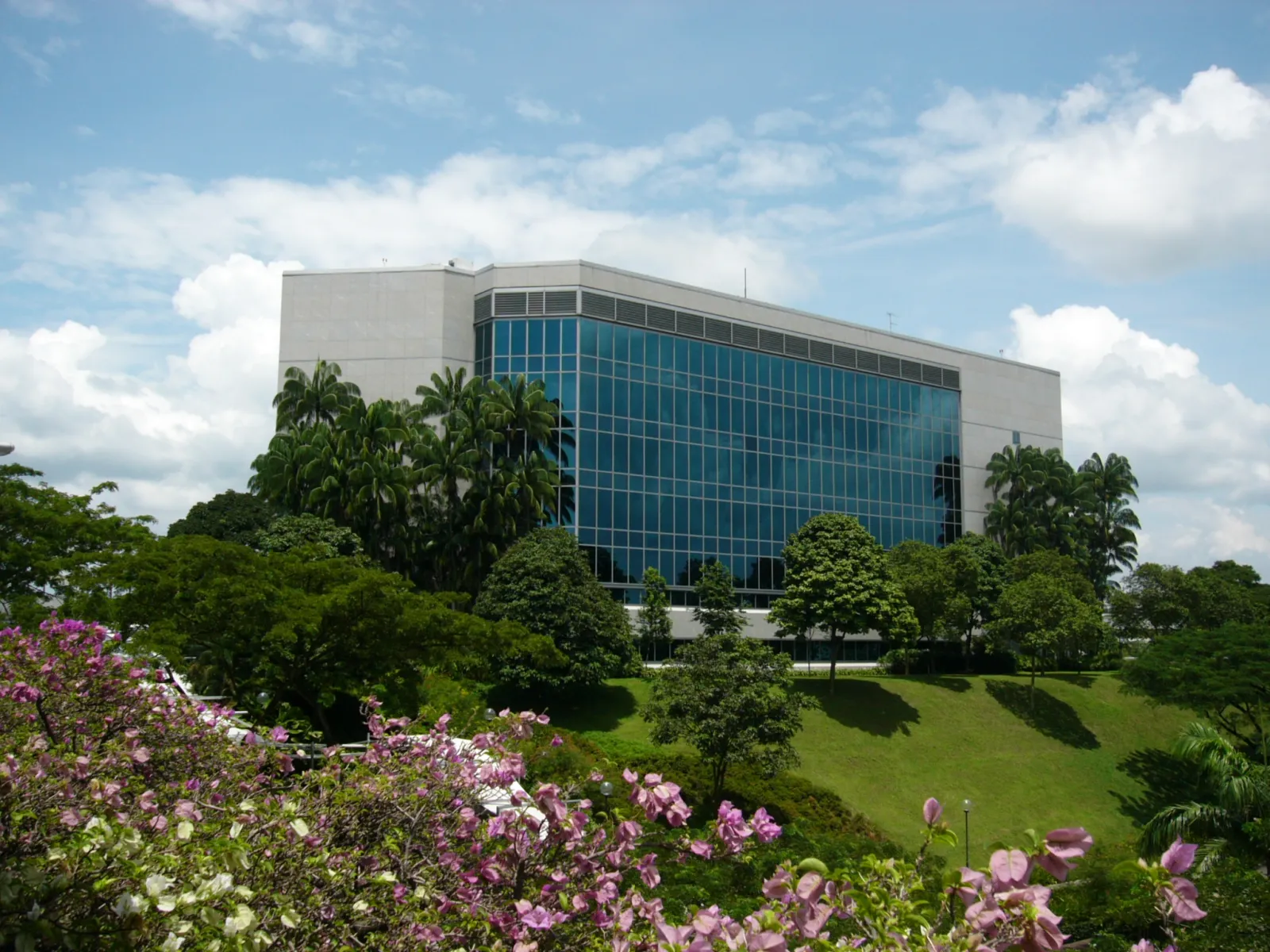
Nanyang Technological University
Singapore, , Singapore · Established 1991
Official website ↗Total Students
40,700
Intl. Students
31%
Setting
Suburban
Overview
Nanyang Technological University traces its roots to Nanyang University, founded in 1955 as the first Chinese-language university outside China, before being reconstituted in its current form as a research-intensive, English-medium university in 1991. NTU's main campus is a single, sprawling, largely self-contained site in Singapore's western Jurong district, known for its distinctive modern architecture (including The Hive's honeycomb-style learning building) and for being one of the greenest, most solar-panelled university campuses in Asia. Unlike Oxford or Cambridge's collegiate model, NTU students belong directly to one of the university's Colleges and Schools, with the large majority of undergraduates guaranteed on-campus hall accommodation for at least part of their degree. NTU is particularly well known for Engineering (it is one of the largest engineering universities in the world by enrolment), Computer Science and Data Science, Materials Science, Business (Nanyang Business School holds triple accreditation), and Communication and Information, and it partners closely with Singapore's technology and manufacturing sectors, as well as global partners like Imperial College London (through a joint LKC Medicine programme) on specific degrees. The university has climbed rapidly through global rankings over the past two decades and now sits consistently among the world's top 15-30 universities across the major ranking systems, reflecting Singapore's broader national investment in research-intensive higher education. For prospective IELTS or TOEFL candidates, NTU applies one of the more moderate English-language thresholds in this dataset: for tests taken before the January 2026 TOEFL rescale, IELTS 6.0 overall with a minimum of 6.0 in Writing and Speaking, or TOEFL iBT 90 overall with a minimum of 25 in the Speaking/Verbal-adjacent section, satisfies the standard requirement for most programs -- though this is meaningfully lower than what Oxbridge or the more selective US privates in this dataset require. Applicants who completed their secondary education in an English-medium system (including Singapore, Malaysia's English stream, the UK, the US, Australia, and Canada, among others) are typically exempted from submitting a separate English test altogether. NTU applies directly (not through a centralised UCAS- or Common App-style portal) and evaluates each applicant against its own published country-specific qualification equivalency tables.
Rankings
Times Higher Education (THE) World University Rankings · Overall (Global)
#31 (2026)
US News Best Global Universities · Overall (Global)
#27 (2027)
Admissions, Requirements & Costs
Requirements, deadlines, and test-score cutoffs differ significantly between undergraduate and graduate/Master's programs — shown separately below.
Undergraduate
Application Fee
$24
Documents required: Direct online application via NTU's admissions portal (no centralised UCAS/Common App-style portal), Certified copies of secondary school transcripts/certificates, English language proficiency test scores, unless exempt via English-medium prior schooling, Certified passport copy, Personal qualities/CCA (co-curricular activities) statement, given weight in NTU's holistic admissions alongside academic results, Portfolio or audition for a small number of programs (e.g. Art, Design and Media)
| Term | Deadline | Type |
|---|---|---|
| Semester 1 (August) | International applications for the August 2027 intake open 15 October 2026 and close 19 March 2027 on NTU's online portal | Regular Decision |
Test Scores
IELTS Minimum
6 (Gabble rec. 6.5)
TOEFL Minimum
90 (4.5 new scale) · Gabble rec. 90 (4.5 new scale)
PTE Minimum
55
IELTS notes: 6.0 overall with a minimum of 6.0 in both Writing and Speaking (Reading and Listening are not separately gated at the same minimum in NTU's published requirement). Only IELTS Academic is accepted; IELTS General Training does not satisfy the requirement.
TOEFL notes: For tests taken before ETS's January 2026 rescale: 90 overall with a minimum of 25 in the Speaking section. For TOEFL iBT tests taken from January 2026 onward under ETS's revised 1-6 CEFR-aligned scale: a minimum overall score of 4.5 with a minimum of 4.5 in Speaking.
TOEFL scores shown as: legacy 0–120 scale (new 1.0–6.0 CEFR-aligned scale, effective Jan 2026).
Accepted tests: IELTS Academic, TOEFL iBT, Pearson Test of English (PTE) Academic, Cambridge English C1 Advanced, SAT (minimum 1250, accepted as an alternative English-proficiency pathway for tests from March 2016 onward), ACT with Writing (minimum composite 30, accepted as an alternative English-proficiency pathway)
Waiver: Applicants who completed their primary and secondary education in an English-medium school system -- including Singapore, Malaysia's English-medium stream, the UK, the US, Australia, Canada, and a number of other recognised systems -- are typically exempt from submitting a separate English proficiency test score.
Tuition (Intl.)
$31,400
Living Expenses/yr
$14,100
Total Cost of Attendance
$45,500
Scholarships
Nanyang Scholarship
Covers tuition fees for the normal duration of the program, plus additional allowances in some award categories, conditional on maintaining good academic standing
NTU's foremost undergraduate scholarship, open to all nationalities, awarded to outstanding incoming students on the basis of academic excellence, leadership potential, and co-curricular achievement.
Eligibility: Open to all nationalities; automatically considered as part of the standard undergraduate application, or via a separate scholarship application depending on the specific award category
Singapore Ministry of Education (MOE) Tuition Grant Scheme
Reduces the international 'non-subsidised' fee (used as tuitionInternationalPerYear in this dataset) by roughly 40-55%, depending on the program
Not a scholarship in the traditional sense but a government subsidy that substantially reduces the tuition fee for eligible international students, in exchange for a bonded obligation to work for a Singapore-registered company for a fixed period (commonly 3 years) after graduation.
Eligibility: Open to international students who opt in at the point of enrolment and agree to the post-graduation work-bond condition; not available to all nationalities or programs in every year, and terms are set by the Singapore government rather than NTU directly
Popular Programs
Gabble Prep Insights
Where applicants lose points: Writing and Speaking are the two components NTU actually gates at a minimum score, so applicants who are otherwise strong but weaker in extended written or spoken academic English should prioritise those two skills specifically rather than assuming a strong overall band automatically clears NTU's bar.
Because NTU's IELTS requirement is comparatively moderate (6.0 overall with 6.0 minimums only in Writing and Speaking), most applicants clear the bar without extensive dedicated test preparation, particularly those who studied any portion of secondary school in English; the more meaningful gap for many applicants is less about the English test itself and more about NTU's holistic evaluation of academic results and co-curricular achievement.
Figures above were converted from SGD at approximately 1 SGD = 0.785 USD (September 2026 spot rate). NTU's 'non-subsidised' (full, non-Tuition-Grant) international tuition for most degree programs is commonly cited in the SGD 36,350-45,600/year range; the figure used here, SGD 40,000 (~USD 31,400), is a representative mid-range estimate rather than an official single figure, since NTU publishes fees per program. This is deliberately the non-subsidised rate rather than the MOE Tuition Grant-subsidised rate, since the Tuition Grant carries a post-graduation work-bond obligation that is a meaningfully different commitment, not simply a discount -- see the Tuition Grant scholarship entry above for how much it typically reduces the fee. Living costs were estimated from widely cited guidance of roughly SGD 1,200-1,800/month, midpoint used (~SGD 1,500/month, ~SGD 18,000/year, ~USD 14,100); NTU does not publish one single official living-cost figure. NTU does not publish an official aggregate acceptance rate, and third-party estimates online (commonly cited around 30-40%) were never calculated or confirmed by the university itself, so this dataset leaves acceptanceRate null rather than publish an unverified figure. The undergraduate application fee is SGD 20 (online payment) or SGD 30 (bank draft); USD 24 used here reflects the SGD 30 figure at the stated conversion rate.
Recommended prep timeline: 6 weeks
Graduate (Master's & PhD)
Application Fee
$24
Documents required: Direct online application via NTU's graduate admissions portal, Official transcripts from all previously attended institutions, Statement of purpose (program-dependent), CV/resume, Academic and/or professional references, English language proficiency test scores, unless exempt, Research proposal for PhD applicants, GRE or GMAT score for some Nanyang Business School and Engineering-related master's programs -- check the specific program page
| Term | Deadline | Type |
|---|---|---|
| Semester 1 (August) | Rolling, program-specific deadlines through the admissions cycle; PhD/research applications are accepted year-round subject to supervisor and funding availability | Rolling |
Test Scores
IELTS Minimum
6 (Gabble rec. 6.5)
TOEFL Minimum
90 (4.5 new scale) · Gabble rec. 90 (4.5 new scale)
PTE Minimum
55
IELTS notes: NTU's graduate English requirement broadly mirrors the undergraduate standard (6.0 overall, with Writing and Speaking minimums), though several Nanyang Business School and Communication-related master's programs set a higher threshold -- always confirm on the specific program's admissions page, since NTU does not publish one single consolidated graduate table.
TOEFL notes: Broadly mirrors the undergraduate standard (90 overall pre-2026 rescale, or the equivalent 4.5 overall on the new 1-6 scale for tests from January 2026), with some programs setting a higher threshold -- confirm on the specific program's admissions page.
TOEFL scores shown as: legacy 0–120 scale (new 1.0–6.0 CEFR-aligned scale, effective Jan 2026).
Accepted tests: IELTS Academic, TOEFL iBT, Pearson Test of English (PTE) Academic, Cambridge English C1 Advanced
Waiver: Applicants who completed a prior degree taught and examined entirely in English at a recognised institution, or who completed secondary/tertiary education in an English-medium system, are typically exempt from submitting a separate test score.
Tuition (Intl.)
$31,400
Living Expenses/yr
$14,100
Total Cost of Attendance
$45,500
Scholarships
Nanyang President's Graduate Scholarship (NPGS)
Full tuition fee support plus a monthly living stipend for the duration of the PhD
NTU's flagship, highly competitive PhD scholarship for outstanding graduates or final-year students, open to all nationalities.
Eligibility: Open to all nationalities; requires an outstanding academic record and a separate, competitive application alongside or shortly after the PhD application
Nanyang Business School and School-specific graduate scholarships
Varies considerably by award; typically a partial tuition contribution
A rotating set of School-administered scholarships for taught master's students, varying by program, subject, and merit criteria.
Eligibility: Varies by scholarship; most require an offer of admission and a separate scholarship application
Popular Programs
Gabble Prep Insights
Where applicants lose points: Writing is generally the section applicants find most demanding, since a competitive statement of purpose and, for Nanyang Business School and research-based programs, sustained analytical writing are weighted heavily in NTU's holistic graduate evaluation.
Given NTU's comparatively moderate standard English requirement, most graduate applicants clear the English-language bar without extensive dedicated preparation; applicants to programs setting a meaningfully higher threshold (some Nanyang Business School and Communication-related master's) should confirm the specific figure early, since NTU does not publish one single consolidated graduate English-requirements table.
Figures above were converted from SGD at approximately 1 SGD = 0.785 USD (September 2026 spot rate) and use the same representative non-subsidised tuition and living-cost estimates as the undergraduate figures above, since NTU does not publish one separate flat postgraduate tuition figure either -- fees vary by program, and the MBA and some Master of Science programs are priced considerably higher than this representative estimate. NTU does not publish an official aggregate postgraduate acceptance rate, so that field is left null. GRE/GMAT: some Nanyang Business School and Engineering-related master's programs accept or require a GRE or GMAT score, but NTU does not publish one official aggregate average score across programs, so avgScore is left null rather than estimated.
Recommended prep timeline: 6 weeks
Programs Offered
Computer Science
Undergraduate · 4 yr
Business (Nanyang Business School)
Undergraduate · 4 yr
Electrical and Electronic Engineering
Undergraduate · 4 yr
Materials Science and Engineering
Undergraduate · 4 yr
Communication Studies
Undergraduate · 4 yr
MBA
Masters · 1 yr
Master of Science in Computer Science
Masters · 1 yr
Master of Science in Financial Engineering
Masters · 1 yr
PhD
PhD · 4 yr
Campus Life
NTU's single, largely self-contained Jurong campus is known for its distinctive modern architecture and sustainability focus, and the large majority of undergraduates are guaranteed on-campus Hall of Residence accommodation for at least part of their degree, each Hall running its own inter-hall sporting and social competitions (a system that functions somewhat like a lighter-weight version of a residential college, without separate academic teaching). NTUSU, the students' union, runs orientation, clubs, and student advocacy, while the Nanyang Chronicle serves as the university's main student publication. Given NTU's large international student body, the university supports a wide range of country- and region-specific cultural societies alongside its academic, sporting, and hobby clubs; NTU's campus is also home to Singapore's Renaissance Engineering Programme and joint-degree partnerships with several major international universities.
Notable clubs: Nanyang Technological University Students' Union (NTUSU), The Nanyang Chronicle, NTU's student newspaper, NTU Sports & Recreation Centre clubs and inter-hall sports competitions, A wide range of Halls of Residence communities, each with its own social and sporting culture, Numerous country- and region-specific and cultural student societies
Outcomes
Undergraduate
Graduate
Notable Alumni
Agus Harimurti Yudhoyono — Coordinating Minister for Infrastructure and Regional Development, Indonesia; earned a Master of Science at NTU's S. Rajaratnam School of International Studies
Carolyn Choo — Managing Director and CEO of Worldwide Hotels; graduated from Nanyang Business School
Visa Interview Prep
Singapore's Student's Pass (issued under the Immigration Act) is the visa/permit route for international students admitted to NTU. Once an offer is accepted, NTU submits the Student's Pass application on the student's behalf through ICA's SOLAR+ (Student's Pass On-Line Application & Registration) system, and successful applicants receive an In-Principle Approval (IPA) letter, which is then used to collect the actual Student's Pass in person after arriving in Singapore (a process that includes fingerprinting and a photograph, but not an interview). Applicants must show evidence of sufficient funds to cover tuition and living costs and, depending on nationality, may need a Singapore entry visa in addition to the Student's Pass to enter the country initially. Popular international students also need to budget separately for medical insurance, which NTU requires as a condition of enrolment. Requirements are periodically updated by ICA and Singapore's Ministry of Education; applicants should confirm current guidance close to their intended application date.
- Singapore's Student's Pass process does not build in a routine in-person interview -- after receiving an admission offer, NTU issues an In-Principle Approval (IPA) letter, and the applicant then applies for the Student's Pass online through Singapore's Immigration and Checkpoints Authority (ICA) SOLAR+ system using that letter
- ICA may request additional documents or clarification in specific cases, but a standard consular-style interview is not part of the typical process
FAQs
What IELTS score do I need to apply to NTU as an undergraduate?Undergrad
NTU's standard undergraduate requirement is a minimum overall IELTS Academic score of 6.0, with at least 6.0 in both Writing and Speaking -- a more moderate threshold than several other universities in this dataset. Applicants who completed secondary school in an English-medium system are typically exempt from submitting a test at all.
Does NTU still accept TOEFL, and has the scale changed?
Yes, NTU accepts TOEFL iBT. For tests taken before ETS's January 2026 rescale, the requirement is 90 overall with at least 25 in Speaking. For tests taken from January 2026 onward under ETS's revised 1-6 CEFR-aligned scale, the equivalent requirement is 4.5 overall with at least 4.5 in Speaking.
Does NTU use UCAS or the Common Application?
No. NTU is not part of the UK's UCAS system or the US Common Application -- international applicants apply directly through NTU's own online admissions portal, and admission is assessed against NTU's published country-specific equivalency tables alongside a holistic review of academic results and co-curricular achievement.
Will I need to attend a visa interview to study at NTU?
No. Singapore's Student's Pass process does not include a routine in-person interview. After NTU issues an In-Principle Approval letter, you apply for the Student's Pass online through Singapore's Immigration and Checkpoints Authority (ICA) SOLAR+ system, then collect the physical pass (including fingerprinting) after arriving in Singapore -- no consular-style interview is required.
What is the MOE Tuition Grant, and should I take it?
The Ministry of Education Tuition Grant is a Singapore government subsidy that substantially reduces international tuition fees (by roughly 40-55%) in exchange for a bonded obligation to work for a Singapore-registered company for about 3 years after graduation. It's a meaningful financial and career commitment, not simply a discount, so weigh the post-graduation work-bond condition carefully before opting in.
Is the GRE or GMAT required for NTU graduate programmes?Grad
It depends on the program. Most NTU taught master's programs do not require a GRE or GMAT score, but some Nanyang Business School and Engineering-related programs accept or require one -- always confirm on the specific program's admissions page.
How competitive is NTU for international applicants?
NTU does not publish an official aggregate acceptance rate, and the 30-40% figures that circulate online were never calculated or confirmed by the university itself, so this dataset does not cite a specific number. Admission is assessed holistically, combining academic results against NTU's country-specific equivalency tables with co-curricular achievement.
How many weeks should I spend preparing for IELTS or TOEFL before applying to NTU?
Given NTU's comparatively moderate standard requirement (IELTS 6.0/TOEFL 90), a realistic window is around 6 weeks of focused preparation for most applicants, concentrated on Writing and Speaking specifically, since those are the two components NTU actually gates at a minimum score.