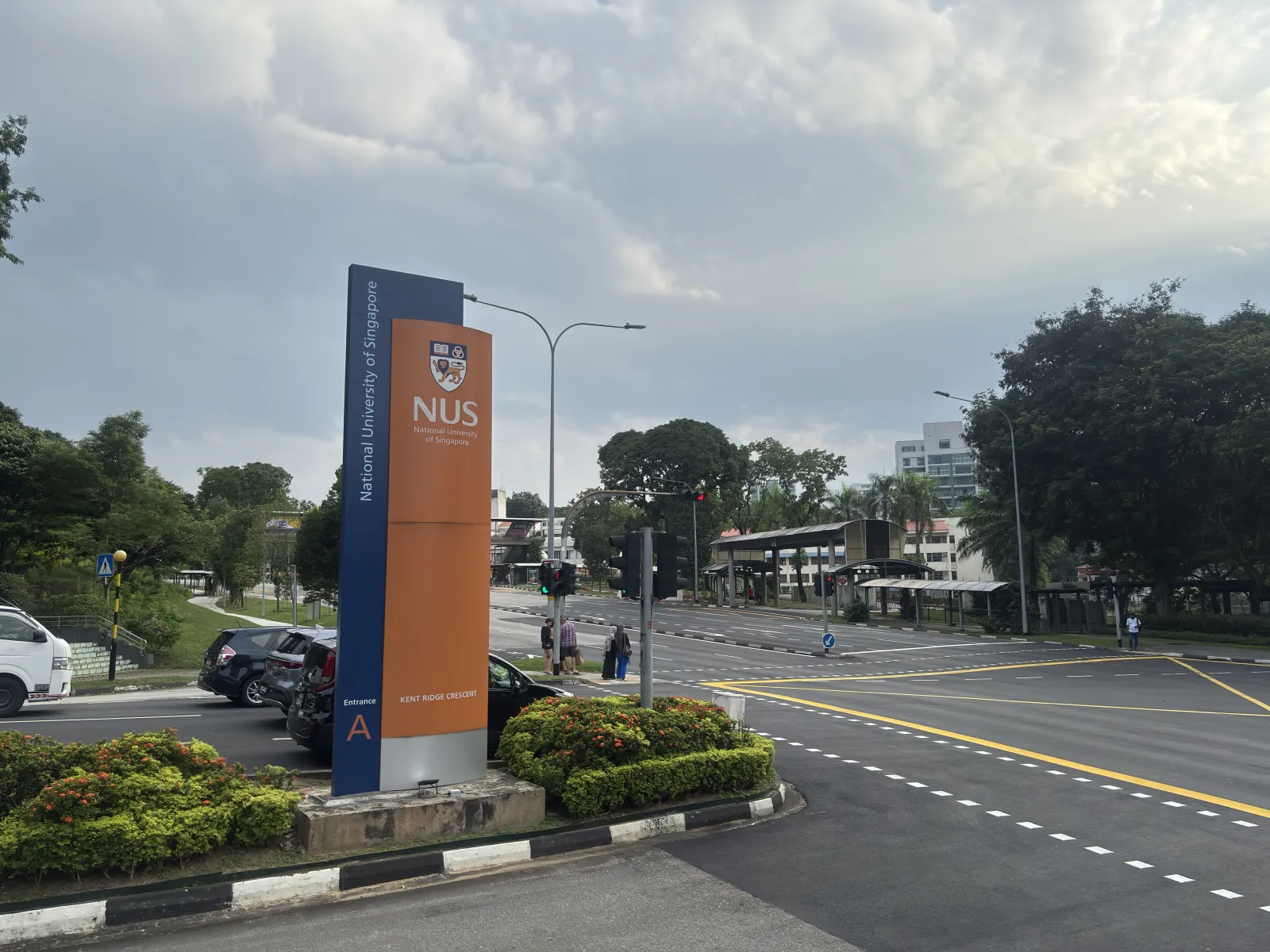
National University of Singapore
Singapore, , Singapore · Established 1905
Official website ↗Total Students
35,600
Intl. Students
31%
Setting
Suburban
Overview
The National University of Singapore traces its roots to 1905 and took its current form in 1980, when the University of Singapore merged with Nanyang University to create a single national university. NUS's main Kent Ridge campus is a large, largely self-contained site in southwestern Singapore, organised into faculties and schools rather than a UK-style collegiate system, though NUS does run a distinctive residential college system (NUS College and several themed residential colleges) that combines campus housing with an interdisciplinary academic curriculum for a subset of undergraduates who opt in. NUS is Singapore's oldest and largest university and is particularly well known for Computing, Business (NUS Business School), Engineering, Law, Medicine, and Public Policy (the Lee Kuan Yew School of Public Policy is one of Asia's most prominent policy schools), and it consistently ranks as Asia's top or near-top university across the major global ranking systems. The university has produced two Singapore Prime Ministers and numerous regional political and business leaders, reflecting its close historical relationship with Singapore's nation-building era. For prospective IELTS or TOEFL candidates, NUS applies a standard undergraduate threshold of IELTS 6.5 overall or TOEFL iBT 92, with a higher requirement of IELTS 7.0 for Medicine (MBBS) and Law (LLB) -- NUS's two most selective and most English-intensive undergraduate programmes. Applicants who completed their primary and secondary education in an English-medium system (including Singapore, Malaysia's English stream, the UK, the US, Australia, and Canada) are typically exempted from submitting a separate English test. NUS applies directly (not through a centralised UCAS- or Common App-style portal) and evaluates international applicants against its own published country-specific qualification equivalency tables.
Rankings
Times Higher Education (THE) World University Rankings · Overall (Global)
#17 (2026)
US News Best Global Universities · Overall (Global)
#20 (2026)
Admissions, Requirements & Costs
Requirements, deadlines, and test-score cutoffs differ significantly between undergraduate and graduate/Master's programs — shown separately below.
Undergraduate
Application Fee
$79
Documents required: Direct online application via NUS's admissions portal (no centralised UCAS/Common App-style portal), Certified copies of secondary school transcripts/certificates, English language proficiency test scores, unless exempt via English-medium prior schooling, Certified passport copy, Personal qualities statement / co-curricular record, given weight in NUS's holistic admissions alongside academic results, Portfolio or additional selection test for a small number of programs (e.g. Architecture, Industrial Design, Music)
| Term | Deadline | Type |
|---|---|---|
| Semester 1 (August) | International applications for August 2027 entry are expected to open in October 2026 and close by March 2027 on NUS's online portal; exact dates are published annually and can shift slightly | Regular Decision |
Test Scores
IELTS Minimum
6.5 (Gabble rec. 6.5)
TOEFL Minimum
92 (4.5 new scale) · Gabble rec. 92 (4.5 new scale)
IELTS notes: Standard undergraduate requirement: 6.5 overall (NUS does not publish separate per-band minimums for the standard tier the way Oxford or Cambridge do). Medicine (MBBS) and Law (LLB) -- NUS's two most selective undergraduate programmes -- require a higher 7.0 overall. Only IELTS Academic is accepted; IELTS General Training does not satisfy the requirement.
TOEFL notes: Standard undergraduate requirement: 92 overall. Medicine and Law require a correspondingly higher score in line with their elevated IELTS 7.0 tier -- confirm the exact figure on the specific program's admissions page, since NUS does not publish one single consolidated table covering every program's higher-tier TOEFL requirement.
TOEFL scores shown as: legacy 0–120 scale (new 1.0–6.0 CEFR-aligned scale, effective Jan 2026).
Accepted tests: IELTS Academic, TOEFL iBT, Pearson Test of English (PTE) Academic, Cambridge English C1 Advanced
Waiver: Applicants who completed their primary and secondary education in an English-medium school system -- including Singapore, Malaysia's English-medium stream, the UK, the US, Australia, Canada, and a number of other recognised systems -- are typically exempt from submitting a separate English proficiency test score.
Tuition (Intl.)
$28,770
Living Expenses/yr
$18,840
Total Cost of Attendance
$47,610
Scholarships
NUS International Undergraduate Scholarship
100% coverage of the MOE Tuition Grant-subsidised tuition fee (i.e. the fee tier shown for Tuition Grant recipients, not the full non-subsidised rate), plus in some award categories an additional living allowance
NUS's premier scholarship for outstanding international freshmen from all countries (other than Singapore), awarded on academic merit and leadership potential.
Eligibility: Open to outstanding international undergraduate applicants of any nationality except Singapore; typically requires opting into the MOE Tuition Grant (and its associated post-graduation work-bond condition) alongside a competitive, separate scholarship application
ASEAN Undergraduate Scholarship
Full MOE Tuition Grant-subsidised tuition fee plus an annual living allowance and one-time computer and settling-in allowances
A scholarship for outstanding students from ASEAN member countries (other than Singapore), covering tuition and a living allowance.
Eligibility: Open to citizens of ASEAN member countries other than Singapore who meet NUS's academic merit bar; requires opting into the MOE Tuition Grant and a separate scholarship application
Popular Programs
Gabble Prep Insights
Where applicants lose points: Writing tends to be the area applicants most underprepare, since NUS's holistic admissions process weighs a personal qualities statement heavily and coursework across NUS's competitive Computing, Business, and Law programmes is essay- and report-heavy from the first year.
Most applicants meeting NUS's standard 6.5 overall requirement report Reading and Listening as the most comfortable sections; applicants to the considerably more demanding Medicine (MBBS) or Law (LLB) programmes, which require 7.0 overall, should budget meaningfully more preparation time than the standard-tier figure below.
Figures above were converted from SGD at approximately 1 SGD = 0.785 USD (September 2026 spot rate). NUS publishes exact, program-specific 2026/27 non-subsidised (no MOE Tuition Grant) international tuition fees: Humanities and Sciences (NUS's broadest faculty grouping, covering most Arts, Social Sciences, and Science majors) is SGD 36,650/year, used here as the representative figure; Computing and most Engineering/Design programmes are considerably higher at SGD 39,700/year; Business is SGD 33,400/year; Law is SGD 44,450/year; and Medicine (except Nursing) is priced far higher still at SGD 190,150/year (source: NUS's official 'Undergraduate Tuition Fees' schedule for AY2026/2027). This dataset deliberately uses the non-subsidised rate rather than the MOE Tuition Grant-subsidised rate, since the Tuition Grant carries a post-graduation work-bond obligation that is a meaningfully different commitment, not simply a discount. Living costs were estimated from widely cited guidance of roughly SGD 1,500-2,500/month, midpoint used (~SGD 2,000/month, ~SGD 24,000/year, ~USD 18,840); NUS does not publish one single official living-cost figure. NUS does not publish an official aggregate acceptance rate, and third-party estimates online vary widely (from roughly 5% for the most competitive programmes up to 20% overall) depending on methodology, so this dataset leaves acceptanceRate null rather than publish an unverified figure.
Recommended prep timeline: 7 weeks
Graduate (Master's & PhD)
Application Fee
$79
Documents required: Direct online application via NUS's graduate admissions portal, Official transcripts from all previously attended institutions, Statement of purpose (program-dependent), CV/resume, Academic and/or professional references, English language proficiency test scores, unless exempt, Research proposal for PhD applicants, GRE or GMAT score for some NUS Business School MBA-adjacent programs -- check the specific program page
| Term | Deadline | Type |
|---|---|---|
| Semester 1 (August) | Rolling, program-specific deadlines through the admissions cycle; PhD/research applications are accepted year-round subject to supervisor and funding availability | Rolling |
Test Scores
IELTS Minimum
6.5 (Gabble rec. 6.5)
TOEFL Minimum
92 (4.5 new scale) · Gabble rec. 92 (4.5 new scale)
IELTS notes: NUS's graduate English requirement broadly mirrors the undergraduate standard (6.5 overall), though several NUS Business School and Law-adjacent master's programs set a higher threshold -- always confirm on the specific program's admissions page, since NUS does not publish one single consolidated graduate table.
TOEFL notes: Broadly mirrors the undergraduate standard (92 overall), with some programs setting a higher threshold -- confirm on the specific program's admissions page.
TOEFL scores shown as: legacy 0–120 scale (new 1.0–6.0 CEFR-aligned scale, effective Jan 2026).
Accepted tests: IELTS Academic, TOEFL iBT, Pearson Test of English (PTE) Academic, Cambridge English C1 Advanced
Waiver: Applicants who completed a prior degree taught and examined entirely in English at a recognised institution, or who completed secondary/tertiary education in an English-medium system, are typically exempt from submitting a separate test score.
Tuition (Intl.)
$28,770
Living Expenses/yr
$18,840
Total Cost of Attendance
$47,610
Scholarships
NUS Research Scholarship
Full tuition fee support plus a monthly living stipend for the duration of the research degree
NUS's standard funding scheme for PhD and select research-based master's students, open to candidates of all nationalities.
Eligibility: Awarded competitively to admitted PhD and eligible research master's candidates; no separate application beyond the standard graduate application in most departments
Faculty and program-specific graduate scholarships
Varies considerably by award; typically a partial tuition contribution
A rotating set of Faculty-administered scholarships for taught master's students, varying by program, subject, and merit criteria.
Eligibility: Varies by scholarship; most require an offer of admission and a separate scholarship application
Popular Programs
Gabble Prep Insights
Where applicants lose points: Writing carries particular weight for the Lee Kuan Yew School of Public Policy and NUS Business School's MBA, where a research-based or leadership-focused statement of purpose and case-study-heavy coursework demand sustained academic argument beyond conversational English.
Given NUS's comparatively moderate standard requirement (IELTS 6.5/TOEFL 92), most graduate applicants clear the English-language bar without extensive dedicated preparation; applicants to programs setting a meaningfully higher threshold should confirm the specific figure early, since NUS does not publish one single consolidated graduate English-requirements table.
Figures above were converted from SGD at approximately 1 SGD = 0.785 USD (September 2026 spot rate) and use the same representative non-subsidised tuition and living-cost estimates as the undergraduate figures, since NUS's postgraduate coursework fees are also set per program rather than as one flat figure -- the MBA and several Business School master's programs are priced considerably higher than this representative estimate; always check the specific program page. NUS does not publish an official aggregate postgraduate acceptance rate, so that field is left null. GRE/GMAT: some NUS Business School MBA-adjacent programs accept or require a GRE or GMAT score, but NUS does not publish one official aggregate average score across programs, so avgScore is left null rather than estimated.
Recommended prep timeline: 7 weeks
Programs Offered
Computer Science
Undergraduate · 4 yr
Business Administration
Undergraduate · 4 yr
Law (LLB)
Undergraduate · 4 yr
Medicine (MBBS)
Undergraduate · 5 yr
Engineering (various disciplines)
Undergraduate · 4 yr
MBA
Masters · 1 yr
Master of Computing
Masters · 1 yr
Master of Public Policy
Masters · 1 yr
PhD
PhD · 4 yr
Campus Life
NUS's large Kent Ridge campus is organised into faculties and schools rather than a UK-style collegiate system, though NUS does run a distinctive residential college system -- NUS College and several themed residential colleges -- that combines on-campus housing with a smaller, interdisciplinary academic curriculum for the subset of undergraduates who opt in, alongside more conventional Halls of Residence for the wider student body. NUSSU, the students' union, runs orientation, clubs, and student advocacy, while student life features NUS's well-known Hall Olympiad and Inter-Faculty Games sports competitions. Given NUS's large international student body (around 31% of the total cohort, drawn from roughly 100 countries), the university supports a wide range of country- and region-specific cultural societies alongside its academic, sporting, and hobby clubs.
Notable clubs: NUS Students' Union (NUSSU), The Ridge, NUS's independent student publication, NUS College and themed residential colleges combining housing with an interdisciplinary curriculum, NUS Sports and a large number of hall- and faculty-based sports competitions (Hall Olympiad and Inter-Faculty Games), Numerous country- and region-specific and cultural student societies
Outcomes
Undergraduate
Graduate
Notable Alumni
Goh Chok Tong — 2nd Prime Minister of Singapore (1990-2004); earned a Bachelor of Arts in Economics (First Class Honours) from the University of Singapore, one of NUS's founding predecessor institutions before the 1980 merger
Kishore Mahbubani — Veteran diplomat and former President of the UN Security Council; Founding Dean of NUS's Lee Kuan Yew School of Public Policy; earned his undergraduate degree from the University of Singapore
Ho Ching — Former CEO of Temasek Holdings, one of the world's largest sovereign wealth funds; NUS alumna
Visa Interview Prep
Singapore's Student's Pass (issued under the Immigration Act) is the visa/permit route for international students admitted to NUS. Once an offer is accepted, NUS submits the Student's Pass application on the student's behalf through ICA's SOLAR+ (Student's Pass On-Line Application & Registration) system, and successful applicants receive an In-Principle Approval (IPA) letter, which is then used to collect the actual Student's Pass in person after arriving in Singapore (a process that includes fingerprinting and a photograph, but not an interview). Applicants must show evidence of sufficient funds to cover tuition and living costs and, depending on nationality, may need a Singapore entry visa in addition to the Student's Pass to enter the country initially. International students also need to budget separately for compulsory medical insurance, which NUS requires as a condition of enrolment. Requirements are periodically updated by ICA and Singapore's Ministry of Education; applicants should confirm current guidance close to their intended application date.
- Singapore's Student's Pass process does not build in a routine in-person interview -- after receiving an admission offer, NUS issues an In-Principle Approval (IPA) letter, and the applicant then applies for the Student's Pass online through Singapore's Immigration and Checkpoints Authority (ICA) SOLAR+ system using that letter
- ICA may request additional documents or clarification in specific cases, but a standard consular-style interview is not part of the typical process
FAQs
What IELTS score do I need to apply to NUS as an undergraduate?Undergrad
Most NUS undergraduate programs require a minimum overall IELTS Academic score of 6.5. Medicine (MBBS) and Law (LLB), NUS's two most selective programmes, require a higher 7.0 overall.
Does NUS use UCAS or the Common Application?
No. NUS is not part of the UK's UCAS system or the US Common Application -- international applicants apply directly through NUS's own online admissions portal, and admission is assessed against NUS's published country-specific equivalency tables alongside a holistic review of academic results and co-curricular achievement.
Will I need to attend a visa interview to study at NUS?
No. Singapore's Student's Pass process does not include a routine in-person interview. After NUS issues an In-Principle Approval letter, you apply for the Student's Pass online through Singapore's Immigration and Checkpoints Authority (ICA) SOLAR+ system, then collect the physical pass (including fingerprinting) after arriving in Singapore -- no consular-style interview is required.
What is the MOE Tuition Grant, and should I take it?
The Ministry of Education Tuition Grant is a Singapore government subsidy that substantially reduces international tuition fees in exchange for a bonded obligation to work for a Singapore-registered company for a fixed period after graduation. It's a meaningful financial and career commitment, not simply a discount, so weigh the post-graduation work-bond condition carefully before opting in.
Is the GRE or GMAT required for NUS graduate programmes?Grad
It depends on the program. Most NUS taught master's programs do not require a GRE or GMAT score, but some NUS Business School MBA-adjacent programs accept or require one -- always confirm on the specific program's admissions page.
Can I get a waiver for the IELTS/TOEFL requirement at NUS?
Yes, in certain cases. You may be exempt if you completed your primary and secondary education in an English-medium school system -- including Singapore, Malaysia's English stream, the UK, the US, Australia, or Canada -- confirmed against NUS's published English Language Proficiency policy.
How competitive is NUS for international applicants?
NUS does not publish an official aggregate acceptance rate, and third-party estimates online vary widely (from roughly 5% for the most competitive programmes up to 20% overall) depending on methodology, so this dataset does not cite a specific figure. Admission is assessed holistically, combining academic results against NUS's country-specific equivalency tables with co-curricular achievement.
How many weeks should I spend preparing for IELTS or TOEFL before applying to NUS?
Given NUS's moderate standard requirement (IELTS 6.5/TOEFL 92), a realistic window is around 7 weeks of focused preparation for most programs, with more time recommended for applicants targeting the considerably higher Medicine or Law thresholds (IELTS 7.0).