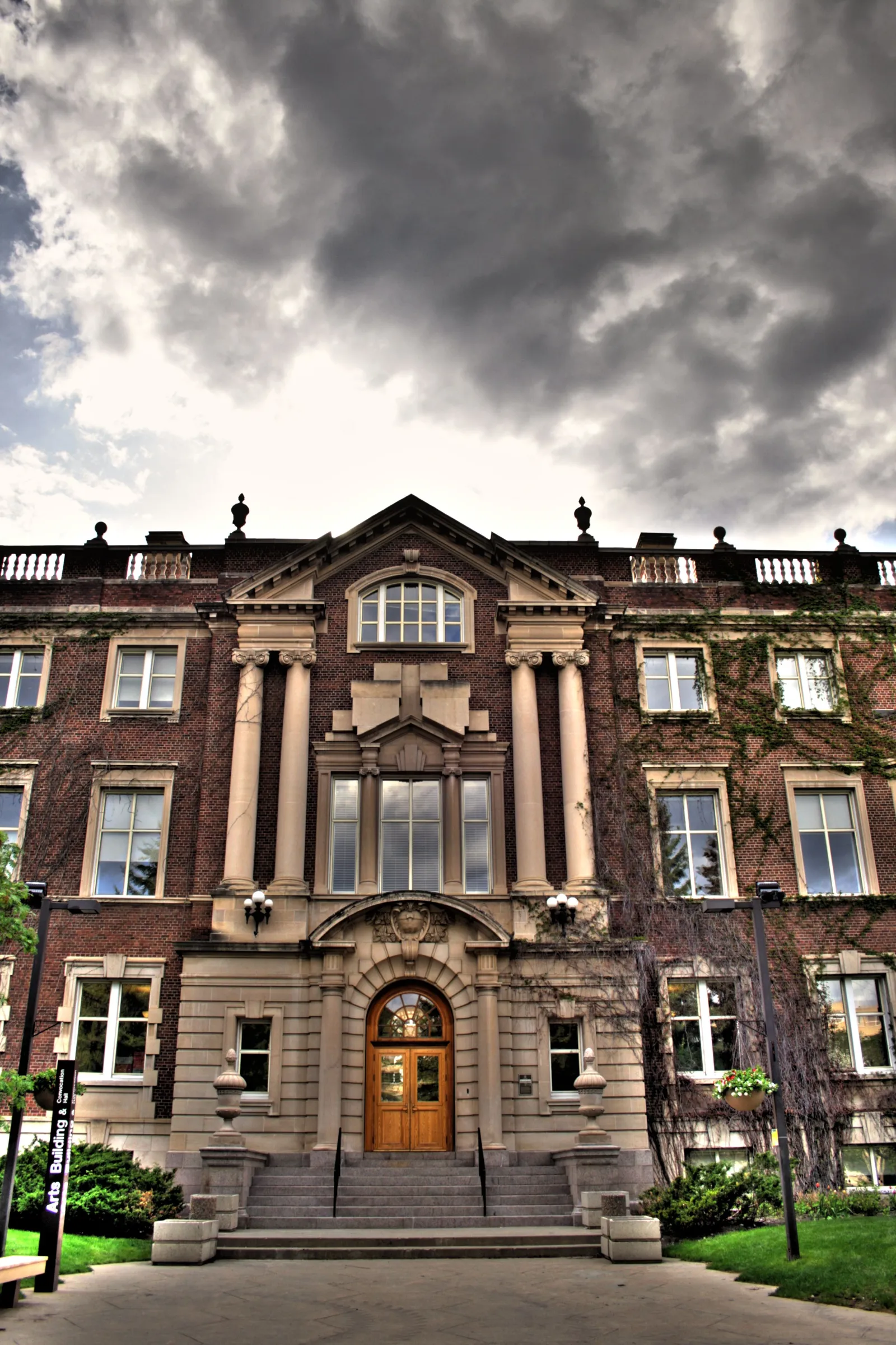
University of Alberta
Edmonton, Alberta, Canada · Established 1908
Official website ↗Total Students
46,201
Intl. Students
17%
Setting
Urban
Overview
The University of Alberta was founded in 1908 in Edmonton, becoming one of Canada's earliest western research universities and a founding member of the U15 group of Canada's leading research-intensive universities. Its main North Campus, on the south rim of the North Saskatchewan River valley, spans roughly 230 acres of interconnected buildings, supplemented by South Campus, Campus Saint-Jean (the university's francophone campus), and Augustana Campus in nearby Camrose. Across 18 faculties and roughly 400 programs, UAlberta enrolls close to 46,000 students, including more than 7,800 international students from over 150 countries, and has produced three Nobel Prize winners and more Rhodes Scholars than any other Canadian university outside Ontario. UAlberta is particularly well known for Engineering (closely tied to Alberta's energy sector), Medicine and Dentistry, Business (Alberta School of Business), Computer Science, and the sciences more broadly, and its location in Edmonton — Alberta's provincial capital and a significantly lower-cost city than Toronto or Vancouver — is a meaningful part of its pitch to international applicants budgeting for a Canadian degree. As with most Canadian universities outside Quebec, UAlberta runs its own direct application process rather than a shared national portal, evaluates international applicants against their home country's own secondary-curriculum grading scale rather than a US-style GPA or SAT/ACT, and Alberta's provincial immigration programs (including the Alberta Advantage Immigration Program) offer graduates additional pathways alongside federal Post-Graduation Work Permits. For prospective IELTS/TOEFL candidates, UAlberta's undergraduate English-proficiency floor (IELTS 6.5, TOEFL 90) sits in the moderate range for Canadian research universities — below McGill's undergraduate requirement but broadly comparable to University of Toronto and UBC — and UAlberta also accepts PTE Academic and the Duolingo English Test in many departments, giving applicants more flexibility than some Canadian peers. Acceptance rates vary widely by program: general Arts and Science admission is comparatively accessible, while Medicine admits a very small number of international students each year and Computer Science and Business are considerably more selective than the university-wide figure.
Rankings
Times Higher Education (THE) World University Rankings · Overall (Global)
#109 (2024)
US News Best Global Universities · Overall (Global)
#136 (2023)
Admissions, Requirements & Costs
Requirements, deadlines, and test-score cutoffs differ significantly between undergraduate and graduate/Master's programs — shown separately below.
Undergraduate
Acceptance Rate
60%
Documents required: UAlberta's own online application (not a shared portal like the US Common App or UK UCAS), Official transcripts/mark sheets for the applicant's specific secondary curriculum, English language proficiency test scores (IELTS/TOEFL/PTE/Duolingo, availability varies by department) unless exempt, Program-specific prerequisite subjects (e.g., mathematics, chemistry, and physics for Engineering), Supplementary materials for select programs
| Term | Deadline | Type |
|---|---|---|
| Fall (September) | Not confirmed from an accessible official page in this research pass — UAlberta's official admissions site could not be fetched (blocked automated access); applicants should confirm current deadlines directly on ualberta.ca | Regular Decision |
Test Scores
IELTS Minimum
6.5
TOEFL Minimum
90 (4.5 new scale)
PTE Minimum
60
IELTS notes: Overall band of 6.5, with a per-band minimum in the 5.5-6.0 range depending on program.
TOEFL notes: Overall 90 on the legacy 0-120 scale, with a per-section minimum around 20.
TOEFL scores shown as: legacy 0–120 scale (new 1.0–6.0 CEFR-aligned scale, effective Jan 2026).
Accepted tests: IELTS Academic, TOEFL iBT, PTE Academic, Duolingo English Test
Waiver: Not confirmed in detail from an accessible official page in this research pass; as with most Canadian universities, applicants with sufficient prior education in English (e.g. a Canadian or other English-medium secondary/post-secondary credential) are typically exempt — confirm exact criteria directly with UAlberta admissions.
Tuition (Intl.)
$24,000
Popular Programs
Gabble Prep Insights
Where applicants lose points: Writing tends to be the area international applicants most underprepare, since UAlberta's admission review and first-year coursework both expect structured academic English beyond the moderate 6.5/90 IELTS/TOEFL floor.
Applicants to Engineering, Computer Science, and Business should prepare well above the general-admission English floor, since these programs are considerably more selective than the university-wide acceptance figure and competitive applicants typically present stronger scores across the board.
UAlberta's official admissions website (ualberta.ca) blocked automated fetching throughout this research pass, so several figures here (acceptance rate, application deadlines/fee, precise tuition-by-program breakdown, domestic tuition, living costs) could not be confirmed from a live official source and are either left null or, where a figure was available from this site's own previously published University of Alberta guide article, used as an approximate representative figure with that caveat. The 60% acceptance rate is a rough midpoint of a previously reported ~55-65% overall undergraduate range and should be treated as approximate rather than an official published figure — UAlberta does not appear to publish one single official aggregate rate on the pages accessible in this pass. International tuition (~CAD 32,000, converted at approximately 1 CAD = 0.75 USD to ~USD 24,000) is a rough representative figure spanning UAlberta's reported program-level range of roughly CAD 30,000-46,000/year depending on faculty (Arts/Science lowest, Engineering highest) — treat as indicative only and confirm the specific program's current fee directly with UAlberta.
Recommended prep timeline: 10 weeks
Graduate (Master's & PhD)
Documents required: Statement of purpose / research proposal (program-dependent), References, generally including academic references, Official transcripts from all previously attended post-secondary institutions, CV/resume, English language proficiency test scores (IELTS/TOEFL, PTE/Duolingo in some departments) unless exempt, GRE or GMAT scores — required by a minority of programs (e.g. some Business/MBA-track programs); not a university-wide requirement
| Term | Deadline | Type |
|---|---|---|
| Fall, Winter, or Spring depending on the program | Rolling and program-specific — not confirmed from an accessible official page in this research pass | Rolling |
Test Scores
IELTS Minimum
6.5 (Gabble rec. 7)
TOEFL Minimum
88 (4.5 new scale) · Gabble rec. 100 (5 new scale)
PTE Minimum
60
IELTS notes: General graduate-level minimum around 6.5-7.0 overall; exact requirement varies by faculty and program.
TOEFL notes: General graduate-level range of roughly 88-100 overall depending on program; Engineering graduate programs commonly cite 88-90.
TOEFL scores shown as: legacy 0–120 scale (new 1.0–6.0 CEFR-aligned scale, effective Jan 2026).
Accepted tests: IELTS Academic, TOEFL iBT, PTE Academic, Duolingo English Test
Popular Programs
Gabble Prep Insights
UAlberta's official graduate admissions pages could not be fetched in this research pass (site blocked automated access), so graduate-level tuition, living costs, total cost of attendance, acceptance rate, application fee, and deadlines are left null rather than estimated. A previously reported representative range for course-based master's tuition (~CAD 25,000-35,000/year) and research-based master's with funding support (~CAD 8,000-12,000/year) exists from this site's own prior research but was not independently re-verified against an official UAlberta source in this pass, so it is noted here rather than entered as a confirmed field value. Confirm exact costs and requirements directly with the specific graduate program.
Programs Offered
Bachelor of Science, Computing Science
Undergraduate · 4 yr
Bachelor of Science in Engineering
Undergraduate · 4 yr
Bachelor of Commerce
Undergraduate · 4 yr
Doctor of Medicine (MD)
Undergraduate · 4 yr
MBA
Masters · 2 yr
PhD (various departments)
PhD · 4 yr
Campus Life
UAlberta's North Campus sits along the North Saskatchewan River valley in Edmonton, connected to downtown via one of North America's largest networks of urban parkland trails. The University of Alberta Students' Union runs student government and a broad range of clubs and services out of its student centre, and with more than 7,800 international students from over 150 countries, the university supports an active international student community. Edmonton's meaningfully lower cost of living relative to Toronto or Vancouver is a frequently cited practical advantage for international students weighing Canadian university options. Athletically, the Golden Bears and Pandas compete in U SPORTS' Canada West conference.
Notable clubs: University of Alberta Students' Union (UASU), The Gateway — UAlberta's independent student newspaper, Golden Bears and Pandas varsity athletics, Numerous faculty-specific student societies (Engineering, Business, Science), Model UN, case-competition, and cultural/international student clubs
Outcomes
Undergraduate
Graduate
Notable Alumni
Richard E. Taylor — 1990 Nobel Prize in Physics for research establishing the existence of quarks; earned his BSc (1950) and MSc (1952) from the University of Alberta before completing his PhD at Stanford
David Silver — Principal research scientist at Google DeepMind and co-developer of AlphaGo, the first AI program to defeat a professional Go player
Tak Wah Mak — Molecular biologist and immunologist known for discovering the T-cell receptor; completed graduate studies connected to the University of Alberta
Visa Interview Prep
As a university outside Quebec, UAlberta students follow the standard federal IRCC study permit process without the additional Quebec-specific CAQ step McGill requires. Graduates are eligible for a Post-Graduation Work Permit (PGWP) matching their program length (up to 3 years for programs of that length or longer), and Alberta's provincial government separately runs the Alberta Advantage Immigration Program, offering additional permanent-residence pathways for graduates who find work in the province. As with the federal study permit process generally, a routine in-person interview is not standard, though IRCC retains discretion to request one.
- Most study permit applicants do NOT attend an in-person visa interview the way US F-1 applicants do — the large majority of applications are decided from the online application and supporting financial and academic documents
- IRCC may request a short interview (in person or by video) or a biometrics appointment in specific risk-based cases, focused on genuine intent to study, ties to the home country, and financial means
FAQs
What IELTS or TOEFL score do I need to apply to UAlberta?
The undergraduate minimum is generally IELTS 6.5 overall or TOEFL iBT 90 overall; graduate programs typically expect a somewhat higher 6.5-7.0 IELTS or 88-100 TOEFL depending on the program. UAlberta also accepts PTE Academic (minimum 60) and the Duolingo English Test in many departments, giving applicants more flexibility than some Canadian peers.
Does UAlberta use a shared application portal like the US Common App or UK UCAS?Undergrad
No. Like most Canadian universities outside Ontario's OUAC system, UAlberta runs its own direct online application process.
Will I need a Quebec-style CAQ to study at UAlberta?
No — the CAQ (Certificat d'acceptation du Quebec) is specific to universities located in Quebec, such as McGill. UAlberta students follow the standard federal IRCC study permit process without that extra provincial step.
How competitive is UAlberta, and does it vary by program?Undergrad
General undergraduate admission is comparatively accessible relative to many international peers, but this varies sharply by program — Medicine admits a very limited number of international students each year, and Computer Science and Business are considerably more selective than the university-wide figure.
What immigration pathways are available to UAlberta graduates?
Graduates are generally eligible for a federal Post-Graduation Work Permit (PGWP) matching their program length (up to 3 years), and Alberta's provincial government separately runs the Alberta Advantage Immigration Program, offering additional permanent-residence pathways specifically for graduates working in the province.
How does Edmonton's cost of living compare to other Canadian university cities?
Edmonton is generally reported to be meaningfully cheaper to live in than Toronto or Vancouver, a factor international students weighing Canadian universities often cite when comparing UAlberta's total cost against schools in those larger, more expensive cities.