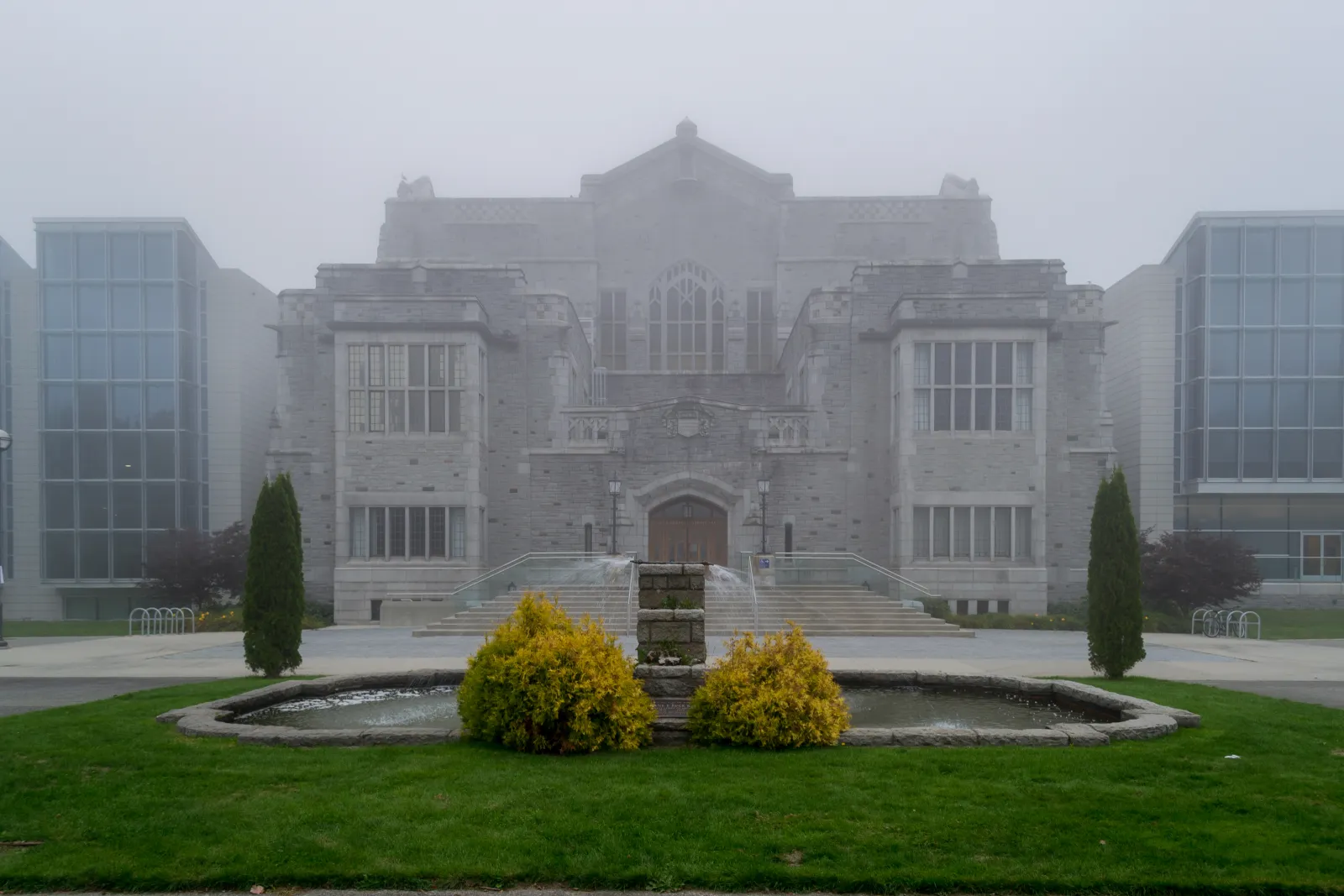

University of British Columbia
Vancouver, British Columbia, Canada · Established 1908
Official website ↗Total Students
72,100
Intl. Students
25%
Setting
Suburban
Overview
The University of British Columbia traces its roots to the University Act of 1908, passed by the provincial legislature to create a public university for British Columbia; the first classes were held in 1915 at a temporary site in Vancouver's Fairview neighbourhood, and the outbreak of the First World War delayed construction of a permanent campus until students and faculty organized "The Great Trek" in 1922 -- a march on the legislature backed by a 56,000-signature petition -- that finally secured funding to open the Point Grey campus in 1925. Since then UBC has grown into a research powerhouse associated with eight Nobel laureates, including biochemist Michael Smith, who developed site-directed mutagenesis while on UBC's faculty and shared the 1993 Nobel Prize in Chemistry, and physicist Carl Wieman, who joined UBC Science in 2007 -- six years after sharing the 2001 Nobel Prize in Physics -- to lead a university-wide overhaul of how science is taught at the undergraduate level. UBC today operates two distinct campuses: the large Point Grey campus in Vancouver, sitting on a forested peninsula a short bus ride from downtown, and the smaller UBC Okanagan campus in Kelowna, which opened in 2005 and has grown into its own research-active community with a more intimate class-size culture. Combined, the two campuses enrolled roughly 72,000 students in 2025/26, including close to 18,000 international students -- about a quarter of the student body -- drawn from more than 145 countries, with China, India, the United States, Indonesia, and Hong Kong among the largest sending countries. Academically, UBC is organized into faculties rather than colleges: the Sauder School of Business (home to the BCom and the MBA), the Faculty of Applied Science (engineering), the Faculty of Science, a large Faculty of Arts, and the Faculty of Medicine, which trains physicians across a distributed network of sites throughout the province. UBC is consistently ranked the third-best university in Canada behind the University of Toronto and McGill, and sits just inside the global top 50 on the major world rankings. For prospective international students, the path into UBC looks meaningfully different from applying to a US or UK institution. There is no UCAS, no Common App, and -- unlike Ontario's province-wide OUAC system -- no BC-wide centralized application service either: applicants apply directly through UBC's own Applicant Portal (myapplication.ubc.ca), and admission is assessed against an applicant's final grades in whatever senior secondary curriculum they completed, combined with UBC's "Personal Profile," a holistic written supplement covering activities, leadership, and personal circumstances, rather than a US-style GPA, SAT, or ACT score. Once admitted, international students apply for a Canadian study permit through Immigration, Refugees and Citizenship Canada (IRCC) -- a process that, unlike the US F-1 visa, does not typically involve an in-person consular interview for most applicants. English-language requirements are broadly similar between undergraduate admission (IELTS 6.5, no band below 6.0) and the general graduate-level minimum set by the Faculty of Graduate and Postdoctoral Studies (also IELTS 6.5, though many individual graduate programs set higher thresholds), and the Sauder School of Business stands out as the part of UBC where a GMAT or GRE score is actually required, for its MBA, Master of Management, and Master of Business Analytics programs.
Rankings
Times Higher Education (THE) World University Rankings · Overall (Global)
#45 (2026)
US News Best Global Universities · Overall (Global)
#42 (2027)
QS World University Rankings by Subject · Life Sciences and Medicine
#25 (2026)
QS World University Rankings by Subject · Social Sciences and Management
#18 (2026)
QS World University Rankings by Subject · Natural Sciences
#22 (2026)
QS World University Rankings by Subject · Engineering and Technology
#29 (2026)
Admissions, Requirements & Costs
Requirements, deadlines, and test-score cutoffs differ significantly between undergraduate and graduate/Master's programs — shown separately below.
Undergraduate
Application Fee
$122
Documents required: UBC Applicant Portal (myapplication.ubc.ca) application -- UBC's own online application system, not a shared national or provincial portal, Official Grade 11 and Grade 12 (or final two years of senior secondary school) transcripts in the applicant's home curriculum, Self-reported grades entered directly into the application portal, later verified against official transcripts after an offer is made, Personal Profile -- UBC's required holistic written supplement covering extracurricular activities, leadership, and personal circumstances, English language proficiency test scores (IELTS/TOEFL/PTE/Duolingo or another approved pathway) unless exempt, Program-specific senior secondary prerequisite courses (e.g., Precalculus 12 and Physics 12 for Applied Science/Engineering; Precalculus 12 for Sauder/Commerce)
| Term | Deadline | Type |
|---|---|---|
| Winter Session (September) | January 15 for most direct-entry Vancouver campus programs (2026-27 cycle); an early submission window (roughly October 1 - November 30) is considered for UBC's Presidential Scholars Awards and, for some programs, a First Round Offer; UBC Okanagan and Vantage College run similar but separately administered deadlines | Regular Decision |
Test Scores
IELTS Minimum
6.5 (Gabble rec. 7)
TOEFL Minimum
90 (4.5 new scale) · Gabble rec. 100 (5 new scale)
PTE Minimum
65
IELTS notes: Overall band of 6.5 with no individual band below 6.0.
TOEFL notes: For tests taken before 21 January 2026 (0-120 scale): overall score of 90, with minimum subscores of 22 in Reading and Listening and 21 in Writing and Speaking. ETS is moving TOEFL iBT to a new 1-6, CEFR-aligned scale for tests taken on or after 21 January 2026; applicants testing on the new scale should confirm UBC's converted minimum directly on the English Language Admission Standard page at time of application, since UBC had not published a final converted figure at the time of this research.
TOEFL scores shown as: legacy 0–120 scale (new 1.0–6.0 CEFR-aligned scale, effective Jan 2026).
Accepted tests: IELTS Academic, TOEFL iBT, PTE Academic, Duolingo English Test, Cambridge English Qualifications
Waiver: Four or more consecutive years of full-time study in English at a school in Canada or another UBC-approved English-medium country/curriculum, qualifying grades in specified courses (e.g., Alberta English 30-1, AP English, IB English A), six transferable university-level English credits, or a prior degree taught and examined in English can each satisfy the requirement without a separate test score. Applicants who narrowly miss the standard requirement may also request a proficiency waiver (due February 15) supported by a letter from a teacher, counsellor, or principal plus official transcripts.
Conditional admission: UBC Vantage College's International Program lets academically qualified applicants who fall just short of the direct-entry English requirement complete a bridging first year that combines credit-bearing coursework with intensive academic English instruction, before transferring into their intended second-year program at either the Vancouver or Okanagan campus.
Tuition (Intl.)
$36,380
Tuition (Domestic)
$4,378
Living Expenses/yr
$16,164
Total Cost of Attendance
$52,544
Scholarships
International Major Entrance Scholarship (IMES)
CAD $10,000-$25,000 per year (2026/27), renewable for up to three additional years of study
UBC's flagship merit-based entrance award for new international undergraduates entering directly from secondary school, recognizing exceptional academic achievement and intellectual promise alongside extracurricular and community impact.
Eligibility: Automatically considered for international applicants (on a Canadian study permit) entering UBC directly from secondary school who apply by the admissions deadline and are not nominated for the separate International Scholars program; no additional application required
Outstanding International Student Award (OIS)
CAD $10,000-$25,000
A merit-based entrance award for international students transferring to UBC from another secondary or post-secondary institution, recognizing strong academic achievement and extracurricular involvement.
Eligibility: Automatically considered for international applicants (on a Canadian study permit) who are new to UBC and apply by the admissions deadline, and are not nominated for the International Scholars program; no additional application required
Popular Programs
Gabble Prep Insights
Where applicants lose points: Writing tends to be the section international undergraduate applicants underperform on relative to Reading and Listening, since UBC's Personal Profile supplement and first-year Arts/Science writing-intensive courses expect sustained, structured argument-building rather than short-answer or conversational English.
Applicants from STEM-heavy secondary programs (common among Applied Science/Engineering, Computer Science, and Sauder Commerce applicants) often clear the Reading and Listening thresholds comfortably but need extra Speaking and Writing practice, since UBC's tutorial- and lab-report-heavy first-year courses lean on skills that general-purpose exam prep does not always cover.
Figures were converted from CAD at approximately 1 CAD = 0.706 USD (July 2026). Tuition figures use UBC's 2026/27 international Bachelor of Arts program fee ($51,530.40 CAD) as the representative undergraduate figure, since UBC does not publish one university-wide tuition rate -- 2026/27 international tuition runs meaningfully higher in other faculties (e.g., Bachelor of Science ~$53,082 CAD; Applied Science/Engineering ~$66,199.66 CAD; Sauder Commerce ~$66,678.30 CAD). The domestic tuitionPerYear figure ($6,200.70 CAD) reflects the BC-resident Arts/Science rate and is not comparable to the international rate; Canada does not have a single 'Home' fee the way the UK does. Living expenses were estimated using IRCC's official minimum proof-of-funds living-cost threshold for a single study permit applicant outside Quebec (CAD $22,895/year, effective since September 1, 2025 and carried into 2026), used as a standardized, well-documented proxy since UBC's own first-year cost estimator is an interactive online calculator without one fixed published annual figure; third-party summaries of that calculator suggest a comparable range (roughly CAD $14,000-$18,100/year for on-campus housing plus a meal plan). UBC does not publish one official aggregate undergraduate acceptance rate, and third-party estimates for it conflict enormously -- commonly cited figures range from roughly 44% (Vancouver campus) to 71% (Okanagan campus, or Vancouver in some more recent third-party estimates), varying sharply by year, campus, and program -- so acceptanceRate has been left null rather than fabricated from unreliable secondary sources; what is well documented is that Sauder Commerce, Computer Science, and Engineering Physics are far more selective than the broad Arts/Science average. On the Canadian-equivalent grading side (since sat/act/minGPA are not applicable): UBC's own general admission standard cites a floor around the high 60s to low 70s (percentage average) as the absolute minimum to be considered, while representative competitive benchmarks for popular programs run from the high 80s well into the low-to-mid 90s for Sauder Commerce, Computer Science, and Engineering; IB applicants are typically expected in the low-to-mid 30s (out of 45) and A-Level applicants around B/B+ or higher, but exact cutoffs are not fixed and shift year to year with applicant volume. The application fee used above (CAD $173.25, UBC's published fee for applicants studying on a Canadian study permit) is UBC's own stated figure, not a composite.
Recommended prep timeline: 10 weeks
Graduate (Master's & PhD)
Application Fee
$119
Documents required: Statement of interest or research proposal (program-dependent), Two to three academic or professional references, Official transcripts from all previously attended post-secondary institutions, CV/resume, English language proficiency test scores (IELTS Academic or TOEFL iBT are the primary tests accepted at the G+PS level for most programs), GMAT or GRE score for the Sauder MBA, Master of Management, and Master of Business Analytics (MBAN) programs, with approved-waiver options available; most other UBC graduate programs do not require GRE/GMAT, Writing sample or portfolio for some humanities, education, and professional programs
| Term | Deadline | Type |
|---|---|---|
| Winter Session (September) | Rolling and program-specific; most research-based master's and PhD programs set deadlines between December and March for a September start, while Sauder's MBA, Master of Management, and MBAN programs run several earlier application rounds | Rolling |
Test Scores
IELTS Minimum
6.5 (Gabble rec. 7)
TOEFL Minimum
90 (4.5 new scale) · Gabble rec. 100 (5 new scale)
IELTS notes: General Faculty of Graduate and Postdoctoral Studies minimum is an overall band of 6.5 with no individual band below 6.0, though a number of individual graduate programs (e.g., the Department of English) set a higher program-specific minimum, in some cases 7.5 overall with no band below 7.0.
TOEFL notes: For tests taken before 21 January 2026 (0-120 scale): general G+PS minimum of 90 overall. ETS is moving TOEFL iBT to a new 1-6, CEFR-aligned scale for tests taken on or after 21 January 2026; applicants should confirm the converted minimum for their specific program directly with G+PS or the graduate unit at time of application. Individual programs may set higher minimums (e.g., 104 for the Department of English).
TOEFL scores shown as: legacy 0–120 scale (new 1.0–6.0 CEFR-aligned scale, effective Jan 2026).
Accepted tests: IELTS Academic, TOEFL iBT, CAEL, Cambridge English (C1/C2)
Waiver: Applicants who completed a prior degree taught and examined in English at a recognized institution in Canada or another approved English-dominant country are generally exempt; exemption policies can vary slightly by graduate program.
Tuition (Intl.)
$7,118
Tuition (Domestic)
$4,052
Living Expenses/yr
$16,164
Total Cost of Attendance
$23,282
Scholarships
Minimum Funding Policy for PhD Students
CAD $40,000/year minimum, effective September 2026 onward, for both domestic and international PhD students (UBC-Vancouver average funding is currently around CAD $41,000/year)
All full-time PhD students at both UBC Vancouver and UBC Okanagan are guaranteed a minimum annual funding package -- made up of any combination of internal or external awards, teaching-related work, research assistantships, and graduate academic assistantships -- for each of the first four years of the program, a structural difference from many US and UK doctoral markets where funding is far less standardized.
Eligibility: Automatic for admitted full-time PhD students regardless of citizenship or visa status; does not apply to most course-based professional master's programs
Affiliated Fellowships (Faculty of Graduate and Postdoctoral Studies)
Individual awards range from about CAD $175 to CAD $30,000, with most in the CAD $16,000 range
Roughly 50 merit-based fellowships awarded each year to high-achieving full-time graduate students working toward a master's or PhD degree, funded through faculty-held endowments administered centrally by G+PS.
Eligibility: Open to current and prospective full-time UBC graduate students regardless of citizenship or visa status, awarded on the basis of academic excellence; no separate application beyond graduate admission in most cases
Popular Programs
Gabble Prep Insights
Where applicants lose points: Writing is typically the weakest section for graduate applicants, since a research statement of interest and, for Sauder MBA and Master of Management applicants especially, case-based written assessments demand structured academic or business English well beyond conversational fluency.
Applicants to research-stream programs (Computer Science, Engineering, life sciences) often post strong Reading/Listening scores but need more Speaking practice for supervisory meetings, TA duties, and thesis-defense-style presentations, while Sauder MBA and Master of Data Science applicants most often need additional Writing polish given the essay- and project-report-heavy application and coursework style.
Figures were converted from CAD at approximately 1 CAD = 0.706 USD (July 2026). Costs use UBC's standard Schedule A research-based graduate program fee as the representative figure, since this rate applies identically to most thesis-based master's and PhD programs and UBC does not publish one single university-wide graduate tuition rate: 2026/27 fees run CAD $5,738.52/year for domestic students and CAD $10,081.65/year for international students. This differs sharply from Sauder's professional graduate programs: the 16-month full-time MBA's published 2026/27 international tuition is CAD $165,710 for the full program (roughly USD $87,700/year when annualized over 16 months), and Master of Data Science and Master of Management fees are similarly set well above the standard research-program rate. On GRE/GMAT: Sauder's own MBA admission requirements page publishes a minimum GMAT score of 515 (GMAT Focus Edition) with at least the 50th percentile in Verbal, Quantitative, and Data Insights, or 550 on the legacy GMAT scale with at least 50% in Quantitative and Verbal, or a GRE score of 155 on both the Verbal and Quantitative sections, with an approved-waiver pathway also available; Sauder does not publish an official combined GRE average or score range for its incoming class. Per this dataset's hard rule against summing separate Verbal/Quantitative sub-score figures into a fabricated combined GRE number, gre.min/max/avgScore have been left null rather than computed by adding the two published per-section minimums together; only the officially published GMAT minimum (515) is populated, and gmat.avgScore has been left null because commonly cited 'average GMAT ~660' figures for Sauder circulate only through third-party MBA consultancy sites, not an official Sauder-published class profile. Sauder's own MBA career-outcomes page reports a Class of 2023 median salary of CAD $101,431 within roughly 90 days of graduation, an average signing bonus of CAD $10,469, and a salary range of CAD $55,000-$200,000, with top recruiters including Amazon, EY, IBM, Lululemon Athletica, RBC, and WorkSafeBC -- these figures are specific to the Sauder MBA cohort, not UBC graduate students as a whole, which is why only topRecruiters (not graduationRate/employmentRateAfter6Months/avgStartingSalaryUSD) has been populated in outcomes.graduate. An official, university-wide graduate acceptance rate is not published and has been left null.
Recommended prep timeline: 12 weeks
Programs Offered
Bachelor of Arts (BA)
Undergraduate · 4 yr · $36,380/yr
Bachelor of Science (BSc) / Computer Science BSc
Undergraduate · 4 yr · $37,476/yr
Bachelor of Commerce (BCom)
Undergraduate · 4 yr · $47,076/yr
Business and Computer Science Combined Major (BCom)
Undergraduate · 4 yr
Applied Science (Engineering) BASc
Undergraduate · 4 yr · $46,738/yr
Life Sciences BSc
Undergraduate · 4 yr
Master of Business Administration (MBA)
Masters · 1.3 yr
Master of Data Science (MDS)
Masters · 0.8 yr
PhD (various graduate units)
PhD · 4 yr · $7,118/yr
Campus Life
UBC operates two campuses with distinct characters: the large Point Grey campus in Vancouver, home to most faculties and graduate programs and about 84% of total enrolment, and the smaller UBC Okanagan campus in Kelowna, which opened in 2005 and offers a more intimate class-size culture within its own faculties and student government (UBCSUO). On the Vancouver campus, the Alma Mater Society (AMS) runs student government, more than 350 registered clubs, and campus services out of the Nest student union building, while faculty-specific societies like the Engineering Undergraduate Society and Sauder's student associations organize discipline-specific events, case competitions, and social life. Athletically, the UBC Thunderbirds compete in U SPORTS and Canada West across a wide range of varsity sports, complemented by a large Thunderbirds Sport Clubs program and campus-wide intramural and recreational leagues on both campuses.
Notable clubs: Alma Mater Society (AMS) of UBC and its 350+ registered AMS Clubs (Vancouver campus student government and club umbrella), UBC Thunderbirds Sport Clubs (13 sports, 15 teams, 330+ student-athletes) alongside UBC's full varsity athletics program, Engineering Undergraduate Society (EUS) and Sauder School of Business student associations and case-competition clubs, UBC Students' Union Okanagan (UBCSUO) and its own Kelowna-based club ecosystem, Faculty- and residence-based student governments across both campuses
Outcomes
Undergraduate
Graduate
Notable Alumni
Kim Campbell — 19th Prime Minister of Canada and the country's only female Prime Minister to date; earned her LLB at UBC
Robert A. Mundell — Shared the 1999 Nobel Prize in Economic Sciences for his analysis of monetary and fiscal policy under different exchange-rate regimes, work widely credited as foundational to the euro; earned his BA in Economics at UBC in 1953
Michael Smith — Shared the 1993 Nobel Prize in Chemistry for developing site-directed mutagenesis; conducted this Nobel-winning research as a long-time UBC biochemistry professor and founded UBC's Michael Smith Laboratories
Rick Hansen — Global disability-rights advocate and 'Man in Motion,' who wheeled around the world in the 1980s to raise awareness and funding for spinal cord injury research; earned his Bachelor of Physical Education at UBC
Joseph Boyden — Giller Prize-winning novelist (Through Black Spruce, The Orenda); completed his MFA in Creative Writing at UBC
Visa Interview Prep
The Canadian study permit process differs procedurally from both the US F-1 system and the UK Student Route: there is no SEVP-style certification or CAS document, and no routine consular interview built into the standard pathway. After accepting a UBC offer and paying the admission deposit, undergraduate and most non-graduate applicants need a Provincial Attestation Letter (PAL) from British Columbia confirming a reserved space in the province's international student allocation before applying for a study permit; as of January 1, 2026, master's and doctoral degree applicants at public institutions like UBC are formally exempt from the PAL requirement and from Canada's national study-permit application cap, though BC may still request an optional attestation for internal data-tracking purposes. Once any required PAL is in hand, applicants apply for the study permit directly through the IRCC website, submitting proof of acceptance, proof of sufficient funds (first-year tuition plus IRCC's living-cost threshold, which stood at CAD $22,895 for a single applicant as of the 2025-26 update), a clean police/medical background where applicable, and biometrics. UBC offers a complimentary study permit concierge service and Enrolment Services Advisors to help students navigate the IRCC process, though these services are facilitated through independent third-party immigration consultants rather than UBC itself for complex cases. Canada does not require most applicants to demonstrate 'non-immigrant intent' through a consular interview the way the US F-1 process does, though officers can still refuse an application on genuine-student or financial grounds. Distinct from the study permit itself is the Temporary Resident Visa (TRV) or Electronic Travel Authorization (eTA) that many applicants also need simply to travel to and enter Canada; both are typically processed together in one IRCC application.
- Most study permit applicants do NOT attend an in-person visa interview the way US F-1 applicants do -- the large majority of applications are decided from the online IRCC application, supporting financial and academic documents, and (for most undergraduate applicants) a Provincial Attestation Letter (PAL) issued once a UBC offer is accepted and the deposit is paid
- IRCC may request a short interview (in person or by video) or a biometrics appointment in specific risk-based cases, focused on genuine intent to study, ties to the home country, and financial means, but this is the exception rather than the routine process
FAQs
What IELTS score do I need to apply to UBC as an undergraduate?
The standard undergraduate minimum is an overall IELTS Academic band of 6.5, with no individual band below 6.0. The general graduate-level minimum set by the Faculty of Graduate and Postdoctoral Studies is also 6.5, though many individual graduate programs set a higher threshold. Always confirm the exact requirement for your specific program, since program-level standards vary.
Does UBC use UCAS, the Common App, or a province-wide portal like Ontario's OUAC?Undergrad
No. UBC only accepts applications through its own Applicant Portal at myapplication.ubc.ca. Unlike Ontario, British Columbia does not run a province-wide centralized application service, so there is no shared portal between UBC and other BC institutions, let alone a UCAS- or Common App-style system shared internationally.
Will I need to attend a visa interview to study at UBC, like the US F-1 process?
Almost certainly not. Canada's study permit process, run by Immigration, Refugees and Citizenship Canada (IRCC), generally does not build in a routine in-person interview the way the US F-1 visa does. Most applications are decided from the online application, supporting financial and academic documents, and (for most undergraduate applicants) a Provincial Attestation Letter issued once you accept your UBC offer; as of January 2026, master's and PhD applicants are exempt from that attestation-letter requirement entirely. IRCC reserves the right to request a short interview or biometrics appointment in specific cases, but this is not the standard process.
What Canadian high-school grades or percentage average do I need instead of a US-style GPA or SAT/ACT score?Undergrad
UBC does not use the SAT, ACT, or a 4.0 GPA scale for admissions decisions. Offers are based on your final grades in whichever senior secondary curriculum you completed, evaluated alongside UBC's Personal Profile supplement. UBC's own general admission standard cites a floor in the high-60s to low-70s percentage range as the absolute minimum to be considered, while competitive benchmarks for popular programs like Sauder Commerce, Computer Science, and Engineering typically run from the high 80s into the low-to-mid 90s -- IB applicants are usually expected in the low-to-mid 30s (out of 45) and A-Level applicants around B/B+ or higher, though exact cutoffs shift year to year with applicant volume.
Is the GRE or GMAT required for UBC graduate programs?Grad
It depends on the program. Most UBC graduate programs (research-stream master's, PhD, and most professional master's) do not require the GRE or GMAT. The notable exception is the Sauder School of Business, whose MBA, Master of Management, and Master of Business Analytics programs require a GMAT or GRE score -- Sauder's own admissions page publishes a minimum of 515 on the GMAT Focus Edition (with at least the 50th percentile in each section) or a GRE score of 155 on both Verbal and Quantitative, with an approved-waiver pathway also available for candidates with substantial relevant work experience.
Can I get a waiver for the IELTS/TOEFL requirement at UBC?
Yes, if you completed four or more consecutive years of full-time study taught and examined in English at a recognized school in Canada or another approved English-dominant country or curriculum, or if you meet one of several other approved pathways (qualifying grades in specific English courses, transferable university English credits, or a prior degree taught in English). Waiver eligibility is assessed as part of your standard application, and specific exemption rules can vary slightly between undergraduate admissions and individual graduate programs.
Does UBC offer conditional admission if my English score is slightly below the requirement?
At the undergraduate level, yes -- UBC Vantage College's International Program lets academically qualified applicants who narrowly miss the direct-entry English requirement complete a bridging first year combining credit coursework with intensive academic English before transferring into their intended program. At the graduate level, the Faculty of Graduate and Postdoctoral Studies does not generally offer a formal conditional-admission pathway in place of a qualifying test score.
How competitive is UBC for international applicants?
It varies sharply by program and campus. UBC does not publish one official university-wide acceptance rate, and third-party estimates conflict significantly -- commonly ranging from roughly 44% to 71% depending on campus, program, and methodology. What is well documented is that Sauder Commerce, Computer Science, and Engineering Physics are considerably more selective than the broader Arts/Science average, so program choice matters as much as your overall academic profile.
How many weeks should I spend preparing for IELTS or TOEFL before applying to UBC?
A realistic window is 10-12 weeks of focused preparation. Undergraduate applicants often need the most additional work on Writing and Speaking, since UBC's tutorial- and lab-report-heavy first-year courses lean on skills that general exam prep doesn't always cover, while graduate applicants -- particularly to Sauder and other case- or project-heavy programs -- tend to need extra time polishing Writing specifically.
As an international student, can I get financial aid at UBC?
At the undergraduate level, yes to some extent: UBC offers merit-based entrance scholarships (including the International Major Entrance Scholarship and the Outstanding International Student Award) plus limited need-based bursaries for enrolled international students facing financial hardship. At the graduate level, funding works differently than aid in the US/UK sense -- all full-time PhD students are guaranteed a minimum annual funding package (currently CAD $40,000/year as of September 2026) combining fellowships, teaching, and research assistantships, while Sauder's professional programs rely mainly on merit scholarships rather than need-based aid.