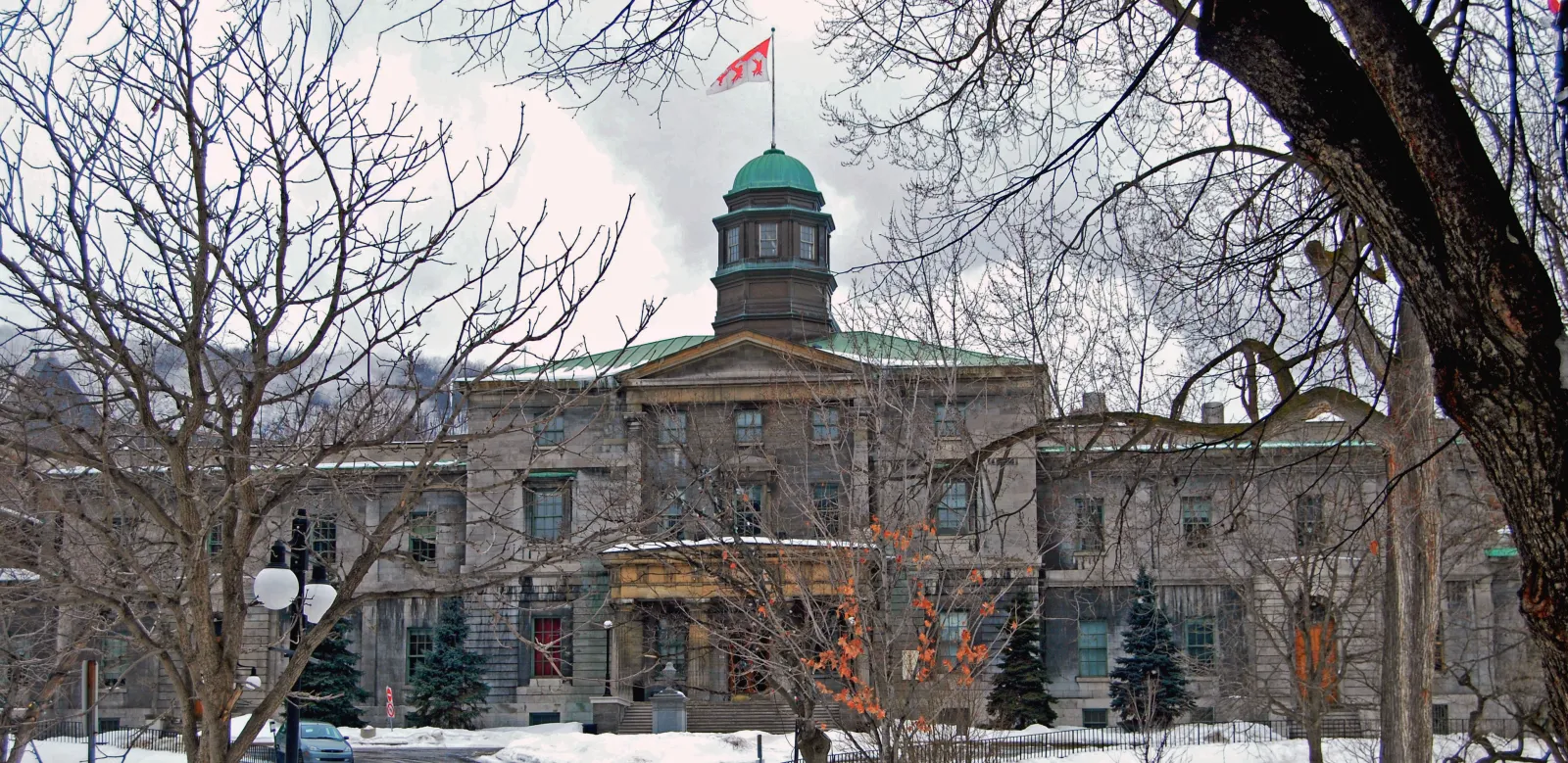

McGill University
Montreal, Quebec, Canada · Established 1821
Official website ↗Total Students
40,531
Intl. Students
29.5%
Setting
Urban
Overview
McGill University traces its charter to 1821, when a royal charter from King George IV created McGill College using land and funds bequeathed by Montreal fur-trade merchant James McGill on his death in 1813; the institution stayed largely dormant until 1829, when the Montreal Medical Institution -- founded in 1823 and later absorbed into McGill -- became Canada's first faculty of medicine and the university's first true academic unit. Two centuries on, McGill has grown into an English-language research university anchored on a roughly 80-acre downtown campus at the foot of Mount Royal in Montreal, Quebec, supplemented by the much larger Macdonald Campus (about 1,600 acres) in Sainte-Anne-de-Bellevue, home to the Faculty of Agricultural and Environmental Sciences. Across its 11 faculties -- spanning Arts, Science, Engineering, Management (Desautels), Law, Medicine and Health Sciences, Dental Medicine, Education, Music (Schulich), Agricultural and Environmental Sciences, and Continuing Studies -- McGill enrolled just over 40,500 students in fall 2025, including roughly 28,200 undergraduates and 10,200 graduate students, with international students from more than 150 countries making up close to 30% of the degree-seeking population, among the highest shares of any Canadian research university. McGill's research intensity and long list of Nobel-connected alumni and faculty (15 laureates across physics, chemistry, and medicine, including CCD-sensor inventor Willard Boyle and telomere researcher Jack Szostak) underpin its standing as one of the most consistently high-ranked universities in Canada: it placed 30th in the world in the QS World University Rankings 2027, its fourth straight year inside QS's global top 30 and the highest of any Canadian institution, while also posting strong subject-level results in Medicine, Law, and the life sciences on both the QS and Times Higher Education subject tables. James Naismith, inventor of basketball, and three Canadian prime ministers (including Justin Trudeau) are among its alumni, and the university's Faculty of Law is known for its distinctive BCL/JD program, which awards both a civil law and a common law degree in a single course of study -- a structure that reflects Quebec's unique bijural legal system and has no real equivalent at most other North American law schools. Because McGill sits in Quebec, applying and enrolling as an international student looks different from both the typical US and typical Canadian-outside-Quebec experience. There is no Common App, UCAS, or OUAC-style shared portal -- applicants use McGill's own Undergraduate Admissions Applicant Portal and are assessed on their final grades in whatever secondary curriculum they completed (a numeric percentage or equivalent, not a US-style 4.0 GPA, SAT, or ACT), with competitive programs like Engineering, Management, and Life Sciences typically expecting minimum overall and prerequisite-subject averages somewhere in the mid-70s to mid-80s percent depending on the applicant's home curriculum. Once admitted, nearly all non-Canadian applicants need a Certificat d'acceptation du Quebec (CAQ) from Quebec's Ministere de l'Immigration, de la Francisation et de l'Integration (MIFI) -- a distinctly Quebec-specific document with no equivalent in Ontario, British Columbia, or other Canadian provinces -- before applying for a study permit from Immigration, Refugees and Citizenship Canada (IRCC); as of January 1, 2026, incoming master's and doctoral students are exempt from the separate Provincial Attestation Letter (PAL) that other provinces require, though they still need the CAQ. Unlike the US F-1 process, the standard IRCC/CAQ pathway does not build in a routine in-person interview. On the academic English side, undergraduate admission generally requires IELTS 6.5 or TOEFL 90 (higher for Management and Education/TESL), while the general graduate-level floor is IELTS 6.5 or TOEFL 86 -- and, notably, the GRE and GMAT are not required for the large majority of McGill's graduate programs; the clearest exception is the Desautels MBA, which requires either the GMAT or GRE with no waivers, and reports an official average incoming GMAT score of 670.
Rankings
Times Higher Education (THE) World University Rankings · Overall (Global)
#41 (2026)
US News Best Global Universities · Overall (Global)
#62 (2027)
QS World University Rankings by Subject · Medicine
#23 (2026)
QS World University Rankings by Subject · Law and Legal Studies
#28 (2026)
Times Higher Education (THE) World University Rankings by Subject · Medical and Health
#27 (2026)
Times Higher Education (THE) World University Rankings by Subject · Law
#33 (2026)
Admissions, Requirements & Costs
Requirements, deadlines, and test-score cutoffs differ significantly between undergraduate and graduate/Master's programs — shown separately below.
Undergraduate
Acceptance Rate
47.5%
Application Fee
$99
Documents required: McGill's own online Undergraduate Admissions Applicant Portal (not a shared portal like the US Common App, UK UCAS, or Ontario's OUAC), Official transcripts/mark sheets for the applicant's specific secondary curriculum, in numeric or standard grade format -- predicted or positional (rank-based) grades are not accepted for most international curricula, English language proficiency test scores (IELTS/TOEFL/PTE/Duolingo/Cambridge or another approved pathway) unless exempt, Program-specific senior secondary prerequisite subjects (e.g., mathematics, chemistry, and physics for Engineering; mathematics for Management; mathematics plus two of biology/chemistry/physics for Science), Supplementary application materials for select programs -- an audition for Music, a portfolio for the Bachelor of Science (Architecture), R-score (cote de rendement au collegial) for Quebec CEGEP applicants specifically -- not applicable to the large majority of international applicants, who instead apply directly on their secondary-school grades
| Term | Deadline | Type |
|---|---|---|
| Fall (September) | January 15, 2027 for Fall 2027 entry for most undergraduate programs (application portal opens October 1, 2026); Medicine and Dentistry run separate, earlier internal deadlines | Regular Decision |
Test Scores
IELTS Minimum
6.5 (Gabble rec. 7)
TOEFL Minimum
90 (4.5 new scale) · Gabble rec. 100 (5 new scale)
PTE Minimum
65
IELTS notes: Overall band of 6.5, with no individual component (Reading, Listening, Writing, Speaking) below 6.0.
TOEFL notes: For tests taken before January 21, 2026 (0-120 scale): overall 90 for most programs, 100 for the B.Ed. (TESL) and B.Com., and 79-80 for Music, with a minimum component score of 21 in each of Reading, Listening, Writing, and Speaking. ETS is moving TOEFL iBT to a new 1-6, CEFR-aligned scale for tests taken on or after January 21, 2026; McGill's published converted minimums on that scale are 4.5 for most programs, 5.0 for B.Ed. (TESL)/B.Com., and 4.0 for Music.
TOEFL scores shown as: legacy 0–120 scale (new 1.0–6.0 CEFR-aligned scale, effective Jan 2026).
Accepted tests: IELTS Academic, TOEFL iBT, PTE Academic, Duolingo English Test, Cambridge English Qualifications (C1 Advanced / C2 Proficiency)
Waiver: Four or more consecutive years of full-time education (high school and/or university) in a country where English is the acknowledged primary language, completion of a DEC at an English-language Quebec CEGEP, an IB Group 1 English score of 5 or higher, a British A-Level English grade of C or better, or a GCSE/IGCSE/GCE O-Level English grade of B (or 5) or better can each satisfy the requirement without a separate test score. Unlike some Canadian peers, McGill does not offer international undergraduate applicants a blanket exemption simply for having a Canadian secondary-school background outside Quebec.
Tuition (Intl.)
$38,124
Tuition (Domestic)
$2,201
Living Expenses/yr
$17,380
Total Cost of Attendance
$55,504
Scholarships
Entrance Scholarship Program (One-Year and Major Entrance Scholarships)
One-year non-renewable awards around CAD $3,000; renewable Major Entrance Scholarships from roughly CAD $3,000 to $12,000 per year for 3-4 years, based on published estimated minimum academic thresholds
McGill's merit-based entrance scholarship program for incoming undergraduates entering directly from secondary school or CEGEP, ranging from a single one-year award to renewable multi-year Major Entrance Scholarships. In the most recent cycle the Scholarships Office offered more than CAD $6.2 million in entrance scholarships to over 2,000 students, including US and international applicants.
Eligibility: A separate scholarship application is required soon after the admissions application; open to newly admitted full-time first-year undergraduates (transfer, mature, diploma, exchange, special, part-time, and visiting students are not eligible)
Entrance Bursary Program
Average entrance bursary offers are proportionate to the student's tuition rate; the published average for US/international recipients is CAD $19,000. In the most recent cycle the Student Aid Office offered CAD $6.3 million in entrance bursaries to 550 newly accepted students with demonstrated financial need
McGill's need-based bursary program for newly admitted undergraduates from low- to modest-income families, including international students who are not eligible for Canadian government student aid.
Eligibility: Newly admitted, financially need-based undergraduates who complete the bursary application alongside their admission application; open to international students
Faculty and department-specific international entrance awards
Varies by faculty; not a single fixed published amount
Individual faculties and departments (e.g., Engineering, Science, Desautels) offer their own supplementary entrance scholarships for high-achieving international admits, on top of the university-wide Entrance Scholarship Program.
Eligibility: Assessed automatically as part of the admission and scholarship review for eligible programs; varies by faculty
Popular Programs
Gabble Prep Insights
Where applicants lose points: Writing tends to be the section where undergraduate applicants are least prepared relative to Reading and Listening, since McGill's numeric-grade-based admission review, subject-specific prerequisite courses, and (for Music and Architecture) supplementary written or portfolio materials all expect sustained, structured written English beyond conversational fluency.
Applicants from strong STEM secondary backgrounds applying to Engineering, Science, and Management typically post comfortable Reading and Listening scores but need more Writing practice, since prerequisite-heavy programs place a premium on structured lab reports, case write-ups, and problem-set explanations rather than purely conversational English.
Figures were converted from CAD at approximately 1 CAD = 0.706 USD (July 2026). McGill does not publish one flat undergraduate international tuition rate -- costs above use the Bachelor of Arts 2026-27 guaranteed-tuition schedule (CAD $54,000 tuition, CAD $57,569.02 including mandatory ancillary fees and international health/dental insurance) as the representative broad-based figure, since Arts is McGill's closest equivalent to a generalist degree; tuitionPerYear/tuitionInternationalPerYear above reflect tuition only (not the additional ~CAD $3,569 in mandatory fees and insurance), for consistency between the domestic and international figures. Tuition varies sharply by faculty: 2026-27 international first-year tuition-only estimates run roughly CAD $65,168 for Engineering and Law (BCL/JD), CAD $71,687 for Management (BCom), CAD $64,786 for Science, CAD $35,561 for Music/Nursing/Agricultural and Environmental Sciences, and CAD $126,882 (Year 1, 61 credits) for Dentistry and CAD $74,678 (Year 1, 63 credits) for Medicine (MDCM) -- see the courses list for per-program figures. The domestic tuitionPerYear figure (CAD $103.92/credit, i.e. roughly CAD $3,118/year for a 30-credit course load) reflects the Quebec-resident rate; Canadian citizens/permanent residents from outside Quebec pay a third, intermediate rate (CAD $432.85/credit, roughly CAD $12,985/year for 30 credits) that is higher than the Quebec rate but well below the international rate, a three-tier structure that does not exist at most Canadian universities outside Quebec. Living expenses were estimated using Quebec's 2026 CAQ/MIFI minimum proof-of-funds threshold for a single study permit applicant (CAD $24,617/year, roughly triple the pre-2026 figure), used as a standardized proxy since McGill's own cost estimator does not publish one fixed annual living-cost figure; note this Quebec-specific threshold is higher than the federal IRCC baseline used for applicants outside Quebec (CAD $22,895/year). McGill's official Fall 2025 Admissions Profile reports a combined undergraduate/professional acceptance rate of 47.5% (18,132 offers of 38,135 applicants) -- this blends highly competitive professional programs (Medicine, Law, Dentistry, Architecture) with less competitive ones, and McGill does not publish a separate general-undergraduate-only rate; program-level rates vary widely (third-party aggregators, not official McGill sources, cite figures as low as roughly 10-15% for Architecture and some Engineering streams). On the Canadian-equivalent grading side (since sat/act/minGPA do not apply): McGill's own India-specific requirements page cites a minimum of 75% on the CBSE/India Senior School Certificate as a floor, with competitive programs such as Engineering and Management commonly expecting notably higher; more broadly, McGill states that overall and prerequisite-subject averages for undergraduate admission usually fall between 75% and 85% depending on the applicant's curriculum and program, though McGill does not publish one fixed universal cutoff and these figures shift year to year with applicant volume. For Quebec CEGEP applicants specifically (a minority of McGill's international intake, since most international students apply directly from their home secondary system without attending CEGEP), the R-score (cote de rendement au collegial) rather than a raw percentage is the key admission metric, with competitive programs like Engineering commonly citing R-scores in the low-to-mid 30s. McGill's official Key Performance Indicators report a six-year bachelor's graduation rate of 87% for the 2018 entering cohort (88% for four-year programs, 85% for three-year programs), among the highest in Canada's U15 research-university group.
Recommended prep timeline: 10 weeks
Graduate (Master's & PhD)
Acceptance Rate
40%
Application Fee
$99
Documents required: Statement of purpose, research proposal, or letter of intent (program-dependent), Two to three references, generally including academic references, Official transcripts from all previously attended post-secondary institutions, CV/resume, English language proficiency test scores (IELTS Academic or TOEFL iBT are the primary tests accepted for graduate admission; PTE and Duolingo are not accepted) unless exempt, GRE General Test -- required by a minority of departments, most often from applicants without a Canadian or US undergraduate degree (e.g., Economics); most McGill graduate programs, including most of Engineering, Computer Science, and the sciences, do not require the GRE, GMAT or GRE General Test -- required with no exemptions for the Desautels MBA and most other Desautels master's programs (Master of Management in Finance, Analytics, etc.); the MBA's most recently reported official average incoming GMAT score is 670
| Term | Deadline | Type |
|---|---|---|
| Fall (September), Winter (January), or Summer, depending on the program | Rolling and program-specific; most departments set deadlines several months ahead of the intended start term, and not all programs admit in every term | Rolling |
Test Scores
Avg. GMAT
670
IELTS Minimum
6.5 (Gabble rec. 7)
TOEFL Minimum
86 (4.5 new scale) · Gabble rec. 95 (5 new scale)
IELTS notes: General graduate-level minimum is an overall IELTS Academic band of 6.5; some programs set their own higher requirement (commonly 7.0).
TOEFL notes: General graduate-level minimum of 86 overall (0-120 scale), with no component score below 20. Individual departments may set higher minimums; McGill's new CEFR-aligned TOEFL scale conversions (effective for tests from January 21, 2026) should be confirmed directly with the specific program.
TOEFL scores shown as: legacy 0–120 scale (new 1.0–6.0 CEFR-aligned scale, effective Jan 2026).
Accepted tests: IELTS Academic, TOEFL iBT
Waiver: Applicants whose mother tongue is English, who have completed or are completing a degree from a recognized institution in Canada or the US, who have completed a degree from a recognized foreign institution where English is the language of instruction, or who have lived, studied, or worked for four or more consecutive years in a country where English is the acknowledged primary language are generally exempt from submitting a separate English test score.
Tuition (Intl.)
$15,072
Tuition (Domestic)
$2,201
Living Expenses/yr
$17,380
Total Cost of Attendance
$32,452
Scholarships
Minimum PhD funding guarantee
Varies by faculty and department -- for example, reported department-level minimums include roughly CAD $27,300/year (Linguistics) and CAD $23,000/year (Psychology, MA/MSc and PhD); McGill does not publish one single university-wide minimum figure
Most McGill departments guarantee full-time PhD students (both domestic and international) a minimum annual funding package, made up of some combination of fellowships, scholarships, and graduate assistantships, and McGill states that international PhD students receive funding to cover the difference between the Quebec-resident and international tuition rates.
Eligibility: Full-time PhD students in good academic standing, generally for up to five years; exact terms vary by department
Graduate Excellence Fellowships and department-specific master's/PhD awards
Varies by faculty and program; not a single fixed published amount
Individual faculties and departments administer their own merit-based graduate fellowships and entrance awards for incoming master's and PhD students, on top of standard funding packages.
Eligibility: International graduate students in eligible programs, typically assessed automatically as part of the admission review
Desautels-specific MBA and master's awards
Varies; Canadian citizens/permanent residents receive a separate CAD $23,000 MBA tuition waiver that international students are not eligible for
The Desautels Faculty of Management considers all international applicants to the MBA and other Desautels master's programs for merit-based Desautels-specific scholarships at the time of admission.
Eligibility: Automatic consideration at admission for eligible Desautels applicants; no separate application required
Popular Programs
Gabble Prep Insights
Where applicants lose points: Writing is typically the weakest section for graduate applicants, since a statement of purpose or research proposal -- and, for Desautels MBA/MMF/MMA applicants especially, case-based written materials -- demand structured academic or professional English well beyond conversational fluency.
Applicants to research-stream programs (Computer Science, Engineering, life sciences) often post strong Reading/Listening scores but need more Speaking practice for supervisory meetings, TA duties, and thesis-defense-style presentations, while Desautels master's applicants most often need additional Writing polish given the case-study- and report-heavy application and coursework style.
Figures were converted from CAD at approximately 1 CAD = 0.706 USD (July 2026). Costs use McGill's standard international Master's Research (Thesis) full-time residency rate as the representative figure (CAD $10,674.30/term for Fall/Winter 2026-27, i.e. roughly CAD $21,348.60/year), since full-time thesis students are billed a flat residency fee rather than per credit; the Quebec-resident equivalent is CAD $1,558.80/term (roughly CAD $3,117.60/year). International PhD students are billed a lower flat residency fee of CAD $9,581.40/term (roughly CAD $19,162.80/year). These thesis-program rates differ sharply from McGill's course-based professional graduate programs, which are priced separately and often are not simple annual figures: the Desautels MBA, for example, charges CAD $2,260.42/credit for the Fall 2026 cohort with total program tuition commonly cited around CAD $108,500 for international students over the program's 12-20 month structure (domestic students receive a CAD $23,000 tuition waiver) -- because this is a total program fee rather than a clean annual rate, MBA tuitionPerYear has been left null in the courses list rather than estimated. Per this dataset's hard rule against fabricating GRE/GMAT figures: McGill does not require the GRE or GMAT for the large majority of graduate programs. Some departments (e.g., Economics) require the GRE General Test only from applicants without a Canadian or US undergraduate degree, and McGill does not publish an official minimum or average GRE score for this conditional requirement, so gre.min/max/avgScore have been left null rather than estimated. The Desautels MBA requires either the GMAT or GRE with no exemptions, and McGill's own MBA FAQ page publishes an official average incoming GMAT score of 670 (with GPA averaging 3.3 and 4-5 years of work experience) -- no official minimum or maximum GMAT range is published (McGill notes only that "there are ranges around" the average), so per this dataset's rule against summing sub-scores or inventing ranges, only gmat.avgScore has been populated and gmat.min/max remain null. An official, university-wide graduate acceptance rate of 40.0% (5,024 offers of 12,538 applicants) is published in McGill's Fall 2025 Admissions Profile.
Recommended prep timeline: 12 weeks
Programs Offered
Bachelor of Arts (BA)
Undergraduate · 4 yr · $38,124/yr
Bachelor of Science (BSc)
Undergraduate · 4 yr · $45,739/yr
Bachelor of Engineering (BEng)
Undergraduate · 4 yr · $46,008/yr
Bachelor of Commerce (BCom)
Undergraduate · 4 yr · $50,611/yr
Bachelor of Civil Law and Juris Doctor (BCL/JD)
Undergraduate · 3.5 yr · $46,008/yr
Doctor of Medicine and Master of Surgery (MDCM)
Undergraduate · 4 yr · $52,731/yr
Master of Business Administration (MBA)
Masters · 1.3 yr
Master of Science (Thesis), Computer Science
Masters · 2 yr · $15,072/yr
PhD (various graduate units)
PhD · 4 yr · $13,529/yr
Campus Life
McGill's downtown campus life centers on the Students' Society of McGill University (SSMU), which runs student government and more than 250 registered clubs, 17 student-run services, and 11 independent student groups out of the University Centre, while the Macdonald Campus Students' Society (MCSS) plays the equivalent role for students at the Sainte-Anne-de-Bellevue campus. Being based in Montreal -- a bilingual city with a large student population across several universities -- gives McGill students easy access to a broader francophone and anglophone cultural and nightlife scene than most single-university college towns. Athletically, the McGill Redbirds and Martlets compete in U SPORTS and the RSEQ, though the university announced in 2025 that it would reduce its varsity sports portfolio for the 2026-27 season, with some programs expected to continue as SSMU-affiliated competitive clubs rather than varsity teams.
Notable clubs: Students' Society of McGill University (SSMU) -- over 250 active clubs, 17 student-run services, and 11 Independent Student Groups on the downtown campus, Macdonald Campus Students' Society (MCSS), representing students at the Sainte-Anne-de-Bellevue campus, McGill Redbirds and Martlets varsity and competitive club teams, Faculty-specific student societies (e.g., Engineering Undergraduate Society, Management Undergraduate Society, Science Undergraduate Society), Model UN, case-competition, and entrepreneurship clubs tied to Montreal's business and startup ecosystem
Outcomes
Undergraduate
Graduation Rate
87%
Graduate
Notable Alumni
Justin Trudeau — 23rd Prime Minister of Canada; earned a Bachelor of Arts in Literature from McGill in 1994, one of three Canadian prime ministers to have graduated from the university (alongside John Abbott and Wilfrid Laurier)
William Shatner — Emmy Award-winning actor best known for Star Trek; earned a Bachelor of Commerce from McGill in 1952
James Naismith — Inventor of the sport of basketball; earned a Bachelor of Arts (1887) and studied theology and physical education at McGill before going on to Springfield, Massachusetts, where he devised the game in 1891
Willard Boyle — Co-recipient of the 2009 Nobel Prize in Physics for the invention of the charge-coupled device (CCD) image sensor; earned his BSc (1947), MSc (1948), and PhD (1950) at McGill
Jack Szostak — Co-recipient of the 2009 Nobel Prize in Physiology or Medicine for the discovery of how chromosomes are protected by telomeres and the enzyme telomerase; completed his undergraduate studies at McGill
Visa Interview Prep
Studying at McGill involves an extra, Quebec-specific immigration step that does not exist for international students at universities in Ontario, British Columbia, or most other Canadian provinces: nearly all non-Canadian applicants must obtain a Certificat d'acceptation du Quebec (CAQ) from Quebec's provincial immigration ministry (MIFI) before they can apply for a federal study permit from IRCC. The CAQ has a standard processing time of about 25 business days once MIFI confirms receipt of supporting documents, and applicants should apply as soon as they accept their McGill offer. Effective January 1, 2026, incoming master's and doctoral applicants are exempt from the separate Provincial Attestation Letter (PAL) that some other provinces require as part of Canada's national study-permit cap system -- but Quebec graduate students still need the CAQ regardless, since the CAQ is a distinct, Quebec-only requirement rather than the PAL mechanism used elsewhere. Also effective January 1, 2026, Quebec sharply raised its minimum proof-of-funds threshold for the CAQ and study permit: a single adult applicant must now show CAD $24,617 in living-expense funds (roughly triple the pre-2026 figure of about CAD $15,508), on top of tuition and travel costs -- higher than the federal IRCC baseline (CAD $22,895) used for applicants studying outside Quebec. Once the CAQ is in hand, applicants apply for the study permit directly through the IRCC website, submitting proof of acceptance, proof of sufficient funds, and biometrics where applicable; a valid study permit must be in hand before classes begin. Unlike the US F-1 process, the standard IRCC/CAQ pathway does not build in a routine in-person consular interview, though officers can still request one or refuse an application on genuine-student or financial grounds. Distinct from the study permit itself is the Temporary Resident Visa (TRV) or Electronic Travel Authorization (eTA) that many applicants also need simply to travel to and enter Canada; both are typically processed alongside the study permit application.
- Most CAQ and study permit applicants do NOT attend an in-person visa interview the way US F-1 applicants do -- the large majority of applications are decided from the online CAQ application, the study permit application, and supporting financial and academic documents
- IRCC may request a short interview (in person or by video) or a biometrics appointment in specific risk-based cases, focused on genuine intent to study, ties to the home country, and financial means, but this is the exception rather than the routine process
FAQs
What IELTS or TOEFL score do I need to apply to McGill?
The standard undergraduate minimum is an overall IELTS Academic band of 6.5 with no component below 6.0, or a TOEFL iBT score of 90 (100 for the B.Ed. TESL and B.Com., 79-80 for Music). The general graduate-level minimum is slightly different: an overall IELTS band of 6.5 or a TOEFL iBT score of 86, though individual graduate departments may set their own, sometimes higher, requirement. Note that PTE Academic and the Duolingo English Test are accepted for undergraduate admission but not for graduate admission.
Does McGill use the Common App, UCAS, or a shared Canadian application portal like OUAC?Undergrad
No. Undergraduate applicants apply directly through McGill's own Undergraduate Admissions Applicant Portal. This is different from Ontario, where most universities are reached through the province-wide OUAC system -- McGill, like other Quebec universities, runs its own independent application process rather than a shared provincial one, and it is a fundamentally different process from a US-style Common App or UK-style UCAS application.
Will I need to attend a visa interview to study at McGill, like the US F-1 process?
Almost certainly not. Canada's study permit process, run by Immigration, Refugees and Citizenship Canada (IRCC), generally does not build in a routine in-person interview the way the US F-1 visa does. Most applications are decided from the online CAQ and study permit applications plus supporting financial and academic documents. IRCC reserves the right to request a short interview or biometrics appointment in specific cases, but this is not the standard process.
What is a CAQ, and why does McGill need one when other Canadian universities don't mention it?
A Certificat d'acceptation du Quebec (CAQ) is a provincial immigration document issued by Quebec's Ministere de l'Immigration, de la Francisation et de l'Integration (MIFI). Because McGill is located in Quebec, almost all non-Canadian students need a CAQ before they can apply for a federal IRCC study permit -- a step that does not exist for students attending universities in Ontario, British Columbia, or most other provinces. Standard CAQ processing takes about 25 business days once MIFI confirms your documents are complete, so applying as soon as you accept your McGill offer is strongly recommended.
What percentage grade do I need instead of a US-style GPA or SAT/ACT score?Undergrad
McGill does not use the SAT, ACT, or a 4.0 GPA scale for admissions. Offers are based on your final grades in whichever senior secondary curriculum you completed. McGill's own published guidance cites a minimum of 75% for the India CBSE/Senior School Certificate as a floor, and more broadly describes overall and prerequisite-subject averages for admission as usually falling between 75% and 85% depending on your curriculum and target program -- competitive programs like Engineering and Management typically expect the higher end of that range. McGill does not publish one universal fixed cutoff, and actual competitiveness shifts year to year.
Is the GRE or GMAT required for McGill graduate programs?Grad
For most McGill graduate programs -- including the large majority of Engineering, Computer Science, and science departments -- no, neither the GRE nor the GMAT is required. A minority of departments (such as Economics) require the GRE only from applicants without a Canadian or US undergraduate degree, and McGill does not publish an official minimum or average score for that conditional requirement. The clear exception is the Desautels MBA, which requires either the GMAT or GRE with no waivers; McGill's own MBA admissions FAQ publishes an official average incoming GMAT score of 670, alongside an average GPA of 3.3 and 4-5 years of work experience.
Can I get a waiver for the IELTS/TOEFL requirement at McGill?
Yes, in certain cases. At both levels, four or more consecutive years of full-time education (or work) in a country where English is the acknowledged primary language, or a degree from a recognized Canadian, US, or English-medium foreign institution, can satisfy the requirement without a separate test. At the undergraduate level, specific exam credentials (an IB Group 1 English score of 5+, an A-Level English grade of C or better, a GCSE/O-Level English grade of B/5 or better, or a DEC from an English CEGEP) can also waive the requirement.
As an international student, can I get financial aid or scholarships at McGill?
Yes, though the structure differs from the US/UK sense of 'financial aid.' At the undergraduate level, international admits are automatically considered for McGill's merit-based Entrance Scholarship Program (one-year and renewable Major Entrance Scholarships), and international students with demonstrated financial need can separately apply to McGill's need-based Entrance Bursary Program, which reports an average award of CAD $19,000 for US/international recipients. At the graduate level, funding works more like guaranteed support than 'aid' -- most PhD students receive a minimum annual funding package, and McGill states that international PhD students receive additional funding specifically to cover the tuition gap between the Quebec-resident and international rates, though the exact package varies by department.
How much money do I need to show to get a CAQ and study permit for Quebec?
As of January 1, 2026, Quebec sharply raised its minimum proof-of-funds threshold: a single adult applicant must now show CAD $24,617 in living-expense funds (on top of tuition and travel costs) to obtain a CAQ and study permit, roughly triple the pre-2026 figure of about CAD $15,508. This Quebec-specific threshold is higher than the federal IRCC baseline of CAD $22,895 used for applicants studying outside Quebec, so budgeting for McGill specifically means planning around the higher Quebec number.
Why do different students at McGill pay different tuition for the same program?
McGill charges three different tuition tiers depending on residency status: a Quebec-resident rate (the lowest, e.g. CAD $103.92/credit for most undergraduate programs), an out-of-province Canadian rate for citizens/permanent residents from other provinces (a Quebec-rate-plus-supplement, e.g. roughly CAD $432.85/credit), and an international rate (the highest, set per faculty -- e.g. CAD $54,000/year tuition for a Bachelor of Arts, guaranteed for the duration of the program for students admitted in 2026-27). This three-tier structure is specific to Quebec and does not exist in the same form at universities in most other Canadian provinces.