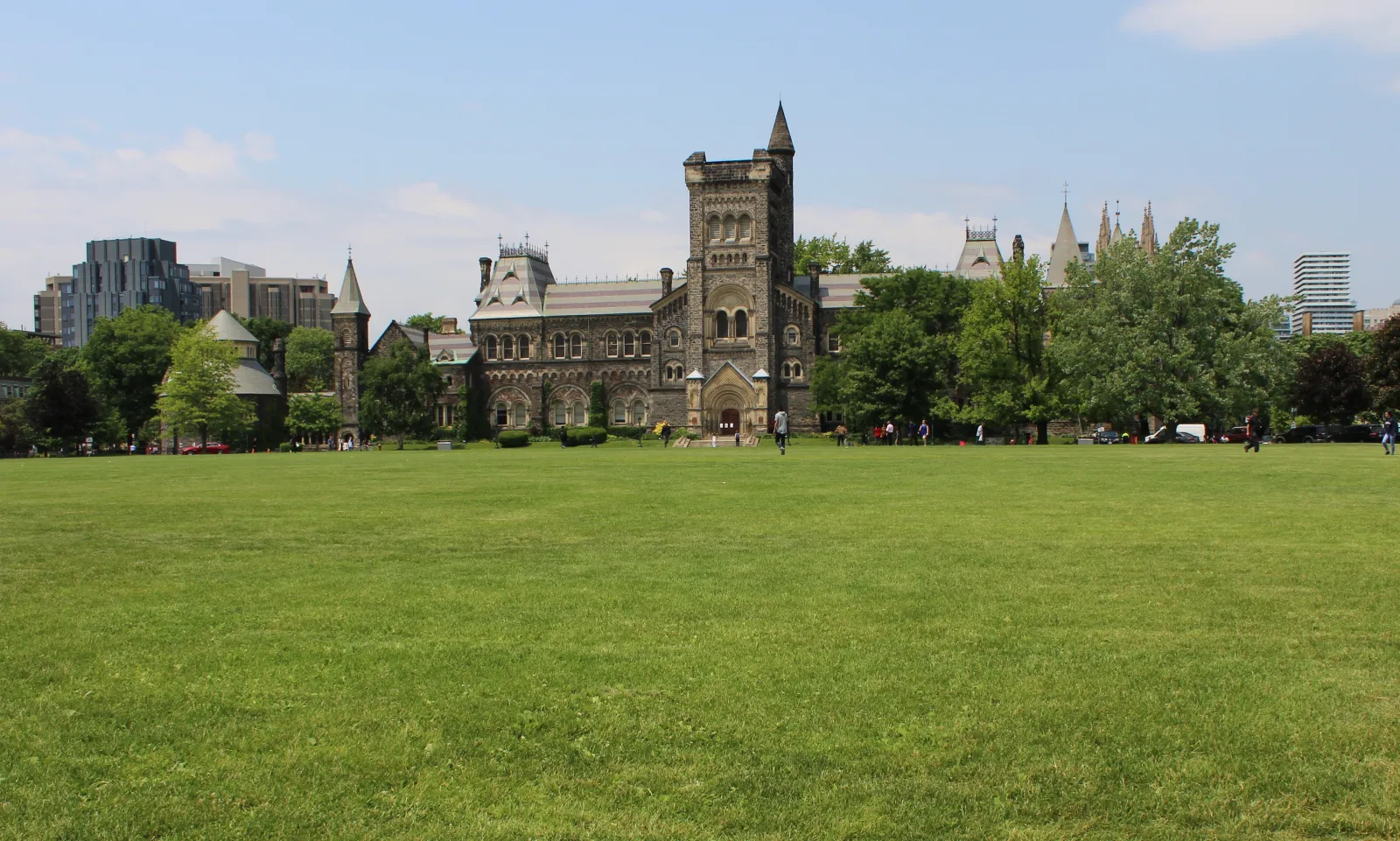

University of Toronto
Toronto, Ontario, Canada · Established 1827
Official website ↗Total Students
102,431
Intl. Students
28.7%
Setting
Urban
Overview
The University of Toronto traces its roots to King's College, founded by royal charter from King George IV in 1827 as Upper Canada's first institution of higher learning; the college was secularized and renamed the University of Toronto in 1849, and the nineteenth century saw a cluster of denominational colleges -- Victoria, Trinity, St. Michael's, and University College among them -- federate with the university, a structure that still shapes undergraduate life today through U of T's system of colleges. Long before it became a modern research university, U of T was already the site of major discovery: Frederick Banting, Charles Best, and J.J.R. Macleod's isolation of insulin in the early 1920s won the university its first Nobel Prize, and the tradition of high-impact research has continued through figures like Geoffrey Hinton, whose foundational work on neural networks and deep learning at U of T earned him a share of the 2024 Nobel Prize in Physics. Today U of T operates across three distinct campuses in the Greater Toronto Area -- the historic downtown St. George campus, University of Toronto Mississauga (UTM), and University of Toronto Scarborough (UTSC) -- together enrolling over 100,000 students and offering more than 700 undergraduate and 300 graduate programs, making it by far the largest university in Canada. Its academic breadth spans the Rotman School of Management (home to the Full-Time MBA and Rotman Commerce), the Faculty of Applied Science & Engineering, the Temerty Faculty of Medicine, and a large Faculty of Arts & Science that most direct-entry undergraduates apply into as a home faculty before choosing a specialist program. U of T is consistently ranked Canada's top university and among the leading public research universities in North America, with particular international strength in life sciences, computer science, and the health professions. For prospective international students, the path into U of T looks different from applying to a US or UK institution: undergraduate applications run through the Ontario Universities' Application Centre (OUAC), using the 105 application type for international and non-Ontario applicants, and are assessed against final grades in a recognized Grade 12 curriculum (Canadian provincial, IB, A-Level, or another country's equivalent senior secondary result) rather than a US-style GPA or SAT/ACT score. Roughly 29,000 international students from about 175 countries make up close to 30% of the student body, and once admitted, those students apply for a Canadian study permit through Immigration, Refugees and Citizenship Canada (IRCC) -- a process that, unlike the US F-1 visa, does not typically involve an in-person consular interview. English-language requirements differ meaningfully between undergraduate admission (generally IELTS 6.5, no band below 6.0) and graduate admission through the School of Graduate Studies (generally IELTS 7.0, minimum 6.5 per component), and the Rotman School of Management stands out among Canadian business schools for actually requiring a GMAT or GRE score for its Full-Time MBA rather than treating it as optional.
Rankings
Times Higher Education (THE) World University Rankings · Overall (Global)
#21 (2026)
US News Best Global Universities · Overall (Global)
#20 (2027)
QS World University Rankings by Subject · Nursing
#4 (2026)
QS World University Rankings by Subject · Psychology
#8 (2026)
QS World University Rankings by Subject · Education and Training
#10 (2026)
QS Global MBA Rankings · MBA (Rotman School of Management)
#56 (2026)
Admissions, Requirements & Costs
Requirements, deadlines, and test-score cutoffs differ significantly between undergraduate and graduate/Master's programs — shown separately below.
Undergraduate
Application Fee
$179
Documents required: OUAC application (Form 105 for international applicants and Canadians attending school outside Ontario; Form 101 for current Ontario high school students), Official Grade 12 (or final senior secondary year) transcripts and, where applicable, predicted grades in the applicant's home curriculum, Senior-level English course grade (all applicants must present a Grade 12-equivalent English course), English language proficiency test scores (IELTS/TOEFL/PTE/Duolingo) unless exempt, Supplementary application materials for select programs (e.g., Rotman Commerce, Computer Science, Engineering, and the Creative Expression and Stated Interest supplementary form used by several St. George programs), Program-specific prerequisite subjects at the senior/Grade 12-equivalent level (e.g., calculus and physics for Engineering)
| Term | Deadline | Type |
|---|---|---|
| Fall (September) | OUAC application: January 15 for most direct-entry programs (2026-27 cycle); supporting documents typically due shortly after, with exact document deadlines varying by faculty and campus | Regular Decision |
Test Scores
IELTS Minimum
6.5 (Gabble rec. 7)
TOEFL Minimum
89 (4.5 new scale) · Gabble rec. 100 (5 new scale)
PTE Minimum
65
IELTS notes: Overall band of 6.5 with no individual band below 6.0.
TOEFL notes: For tests taken before 21 January 2026: overall score of 89, with a minimum of 22 in Speaking and 22 in Writing. ETS moved TOEFL iBT to a new 1-6, CEFR-aligned scale for tests taken on or after 21 January 2026; on that new scale U of T's undergraduate minimum is an overall 4.5, with 4.5 in Writing and 4.0 in Speaking.
TOEFL scores shown as: legacy 0–120 scale (new 1.0–6.0 CEFR-aligned scale, effective Jan 2026).
Accepted tests: IELTS Academic, TOEFL iBT, PTE Academic, Duolingo English Test
Waiver: Applicants who have completed four or more years of full-time study in English at a recognized school in Canada or another approved English-dominant country/curriculum (e.g., UK GCSE/A-Level study) are generally exempt from submitting a separate English test score.
Conditional admission: U of T's English language transition/bridging programs (offered through International Programs and individual campuses) run from roughly six weeks to eight months and let academically admissible students who narrowly miss the English requirement build proficiency before starting their degree.
Tuition (Intl.)
$44,880
Tuition (Domestic)
$4,307
Living Expenses/yr
$9,178
Total Cost of Attendance
$54,058
Scholarships
Lester B. Pearson International Scholarship
Full tuition, incidental fees, books, and full residence support for four years
U of T's most prestigious undergraduate award for international students and one of the largest merit scholarship programs for international students in Canada, recognizing outstanding academic achievement, creativity, and leadership impact on an applicant's school and community.
Eligibility: Open only to first-entry international undergraduate applicants; candidates must be nominated by their high school, and roughly 37 Pearson Scholars are named per year across the entire incoming international class
International Scholar Awards and faculty/college entrance scholarships
Varies by award; typically a one-time or renewable partial contribution toward tuition rather than a full-fee waiver
A set of merit-based entrance scholarships that individual faculties and colleges automatically consider eligible international applicants for at the point of admission, without a separate application, alongside a smaller number of program-specific and country-specific awards.
Eligibility: Automatically considered for admitted international undergraduates with strong academic records in most cases; some awards require a supplementary application
Popular Programs
Gabble Prep Insights
Where applicants lose points: Writing tends to be the section international undergraduate applicants underperform on relative to Reading and Listening, since U of T's Arts & Science curriculum -- and the ENG4U-equivalent senior English requirement built into admission itself -- expects sustained essay-style argument-building rather than short-answer or conversational English.
Applicants from strong STEM-heavy secondary programs (common among Engineering, Computer Science, and Life Sciences applicants) often clear the Reading and Listening thresholds comfortably but need extra Speaking and Writing practice, since Canadian first-year courses lean heavily on tutorial discussion and written problem sets/lab reports that general-purpose exam prep doesn't always cover.
Figures were converted from CAD at approximately 1 CAD = 0.706 USD (July 2026). Tuition figures use the 2025-26 Faculty of Arts & Science international Program Fee for a full course load at the St. George campus ($63,570 CAD tuition; $66,375.22 CAD once the $2,013.22 mandatory incidental/system-access/ancillary fees and $792 UHIP health insurance fee are added) as the representative undergraduate figure, since U of T does not publish one university-wide tuition rate -- 2025-26 international tuition runs meaningfully higher in some programs (e.g., Engineering ~$70,060 CAD; upper-year Computer Science Major/Specialist ~$65,740 CAD; upper-year Rotman Commerce Specialist ~$72,260 CAD, 2024-25 figure). The domestic tuitionPerYear figure ($6,100 CAD) reflects the Ontario-resident Arts & Science rate and is not comparable to the international rate; Canada does not have a single 'Home' fee the way the UK does, since Ontario, other-province, and international rates all differ. Living expenses were estimated from U of T's own official cost estimator range of CAD $10,000-$16,000 per academic year (excluding tuition), using the midpoint. U of T does not publish one official aggregate undergraduate acceptance rate, and third-party estimates for it conflict enormously (commonly cited figures range from roughly 40% to 70%+ depending on methodology and year), so acceptanceRate has been left null rather than fabricated from unreliable secondary sources; what is well documented is that acceptance varies sharply by program, with Rotman Commerce, Computer Science, and Engineering Science far more selective than the Arts & Science average. On the Canadian-equivalent grading side (since sat/act/minGPA are not applicable): representative published/commonly cited final-grade benchmarks for competitive admission run from the low-to-mid 80s (percentage average) for many Arts & Science programs up to the low-to-high 90s for Computer Science, Engineering Science, and Rotman Commerce; IB applicants are typically expected in the 30s (out of 45) and A-Level applicants around B/B+ or higher, but exact cutoffs are not fixed and shift year to year with applicant volume. The OUAC/U of T application fee used above (CAD $254 = the OUAC base fee of $156 for up to three program choices plus U of T's non-refundable $98 supplementary fee for applicants using Form 105) is a representative composite, not a single published U of T fee, since OUAC and U of T bill separately.
Recommended prep timeline: 10 weeks
Graduate (Master's & PhD)
Application Fee
$92
Documents required: Statement of intent / research interest statement, Two to three academic (or academic plus professional) references, Official transcripts from all previously attended post-secondary institutions, CV/resume, English language proficiency test scores (IELTS or TOEFL; PTE is not accepted at the graduate/SGS level), GMAT or GRE score for the Rotman Full-Time MBA (required, with exemptions for candidates holding CFA Level II, CPA CFE, PEng, or ACIA/FCIA designations, or U of T undergraduate alumni with a 3.5+ GPA); most other graduate programs at U of T do not require GRE/GMAT, Writing sample or portfolio for some humanities, design, and professional programs
| Term | Deadline | Type |
|---|---|---|
| Fall (September) | Rolling and program-specific; most research-based master's and PhD programs set deadlines between December and February for a September start, while the Rotman Full-Time MBA runs multiple earlier application rounds | Rolling |
Test Scores
IELTS Minimum
7 (Gabble rec. 7.5)
TOEFL Minimum
93 (4.5 new scale) · Gabble rec. 100 (5 new scale)
IELTS notes: Overall band of 7.0 with at least 6.5 in each of the four components.
TOEFL notes: For tests taken before 21 January 2026: overall score of 93, with a minimum of 22 in Speaking and Writing. For tests on the new 1-6, CEFR-aligned scale from 21 January 2026 onward: overall 4.5, with 4.5 in Writing and 4.0 in Speaking.
TOEFL scores shown as: legacy 0–120 scale (new 1.0–6.0 CEFR-aligned scale, effective Jan 2026).
Accepted tests: IELTS Academic, TOEFL iBT, Cambridge English (C1/C2), COPE, CAEL
Waiver: Applicants who completed a prior degree taught and examined in English at a recognized institution in Canada or another approved English-dominant country are generally exempt; exemption policies can vary slightly by graduate unit.
Tuition (Intl.)
$24,640
Tuition (Domestic)
$6,784
Living Expenses/yr
$12,284
Total Cost of Attendance
$36,924
Scholarships
SGS/graduate unit funding packages for research-stream master's and PhD students
Varies by graduate unit; PhD funding packages commonly meet or exceed the program's base tuition and living-cost benchmark for the guaranteed funding period (typically 4-5 years for PhD)
Most research-based (thesis-stream) master's programs and virtually all PhD programs at U of T guarantee incoming domestic and international students a minimum annual funding package combining fellowships, teaching assistantships, and research assistantships that substantially offsets the international tuition premium -- a structural difference from many US and UK master's markets, where funding is far less standard.
Eligibility: Automatic for admitted students in funded research-stream master's and PhD programs; professional/course-based master's programs (e.g., most Rotman master's, MEng) are typically not eligible for guaranteed funding
Rotman MBA entrance scholarships and merit awards
Varies by award; typically a partial tuition contribution rather than a full-ride
The Rotman School of Management offers a range of merit-based entrance scholarships to incoming Full-Time MBA students, awarded automatically at the point of admission based on the strength of the overall application.
Eligibility: Automatically considered for all admitted Full-Time MBA applicants; no separate scholarship application required
Popular Programs
Gabble Prep Insights
Where applicants lose points: Writing is typically the weakest section for graduate applicants, since a research-focused statement of intent and, for Rotman programs especially, case-based written assessments demand structured academic or business English well beyond conversational fluency.
Applicants to quantitative and research-stream programs (Computer Science, Engineering) often post strong Reading/Listening scores but need more Speaking practice for supervisory meetings, TA duties, and defense-style presentations, while Rotman MBA and Master of Information applicants most often need additional Writing polish given the essay- and case-heavy application and coursework style.
Figures were converted from CAD at approximately 1 CAD = 0.706 USD (July 2026). Costs use a representative research-based (thesis-stream) MSc as the graduate figure, since U of T does not publish one university-wide graduate tuition rate: 2025-26 incoming MSc fees (inclusive of incidental/ancillary charges) run roughly CAD $9,608 for domestic students and CAD $34,900 for international students. This differs sharply from two other common graduate paths at U of T: funded PhD tuition, which is set at a flat CAD $6,210/year for both domestic and international students under U of T's guaranteed-funding PhD policy, and the Rotman Full-Time MBA, a professional (non-funded) program whose 2025-26 published international tuition is CAD $68,880 in year one and CAD $70,260 in year two (CAD $139,140 total for the two-year program) -- roughly USD $48,630 and USD $49,604 per year respectively. Living costs were estimated using a 12-month graduate academic year applied to U of T's own monthly cost-of-living guidance. On GRE/GMAT: Rotman's own Full-Time MBA FAQ page states the GMAT or GRE is required (with exemptions for CFA Level II, CPA CFE, PEng, or ACIA/FCIA holders, and for U of T undergraduate alumni with a 3.5+ GPA), and it publishes minimum recommended scores only -- 525 for GMAT Focus, 550 for GMAT Legacy, and 309 for GRE -- explicitly declining to publish an official class-profile average or score range because admission is holistic. Third-party MBA consultancies commonly cite unofficial averages around GMAT 680 (Classic scale) and GRE 320 for recent incoming classes, but since these are not Rotman-published figures, avgScore and max have been left null per this dataset's rule against using unverified secondary-source averages; only the officially published minimum is populated. Rotman's own Full-Time MBA Employment and Salary Report (Class of 2024) states 92% of the class had a job offer within six months of graduation, with average total compensation around CAD $134,000 and top hiring employers including Amazon, EY, Deloitte, KPMG, Gartner, and McKinsey & Company -- these figures are specific to the Full-Time MBA cohort, not U of T graduate students as a whole, which is why they are not populated into the university-wide outcomes.graduate fields. An official, university-wide graduate acceptance rate is not published and has been left null.
Recommended prep timeline: 12 weeks
Programs Offered
Computer Science BSc (Major/Specialist)
Undergraduate · 4 yr
Rotman Commerce BCom
Undergraduate · 4 yr
Engineering Science BASc
Undergraduate · 4 yr · $49,462/yr
Life Sciences BSc
Undergraduate · 4 yr
Management BBA
Undergraduate · 4 yr
Full-Time MBA
Masters · 2 yr · $49,117/yr
Master of Information (MI)
Masters · 2 yr
MSc/MASc in Computer Science
Masters · 2 yr · $24,640/yr
PhD (various graduate units)
PhD · 4 yr · $4,384/yr
Campus Life
U of T operates across three campuses: the historic St. George campus in downtown Toronto (home to most graduate and professional faculties and the largest concentration of undergraduate colleges), University of Toronto Mississauga (UTM), and University of Toronto Scarborough (UTSC), each with its own residences, libraries, and student government. First-year students at St. George are affiliated with one of seven colleges (e.g., Victoria, Trinity, University College, New College, Innis, Woodsworth, St. Michael's), which provide smaller academic and social communities within the larger university and, for many students, guaranteed first-year residence space. Hart House, U of T's century-old student centre, anchors much of St. George's club, arts, and recreation life, while UTM and UTSC run their own parallel student unions, athletics facilities, and club ecosystems. The university fields varsity teams -- the Varsity Blues -- in U SPORTS, the Canadian university athletics body, alongside a large intramural and recreational sports program across all three campuses.
Notable clubs: University of Toronto Students' Union (UTSU) and campus-specific unions (UTMSU, SCSU), Hart House (arts, wellness, and dialogue-focused clubs and facilities at St. George), Skule (Engineering Society) and Rotman Commerce Students' Association, 1,000+ recognized student clubs and organizations searchable via the Student Organization Portal, Varsity Blues athletics clubs and intramural sports across all three campuses
Outcomes
Undergraduate
Graduate
Notable Alumni
Frederick Banting, Charles Best, and J.J.R. Macleod — Co-discoverers of insulin at U of T in the early 1920s; Banting and Macleod shared the 1923 Nobel Prize in Physiology or Medicine
Lester B. Pearson — 14th Prime Minister of Canada; awarded the 1957 Nobel Peace Prize for organizing the UN's first large-scale peacekeeping force during the Suez Crisis; earned his BA at U of T's Victoria College
Geoffrey Hinton — University Professor Emeritus at U of T; shared the 2024 Nobel Prize in Physics for foundational work on artificial neural networks and deep learning, and is widely known as one of the 'godfathers of AI'
John Charles Polanyi — Shared the 1986 Nobel Prize in Chemistry for research into the dynamics of chemical reactions; long-time U of T chemistry professor
Margaret Atwood — Internationally acclaimed novelist and poet (The Handmaid's Tale, Alias Grace); studied at Victoria College, University of Toronto
Visa Interview Prep
The Canadian study permit process differs procedurally from both the US F-1 system and the UK Student Route: there is no SEVP-style certification or CAS document, and no routine consular interview built into the standard pathway. After accepting a U of T offer and paying the admission deposit, most undergraduate and many master's applicants first need a Provincial Attestation Letter (PAL) from Ontario confirming a reserved space in the province's international student allocation (master's and PhD applicants are currently exempt from the PAL requirement); once the PAL (where required) is issued, applicants apply for the study permit directly through the IRCC website, submitting proof of acceptance, proof of sufficient funds (tuition plus a set living-cost threshold, which IRCC updates periodically), a clean police/medical background where applicable, and biometrics. Processing times vary significantly by country of application, so U of T advises applying as soon as the PAL (if required) and offer are in hand, well ahead of a September start. Canada does not require most applicants to demonstrate 'non-immigrant intent' through a consular interview the way the US F-1 process does, though officers can still refuse an application on genuine-student or financial grounds. Distinct from the study permit itself is the Temporary Resident Visa (TRV) or Electronic Travel Authorization (eTA) that many applicants also need simply to travel to and enter Canada; both are typically processed together in one IRCC application.
- Most study permit applicants do NOT attend an in-person visa interview the way US F-1 applicants do -- the vast majority of applications are decided from the online IRCC application, supporting financial and academic documents, and (for most applicants outside Quebec's PhD/master's exemption) a Provincial Attestation Letter (PAL) issued once a U of T offer is accepted and the deposit is paid
- IRCC may request a short interview (in person or by video) or biometrics appointment in specific risk-based cases, focused on genuine intent to study, ties to the home country, and financial means, but this is the exception rather than the routine process
FAQs
What IELTS score do I need to apply to the University of Toronto as an undergraduate?
The standard undergraduate minimum is an overall IELTS Academic band of 6.5, with no individual band below 6.0. Graduate applicants face a higher bar through the School of Graduate Studies: 7.0 overall with at least 6.5 in each component. Always confirm the exact requirement for your specific program, since some competitive programs and faculties set higher internal expectations.
Does U of T use the Common Application or UCAS like US or UK universities?Undergrad
No. U of T only accepts undergraduate applications through the Ontario Universities' Application Centre (OUAC) -- Form 105 for international applicants and Canadians attending school outside Ontario, or Form 101 for current Ontario high school students. There is no Common App or UCAS-style centralized system shared with other countries; OUAC is Ontario-specific.
Will I need to attend a visa interview to study at U of T, like the US F-1 process?
Almost certainly not. Canada's study permit process, run by Immigration, Refugees and Citizenship Canada (IRCC), generally does not build in a routine in-person interview the way the US F-1 visa does. Most applications are decided from the online application, supporting financial and academic documents, and (for most non-master's/PhD applicants) a Provincial Attestation Letter issued once you accept your U of T offer. IRCC reserves the right to request a short interview or biometrics appointment in specific cases, but this is not the standard process.
What Canadian high-school grades or percentage average do I need instead of a US-style GPA or SAT/ACT score?Undergrad
U of T does not use the SAT, ACT, or a 4.0 GPA scale for admissions decisions. Offers are based on your final grades in whichever senior secondary curriculum you completed. Representative competitive benchmarks run from the low-to-mid 80s (percentage average) for many Arts & Science programs up to the low-to-high 90s for Computer Science, Engineering Science, and Rotman Commerce, though exact cutoffs shift year to year with applicant volume -- IB applicants are typically expected in the 30s (out of 45) and A-Level applicants around B/B+ or higher.
Is the GRE or GMAT required for U of T graduate programs?Grad
It depends on the program. Most U of T graduate programs (research-stream master's, PhD, and most professional master's) do not require the GRE or GMAT. The notable exception is the Rotman Full-Time MBA, which does require a GMAT or GRE score -- Rotman's own FAQ publishes minimum recommended scores (525 GMAT Focus / 550 GMAT Legacy / 309 GRE) but does not publish an official average, since admission is holistic. Exemptions from the test requirement exist for candidates with certain professional designations (CFA Level II, CPA CFE, PEng, ACIA/FCIA) or strong U of T undergraduate alumni.
Can I get a waiver for the IELTS/TOEFL requirement at U of T?
Yes, if you completed four or more years of full-time study taught and examined in English at a recognized school in Canada or another approved English-dominant country or curriculum. Waiver eligibility is assessed as part of your standard application, and specific exemption rules can vary slightly between the undergraduate admissions office and individual graduate units.
Does U of T offer conditional admission if my English score is slightly below the requirement?
At the undergraduate level, yes -- U of T's English language transition/bridging programs (roughly six weeks to eight months) let academically admissible students build proficiency before their degree starts. At the graduate level, the School of Graduate Studies generally does not offer a formal conditional-admission pathway in place of a qualifying test score, though some graduate units may point admitted students toward separate English bridging coursework.
How competitive is U of T for international applicants?
It varies sharply by program. U of T does not publish one official university-wide acceptance rate, and third-party estimates conflict significantly depending on methodology. What is well documented is that Rotman Commerce, Computer Science, and Engineering Science are considerably more selective than the broader Arts & Science average, so program choice matters as much as your overall academic profile.
How many weeks should I spend preparing for IELTS or TOEFL before applying to U of T?
A realistic window is 10-12 weeks of focused preparation. Undergraduate applicants often need the most additional work on Writing and Speaking, since Canadian first-year courses lean heavily on tutorial discussion and written assignments, while graduate applicants -- particularly to Rotman and other case- or essay-heavy programs -- tend to need extra time polishing Writing specifically.
As an international student, can I get financial aid at U of T?
At the undergraduate level, yes to some extent: U of T offers merit-based entrance scholarships (including the prestigious, full-ride Lester B. Pearson International Scholarship) and limited need-based bursaries for enrolled international students facing financial hardship. At the graduate level, funding works differently than aid in the US/UK sense -- most research-stream master's and PhD programs guarantee a funding package (fellowships, teaching/research assistantships) that substantially offsets tuition, while professional programs like the Rotman MBA rely mainly on merit scholarships rather than need-based aid.