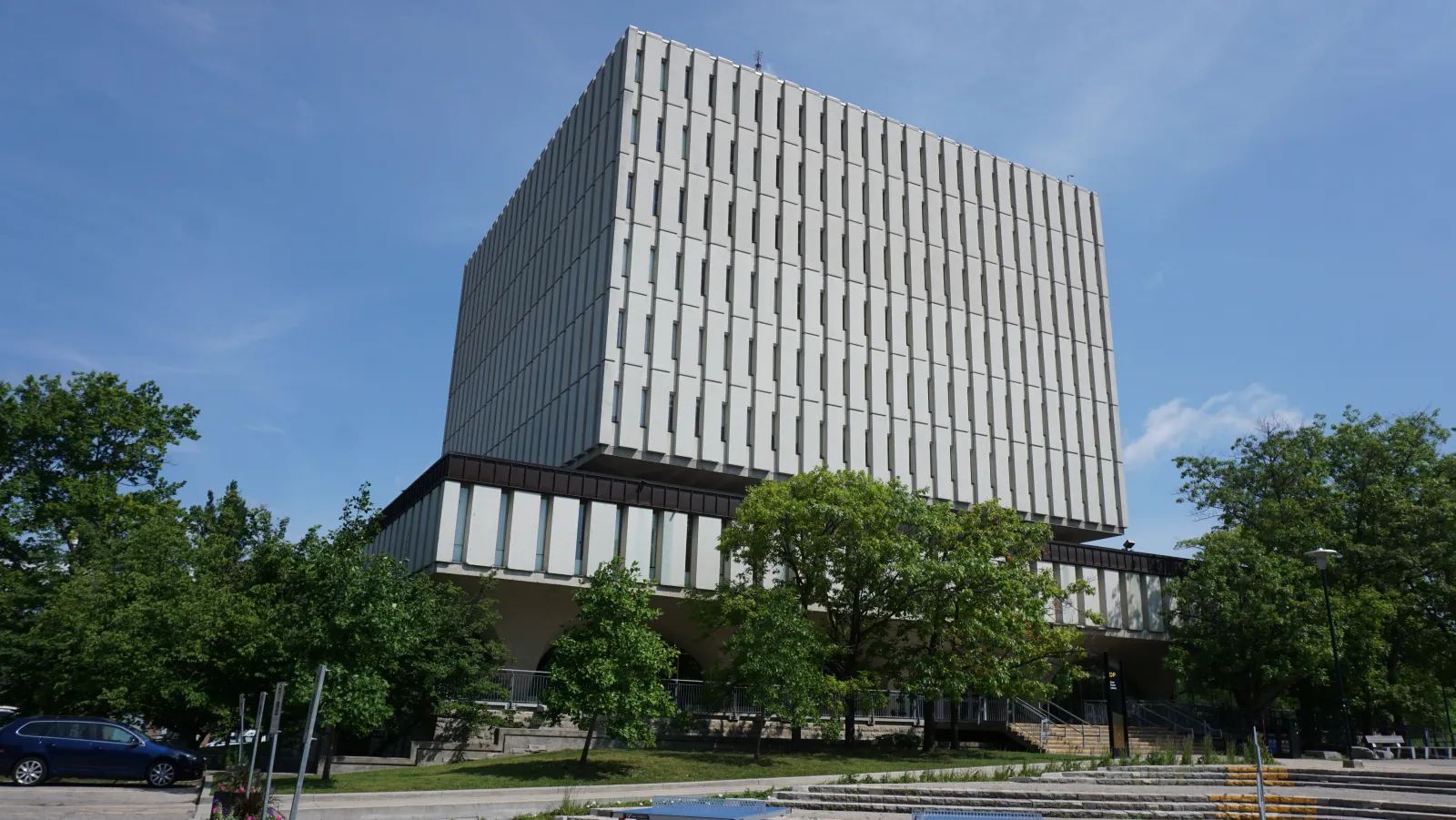

University of Waterloo
Waterloo, Ontario, Canada · Established 1957
Official website ↗Total Students
41,000
Intl. Students
18.7%
Setting
Small City
Overview
The University of Waterloo traces its origin to July 1957, when 74 young men began engineering classes in two tin-roofed portable buildings on what was then the Waterloo College Associate Faculties campus; that October those same students walked into Canada's first-ever cooperative education work term, alternating three-month stretches of classroom study with paid placements in industry -- a model Waterloo Engineering has never abandoned. The university separated from Waterloo College and was incorporated in its own right by the University of Waterloo Act in 1959, and within a decade had built out a distinct Faculty of Mathematics (1967), one of the first standalone mathematics faculties anywhere in the world and the administrative home the Cheriton School of Computer Science still sits inside today. That math-and-engineering DNA, reinforced more recently by the Institute for Quantum Computing (2002) and its close working relationship with the neighbouring Perimeter Institute for Theoretical Physics, is a large part of why the Kitchener-Waterloo region is often described in Canadian tech circles as the country's answer to Silicon Valley. Waterloo today enrolls more than 41,000 full- and part-time students across six faculties -- Arts, Engineering, Environment, Health, Mathematics, and Science -- with international students making up roughly 15% of the undergraduate body and about 41% of the graduate body, drawn from more than 120 countries. Its signature feature remains co-operative education: in most co-op programs, students alternate four-month academic terms with four-month paid work terms starting in second year, completing between four and six work terms and graduating with close to two years of real industry experience through a network of more than 8,000 employers in 70-plus countries. Co-op employment rates during the work-term search regularly land in the mid-to-high 90s percent, and the university is consistently cited as one of the largest single sources of Canadian startup founders -- alumni have gone on to found or co-found companies including BlackBerry/Research In Motion, Instacart, and OpenText, and the David R. Cheriton School of Computer Science carries the name of an alumnus who wrote one of Google's first outside investment cheques. Rankings bear out the STEM reputation: Waterloo regularly places among the world's top 30 in Computer Science and Mathematics on subject-specific tables and is rated the top-ranked Canadian university in several engineering subfields by US News. For prospective international students, applying to Waterloo looks quite different from the US or UK process. There is no Common App or UCAS; applicants apply through the Ontario Universities' Application Centre (OUAC), typically the 105 form for students who have not attended an Ontario high school, and are assessed on their final grades in whatever senior secondary curriculum they completed rather than a US-style GPA, SAT, or ACT score -- competitive programs like Computer Science, Software Engineering, and Computer Engineering routinely admit students with averages in the mid-90s percent and above, and most Engineering and Mathematics/Computer Science applicants must also complete Waterloo's own Admission Information Form (AIF), a set of short written responses used alongside grades in the admission decision. Once admitted, most international undergraduates need a Provincial Attestation Letter (PAL) from the Ontario government -- obtained only after paying a tuition deposit -- before they can apply for a Canadian study permit through Immigration, Refugees and Citizenship Canada (IRCC); as of January 1, 2026, master's and doctoral applicants are exempt from that PAL step entirely. Unlike the US F-1 process, the standard IRCC study permit pathway does not build in a routine in-person consular interview. On the academic English side, undergraduate admission generally requires IELTS 6.5 or TOEFL 90, while the general graduate-level floor is somewhat higher at IELTS 7.0 or TOEFL 90 -- and, notably, the GRE and GMAT are not required for the large majority of Waterloo's graduate programs, including its flagship Computer Science, Engineering, and Mathematics programs, which sets it apart from many US peer institutions.
Rankings
Times Higher Education (THE) World University Rankings · Overall (Global)
#162 (2026)
US News Best Global Universities · Overall (Global)
#192 (2027)
QS World University Rankings by Subject · Computer Science and Information Systems
#27 (2026)
QS World University Rankings by Subject · Mathematics
#29 (2026)
QS World University Rankings by Subject · Electrical and Electronic Engineering
#30 (2026)
Times Higher Education (THE) World University Rankings by Subject · Computer Science
#43 (2026)
Times Higher Education (THE) World University Rankings by Subject · Engineering
#78 (2026)
US News Best Global Universities · Computer Science
#54 (2027)
US News Best Global Universities · Engineering
#63 (2027)
Admissions, Requirements & Costs
Requirements, deadlines, and test-score cutoffs differ significantly between undergraduate and graduate/Master's programs — shown separately below.
Undergraduate
Application Fee
$183
Documents required: Ontario Universities' Application Centre (OUAC) application -- the 105 form for applicants who have not attended an Ontario high school (the route most international applicants use), or the 101 form for current Ontario secondary school students, Official transcripts covering the final two years (or equivalent) of the applicant's senior secondary curriculum, Admission Information Form (AIF) -- required supplementary short-answer written responses for Engineering, Mathematics/Computer Science, and several other competitive programs; used alongside grades in the admission decision, English language proficiency test scores (IELTS/TOEFL/PTE/Duolingo/Cambridge or another approved pathway) unless exempt, Program-specific senior secondary prerequisite courses (e.g., Advanced Functions and Calculus & Vectors, or their curriculum equivalents, for Mathematics/Computer Science and Engineering programs), Waterloo Math and Computing Contest results (optional but encouraged for Faculty of Mathematics applicants; used in scholarship decisions and, in some cases, admission decisions)
| Term | Deadline | Type |
|---|---|---|
| Fall (September) | January 15 for Engineering programs (with a document deadline of February 1); February 1 for most other undergraduate programs (2026-27 cycle) | Regular Decision |
Test Scores
IELTS Minimum
6.5 (Gabble rec. 7)
TOEFL Minimum
90 (4.5 new scale) · Gabble rec. 100 (5 new scale)
PTE Minimum
63
IELTS notes: Overall band of 6.5, with Writing and Speaking bands of at least 6.5 and Reading and Listening bands of at least 6.0; alternatively, an overall band of 7.0 with no individual band below 6.0 is also accepted.
TOEFL notes: For tests taken before January 21, 2026 (0-120 scale): overall score of 90, with Writing and Speaking subscores of at least 25. ETS is moving TOEFL iBT to a new 1-6, CEFR-aligned scale for tests taken on or after January 21, 2026; Waterloo's published converted minimum on that new scale is an overall score of 4.5 with Writing and Speaking subscores of at least 5.
TOEFL scores shown as: legacy 0–120 scale (new 1.0–6.0 CEFR-aligned scale, effective Jan 2026).
Accepted tests: IELTS Academic, TOEFL iBT, PTE Academic, Duolingo English Test, Cambridge English Qualifications (C1/C2)
Waiver: Four or more consecutive recent years of full-time education in an English-language school system, being a bilingual Francophone Canadian applicant with four years at a Canadian high school, or having English as a first language combined with a Canadian education can each satisfy the requirement without a separate test score.
Conditional admission: Waterloo's Bridge to Academic Success in English (BASE) program lets academically qualified applicants who fall short of the standard English requirement complete a structured pathway that combines academic English instruction with progress toward their intended Waterloo degree, rather than requiring a passed standalone test before any admission offer.
Tuition (Intl.)
$40,948
Tuition (Domestic)
$4,413
Living Expenses/yr
$16,164
Total Cost of Attendance
$57,112
Scholarships
International Student Entrance Scholarship
CAD $10,000 (2026/27), paid as CAD $5,000 toward first-term tuition and CAD $5,000 toward second-term tuition; no minimum admission average required
Waterloo's automatic entrance award for new international undergraduates entering directly from secondary school, paid out in two installments to help cover first-year tuition.
Eligibility: Automatic for international fee-paying students admitted to a full-time, first-year degree program starting in September 2026; no separate application required. Excludes Medical Sciences, Doctor of Medicine, Bachelor of Social Work, Doctor of Optometry, Doctor of Pharmacy, transfer students, deferred admissions, and 2+2 programs
President's Scholarship / President's Scholarship of Distinction
CAD $2,000 one-time award for an early-May admission average of 90-94.9%; the same CAD $2,000 President's Scholarship of Distinction applies at 95%+, with Distinction recipients also eligible for a CAD $1,500 Research Award and a CAD $1,500 International Experience Award later in their program
Merit-based entrance scholarships recognizing top academic performance, assessed using an applicant's updated "early May" admission average once final grades are available.
Eligibility: Automatically assessed for admitted undergraduates based on final admission average; no separate application required
Faculty of Mathematics Global Scholarships
Up to 10 awards per year, ranging from CAD $12,000 to CAD $40,000
A set of merit-based entrance scholarships for incoming international students in most Faculty of Mathematics programs (including Computer Science), recognizing outstanding academic achievement.
Eligibility: International applicants entering most Faculty of Mathematics undergraduate programs; assessed automatically as part of the admission review
Faculty of Engineering International Student Entrance Scholarships
CAD $10,000, which can combine with an additional CAD $10,000 Faculty of Engineering scholarship for a total of up to CAD $20,000
Entrance scholarships specifically for international students admitted to Waterloo's Environmental Engineering and Geological Engineering programs, on top of the standard international entrance scholarship.
Eligibility: Full-time international undergraduates admitted to Environmental Engineering or Geological Engineering; no minimum admission average required
Popular Programs
Gabble Prep Insights
Where applicants lose points: Speaking tends to be the section where applicants to Waterloo's co-op-intensive Engineering, Mathematics, and Computer Science programs are least prepared relative to Reading and Listening, since strong spoken English becomes immediately important once a student starts cycling through employer job interviews every four months to secure each co-op work term.
Applicants from STEM-heavy secondary programs (the majority of Computer Science, Software Engineering, and Mathematics applicants) typically clear Reading and Listening comfortably but need more practice with Writing, since Waterloo's required Admission Information Form and first-year lab-report- and proof-heavy coursework both expect sustained, structured written English beyond short-answer or conversational proficiency.
Figures were converted from CAD at approximately 1 CAD = 0.706 USD (July 2026). Waterloo does not publish one university-wide undergraduate tuition rate -- costs above use the Faculty of Arts 2026/27 international first-year estimate (CAD $58,000 for two terms) as the representative broad-based figure, since Arts is Waterloo's closest equivalent to a generalist degree. Tuition runs meaningfully higher in Waterloo's flagship STEM programs: 2026/27 international first-year estimates run roughly CAD $73,000 for Computer Science, CAD $75,000 for Engineering and Software Engineering, CAD $62,000 for other Faculty of Mathematics programs, CAD $54,000 for Science and Health, and CAD $51,000 for Environment (all approximate, per-program figures from Waterloo's tuition estimator; co-op students also pay an additional CAD $836/term co-op fee). The domestic tuitionPerYear figure (CAD $6,250/year, Arts, Fall 2026 schedule) reflects the Ontario-resident rate and is not comparable to the international rate; domestic Computer Science and Engineering rates are also charged at higher per-term amounts than general Arts/Science. Living expenses were estimated using IRCC's official minimum proof-of-funds living-cost threshold for a single study permit applicant outside Quebec (CAD $22,895/year), used as a standardized proxy since Waterloo's own online tuition/cost estimator does not publish one fixed annual living-cost figure. Waterloo does not publish one official university-wide undergraduate acceptance rate, and third-party aggregator estimates for it conflict substantially -- figures citing an overall rate near 53% and per-program rates as low as roughly 14% for Computer Science both circulate, but neither comes from an official Waterloo-published source, so acceptanceRate has been left null rather than fabricated from unreliable secondary sites. On the Canadian-equivalent grading side (since sat/act/minGPA do not apply): third-party admissions-data aggregators (not an official Waterloo source) suggest Computer Science admits commonly cluster around a mid-90s to high-90s percent admission average, and Software Engineering and Computer Engineering are cited as similarly competitive, with roughly 86% of recent Software Engineering admits reportedly scoring 95%+; these are directional benchmarks from secondary sources, not official Waterloo-published cutoffs, since Waterloo does not publish a fixed minimum grade threshold per program. The application fee used above (CAD $259.50 total -- the OUAC 105 base fee of CAD $156, a one-time OUAC evaluation fee of CAD $93.50, and Waterloo's CAD $10 international service fee) reflects the typical total cost for an international applicant using the 105 form, not a single official Waterloo-published figure alone. Waterloo reports a seven-year (not six-year) undergraduate graduation rate, since co-op commonly extends a four-year program to roughly five years; Ontario's Strategic Mandate Agreement data cites this seven-year rate in the roughly 79-81% range in recent years.
Recommended prep timeline: 10 weeks
Graduate (Master's & PhD)
Application Fee
$106
Documents required: Statement of interest, research proposal, or letter of intent (program-dependent), Two to three references, generally including at least two academic references, Official transcripts from all previously attended post-secondary institutions, CV/resume, English language proficiency test scores (IELTS Academic or TOEFL iBT are the primary tests accepted for most programs) unless exempt, GRE General Test -- required specifically by the Cheriton School of Computer Science for applicants who have not completed a four-year undergraduate degree at a North American university where English is the primary language of instruction; most other Waterloo graduate programs, including Engineering and Mathematics, do not require the GRE, GMAT -- required specifically for the PhD in Accounting; not required for the Master of Accounting (MAcc), Master of Business, Entrepreneurship and Technology (MBET), or the large majority of other Waterloo graduate programs
| Term | Deadline | Type |
|---|---|---|
| Fall (September), Winter (January), or Spring (May) | Rolling and program-specific; Waterloo runs three academic terms per year and many graduate programs accept applications for more than one entry term, though exact deadlines vary by department and are generally several months ahead of the intended start term | Rolling |
Test Scores
IELTS Minimum
7 (Gabble rec. 7.5)
TOEFL Minimum
90 (4.5 new scale) · Gabble rec. 100 (5 new scale)
IELTS notes: General graduate-level minimum is an overall IELTS Academic band of 7.0; individual graduate programs and departments may set their own higher requirements.
TOEFL notes: General graduate-level minimum of 90 overall (0-120 scale, tests taken before January 21, 2026). ETS is moving TOEFL iBT to a new 1-6, CEFR-aligned scale for tests taken on or after January 21, 2026; applicants should confirm the converted minimum for their specific program at time of application. Individual departments may set higher minimums.
TOEFL scores shown as: legacy 0–120 scale (new 1.0–6.0 CEFR-aligned scale, effective Jan 2026).
Accepted tests: IELTS Academic, TOEFL iBT, CAEL, Cambridge English (C1/C2)
Waiver: Applicants who have completed three or more years of full-time post-secondary education at a Canadian institution are generally exempt from submitting a separate English proficiency test score; exemption details can vary slightly by graduate program.
Tuition (Intl.)
$16,300
Tuition (Domestic)
$4,774
Living Expenses/yr
$16,164
Total Cost of Attendance
$32,464
Scholarships
Minimum Funding for Full-Time Doctoral Students
CAD $28,351/year minimum (effective May 1, 2025), for up to four years
Full-time PhD students at Waterloo (both domestic and international) are guaranteed a minimum annual funding package for up to four years, made up of any combination of scholarships, awards, and graduate student employment such as teaching and research assistantships.
Eligibility: Automatic for full-time PhD students in good academic standing, regardless of citizenship or visa status
International Doctoral Student Award (IDSA)
Approximately CAD $5,140 per term for most recipients, varying by program
An automatic award for international full-time PhD students that offsets most of the tuition gap between the domestic and international PhD rate.
Eligibility: Automatic for eligible international full-time PhD students; no separate application typically required
International Master's Award of Excellence (IMAE)
Varies by faculty and program; not a single fixed published amount
A faculty-administered award granted on top of standard minimum funding to help offset the international tuition differential for research-based master's students.
Eligibility: International students in full-time research-based master's programs, awarded at the discretion of the student's faculty
Popular Programs
Gabble Prep Insights
Where applicants lose points: Writing is typically the weakest section for graduate applicants, since a statement of interest or research proposal -- and, for MBET and MAcc applicants especially, case-based written materials -- demand structured academic or professional English well beyond conversational fluency.
Applicants to research-stream programs (Computer Science, Engineering, Mathematics) often post strong Reading/Listening scores but need more Speaking practice for supervisory meetings, TA duties, and thesis-defense-style presentations, while MBET and MAcc applicants most often need additional Writing polish given the case-study- and report-heavy application and coursework style.
Figures were converted from CAD at approximately 1 CAD = 0.706 USD (July 2026). Costs use Waterloo's standard Schedule A research-based graduate tuition (Master's Research / PhD Research) as the representative figure, applied across Waterloo's three-term academic year since full-time research students are generally registered continuously: 2025/26-era per-term rates were CAD $7,696 (Master's Research, international) and CAD $7,396 (PhD Research, international), i.e. roughly CAD $23,088/year and CAD $22,188/year respectively when annualized over three terms; the domestic Ontario per-term rate was CAD $2,254 (roughly CAD $6,762/year annualized). This standard research rate differs sharply from Waterloo's professional graduate programs, which are course-based and priced separately: 2026-era full-time per-term international rates included roughly CAD $17,400 for the Master of Engineering (MEng), CAD $25,136 for the Master of Accounting (MAcc), and CAD $23,103 for the Master of Business, Entrepreneurship and Technology (MBET) -- these programs also run on different total-length structures (often 12-16 months) rather than a simple annual rate, so per-program tuitionPerYear has been left null in the courses list for MEng and MBET rather than estimated. Per this dataset's hard rule against fabricating GRE/GMAT figures: Waterloo does not require the GRE or GMAT for the large majority of graduate programs, including its flagship Computer Science, Engineering, and Mathematics programs. The Cheriton School of Computer Science does require the GRE General Test, but only from applicants who have not completed a four-year undergraduate degree at a North American, English-instruction university, and it does not publish an official minimum or average combined GRE score for this conditional requirement, so gre.min/max/avgScore have been left null. Similarly, the GMAT is required for the PhD in Accounting but Waterloo does not publish an official minimum or average GMAT score for that program, so gmat.min/max/avgScore have also been left null rather than estimated from third-party sources. An official, university-wide graduate acceptance rate is not published and has been left null.
Recommended prep timeline: 12 weeks
Programs Offered
Bachelor of Computer Science (Honours)
Undergraduate · 4 yr · $51,538/yr
Software Engineering (BASc)
Undergraduate · 5 yr · $52,950/yr
Mechatronics Engineering (BASc)
Undergraduate · 5 yr · $52,950/yr
Mathematics (Data Science, Statistics, Combinatorics & Optimization, and other plans)
Undergraduate · 4 yr · $43,772/yr
Bachelor of Science (Honours)
Undergraduate · 4 yr · $38,124/yr
Bachelor of Arts
Undergraduate · 4 yr · $40,948/yr
Master of Mathematics (MMath), Computer Science
Masters · 1.5 yr · $16,300/yr
Master of Engineering (MEng)
Masters · 1.3 yr
Master of Business, Entrepreneurship and Technology (MBET)
Masters · 1.3 yr
PhD (various graduate units)
PhD · 4 yr · $15,665/yr
Campus Life
Waterloo's campus life is shaped heavily by its co-op calendar: because students rotate through work terms year-round, the on-campus population and social rhythm shift term to term rather than following a single fixed academic year. The Waterloo Undergraduate Student Association (WUSA) runs student government and more than 200 registered clubs out of the Student Life Centre, while faculty-specific societies like EngSoc and MathSoc organize discipline-specific events and competitions. The university is also home to Hack the North, Canada's largest student hackathon, which draws roughly 1,000 participants annually and reflects the broader Kitchener-Waterloo tech and startup culture that surrounds the campus. Athletically, the Waterloo Warriors compete in U SPORTS and the OUA across 20 varsity sports, complemented by a large recreational and competitive club sport program.
Notable clubs: Waterloo Undergraduate Student Association (WUSA) and its 200+ registered clubs, Hack the North -- Canada's largest hackathon, hosted annually on Waterloo's campus and drawing roughly 1,000 student hackers, Engineering Society (EngSoc) and Mathematics Society (MathSoc), the largest faculty-specific student governments, Waterloo Warriors varsity and competitive club teams (badminton, rowing, dragon boat, ball hockey, and more), WaterlooWorks-affiliated career, entrepreneurship, and case-competition clubs tied to the region's tech and startup ecosystem
Outcomes
Undergraduate
Graduation Rate
80%
Graduate
Notable Alumni
Mike Lazaridis — Co-founder of Research In Motion (BlackBerry); studied Electrical Engineering at Waterloo starting in 1979 and left just two months before graduating to commercialize the technology that became RIM, later receiving an honorary Doctor of Engineering from Waterloo in 2000 and co-founding the Perimeter Institute for Theoretical Physics and Waterloo's Institute for Quantum Computing
David Cheriton — Earned his Master's (1974) and PhD (1978) in computer science at Waterloo before becoming a longtime Stanford professor and one of Google's earliest outside investors; the David R. Cheriton School of Computer Science is named for him following his major donations to the university
Apoorva Mehta — Founder and former CEO of Instacart; earned a Bachelor of Applied Science in Electrical Engineering at Waterloo
David McKay — President and CEO of the Royal Bank of Canada (RBC); earned a Bachelor of Mathematics from Waterloo in 1987
Kevin O'Leary — Entrepreneur and investor known for Shark Tank/Dragons' Den; earned an honours bachelor's degree in environmental studies and psychology at Waterloo in 1977
Visa Interview Prep
The Canadian study permit process differs procedurally from both the US F-1 system and the UK Student Route: there is no SEVP-style certification or CAS document, and no routine consular interview built into the standard pathway. Most international undergraduate applicants (and English language pathway applicants) must obtain a Provincial Attestation Letter (PAL) from the Government of Ontario before applying for a study permit; the PAL only becomes available after the student accepts their Waterloo offer and pays a CAD $5,000 non-refundable tuition deposit, after which the PAL typically appears in Waterloo's Quest student system within three to five business days. Effective January 1, 2026, master's and doctoral applicants are formally exempt from the PAL requirement and from Canada's national study-permit application cap. Once any required PAL is in hand, applicants apply for the study permit directly through the IRCC website, submitting proof of acceptance, proof of sufficient funds (tuition plus IRCC's living-cost threshold, CAD $22,895 for a single applicant as of the 2025-26 update), and biometrics where applicable; a valid study permit must be in hand before classes begin, and Waterloo recommends applying as early as possible since processing can take several months. Canada does not require most applicants to demonstrate 'non-immigrant intent' through a consular interview the way the US F-1 process does, though officers can still refuse an application on genuine-student or financial grounds. Distinct from the study permit itself is the Temporary Resident Visa (TRV) or Electronic Travel Authorization (eTA) that many applicants also need simply to travel to and enter Canada; both are typically processed together in one IRCC application. Waterloo's own materials cite that roughly 70% of its international students go on to obtain Canadian Permanent Resident status, well above the national average for university graduates.
- Most study permit applicants do NOT attend an in-person visa interview the way US F-1 applicants do -- the large majority of applications are decided from the online IRCC application, supporting financial and academic documents, and (for most undergraduate applicants) a Provincial Attestation Letter (PAL) obtained after accepting a Waterloo offer and paying the tuition deposit
- IRCC may request a short interview (in person or by video) or a biometrics appointment in specific risk-based cases, focused on genuine intent to study, ties to the home country, and financial means, but this is the exception rather than the routine process
FAQs
What IELTS score do I need to apply to Waterloo as an undergraduate?
The standard undergraduate minimum is an overall IELTS Academic band of 6.5, with Writing and Speaking bands of at least 6.5 and Reading and Listening bands of at least 6.0 (an overall 7.0 with no band below 6.0 is also accepted). The general graduate-level minimum is somewhat higher, at an overall band of 7.0, though individual graduate programs may set their own requirement.
Does Waterloo use the Common App, UCAS, or a shared portal with other universities?Undergrad
No. Undergraduate applicants apply through the Ontario Universities' Application Centre (OUAC) -- most international applicants use the OUAC 105 form, since it is designed for students who have not attended an Ontario high school. This is Ontario's own province-wide application service, not a US-style Common App or UK-style UCAS system, and it is a fundamentally different process from applying directly to a US or UK university.
Will I need to attend a visa interview to study at Waterloo, like the US F-1 process?
Almost certainly not. Canada's study permit process, run by Immigration, Refugees and Citizenship Canada (IRCC), generally does not build in a routine in-person interview the way the US F-1 visa does. Most applications are decided from the online application plus supporting financial and academic documents. IRCC reserves the right to request a short interview or biometrics appointment in specific cases, but this is not the standard process.
What is a Provincial Attestation Letter (PAL), and do I need one?
A PAL is a letter from the Government of Ontario confirming your enrollment is counted within the province's allocation of study permits; most international undergraduate applicants need one before they can apply for a study permit. You can only access your PAL after accepting your Waterloo offer and paying a CAD $5,000 non-refundable tuition deposit, after which it typically appears in Waterloo's Quest system within three to five business days. As of January 1, 2026, master's and doctoral applicants are exempt from the PAL requirement entirely -- a distinctly Canadian step with no real US or UK equivalent.
What Canadian high-school percentage average do I need instead of a US-style GPA or SAT/ACT score?Undergrad
Waterloo does not use the SAT, ACT, or a 4.0 GPA scale for admissions. Offers are based on your final grades in whichever senior secondary curriculum you completed, and for Engineering and most Faculty of Mathematics programs, on Waterloo's own Admission Information Form (AIF) as well. Waterloo does not publish fixed minimum cutoffs, but third-party admissions-data trackers commonly cite Computer Science, Software Engineering, and Computer Engineering admits clustering in the mid-90s to high-90s percent range -- these are directional secondary-source benchmarks, not official published thresholds, since actual competitiveness shifts year to year with applicant volume.
How does Waterloo's co-op program work, and can international students take part?
In most co-op programs, students alternate four-month academic terms with four-month paid work terms, typically starting in second year, and complete between four and six work terms over the course of their degree -- graduating with close to two years of industry experience. International students on a valid study permit are eligible to apply for any of Waterloo's co-op programs and access the same network of 8,000+ employers, though students on a study permit should talk to a co-op advisor before planning irregular work-term sequences, since gaps can affect eligibility for a Post-Graduation Work Permit later.
Is the GRE or GMAT required for Waterloo graduate programs?Grad
For most Waterloo graduate programs -- including its flagship Computer Science, Engineering, and Mathematics programs -- no, neither the GRE nor the GMAT is required. There are narrow exceptions: the Cheriton School of Computer Science requires the GRE General Test only from applicants who have not completed a four-year undergraduate degree at a North American, English-instruction university, and the GMAT is required specifically for the PhD in Accounting. Waterloo does not publish an official minimum or average score for either of these conditional requirements.
Can I get a waiver for the IELTS/TOEFL requirement at Waterloo?
Yes, in certain cases. At the undergraduate level, four or more consecutive years of full-time education in an English-language school system (or a Canadian education as a first-language English speaker) can waive the requirement. At the graduate level, three or more years of full-time post-secondary education at a Canadian institution generally satisfies the exemption. Exact exemption rules can vary slightly by program.
Does Waterloo offer conditional admission if my English score is slightly below the requirement?
At the undergraduate level, yes -- the Bridge to Academic Success in English (BASE) program lets academically qualified applicants who fall short of the standard requirement work toward their Waterloo degree while completing structured English instruction. At the graduate level, Graduate Studies and Postdoctoral Affairs does not offer an equivalent formal conditional-admission pathway in place of a qualifying test score.
As an international student, can I get financial aid at Waterloo?
At the undergraduate level, yes to a meaningful extent: most international first-year students automatically receive the CAD $10,000 International Student Entrance Scholarship, plus merit-based President's Scholarships and faculty-specific awards for top academic averages, alongside limited need-based bursaries for enrolled students facing financial hardship. At the graduate level, funding works differently than aid in the US/UK sense -- full-time PhD students are guaranteed a minimum annual funding package (CAD $28,351/year as of 2025) plus an International Doctoral Student Award that offsets most of the tuition gap, while research-based master's students may receive an International Master's Award of Excellence on top of standard funding.